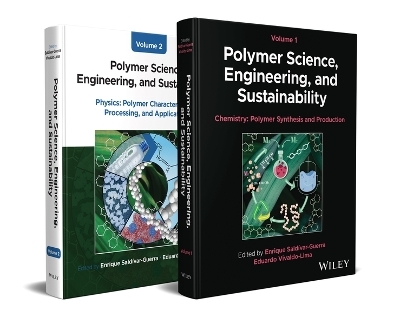
Polymer Science, Engineering, and Sustainability, 2 Volume Set
John Wiley & Sons Inc (Verlag)
978-1-119-82009-3 (ISBN)
In this 2-volume set of Polymer Science, Engineering, and Sustainability: From Fundamentals to Applications in Synthesis, Characterization, and Processing, a team of distinguished researchers delivers a comprehensive discussion of polymer chemistry and industrial production.
The first volume covers polymer chemistry and engineering, as well as industrial polymer production. The second volume stresses physico-chemical, mechanical and advanced characterization techniques, polymer processing principles and transformation processes, advanced applications, and sustainability and recycling principles and processes.
Each volume features useful case studies, as well as sections focused on sustainability that covers renewable and biobased polymers and polymer recycling. They also emphasize sustainable practices guided by twelve principles of green chemistry.
Readers will also find:
A thorough introduction to polymer chemistry and industrial polymer production
Comprehensive explorations of physico-chemical characterization techniques
Practical discussions of mechanical and advanced characterization techniques and polymer processing principles and transformation processes
Complete treatments of sustainability and recycling principles and processes
Perfect for polymer scientists and engineers in industry, Polymer Science, Engineering, and Sustainability, 2 Volume Set will also benefit chemical engineers, materials scientists, and postgraduate students in polymer engineering or production programs.
Enrique Saldivar-Guerra, PhD, is Senior Researcher at the Center for Research in Applied Chemistry in Mexico. Eduardo Vivaldo-Lima, PhD, is Full Professor at the Universidad Nacional Autonoma de Mexico, external academic member of the Institute for Polymer Research at the University of Waterloo, and Associate Editor of The Canadian Journal of Chemical Engineering.
About the Editors xxiii
List of Contributors xxv
Preface xxix
Acknowledgments xxxi
Volume 1
1 Introduction to Polymers and Polymer Types 1
Enrique Saldívar-Guerra and Eduardo Vivaldo-Lima
1.1 Introduction to Polymers 1
1.1.1 Basic Concepts 1
1.1.2 History 2
1.1.3 Mechanical and Rheological Properties 2
1.1.3.1 Mechanical Properties 2
1.1.3.2 Rheological Properties 3
1.1.4 Polymer States 4
1.1.5 Molecular Weight 4
1.1.5.1 Moments of the Molar Mass Distribution 6
1.1.6 Main Types and Uses 8
1.2 Classification of Polymers 9
1.2.1 Classification Based on Structure 9
1.2.2 Classification Based on Mechanism 10
1.2.2.1 Step-Growth Polymerization (SGP) 10
1.2.2.2 Chain or Chain-growth Polymerization (CP) 10
1.2.3 Classification by Chain Topology 11
1.2.4 Other Classification Criteria 14
1.2.4.1 Homo and Copolymers 14
1.2.4.2 Origin 14
1.2.4.3 Biodegradability and Sustainability 14
1.2.4.4 Production Volume 15
1.3 Nomenclature 15
1.3.1 Conventional Nomenclature 15
1.3.2 IUPAC Structure-based Nomenclature 16
1.3.3 Trade, Common Names, and Abbreviations 16
1.4 Further Reading 16
Acknowledgments 17
References 17
2 Polycondensation 19
Luis Ernesto Elizalde, Gladys de losSantos, Rita del Rosario Sulub-Sulub, and Manuel Aguilar-Vega
2.1 Introduction 19
2.1.1 General Principles 19
2.1.2 Number-Average Degree of Polymerization 21
2.1.3 Molecular Weight Distribution 23
2.1.4 Polymers Obtained by Polycondensation Polymerization 24
2.2 Polycondensation Kinetics 27
2.3 Polyamides 28
2.3.1 Polyamidation 28
2.3.2 Aromatic Polyamides 30
2.4 Polyimides 30
2.5 Polyesters 32
2.5.1 Polyesters from Diols 32
2.5.2 Polyethers 34
2.5.3 Polyurethanes 35
2.5.4 Polyureas 35
2.5.5 Polycarbonates 36
2.5.6 Polysulfones 37
2.5.7 Polybenzimidazole 37
2.5.8 Depolymerization and Recycling 39
2.6 Inorganic Condensation Polymers 41
2.6.1 Polysiloxanes 41
2.6.2 Polysilanes 42
2.6.3 Polyphosphazenes 43
2.7 Dendrimers 44
2.8 Thermoset Polycondensation Polymers 45
2.8.1 Polyester Resins 45
2.8.2 Epoxy Resins 45
2.8.3 Alkyd Resins 47
2.8.4 Phenolic Resins 47
2.8.5 Urea-Formaldehyde Resins 47
2.9 Bio-based Step-Growth Polymers 48
2.10 Bio-based Polycondensation Polymers 50
2.10.1 Dicarboxylic Acids and Diols 52
2.10.2 Hydroxy Acids and Hydroxyl Esters 52
2.10.3 Amino Acids and Lactams 52
2.10.4 Diamines 52
2.11 Controlled Molecular Weight Condensation Polymers 53
2.11.1 Solid Phase Synthesis 54
2.11.2 Use of Macromonomers in Condensation Reactions 54
References 57
3 Free-Radical Polymerization 65
Ramiro Guerrero-Santos, Enrique Saldívar-Guerra, Iván Zapata-González, José Bonilla-Cruz, and Eduardo Vivaldo-Lima
3.1 Introduction 65
3.2 Basic Mechanism 66
3.2.1 Chemical Initiation 67
3.2.2 Propagation 68
3.2.3 Termination 69
3.3 Other Free Radical Reactions 70
3.3.1 Chain Transfer to Small Species 70
3.3.2 Chain Transfer to Monomer 71
3.3.3 Chain Transfer to Initiator 71
3.3.4 Chain Transfer to Solvent and Chain Transfer Agents 71
3.3.5 Chain Transfer to Impurities 72
3.3.6 Chain Transfer to Polymer 72
3.3.7 Backbiting 74
3.3.8 Reactions to Internal and Terminal Double Bonds and Crosslinking 75
3.3.9 Inhibition 76
3.4 Kinetics and Polymerization Rate 77
3.4.1 Diffusion-Controlled (DC) Effects 79
3.5 Molecular Weight and Molecular Weight Distribution 83
3.5.1 Full Molecular Weight Distribution 84
3.6 Experimental Determination of Rate Constants 86
3.7 Thermodynamics of Polymerization 86
Acknowledgment 89
References 89
4 Reversible-Deactivation Radical Polymerization (RDRP) 97
Graeme Moad, Eduardo Vivaldo-Lima, Michael F. Cunningham, Robin A. Hutchinson, Connor Sanders, Enrique Saldívar-Guerra, and Alexander Penlidis
4.1 Introduction to RDRP 97
4.1.1 Terminology for RDRP 97
4.1.1.1 RDRP with Unimolecular Activation – Stable radical-mediated Polymerization 97
4.1.1.2 RDRP with Bimolecular Activation – Atom-Transfer Radical Polymerization 98
4.1.1.3 RDRP with Activation by Degenerative Chain Transfer – Degenerative Chain-Transfer Radical Polymerization 100
4.1.1.4 Multiple Mechanism RDRP 100
4.2 Nitroxide-Mediated Polymerization (NMP) 102
4.2.1 Historical Background 102
4.2.2 Polymer Chemistry of NMP 102
4.2.2.1 Mechanistic Aspects and Chemical Routes 102
4.2.2.2 Nitroxides Most Commonly Used 103
4.2.2.3 Structure Control and Macromolecular Architectures 106
4.2.3 A Polymer Reaction Engineering (PRE) View of NMP 107
4.2.3.1 Kinetics and Mathematical Modeling 107
4.2.3.2 Dispersed-Phase Polymerizations 109
4.2.3.3 NMP in scCO2 109
4.2.3.4 Continuous NMP 109
4.2.4 Applications and Perspectives 109
4.2.5 Closing Remarks 110
4.3 Atom-Transfer Radical Polymerization (ATRP) 111
4.3.1 Normal ATRP 111
4.3.2 ATRP Variants 113
4.3.3 Future Outlook 115
4.4 Reversible-Addition-Fragmentation Chain-Transfer Polymerization (RAFT) 115
4.4.1 RAFT Mechanism 116
4.4.2 Monomers in RAFT Polymerization 117
4.4.3 Initiation and Termination in RAFT Polymerization 117
4.4.4 RAFT Agents 118
4.4.4.1 Z Group Selection 120
4.4.4.2 R Group Selection 121
4.4.4.3 Other Considerations in RAFT Agent Selection 122
4.4.5 Sequence-defined Oligomers 122
4.4.6 (Multi)Block Copolymer Synthesis 122
4.4.7 Star Synthesis 124
4.5 Other RDRP Systems 125
4.5.1 Degenerative Transfer Controlled Radical Polymerization Mediated by Organotellurium (TERP) 125
4.5.2 Degenerative Transfer RDRP Mediated by Organostibine (SBRP) and Organobismuthine (BIRP) 126
4.5.3 Iodine Transfer Polymerization (ITP) and Variants 127
4.5.4 Reversible Chain-Transfer Catalyzed Polymerization (RTCP) 127
4.5.5 Organometallic Mediated Radical Polymerization 128
4.6 RDRP in Aqueous Dispersions 129
4.6.1 Introduction 129
4.6.2 Nitroxide-mediated Polymerization (NMP) 130
4.6.2.1 Emulsion Polymerization 130
4.6.2.2 Miniemulsion Polymerization 130
4.6.2.3 Microemulsion Polymerization 130
4.6.3 Atom-Transfer Radical Polymerization (ATRP) 130
4.6.3.1 Emulsion Polymerization 130
4.6.3.2 Miniemulsion Polymerization 131
4.6.3.3 Microemulsion Polymerization 132
4.6.4 Reversible-Addition-Fragmentation Chain-Transfer (RAFT) Polymerization 132
4.6.4.1 Emulsion Polymerization 132
4.6.4.2 Miniemulsion Polymerization 133
4.6.4.3 Microemulsion Polymerization 133
4.6.5 Tellurium-Mediated Radical Polymerization (TERP) 133
4.6.6 Iodine Transfer Polymerization 134
4.6.7 Concluding Remarks 134
Acknowledgments 134
References 135
5 Coordination Polymerization 161
João Soares, Odilia Pérez, and Arash Alizadeh
5.1 Introduction 161
5.2 Polyolefin Types 162
5.3 Catalysts Types 162
5.3.1 Phillips Catalyst 162
5.3.2 Classical Ziegler–Natta Catalysts 163
5.3.2.1 Conjugated and Nonconjugated Dienes Polymerizations 164
5.3.3 Single-Site Catalysts 164
5.3.3.1 Metallocenes and Constrained Geometry Catalysts 164
5.3.3.2 Nonmetallocene Early Transition Metal-Based SSCs 167
5.3.3.3 Late Transition Metal Catalysts 168
5.3.3.4 Supported Single-Site Catalysts 168
5.4 Coordination Polymerization Mechanism 169
5.5 Polymerization Kinetics and Mathematical Modeling 170
5.5.1 Polymer Microstructural Models 170
5.6 Modeling Particle-Scale Phenomena 176
5.7 Polymerization Reactor Models 181
References 183
6 Copolymerization 191
Marc A. Dubé, Enrique Saldívar-Guerra, Iván Zapata-González, and Eduardo Vivaldo-Lima
6.1 Introduction 191
6.1.1 What Are Copolymers? 191
6.1.2 Commercial Copolymer Examples 192
6.1.2.1 Step-Growth Copolymerization 192
6.2 Types of Copolymers 192
6.2.1 Statistical Copolymers 192
6.2.2 Alternating Copolymers 193
6.2.3 Block Copolymers 193
6.2.4 Gradient Copolymers 194
6.2.5 Graft Copolymers 194
6.2.6 Notes on Nomenclature 194
6.3 Copolymer Composition and Microstructure 194
6.3.1 Terminal Model Kinetics 194
6.3.1.1 Copolymer Composition Behavior 197
6.3.2 Other Copolymerization Models 199
6.3.2.1 Penultimate Model 200
6.3.2.2 Depropagation Models 201
6.3.2.3 Models Involving the Participation of Complexes 202
6.3.2.4 Model Discrimination 202
6.3.3 Reactivity Ratio Estimation 203
6.3.4 Sequence Length Distribution 204
6.3.5 Composition Measurement Methods 205
6.3.6 Extensions to Multicomponent Copolymerization 206
6.4 Reaction Condition Considerations 208
6.4.1 Copolymerization Rate 208
6.4.2 Effect of Temperature 210
6.4.3 Reaction Medium 211
6.4.4 Monomer Concentration Effects 212
6.4.5 Effect of Pressure 213
6.4.6 Achieving Uniform Copolymer Composition 213
6.4.6.1 Policy I 213
6.4.6.2 Policy II 214
6.5 Reversible-Deactivation Radical Copolymerization (RDRcoP) 215
6.5.1 Reactivity Ratios for Linear Structures 215
6.5.2 Conventional Copolymerizations and RDRcoP Leading to Nonlinear Structures (Effect of Branching and Cross linking) 216
6.6 Copolymerization Systems Including Bio-Based Monomers 218
Acknowledgment 218
References 219
7 Anionic Polymerization 233
Roderic Quirk and Hongwei Ma
7.1 Introduction 233
7.2 Living Anionic Polymerization 234
7.2.1 Molecular Weight Control 234
7.2.2 Molecular Weight Distribution 235
7.3 General Considerations 236
7.3.1 Monomers 236
7.3.2 Solvents 238
7.3.3 Initiators 238
7.3.4 Initiation by Electron Transfer Alkali Metals 238
7.3.4.1 Radical Anions 239
7.3.5 Initiation by Nucleophilic Addition 240
7.3.5.1 Alkyllithium Compounds 240
7.3.5.2 Organoalkali Initiators 242
7.3.5.3 Organoalkaline Earth Initiators 242
7.3.5.4 Ate Complexes 243
7.3.5.5 Difunctional Initiators 243
7.3.5.6 Functionalized Initiators 244
7.3.5.7 1,1-Diphenylmethyl Carbanions 244
7.4 Kinetics and Mechanism of Polymerization 245
7.4.1 Styrene and Diene Monomers 245
7.4.1.1 Initiation in Hydrocarbon Solvents? 245
7.4.1.2 Propagation 246
7.4.1.3 Polar Solvents 247
7.4.1.4 Termination Reactions 248
7.4.1.5 Chain Transfer Reactions 251
7.4.2 Polar Monomers 251
7.4.2.1 Polar Vinyl Monomers 251
7.4.2.2 Methyl Methacrylate 252
7.4.2.3 Heterocyclic Monomers 253
7.4.2.4 Ethylene Oxide 253
7.4.2.5 Propylene Oxide 254
7.4.2.6 Propylene Sulfide 254
7.4.2.7 Lactones 255
7.4.2.8 Cyclic Carbonates 256
7.4.2.9 Siloxanes 257
7.5 Stereochemistry 258
7.5.1 Polydienes 258
7.5.1.1 Hydrocarbon Solvents 258
7.5.1.2 Polar Solvents and Polar Additives 260
7.5.2 Methacrylate Stereochemistry 262
7.5.3 Styrene 263
7.5.4 Vinylpyridines 263
7.6 Copolymerization of Styrenes and Dienes 263
7.6.1 Tapered Block Copolymers 265
7.6.2 Random Styrene-Diene Copolymers (Styrene-Butadiene Rubber) 266
7.7 Synthetic Applications of Living Anionic Polymerization 267
7.7.1 Block Copolymers 267
7.7.1.1 Block Copolymer Synthesis by Three-Step Sequential Monomer Addition 268
7.7.1.2 Block Copolymer Synthesis by Two-Step Sequential Monomer Addition and Coupling 269
7.7.1.3 Block Copolymers by Difunctional Initiation and Two-Step Sequential Monomer Addition 270
7.7.2 Star-Branched Polymers 271
7.7.2.1 Linking Reactions with Silyl Halides 271
7.7.2.2 Divinylbenzene Linking Reactions 272
7.7.2.3 New Linking Chemistry 273
7.7.3 Synthesis of Chain-End Functionalized Polymers 274
7.7.3.1 Chain-End Functionalization by Termination with Electrophilic Reagents 274
7.7.3.2 Functionalizations Via Silyl Hydride Functionalization and Hydrosilation 275
7.7.4 Industrial Applications of Alkyllithium-Initiated Anionic Polymerization 276
References 277
8 Cationic Polymerizations 291
Filip E. Du Prez, Eric J. Goethals, Ricardo Acosta Ortiz, and Richard Hoogenboom
8.1 Introduction 291
8.2 Carbocationic Polymerization 292
8.2.1 Isobutene 293
8.2.2 Vinyl Ethers 297
8.2.3 Styrene Monomers 301
8.3 Cationic Ring-Opening Polymerization 302
8.3.1 Cyclic Ethers 303
8.3.1.1 Poly(ethylene oxide) 303
8.3.1.2 Poly(oxetane) 303
8.3.1.3 Poly(tetrahydrofuran) 304
8.3.2 Cyclic Amines 308
8.3.2.1 Aziridines 308
8.3.2.2 Azetidines 310
8.3.3 Cyclic Imino Ethers 310
8.3.4 Photoinitiated Cationic Polymerization 314
8.3.4.1 Diaryliodonium Salts 315
8.3.4.2 Triarylsulfonium Salts 317
8.3.4.3 Photosensitizers 319
8.4 Summary and Prospects 319
Acknowledgment 320
References 320
9 Crosslinking 333
Julio César Hernández-Ortiz, Porfirio López-Domínguez, Patricia Pérez-Salinas, and Eduardo Vivaldo-Lima
9.1 Introduction 333
9.2 Background on Polymer Networks 334
9.2.1 Types of Polymer Networks Based on Structure 334
9.2.1.1 Definition and Structure of Polymer Networks 334
9.2.1.2 Ideal or Perfect Networks 335
9.2.1.3 Imperfect Polymer Network 335
9.2.1.4 Model Polymer Network 335
9.2.1.5 Interpenetrating and Semi-interpenetrating Polymer Networks 336
9.2.2 Chemical and Physical Networks 336
9.2.2.1 Physical Networks 336
9.2.2.2 Chemical or Covalent Networks 336
9.2.3 Intermolecular and Intramolecular Crosslinking 337
9.2.4 Monomer Functionality ( f ) 338
9.2.5 Crosslink Density 338
9.2.6 Gelation and Swelling Index 338
9.2.6.1 Swelling Index 339
9.3 Main Chemical Routes for Synthesis of Polymer Networks 339
9.3.1 Step-Growth Polymerization 339
9.3.2 Vulcanization 340
9.3.3 End-linking 340
9.3.4 Free-Radical Copolymerization (FRC) 340
9.3.4.1 FRC Using Divinyl Monomers 340
9.3.4.2 Crosslinking During Post-polymerization Processing 341
9.4 Characterization of Polymer Networks and Gels 342
9.4.1 Determination of the Gelation Point 343
9.4.2 Measurement of Crosslink Density 344
9.5 Theory and Mathematical Modeling of Crosslinking 345
9.5.1 Statistical Gelation Theories 346
9.5.2 Percolation Gelation Theories 348
9.5.3 Kinetic Theories 350
9.5.4 Full CLD in FRC 351
9.5.4.1 Full CLDs for FRC Using kMC 353
9.5.5 Crosslinking and Reversible-Deactivation Radical Polymerization 354
Acknowledgments 356
References 356
10 Polymer Modification and Grafting 369
Mariamne Dehonor-Gómez, Enrique Saldívar-Guerra, Alfonso González-Montiel, José Bonilla-Cruz, and Eduardo Vivaldo-Lima
10.1 General Concepts 369
10.1.1 Methods for the Synthesis of Functional Polymers 369
10.1.2 Grafting onto, Grafting Through, and Grafting from 370
10.1.3 Grafting on Polymeric and Inorganic Surfaces 370
10.1.4 Polymer Coupling Reactions 372
10.2 Graft Copolymers 373
10.2.1 Commercial Polymer Grafting 373
10.2.1.1 High-Impact Polystyrene 373
10.2.1.2 Technical Aspects 373
10.2.1.3 Acrylonitrile-Butadiene-Styrene Polymers (ABS) 375
10.2.1.4 Other Impact-Modified Commercial Grafting-Based Polymers 375
10.2.1.5 Graft-Polyols 376
10.2.2 Polyolefins 376
10.2.2.1 Borane Compounds 376
10.2.2.2 Ziegler–Natta and Metallocenes 376
10.2.2.3 Cationic and Anionic Graft Copolymerization 376
10.2.3 Modern Grafting Techniques onto Polymers 377
10.2.3.1 NMP, RAFT, and ATRP 377
10.2.3.2 Grafting of Synthetic Polymers onto Biopolymers 381
10.2.4 Functionalization and Grafting from Surfaces 382
10.2.4.1 Grafting from Nanoparticles 382
10.2.4.2 Carbon Derivatives 385
10.2.5 Modeling of Polymer Grafting 389
10.2.6 Concluding Remarks 391
Acknowledgments 391
References 392
11 Polymer Additives 409
Rudolf Pfaendner
11.1 Introduction 409
11.2 Antioxidants 411
11.2.1 Primary Antioxidants 412
11.2.2 Secondary Antioxidants 414
11.2.3 Other Antioxidative Stabilizers 414
11.2.4 Testing of Antioxidants 415
11.2.5 Selected Examples 415
11.2.6 Trends in Antioxidants 417
11.3 PVC Heat Stabilizers 417
11.3.1 Mixed Metal Salts 417
11.3.2 Organo Tin Heat Stabilizers 417
11.3.3 Metal-Free Heat Stabilizers 418
11.3.4 Costabilizers 418
11.3.5 Testing of PVC Heat Stabilizers 418
11.3.6 Selected Examples of PVC Heat Stabilization 419
11.3.7 Trends in PVC Stabilization 420
11.4 Light Stabilizers 420
11.4.1 UV Absorbers 421
11.4.2 Hindered Amine Light Stabilizers 421
11.4.3 Testing of Light Stabilizers 422
11.4.4 Selected Examples of Light Stabilization 423
11.4.5 Trends in UV/Light Stabilizers 423
11.5 Flame Retardants 424
11.5.1 Halogenated Flame Retardants 425
11.5.2 Inorganic Flame Retardants 425
11.5.3 Phosphorus and Nitrogen-Containing Flame Retardants 425
11.5.4 Testing of Flame Retardancy 426
11.5.5 Selected Examples of Flame Retardancy 427
11.5.6 Trends in Flame Retardants 427
11.6 Plasticizers 428
11.6.1 Chemical Structures 428
11.6.2 Testing of Plasticizers 429
11.6.3 Trends in Plasticizers 429
11.7 Impact Modifiers 429
11.7.1 Chemical Structures of Impact Modifiers 430
11.7.2 Testing 430
11.7.3 Trends 430
11.8 Scavenging Agents 430
11.8.1 Acid Scavengers 430
11.8.2 Aldehyde Scavengers 431
11.8.3 Odor Reduction 431
11.9 Additives to Enhance Processing 431
11.10 Additives to Modify Plastic Surface Properties 432
11.10.1 Slip and Antiblocking Agents 432
11.10.2 Antifogging Agents 432
11.10.3 Antistatic Agents 432
11.11 Additives to Modify Polymer Chain Structures 433
11.11.1 Chain Extenders 433
11.11.2 Controlled Degradation 434
11.11.3 Prodegradants 434
11.11.4 Crosslinking Agents 434
11.12 Additives to Influence Morphology and Crystallinity of Polymers 435
11.12.1 Nucleating Agents/Clarifiers 435
11.12.2 Coupling Agents/Compatibilizers 436
11.13 Antimicrobials 436
11.14 Additives to Enhance Thermal Conductivity 436
11.15 Additives for Recycled Plastics 437
11.16 Active Protection Additives (Smart Additives) 437
11.16.1 Content Protection 437
11.16.2 Productivity Enhancer 438
11.16.3 Heat Control 438
11.17 Odor Masking 439
11.18 Animal Repellents 439
11.19 Markers 439
11.20 Blowing Agents 439
11.21 Summary and Trends in Polymer Additives 440
11.22 Selected Literature 440
References 441
12 Polymer Reaction Engineering 445
Alexander Penlidis, Eduardo Vivaldo-Lima, Julio C. Hernández-Ortiz, Enrique Saldívar-Guerra, Porfirio López-Domínguez, and Carlos Guerrero-Sánchez
12.1 Introduction 445
12.2 Mathematical Modeling of Polymerization Processes 446
12.2.1 Chemical Reactor Modeling Background 446
12.2.2 The Method of Moments 448
12.2.3 Bivariate Distributions 450
12.2.4 Pseudo-homopolymer Approach or Pseudo-kinetic Rate Constants Method 452
12.3 Useful Tips on Polymer Reaction Engineering and Modeling 455
12.3.1 Tip 1: (Initiators, Initiator Data, and Initiator Decomposition) 455
12.3.2 Tip 2: (Chain Stereoregularity and Active Sites) 455
12.3.3 Tip 3: (Radical Lifetime) 455
12.3.4 Tip 4: (Chain Microstructure and Propagation Reactions) 455
12.3.5 Tip 5: (Transfer Reactions, Branching, Effects on Molecular Weight Averages, and Effects on Polymerization Rate) 456
12.3.6 Tip 6 (Related to Tip 5): (Impurities, Transfer to Monomer, and Terminal Double Bonds) 456
12.3.7 Tip 7: (Glass Transition Temperature, Limiting Conversion, Methyl Methacrylate Polymerization, and Depropagation) 456
12.3.8 Tip 8: (Terminal Double Bond Polymerization) 457
12.3.9 Tip 9: (Radical Stationary State Hypothesis) 457
12.3.10 Tip 10: (Troubleshooting with Molecular Weight Data and Detection of Branching) 458
12.3.11 Tip 11: (Long Chain Approximation, Density/Volume of Polymerizing Mixture, and Ideal vs. Diffusionally Limited Kinetics) 458
12.3.12 Tip 12: (Copolymerization, Reactivity Ratios, and Estimation of Reactivity Ratios) 458
12.3.13 Tip 13 (Related to Tip 12): (Copolymerization, Copolymer Composition, Composition Drift, Azeotropy, Semibatch Reactor, and Copolymer Composition Control) 459
12.3.14 Tip 14: (Instantaneous vs. Cumulative Properties and Troubleshooting with Molecular Weight Data) 460
12.3.15 Tip 15: (Expressions for Rate of Polymerization) 460
12.3.16 Tip 16: (Polymerization of Methyl Methacrylate, Styrene, and Vinyl Acetate) 461
12.3.17 Tip 17: (Termination in Homopolymerization and Copolymerization, and Initiation Rate in Homopolymerization and Copolymerization) 461
12.3.18 Tip 18: (Internal Double Bond Polymerization) 462
12.3.19 Tip 19: (Intramolecular Chain Transfer, Backbiting, and Short Chain Branching) 462
12.3.20 Tip 20: (Polymerization Heat Effects and Energy Balances) 462
12.3.21 Tip 21: (Crosslinking, Gelation, Gel Formation, and Sol vs. Gel) 463
12.3.22 Tip 22: (Design and Selection of Polymeric Materials with Specific Properties) 464
12.3.23 Tip 23: (Additional Techniques for Polymer Reactor/Process Troubleshooting) 464
12.4 Machine Learning in Polymer Research and Development 464
12.5 Examples of Several Free-Radical (Co)polymerization Schemes and the Resulting Kinetic and Molecular Weight Development Equations 466
12.5.1 Modeling Linear and Nonlinear Homo- and Co-polymerizations Assuming Monofunctional Polymer Molecules and Using the PKRCM 466
12.5.2 Modeling Linear and Nonlinear Homo- and Co-polymerizations Assuming Multifunctional Polymer Molecules and Using the PKRCM 469
Acknowledgments 475
References 475
13 Bulk and Solution Processes 481
Marco Aurelio Villalobos Montalvo and Jon Debling
13.1 Definition 481
13.2 History 481
13.3 Processes for Bulk and Solution Polymerization 482
13.3.1 Reactor Types 482
13.3.1.1 Batch/Semi-batch Reactor 482
13.3.1.2 Continuous Stirred Tank Reactor (CSTR) 482
13.3.1.3 Autoclave Reactor 483
13.3.1.4 Tubular Reactor 483
13.3.1.5 Loop Reactor 484
13.3.1.6 Casts and Molds 484
13.3.1.7 Continuous Micro-Reactors 485
13.3.2 Processes for Free-Radical Polymerization 486
13.3.2.1 Polystyrene 486
13.3.2.2 Styrene-Acrylonitrile (SAN) Copolymers 488
13.3.2.3 High-Impact Polystyrene (HIPS) 488
13.3.2.4 Acrylonitrile/Butadiene/Styrene (ABS) 489
13.3.2.5 Acrylics 490
13.3.2.6 Water-Soluble Polymers 492
13.3.2.7 Branched and Hyperbranched Polymers 492
13.3.2.8 In Situ Polymerization 492
13.3.3 Processes for Step-Growth Polymerization 493
13.3.3.1 Polyesters 494
13.3.3.2 Polyamides 497
13.3.3.3 Polycarbonates 498
13.3.3.4 Epoxy Resins 499
13.3.3.5 Polysulfones 500
13.3.3.6 Dendrimers and Hyperbranched Polymers 501
13.3.3.7 Biopolymers 501
13.3.4 Processes for Ionic/Anionic Polymerization 502
13.3.4.1 Anionic Polystyrene (PS), Styrene-Butadiene (SB), and Styrene–Isoprene (SI) Copolymers 502
13.3.5 Processes for Homogenous Catalyzed Polymerization 504
13.3.5.1 Polyethylene 504
13.4 Energy Considerations 505
13.4.1 Heat of Polymerization 505
13.4.2 Adiabatic Temperature Rise 506
13.4.3 Self-Accelerating Temperature 506
13.4.4 Reactor Energy Balance 507
13.4.4.1 Continuous Stirred Tank Reactor 507
13.4.4.2 Cascade of CSTR’s 508
13.4.4.3 Tubular Reactors 508
13.5 Mass Considerations 508
13.5.1 Reactor Size 508
13.5.2 Process Residence Time, Conversion, Transients, and Steady State 509
13.5.3 Reactor Pressure 510
13.5.4 Viscosity 510
13.5.5 Mixing 511
13.5.6 Polymer Purification 511
13.6 Sustainability 512
13.6.1 Monomers from Recycled Content 512
13.6.2 Biobased Monomers and Solvents 513
13.6.3 Life Cycle Assessment LCA of Polymerization Processes 514
References 514
14 Dispersed-phase Polymerization Processes 521
Jorge Herrera-Ordóñez, Enrique Saldívar-Guerra, Eduardo Vivaldo-Lima, and Francisco López-Serrano
14.1 Introduction 521
14.2 Emulsion Polymerization 522
14.2.1 Physicochemical Aspects 522
14.2.1.1 Monomer Partitioning and Swelling in Polymer Colloids 522
14.2.2 Formulation Components in Emulsion Polymerization 523
14.2.2.1 Monomers 523
14.2.2.2 Water 523
14.2.2.3 Water-soluble Initiator 524
14.2.2.4 Surfactants 524
14.2.2.5 Chain Transfer Agents 525
14.2.2.6 Other Components 525
14.2.3 Overall Description of Emulsion Polymerization 525
14.2.3.1 Nucleation Mechanisms 525
14.2.3.2 Intervals of an Emulsion Polymerization 529
14.2.3.3 Rate of Polymerization (Rp) 530
14.2.3.4 Molar Mass 533
14.2.4 Batch, Semibatch, and Continuous Processes 533
14.2.5 Control of Number and Size Distribution of Particles 534
14.2.6 Particle Morphology 535
14.2.7 Latex Characterization 535
14.2.7.1 Monomer Conversion 535
14.2.7.2 Particle Size and PSD 535
14.2.7.3 Particle Morphology 536
14.3 Microemulsion Polymerization 536
14.4 Miniemulsion Polymerization 536
14.5 Applications of Polymer Latexes 537
14.6 Dispersion and Precipitation Polymerizations 538
14.7 Suspension Polymerization 539
14.7.1 Generalities 539
14.7.2 Some Issues About the Modeling of PSD in Suspension Polymerization 540
14.8 Pickering Emulsions 542
Acknowledgments 545
References 545
15 New Polymerization Processes 565
Eduardo Vivaldo-Lima, Carlos Guerrero-Sánchez, Iraís A. Quintero-Ortega, Gabriel Luna-Bárcenas, Miguel Rosales-Guzmán, and Christian H. Hornung
15.1 Introduction 565
15.2 Polymerizations in Benign or Green Solvents 566
15.2.1 Polymerizations in Compressed and Supercritical Fluids (SCFs) 566
15.2.1.1 Phase Behavior of Polymer Systems in High-Pressure Fluids 566
15.2.1.2 Earlier High-Pressure Polymerization Processes 569
15.2.1.3 Polymerization in Supercritical Carbon Dioxide (scCO2) 569
15.2.1.4 Polymerization in Other Compressed Green Solvents 570
15.2.2 Polymerizations in Ionic Liquids 571
15.3 Alternative Energy Sources for Polymerization Processes 573
15.3.1 Microwave-Activated Polymerization 573
15.3.2 Polymerization Under Irradiation of Other Wavelengths 574
15.4 Polymerization in Microreactors 575
15.5 Photochemistry in Reversible-Deactivation Radical Polymerizations 577
15.6 High-Throughput/-Output Experimentation in Polymer Science 578
15.7 Scale-Up or Commercial Production of New Polymers or New Chemical Routes for Existent Polymers (e.g. Enzymatic Polymerizations; Superacid Catalyzed Polymerizations; Synthesis of Hybrid Materials; Etc.) 579
15.8 Polymerization in Deep Eutectic Solvents 580
15.8.1 Free-Radical Polymerizations 581
15.8.2 RDRP 581
15.8.3 Hydrogels 581
15.8.4 Perspectives 581
Acknowledgments 582
References 582
16 Enzymatic Polymerization and Processing 597
Miquel Gimeno, Miguel Angel Pimentel, and Eduardo Bárzana
16.1 Advantages of Enzymes as Robust Catalysts in Synthesis 597
16.1.1 Superb Activity and Specificity 597
16.1.2 Innocuous to the Environment 598
16.1.3 Obtained from Natural Sources 598
16.1.4 Constantly Improved by Molecular Biology Methods 598
16.2 Enzyme Sources and Their Conditioning 599
16.2.1 Microbial Fermentation and Bioseparation 599
16.2.2 Enzyme Immobilization 599
16.3 The Breakthrough: The Ability of Enzymes to Perform in Nonaqueous Environments 601
16.3.1 First Reports and Critical Issues on Enzyme Catalysis in Nonaqueous Media 601
16.4 Main Enzyme Groups for a Diverse Set of Polymers 603
16.4.1 Oxidoreductases (EC 1) 603
16.4.2 Transferases (EC 2) 604
16.4.3 Hydrolases (EC 3) 604
16.5 The New Frontier. Enzyme Synthesis in Compressed Fluids as Green Solvents 606
16.5.1 1,1,1,2-Tetrafluoroethane 608
16.6 Dealing with Polar Polymers: Novel Media and Processing 609
16.6.1 Ionic Liquids 609
16.6.2 Deep Eutectic Solvents 610
16.7 Current Industrial Processes and Perspectives 611
16.7.1 Poly(lactic Acid), Its Copolymers and Other Polyesters 611
16.8 Enzymatic Modification and Functionalization of Polymers to Reach New Properties 612
16.8.1 Novel Properties 612
16.8.2 Antimicrobial Polymers 613
16.9 Contribution of Enzymes to Circular Bioeconomy: Synthesis and Depolymerization 614
16.10 Conclusions and Perspectives 615
References 615
17 Renewable Monomer and Polymer Synthesis 625
Héctor Ricardo López-González, Teresa Córdova, and Ramón Díaz de León
17.1 Introduction 625
17.2 Biopolymers, Bio-Based Polymers, Biodegradable Polymers, and Biocomposites 626
17.2.1 Biopolymers 626
17.2.2 Bio-Based Polymers 626
17.2.3 Biocomposites 627
17.3 Bio-Based Monomers for Polymer Synthesis 627
17.3.1 Bio-Monomers from Biomass 627
17.3.2 Chemical Platforms for Bio-Based Monomer Synthesis Derived from Lignocellulosic Biomass 628
17.3.2.1 Diols and Polyols as a Chemical Platform 629
17.3.2.2 Furane-Derived Chemical Platform 631
17.3.3 Chemical Platforms for Bio-Based Monomers Derived from Vegetable Oils 633
17.3.4 Chemical Platforms for Bio-Based Monomers and Polymers Derived from Terpenes 634
17.4 Polymers Derived from Bio-Based Monomers 639
17.4.1 Polyesters 639
17.4.1.1 Polylactic Acid (PLA) 639
17.4.1.2 Poly(butylene succinate) (PBS) 640
17.4.1.3 Furane-Based Polyesters 641
17.4.1.4 Polyurethanes 641
References 642
Index 655
| Erscheinungsdatum | 13.11.2025 |
|---|---|
| Verlagsort | New York |
| Sprache | englisch |
| Themenwelt | Naturwissenschaften ► Chemie |
| Technik ► Maschinenbau | |
| ISBN-10 | 1-119-82009-X / 111982009X |
| ISBN-13 | 978-1-119-82009-3 / 9781119820093 |
| Zustand | Neuware |
| Informationen gemäß Produktsicherheitsverordnung (GPSR) | |
| Haben Sie eine Frage zum Produkt? |
aus dem Bereich