


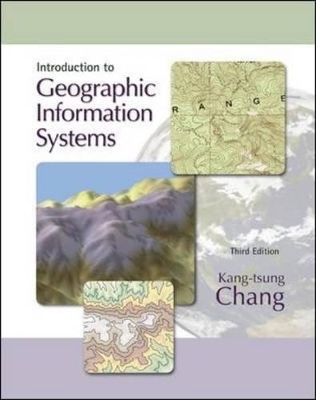
Introduction to Geographic Information Systems
Seiten
2005
|
3rd Revised edition
McGraw Hill Higher Education
9780073101712 (ISBN)
McGraw Hill Higher Education
9780073101712 (ISBN)
- Titel ist leider vergriffen;
keine Neuauflage - Artikel merken
Provides students in a first or second GIS course with a foundation in both GIS concepts and the use of GIS. This book stresses both concepts and practices. It features GIS concepts from fields such as geography to explain the purpose and objectives of GIS operations and the interrelationship among GIS operations.
This book is designed to provide students in a first or second GIS course with a solid foundation in both GIS concepts and the use of GIS. The book retains the same comprehensive coverage of GIS topics as featured in the first edition. This edition is organized into five parts. Part 1 (Chapters 1 to 7) explains the fundamentals of GIS, including coordinate systems, data models, data input, spatial data editing, and attribute data management. Part 2 (Chapters 8 and 9) includes data display and data exploration. Part 3 (Chapters 10 and 11) examines the basic tools for GIS analysis and their applications. Part 4 (Chapters 12 and 13) covers terrain mapping and analysis, and spatial interpolation. Part 5 (Chapters 14 to 16) deals with GIS models and modeling, regions, and network and dynamic segmentation. This book stresses both concepts and practices. GIS concepts from fields such as geography, cartography, spatial analysis, and database management explain the purpose and objectives of GIS operations and the interrelationship among GIS operations.
For example, a basic understanding of map projection explains why we must project map layers to be used together with a common coordinate system and why we need to input numerous projection parameters. Each chapter in this book is divided into two main sections. The first section covers topics and concepts addressed in the chapter. The second section covers applications, usually with three to five problem-solving tasks.
This book is designed to provide students in a first or second GIS course with a solid foundation in both GIS concepts and the use of GIS. The book retains the same comprehensive coverage of GIS topics as featured in the first edition. This edition is organized into five parts. Part 1 (Chapters 1 to 7) explains the fundamentals of GIS, including coordinate systems, data models, data input, spatial data editing, and attribute data management. Part 2 (Chapters 8 and 9) includes data display and data exploration. Part 3 (Chapters 10 and 11) examines the basic tools for GIS analysis and their applications. Part 4 (Chapters 12 and 13) covers terrain mapping and analysis, and spatial interpolation. Part 5 (Chapters 14 to 16) deals with GIS models and modeling, regions, and network and dynamic segmentation. This book stresses both concepts and practices. GIS concepts from fields such as geography, cartography, spatial analysis, and database management explain the purpose and objectives of GIS operations and the interrelationship among GIS operations.
For example, a basic understanding of map projection explains why we must project map layers to be used together with a common coordinate system and why we need to input numerous projection parameters. Each chapter in this book is divided into two main sections. The first section covers topics and concepts addressed in the chapter. The second section covers applications, usually with three to five problem-solving tasks.
1 Introduction2 Coordinate Systems3 Georelational Vector Data Model4 Object-Based Vector Data Model5 Raster Data Model6 Data Input7 Geometric Transformation8 Spatial Data Editing9 Attribute Data Input and Management10 Data Display and Cartography11 Data Exploration12 Vector Data Analysis13 Raster Data Analysis14 Terrain Mapping and Analysis15 Viewsheds and Watersheds16 Spatial Interpolation17 Geocoding and Dynamic Segmentation18 Path Analysis and Network Applications19 GIS Models and Modeling
| Erscheint lt. Verlag | 10.3.2005 |
|---|---|
| Verlagsort | London |
| Sprache | englisch |
| Maße | 188 x 241 mm |
| Gewicht | 875 g |
| Themenwelt | Naturwissenschaften ► Geowissenschaften ► Geografie / Kartografie |
| ISBN-13 | 9780073101712 / 9780073101712 |
| Zustand | Neuware |
| Informationen gemäß Produktsicherheitsverordnung (GPSR) | |
| Haben Sie eine Frage zum Produkt? |
Mehr entdecken
aus dem Bereich



aus dem Bereich
Wasserstraßen zwischen Emden, Hörstel und Bremen
Media-Kombination (2025)
Kartenwerft
CHF 69,85
Wasserstraßen zwischen Cuxhaven, Lübeck und Magdeburg
Media-Kombination (2025)
Kartenwerft
CHF 69,85
Media-Kombination (2025)
Pearson Education Limited
CHF 145,55


