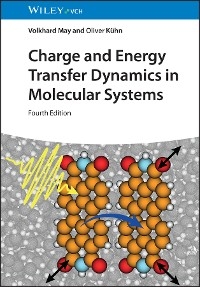
Charge and Energy Transfer Dynamics in Molecular Systems (eBook)
Wiley-VCH GmbH (Verlag)
978-3-527-69626-0 (ISBN)
Charge and Energy Transfer Dynamics in Molecular Systems
Comprehensive resource offering knowledge on charge and energy transfer dynamics in molecular systems and nanostructures
Charge and Energy Transfer Dynamics in Molecular Systems provides a unified description of different charge and energy transfer phenomena in molecular systems with emphasis on the theory, bridging the regimes of coherent and dissipative dynamics and thus presenting classic rate theories as well as modern treatments of ultrafast phenomena. Starting from microscopic models, the common features of the different transfer processes are highlighted, along with applications ranging from vibrational energy flow in large polyatomic molecules, the motion of protons in solution, up to the concerted dynamics of electronic and nuclear degrees of freedom in molecules and molecular aggregates.
The newly revised and updated Fourth Edition contains a more detailed coverage of recent developments in density matrix theory, mixed quantum-classical methods for dynamics simulations, and a substantially expanded treatment of time-resolved spectroscopy.
The book is written in an easy-to-follow style, including detailed mathematical derivations, thus making even complex concepts understandable and applicable.
Charge and Energy Transfer Dynamics in Molecular Systems includes information on:
- Electronic and vibrational molecular states, covering molecular Schrödinger equation, Born-Oppenheimer separation and approximation, Hartree-Fock equations and other electronic structure methods
- Dynamics of isolated and open quantum systems, covering multidimensional wave packet dynamics, and different variants of density operator equations
- Interaction of molecular systems with radiation fields, covering linear and nonlinear optical response using the correlation function approach
- Intramolecular electronic transitions, covering optical transition and internal conversion processes
- Transfer processes of electrons, protons, and electronic excitation energy
Providing in-depth coverage of the subject, Charge and Energy Transfer Dynamics in Molecular Systems is an essential resource for anyone working on timely problems of energy and charge transfer in physics, chemistry and biophysics as well as for all engaged in nanoscience and organic electronics.
Volkhard May studied physics at Humboldt University, Berlin, and received his Ph.D. in Theoretical Physics in 1981, and his Habilitation at the College of Education, Güstrow, in 1987. His research activities focused on the theory of transfer phenomena in molecular nanostructures. He is retired since 2019.
Oliver Kühn received his PhD from Humboldt University, Berlin. Since 2008 he is a Professor of Theoretical Physics at the University of Rostock. His current research focusses on dynamics of condensed phase systems such as molecular aggregates and novel materials.
Volkhard May studied physics at Humboldt University, Berlin, and received his Ph.D. in Theoretical Physics in 1981, and his Habilitation at the College of Education, Güstrow, in 1987. He worked in the Department of Biophysics at the Institute of Molecular Biology in Berlin from 1987 to 1991, and has been a senior researcher at the Instiute of Physics, Humboldt University, since 1992. His current research activities focus on the theory of transfer phenomena in molecular nanostructures. Oliver Kühn studied physics at Humboldt University, Berlin. After receiving his Ph.D. degree in Theoretical Physics in 1995, he worked as a postdoc first at the University of Rochester, USA, then at Lund University, Sweden. From 1997 to 2007, Prof. Kühn has been a senior researcher at the Institute of Chemistry, Free University Berlin, where he earned his habilitation in 2000. Since 2008 he is a Professor of Theoretical Physics at the University of Rostock. His current research interests lie in ultrafast spectroscopy and dynamics of condensed phase systems such as biomolecular hydrogen bonds and excitons in molecular aggregates.
I NTRODUCTION
ELECTRONIC AND VIBRATIONAL MOLECULAR STATES
Introduction
Molecular Schrödinger Equation
Born-Oppenheimer Separations
Electronic Structure Methods
Potential Energy Surfaces
Adiabatic versus Diabatic Representation of the Molecular Hamiltonian
Condensed Phase Approaches
Supplement
DYNAMICS OF ISOLATED AND OPEN QUANTUM SYSTEM
Introduction
Time-Dependent Schrödinger Equation
The Golden Rule of Quantum Mechanics
The Nonequilibrium Statistical Operator and the Density Matrix
The Reduced Density Operator and the Reduced Density Matrix
Quantum Mater Equation
The Reservoir Correlation Function
Reduced Density Matrix in Energy Representation
Coordinate and Wigner Representation of the Reduced Density Matrix
The Path Integral Representation of the Density Matrix
Hierarchy Equations of Motion Approach
Coherent to Dissipative Dynamics of a Two-Level System
Trajectory-Based Methods
Generalized Rate Equations: The Liouville Space Approach
Supplement
INTERACTION OF MOLECULAR SYSTEMS WITH RADIATION FIELDS
Introduction
Absorption of Light
Nonlinear Optical Response
Field Organization and Spontaneous Emission of Light
VIBRATIONAL DYNAMICS: ENERGY REDISTRIBUTION, RELAXATION, AND DEPHASING
Introduction
Intramolecular Vibrational Energy Redistribution
Intermolecular Vibrational Energy Relaxation
Polyatomic Molecules in Solution
Quantum-Classical Approaches to Relaxation and Dephasing
INTRAMOLECULAR ELECTRONIC TRANSITIONS
Introduction
The Optical Absorption Coefficient
Absorption Coefficient and Dipole-Dipole Correlation Function
The Emission Spectrum
Optical Preparation of an Excited Electronic State
Internal Conversion Dynamics
Supplement
ELECTRON TRANSFER
Classification of Electron Transfer Reactions
Theoretical Models for Electron Transfer Systems
Regimes of Electron Transfer
Nonadiabatic Electron Transfer in a Donor-Acceptor Complex
Bridge-Mediated Electron Transfer
Nonequilibrium Quantum Statistical Description of Electron Transfer
Heterogeneous Electron Transfer
Charge Transmission through Single Molecules
Photoinduced Ultrafast Electron Transfer
Supplement
PROTON TRANSFER
Introduction
Proton Transfer Hamiltonian
Adiabatic Proton Transfer
Nonadiabatic Proton Transfer
The Intermediate Regime: From Quantum to Quantum-Classical Hybrid Methods
Proton-Coupled Electron Transfer
EXCITATION ENERGY TRANSFER
Introduction
The Aggregate Hamiltonian
Exciton-Vibrational Interaction
Regimes of Excitation Energy Transfer
Transfer Dynamics in the Case of Weak Excitonic Coupling: Förster Theory
Transfer Dynamics in the Case of Strong Excitonic Coupling
Optical Properties of Aggregates
Excitation Energy Transfer Including Charge Transfer States
Exciton-Exciton Annihilation
Supplement
INDEX
| Erscheint lt. Verlag | 2.6.2023 |
|---|---|
| Sprache | englisch |
| Themenwelt | Naturwissenschaften ► Physik / Astronomie ► Atom- / Kern- / Molekularphysik |
| Schlagworte | atomic and molecular physics • Atom- u. Molekülphysik • Born–Oppenheimer separation • Chemie • Chemistry • Electronic molecular state • electronic structure methods • Energietransfer (Mikrophysik) • energy transfer textbook • Hartree–Fock equations • interaction representation • Ladungstransfer • Materials Science • Materialwissenschaften • molecular Schrödinger equation • Molekülphysik • open wave packets • Organic electronics • Organische Elektronik • Physical Chemistry • Physics • Physik • Physikalische Chemie • vibrational molecular states |
| ISBN-10 | 3-527-69626-1 / 3527696261 |
| ISBN-13 | 978-3-527-69626-0 / 9783527696260 |
| Informationen gemäß Produktsicherheitsverordnung (GPSR) | |
| Haben Sie eine Frage zum Produkt? |
 PDF (Adobe DRM)
Kopierschutz: Adobe-DRM
Adobe-DRM ist ein Kopierschutz, der das eBook vor Mißbrauch schützen soll. Dabei wird das eBook bereits beim Download auf Ihre persönliche Adobe-ID autorisiert. Lesen können Sie das eBook dann nur auf den Geräten, welche ebenfalls auf Ihre Adobe-ID registriert sind.
Details zum Adobe-DRM
Dateiformat: PDF (Portable Document Format)
Mit einem festen Seitenlayout eignet sich die PDF besonders für Fachbücher mit Spalten, Tabellen und Abbildungen. Eine PDF kann auf fast allen Geräten angezeigt werden, ist aber für kleine Displays (Smartphone, eReader) nur eingeschränkt geeignet.
Systemvoraussetzungen:
PC/Mac: Mit einem PC oder Mac können Sie dieses eBook lesen. Sie benötigen eine
eReader: Dieses eBook kann mit (fast) allen eBook-Readern gelesen werden. Mit dem amazon-Kindle ist es aber nicht kompatibel.
Smartphone/Tablet: Egal ob Apple oder Android, dieses eBook können Sie lesen. Sie benötigen eine
Geräteliste und zusätzliche Hinweise
Buying eBooks from abroad
For tax law reasons we can sell eBooks just within Germany and Switzerland. Regrettably we cannot fulfill eBook-orders from other countries.
aus dem Bereich