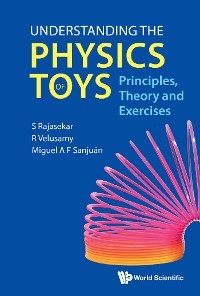
UNDERSTANDING THE PHYSICS OF TOYS (eBook)
472 Seiten
World Scientific Publishing Company (Verlag)
978-981-12-6802-1 (ISBN)
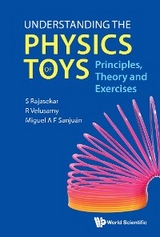
Demonstrating many fundamental concepts of physics and engineering through the working principles of popular science toys is inexpensive, quickly reaching the senses and inspiring a better learning. The systematic way of setting theoretical model equations for the toys provides a remarkable experience in constructing model equations for physical and engineering systems.
Given that most science toys are based on the principles of physics, and to cater to the needs of graduate and master-level programme students in physics and engineering, the present book covers more than 40 wide ranging popular toys. For each toy various features are presented including history, construction, working principle, theoretical model, a solved problem and 5–10 exercises.
A course on The Physics of Toys can be designed based on the proposed book to be taught as a full course at graduate and master-level and even to students who have never been exposed to physics. Further, the features of the toys covered in this book can be used to illustrate various concepts and principles in different branches of physics and engineering.
Contents:
- Preface
- Introduction:
- Fundamental Concepts
- Mechanical Toys:
- Roly-Poly
- Seesaw
- Newton's Cradle
- Falling Slinky
- Walking Slinky
- Woodpecker
- Cartesian Diver
- Spinning Toys:
- Top
- Tippe Top
- PhiTOP
- Euler's Disk
- Fidget Spinner
- Rattleback
- Hurricane Balls
- Gee-Haw Whammy-Diddle (The Notched Stick)
- Gyroscope
- The Buzzer
- Yo-Yo
- Astrojax
- Hula Hoop
- Flying Toys:
- Balsa Gliders
- Magnus Glider
- Kite
- Throwable Toys:
- Frisbee
- Boomerang
- Skipping Stones
- Bouncing Popper
- Heat and Thermodynamic Toys:
- Drinking Bird
- Putt-Putt Boat
- Crookes Radiometer
- Electric and Magnetic Toys:
- The Gauss Rifle
- The Levitron
- Electric Train
- A Simple Electromagnetic Train
- Fun-Fly-Stick
- Plasma Ball
- Miscellaneous Toys:
- Some Other Toys
- Index
Readership: Graduate students in physics and engineering, physics educators and practitioners in the field of physics of toys.
'The use of toys in physics teaching and demonstrations for general audiences is amazing, capturing the attention of the public and providing a fun context for better understanding physics principles.This book offers a wonderful description of the physics behind numerous toys, with plenty of exercises to reinforce learning.It is an inspiring and useful resource not only for educators from elementary to university level, but also for science and engineering students and anyone who loves physics.' - Manuel FiolhaisUniversity of Coimbra, Portugal
'This book describes the physics of 46 different toys under chapter headings Mechanical, Spinning, Flying, Throwable, Thermodynamics, Electric and Magnetic and Miscellaneous. There is a comprehensive selection of toys in the 472 pages, including well known toys such as Newton's cradle, the drinking bird, a tippe top and Euler's disk, plus more modern toys such as the fidget spinner, the Phitop and the Astrojax. Each toy is described and explained in detail, with clear illustrations, and includes a helpful list of references as well as a set of exercises to challenge the reader.There are many published papers on the physics of toys, primarily aimed at high school students. This book is different in that the authors offer more advanced theoretical explanations. The level is similar to that in papers found in the American and European Journals of Physics. Despite the fact that toys are usually designed to amuse young children, the underlying physics can be quite complicated. The authors have succeeded in extracting the relevant physics, at a level suitable for undergraduate and postgraduate physics students. It will also appeal to university lecturers looking for interesting material to illustrate their lectures.' - Rod CrossUniversity of Sydney, Australia
Key Features:
- Developed as a textbook covering various features of wide variety of low-cost popular science toys
- No text/popular book currently available that cover exhaustive details on the construction, working principle, theoretical model equations and explanation of functioning of the toys
- In addition to solved problems the book contains 5-10 exercises on each toy
- The content of each toy presented in the book will guide the students and teachers to identify project works, develop modified version of the toys through creative thinking, invent new toys exploiting the recently found fascinating characteristics of materials and pave a way for entrepreneurs of science toys
- Will serve as a source for readers to experience physics as a part of everyday experiences
| Erscheint lt. Verlag | 21.2.2023 |
|---|---|
| Verlagsort | Singapore |
| Sprache | englisch |
| Themenwelt | Naturwissenschaften ► Physik / Astronomie |
| ISBN-10 | 981-12-6802-9 / 9811268029 |
| ISBN-13 | 978-981-12-6802-1 / 9789811268021 |
| Informationen gemäß Produktsicherheitsverordnung (GPSR) | |
| Haben Sie eine Frage zum Produkt? |
 EPUB (Adobe DRM)
Kopierschutz: Adobe-DRM
Adobe-DRM ist ein Kopierschutz, der das eBook vor Mißbrauch schützen soll. Dabei wird das eBook bereits beim Download auf Ihre persönliche Adobe-ID autorisiert. Lesen können Sie das eBook dann nur auf den Geräten, welche ebenfalls auf Ihre Adobe-ID registriert sind.
Details zum Adobe-DRM
Dateiformat: EPUB (Electronic Publication)
EPUB ist ein offener Standard für eBooks und eignet sich besonders zur Darstellung von Belletristik und Sachbüchern. Der Fließtext wird dynamisch an die Display- und Schriftgröße angepasst. Auch für mobile Lesegeräte ist EPUB daher gut geeignet.
Systemvoraussetzungen:
PC/Mac: Mit einem PC oder Mac können Sie dieses eBook lesen. Sie benötigen eine
eReader: Dieses eBook kann mit (fast) allen eBook-Readern gelesen werden. Mit dem amazon-Kindle ist es aber nicht kompatibel.
Smartphone/Tablet: Egal ob Apple oder Android, dieses eBook können Sie lesen. Sie benötigen eine
Geräteliste und zusätzliche Hinweise
Buying eBooks from abroad
For tax law reasons we can sell eBooks just within Germany and Switzerland. Regrettably we cannot fulfill eBook-orders from other countries.
aus dem Bereich