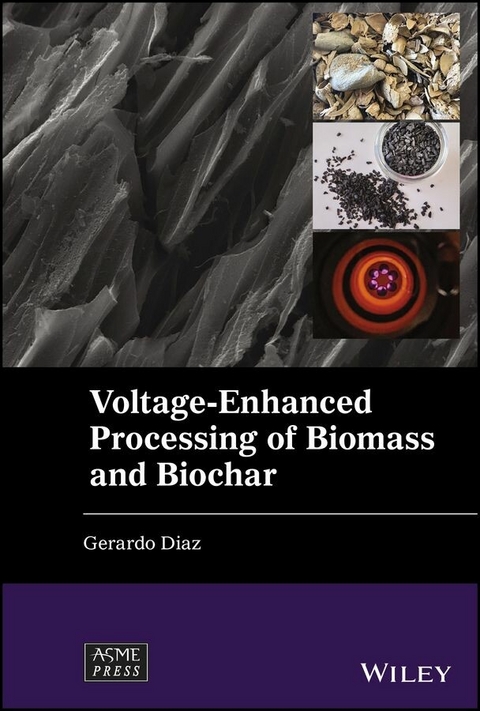
Voltage-Enhanced Processing of Biomass and Biochar (eBook)
176 Seiten
John Wiley & Sons (Verlag)
978-1-119-73976-0 (ISBN)

A detailed introduction to voltage-enhanced processing of carbonaceous materials
While there are many well-established biomass processing techniques that are suitable for a variety of different situations, the utilization of voltage-driven techniques for the processing of biomass and biochar has been shown to have advantages for certain applications. Specifically, the field of thermal plasma gasification--where plasma provides the conversion energy--is relied upon in certain commercial equipment that is already available on the market. Crucially, however, the field of non-thermal plasma pyrolysis and gasification--chemical reactions are intensified by the presence of the plasma discharge--is still a developing subject with a great scope for innovation in research and development.
A timely book considering its potential applications in a greener market, Voltage-Enhanced Processing of Biomass and Biochar helpfully provides a detailed description of voltage-enhanced processing of carbonaceous materials. The book explains aspects of this processing method in thermal and non-thermal plasmas, as well as describing the effects of Joule heating as part of the temperature distribution and conversion rate. In many ways, this book presents a detailed description of different processes and plasma discharges currently available, with the provision of experimental and simulation results gathered over years of research and development. Importantly, it also offers many methods by which we can be environmentally friendly when working with biomass and biochar.
Voltage-Enhanced Processing of Biomass and Biochar readers will also find:
* Simulation results of Joule heating of biomass, biochar, and pyrolytic graphite
* Descriptions of thermal plasma torches currently available in the market
* Accounts of the experimental results of conversion utilizing steam plasma
* Comparison of results against provided numerical models that predict synthesis gas composition under the presence of thermal plasma discharge
Voltage-Enhanced Processing of Biomass and Biochar is a useful reference for researchers and practitioners working on applications of plasma for the conversion of biomass and biochar, as well as graduate students studying mechanical, electrical, and chemical engineering.
Gerardo Diaz, PhD, is a Professor of Mechanical Engineering and Director of the Sustainable Plasma Gasification Lab at the University of California at Merced. He received his PhD in Mechanical Engineering from the University of Notre Dame in 2000.
Contributors xi
Preface xiii
Acknowledgments xv
Acronyms xvii
Introduction xix
1 Carbonaceous Material Characterization 1
1.1 Material Characterization 2
1.1.1 Thermophysical properties 3
1.1.2 Moisture Content 3
1.1.3 Ultimate and Proximate analysis 4
1.1.4 Dielectric and electrical properties 4
1.2 Biomass 6
1.3 Biochar 7
1.3.1 Surface area, cation exchange capacity, and pH 9
1.4 Activated carbon 11
1.5 Pyrolytic graphite 11
Bibliography 12
2 Conventional Processing Methods 21
2.1 Biomass Processing 22
2.1.1 Biomass Pyrolysis 23
2.1.2 Biomass Gasification 26
2.2 Biochar production and post processing 28
2.2.1 Biochar Activation 34
Bibliography 44
3 Introduction to Plasmas 49
3.1 Thermal Plasmas 50
3.1.1 Mathematical model 53
3.2 Non-thermal Plasmas 56
3.2.1 DC non-thermal electrical discharges 59
3.2.2 Dielectric barrier discharge 64
3.2.3 Pulsed discharges 65
3.2.4 Gliding arc 66
3.2.5 Microwave-induced discharges 67
3.3 Impedance matching 68
3.4 Discharges in liquids 71
3.4.1 Contact glow discharge electrolysis 72
3.4.2 Plasma electrolysis with AC power 76
3.4.3 Gliding arc in glycerol for hydrogen generation 77
Bibliography 78
4 Voltage-Enhanced Processing of Biomass 85
4.1 Biomass gasification with thermal plasma 86
4.1.1 Plasma parameters 87
4.1.2 Syngas composition 88
4.1.3 Energy balance 92
4.1.4 Temperature decay in plasma/biomass discharge 95
4.2 Dielectric breakdown of biomass 97
4.2.1 Biomass-in-the-loop 98
4.3 Biomass gasification with non-thermal plasma 99
4.3.1 Tar breakdown 100
4.3.2 Circuit configuration 104
4.3.3 Scaling up of the technology 107
Bibliography 107
5 Voltage-Enhanced Processing of Biochar 113
5.1 DC Power Applied to Biochar 114
5.1.1 Joule heating of biochar 114
5.1.2 Joule heating of activated carbon 118
5.1.3 Recent Trends in Mathematical modelling 150
5.2 Physical activation of biochar with non-thermal plasma 159
5.2.1 Plasma-steam activation 160
Bibliography 162
6 Numerical simulations 167
6.1 Background 167
6.2 Modeling approaches 168
6.2.1 Kinetic approach 169
6.2.2 Fluid model approach 172
6.3 Examples of non-thermal plasma modeling 175
6.3.1 Cathode fall of a DC glow discharge 176
6.3.2 RF plasma discharge 179
6.3.3 Plasma chemistry 185
Bibliography 191
7 Control of plasma systems 195
7.1 Control of thermal plasma torches 196
7.1.1 Dynamics 198
7.1.2 Control 201
7.2 Control of nonthermal plasma discharges 207
7.2.1 Plasma diagnostics 208
7.2.2 AI-based control 209
Bibliography 214
| Erscheint lt. Verlag | 6.7.2022 |
|---|---|
| Reihe/Serie | Wiley-ASME Press Series | Wiley-ASME Press Series |
| Sprache | englisch |
| Themenwelt | Naturwissenschaften ► Physik / Astronomie |
| Technik ► Elektrotechnik / Energietechnik | |
| Schlagworte | Biomasse • chemical thermodynamics • Chemie • Chemische Thermodynamik • Chemistry • Energie • Energy • Erneuerbare Energien • Maschinenbau • mechanical engineering • renewable energy • thermodynamics • Thermodynamik |
| ISBN-10 | 1-119-73976-4 / 1119739764 |
| ISBN-13 | 978-1-119-73976-0 / 9781119739760 |
| Informationen gemäß Produktsicherheitsverordnung (GPSR) | |
| Haben Sie eine Frage zum Produkt? |
 EPUB (Adobe DRM)
Kopierschutz: Adobe-DRM
Adobe-DRM ist ein Kopierschutz, der das eBook vor Mißbrauch schützen soll. Dabei wird das eBook bereits beim Download auf Ihre persönliche Adobe-ID autorisiert. Lesen können Sie das eBook dann nur auf den Geräten, welche ebenfalls auf Ihre Adobe-ID registriert sind.
Details zum Adobe-DRM
Dateiformat: EPUB (Electronic Publication)
EPUB ist ein offener Standard für eBooks und eignet sich besonders zur Darstellung von Belletristik und Sachbüchern. Der Fließtext wird dynamisch an die Display- und Schriftgröße angepasst. Auch für mobile Lesegeräte ist EPUB daher gut geeignet.
Systemvoraussetzungen:
PC/Mac: Mit einem PC oder Mac können Sie dieses eBook lesen. Sie benötigen eine
eReader: Dieses eBook kann mit (fast) allen eBook-Readern gelesen werden. Mit dem amazon-Kindle ist es aber nicht kompatibel.
Smartphone/Tablet: Egal ob Apple oder Android, dieses eBook können Sie lesen. Sie benötigen eine
Geräteliste und zusätzliche Hinweise
Buying eBooks from abroad
For tax law reasons we can sell eBooks just within Germany and Switzerland. Regrettably we cannot fulfill eBook-orders from other countries.
aus dem Bereich