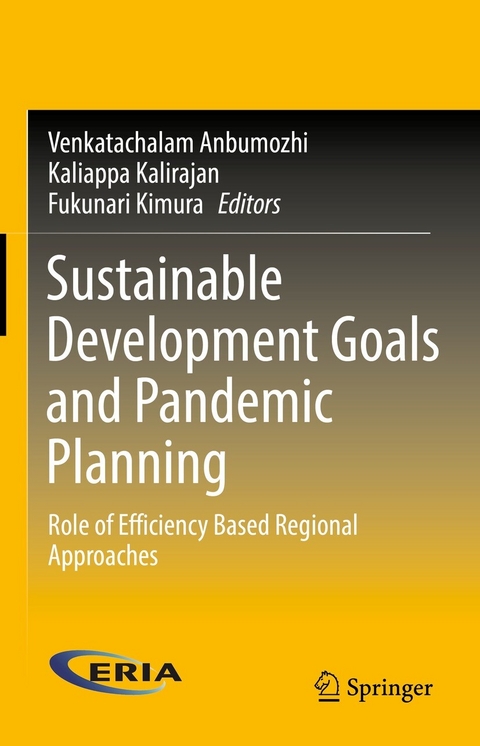
Sustainable Development Goals and Pandemic Planning (eBook)
749 Seiten
Springer Nature Singapore (Verlag)
978-981-16-6734-3 (ISBN)
?Venkatachalam Anbumozhi is a Senior Economist and the Director of Research Strategy and Innovations at the Economic Research Institute for ASEAN and East Asia (ERIA), Indonesia. His previous positions include Capacity Building Specialist and Senior Fellow at Asian Development Bank Institute and Assistant Professor at the University of Tokyo. A distinguished fellow of Asia Pacific Rim University (APRU) Forum on Development and Environment, he also advised ADB, JICA, JBIC, UNESCAP projects on sustainable development. He has published several books, authored numerous research articles, and produced many project reports on natural resource management, climate friendly infrastructure design, and private sector participation in green growth. Anbumozhi was invited as a member of the APEC Expert Panel on Green Climate Finance and the ASEAN Panel for promoting climate-resilient growth. He has taught resource management, international cooperation, and development finance at the University of Tokyo and has speaking engagements at some of the leading international organizations. He obtained his Ph.D. from the University of Tokyo.
This book assesses the progress in the implementation of Sustainable Development Goals (SDGs) in ASEAN, India and China using the above framework conditions in the context with three main propositions. First, translating the SDGs into regional economic integration strategies during the pandemic recovery can enhance the link between global objectives and the multifaceted reality of an ASEAN community building process, and providing a strategic option to strengthen the regional approaches. Secondly, a regional approach on complementarities to SDGs can facilitate the definition of relevant targets/indicators and enhance the monitoring and evaluation framework. In so doing it could also offer the scope to integrate more closely ASEAN community's social and environmental concerns into existing economic, social and political frameworks. Thirdly, focusing just on the geo-economic sphere - the area where south east and East Asian economic integration is relatively more advanced - will prove the hypothesis that effective regional integration through mega trade agreements such as the Regional Comprehensive Economic Partnership (RCEP) can support the Asia's transformation agenda and foster more inclusive and sustainable growth.
| Erscheint lt. Verlag | 10.6.2022 |
|---|---|
| Zusatzinfo | XII, 749 p. 1 illus. |
| Sprache | englisch |
| Themenwelt | Geisteswissenschaften ► Geschichte ► Regional- / Ländergeschichte |
| Naturwissenschaften | |
| Sozialwissenschaften ► Politik / Verwaltung | |
| Sozialwissenschaften ► Soziologie ► Spezielle Soziologien | |
| Wirtschaft ► Betriebswirtschaft / Management ► Unternehmensführung / Management | |
| Wirtschaft ► Volkswirtschaftslehre ► Makroökonomie | |
| Schlagworte | 2030 Agenda • ASEAN • Capital Markets • climate change • Corporate Sustainability Reporting • Economic Integration • Free Trade Agreements • Geo-economics Importance Index • Green Financing • regional cooperation • SDGs • South East Asia • sustainable development • Sustainable Development Goals |
| ISBN-10 | 981-16-6734-9 / 9811667349 |
| ISBN-13 | 978-981-16-6734-3 / 9789811667343 |
| Informationen gemäß Produktsicherheitsverordnung (GPSR) | |
| Haben Sie eine Frage zum Produkt? |
 PDF (Wasserzeichen)
DRM: Digitales Wasserzeichen
Dieses eBook enthält ein digitales Wasserzeichen und ist damit für Sie personalisiert. Bei einer missbräuchlichen Weitergabe des eBooks an Dritte ist eine Rückverfolgung an die Quelle möglich.
Dateiformat: PDF (Portable Document Format)
Mit einem festen Seitenlayout eignet sich die PDF besonders für Fachbücher mit Spalten, Tabellen und Abbildungen. Eine PDF kann auf fast allen Geräten angezeigt werden, ist aber für kleine Displays (Smartphone, eReader) nur eingeschränkt geeignet.
Systemvoraussetzungen:
PC/Mac: Mit einem PC oder Mac können Sie dieses eBook lesen. Sie benötigen dafür einen PDF-Viewer - z.B. den Adobe Reader oder Adobe Digital Editions.
eReader: Dieses eBook kann mit (fast) allen eBook-Readern gelesen werden. Mit dem amazon-Kindle ist es aber nicht kompatibel.
Smartphone/Tablet: Egal ob Apple oder Android, dieses eBook können Sie lesen. Sie benötigen dafür einen PDF-Viewer - z.B. die kostenlose Adobe Digital Editions-App.
Buying eBooks from abroad
For tax law reasons we can sell eBooks just within Germany and Switzerland. Regrettably we cannot fulfill eBook-orders from other countries.
aus dem Bereich