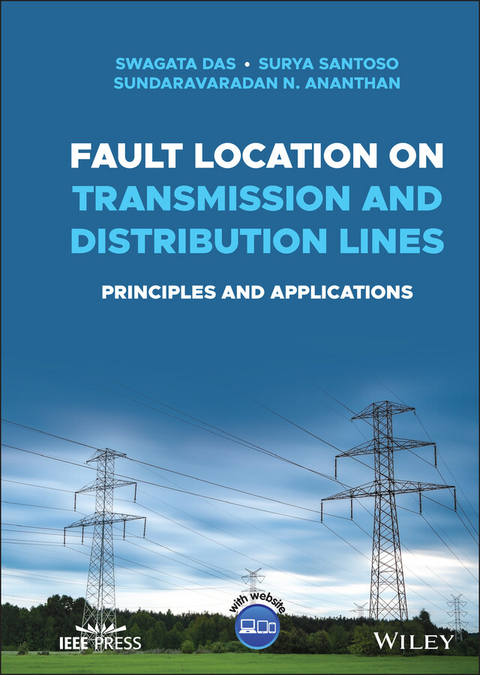
Fault Location on Transmission and Distribution Lines (eBook)
John Wiley & Sons (Verlag)
978-1-119-12149-7 (ISBN)
This book provides readers with up-to-date coverage of fault location algorithms in transmission and distribution networks. The algorithms will help readers track down the exact location of a fault in the shortest possible time. Furthermore, voltage and current waveforms recorded by digital relays, digital fault recorders, and other intelligent electronic devices contain a wealth of information. Knowledge gained from analysing the fault data can help system operators understand what happened, why it happened and how it can be prevented from happening again. The book will help readers convert such raw data into useful information and improve power system performance and reliability.
Swagata Das, PhD, is an Application Engineer (Protection) at Schweitzer Engineering Laboratories, Texas, USA. She is an IEEE Senior Member and has published in peer-reviewed journals and presented her research on fault location and fault data analysis in transmission and distribution networks to industry professionals at several IEEE Power and Energy Society conferences.
Surya Santoso, PhD, is a Professor in Electrical Engineering at The University of Texas at Austin, USA. His research interests include power systems fault analytics and protection, power systems modeling and simulation, and power quality. He is an IEEE Fellow and a Distinguished Lecturer for the IEEE Power and Energy Society.
Sundaravaradan N. Ananthan, PhD, is a Project Engineer (Protection) at Schweitzer Engineering Laboratories, Texas, USA. He has a background in power system protection and fault location in transmission and distribution networks and has published his research in many international journals and conferences.
This book provides readers with up-to-date coverage of fault location algorithms in transmission and distribution networks. The algorithms will help readers track down the exact location of a fault in the shortest possible time. Furthermore, voltage and current waveforms recorded by digital relays, digital fault recorders, and other intelligent electronic devices contain a wealth of information. Knowledge gained from analysing the fault data can help system operators understand what happened, why it happened and how it can be prevented from happening again. The book will help readers convert such raw data into useful information and improve power system performance and reliability.
Swagata Das, PhD, is an Application Engineer (Protection) at Schweitzer Engineering Laboratories, Texas, USA. She is an IEEE Senior Member and has published in peer-reviewed journals and presented her research on fault location and fault data analysis in transmission and distribution networks to industry professionals at several IEEE Power and Energy Society conferences. Surya Santoso, PhD, is a Professor in Electrical Engineering at The University of Texas at Austin, USA. His research interests include power systems fault analytics and protection, power systems modeling and simulation, and power quality. He is an IEEE Fellow and a Distinguished Lecturer for the IEEE Power and Energy Society. Sundaravaradan N. Ananthan, PhD, is a Project Engineer (Protection) at Schweitzer Engineering Laboratories, Texas, USA. He has a background in power system protection and fault location in transmission and distribution networks and has published his research in many international journals and conferences.
1
Introduction
The power system is a complex network of generators, transformers, transmission lines, distribution feeders, loads, and other electrical components. The purpose of this network is to deliver electrical power from generators to loads through transmission lines and distribution feeders. Today, electrical power is a necessity of everyday life and is expected to be present whenever we flip the light switch, charge our phones, and turn on other gadgets. Unfortunately, this expected service may not always be available, particularly when there is a fault on the power system.
Faults are abnormal conditions on the power system that disrupt the normal flow of electrical power from generators to loads. Lightning, animal contact, tree contact, and adverse weather such as strong winds and winter storms are some of the major reasons for power system faults. Utilities take many preventive steps such as installing shield wires and surge arresters to divert the energy of lightning strikes, putting up animal guards, and trimming trees at periodic intervals to minimize the chances of a fault. In spite of all these measures, faults are inevitable on the power system. So when they occur, all efforts must be made to locate the fault as quickly as possible, make repairs, and restore power. This is why fault location is so important and critical to improving power system reliability.
We begin this chapter by explaining the types of faults that can occur on the power system and their root cause. We then move our focus to fault-locating algorithms. We discuss their aim and importance, their principles, their implementation in the field, and their evaluation criteria. Finally, we discuss how to choose the best fault-locating algorithm from among the many algorithms that have been proposed in the literature.
1.1 Power System Faults
Faults are abnormal conditions on the power system that cause voltage, current, frequency, and power to deviate from their nominal values. Protective relays are typically used to detect and isolate these faults as quickly as possible to return the power system back to normal operating conditions. The Institute of Electrical and Electronics Engineers (IEEE) defines a protective relay as “a device whose function is to detect defective lines or apparatus or other power system conditions of an abnormal or dangerous nature and to initiate appropriate control action” [1]. Protective relays use current transformers (CTs) and potential transformers (PTs) to monitor the state of the power system. When a fault is detected, they send a trip command to circuit breakers, which then open to isolate the fault. In low-voltage distribution systems, fuses are often used instead of protective relays and circuit breakers to detect and isolate faults that create an overcurrent condition. A fuse is defined by IEEE as “an overcurrent protective device with a circuit-opening fusible part that is heated and severed by the passage of the overcurrent through it.”
Faults experienced by the power system can be of two types, series faults and shunt faults. Series faults usually occur when there is an open circuit on one or two phase conductors during load conditions. Because the open circuit occurs in series with the phase conductor, these faults are known as series faults. Series faults can be caused by broken jumpers or when all three poles of a circuit breaker pole are unable to close during a manual or an automatic close operation. They can also be caused by a blown fuse. For example, Fig. 1.1 shows a distribution transformer being protected by high-side fuses. If one or two high-side fuse blows due to an overcurrent condition, it will result in a series fault. During a series fault, the current in the faulted phase decreases due to loss in load while the healthy phase continues to carry load current. The voltage and frequency of the faulted phase also increase as compared to the healthy phase. While series faults do not result in high magnitude currents to flow in the faulted phases, they make the power system unbalanced, causing unbalanced currents to flow in the power system. The heat generated by the unbalanced currents can damage transformers and motors. References [2–4] explain how protective relays can be set up to detect and isolate series faults.
Shunt faults occur when there is a shunt connection between one or more phase conductors to the ground or between each other. The shunt connection creates a short-circuit condition allowing current to flow through an alternate, lower impedance path. The lower impedance causes the current in the faulted phase to dramatically increase while the voltage of the faulted phase decreases. Because shunt faults are more common and more damaging than series faults, this book will focus on locating shunt faults.
There are four types of shunt faults (see Fig. 1.2). Single line-to-ground faults (also referred to as single phase-to-ground faults) occur when one of the three phase conductors makes contact with the ground wire or the grounded piece of an equipment. Seventy to eighty percent of all faults are single line-to-ground faults, making this the most common fault type [5]. Line-to-line faults (also referred to as phase-to-phase faults) occur when two phase conductors make contact with each other. Double line-to-ground faults (also referred to as double phase-to-ground faults) occur when two phase conductors make contact with each other and the ground wire or the grounded piece of an equipment. Three-phase faults occur when all three phase conductors make contact with each other, with or without ground connection. This fault type is quite rare and is most often the result of human errors. Three-phase faults are referred to as balanced faults as the fault involves all three phases. The other fault types involve one or two phases and make the power system unbalanced. As a result, they are referred to as unbalanced faults.
Figure 1.1 A distribution delta/wye-grounded transformer being protected by high-side fuses. A blown fuse will result in a series fault.
Figure 1.2 The four types of shunt faults.
Shunt faults can be permanent (leading to sustained outages) or temporary (leading to momentary outages). Permanent faults occur when there is permanent damage to a power system equipment and require line crew to make repairs before reenergization. Temporary faults occur due to lightning, animal contact, flying debris, and other temporary sources of fault. Such faults clear out on their own after the fault arc gets extinguished. When the arc gets extinguished by itself without the operation of any protective device, the fault is referred to as a self-clearing fault. These faults generally occur when insulation breaks down near the voltage peak but clear out on their own within a quarter cycle. The frequency of self-clearing faults increase over time and eventually lead to permanent faults [6]. Fault arcs can also get extinguished by the operation of a relay and circuit breaker. After a short open time delay, which allows the arc to get extinguished, the relay sends a reclose command to the circuit breaker to resume normal operation. Most faults on underground cables are permanent faults. In contrast, most faults on overhead systems are temporary faults [7].
Shunt faults can cause significant thermal damage to power system equipment. Thermal energy during a fault is proportional to the magnitude and duration of the fault current. If this thermal energy exceeds the thermal limit of power transformers, motors, and other power system equipment, they get damaged due to insulation failure. In addition, strong mechanical forces developed by the high magnitude current can break and physically damage power system equipment. In fact, [8] reports that transformers, a critical asset in the substation, most often fail due to mechanical and thermal stress caused by external through faults. Shunt faults are also a safety concern. Sparks from faults can start forest fires. Faults inside oil-filled transformers can lead to fires and explosions, creating dangerous working conditions for personnel inside the substation. Arc flash events in a switchgear can lead to dangerous and possibly fatal conditions due to heat, ultraviolet radiation, shrapnel, noise, and pressure from the blast [9]. Shunt faults if not cleared before the critical clearing time can make the power system unstable, leading to cascading outages [10]. Finally, shunt faults can cause voltage sags or swells on other healthy feeders. A voltage sag is defined as an event in which the rms voltage drops to a value between 0.1 and 0.9 per unit for a duration between a half cycle to one minute. An example of voltage sag during a single line-to-ground fault is shown in Fig. 1.3. Voltage sag is a power quality event that can shut down sensitive equipment in industrial plants, resulting in a revenue loss of several million dollars. Voltage swell is defined as an event in which the rms voltage increases to a value between 1.1 and 1.8 per unit for a duration between a half cycle to one minute. This can occur when single line-to-ground faults occur on an ungrounded system. Voltage of the unfaulted phases swells to 1.73 per unit and stresses the insulators. For all the reasons listed above, shunt faults must be detected and isolated as fast as possible. The latest generation of protective relays can detect faults in as fast as 2 ms [11]. The breaker takes an additional two or three cycles to open. The fast clearing time limits the...
| Erscheint lt. Verlag | 22.11.2021 |
|---|---|
| Reihe/Serie | IEEE Press |
| Wiley - IEEE | Wiley - IEEE |
| Sprache | englisch |
| Themenwelt | Naturwissenschaften ► Physik / Astronomie |
| Technik ► Elektrotechnik / Energietechnik | |
| Schlagworte | Electrical & Electronics Engineering • Electric Power Electronics • electric power systems • Elektrische Energietechnik • Elektrotechnik u. Elektronik • Energie • Energy • fault location algorithms • fault location analysis • fault location applications • fault location MATLAB • fault location methods • fault location power systems • fault location principles • fault location simulation • fault location theory • Fehlersuche • Leistungselektronik • Numerical Methods & Algorithms • Numerische Methoden u. Algorithmen • Power Electronics |
| ISBN-10 | 1-119-12149-3 / 1119121493 |
| ISBN-13 | 978-1-119-12149-7 / 9781119121497 |
| Informationen gemäß Produktsicherheitsverordnung (GPSR) | |
| Haben Sie eine Frage zum Produkt? |
 EPUB (Adobe DRM)
Kopierschutz: Adobe-DRM
Adobe-DRM ist ein Kopierschutz, der das eBook vor Mißbrauch schützen soll. Dabei wird das eBook bereits beim Download auf Ihre persönliche Adobe-ID autorisiert. Lesen können Sie das eBook dann nur auf den Geräten, welche ebenfalls auf Ihre Adobe-ID registriert sind.
Details zum Adobe-DRM
Dateiformat: EPUB (Electronic Publication)
EPUB ist ein offener Standard für eBooks und eignet sich besonders zur Darstellung von Belletristik und Sachbüchern. Der Fließtext wird dynamisch an die Display- und Schriftgröße angepasst. Auch für mobile Lesegeräte ist EPUB daher gut geeignet.
Systemvoraussetzungen:
PC/Mac: Mit einem PC oder Mac können Sie dieses eBook lesen. Sie benötigen eine
eReader: Dieses eBook kann mit (fast) allen eBook-Readern gelesen werden. Mit dem amazon-Kindle ist es aber nicht kompatibel.
Smartphone/Tablet: Egal ob Apple oder Android, dieses eBook können Sie lesen. Sie benötigen eine
Geräteliste und zusätzliche Hinweise
Buying eBooks from abroad
For tax law reasons we can sell eBooks just within Germany and Switzerland. Regrettably we cannot fulfill eBook-orders from other countries.
aus dem Bereich