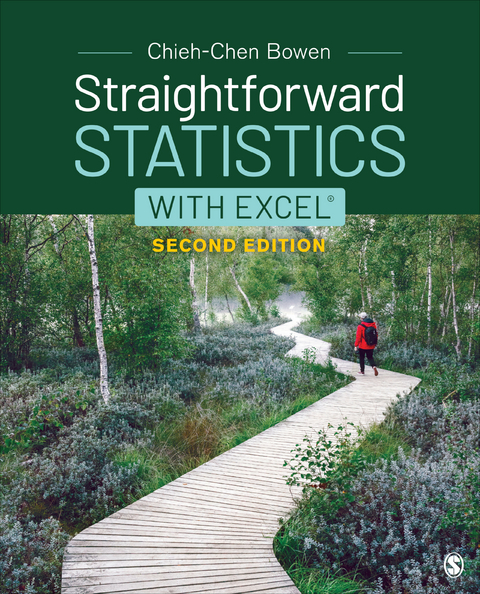
Straightforward Statistics with Excel (eBook)
Sage Publications, Inc (Verlag)
978-1-5443-6193-2 (ISBN)
Preface
Acknowledgments
About the Author
Chapter 1. Introduction to Statistics
What Is Statistics?
Random Sampling Methods
Scales of Measurement
Variable Classifications
Required Mathematical Skills for This Course
Exercise Problems
Chapter Resources
What You Learned
Key Words
Learning Assessment
Chapter 2. Summarizing, Organizing Data, and Measures of Central Tendency
What You Know and What Is New
Frequency Distribution Table
Graphs
Common Distribution Shapes
Measures of Central Tendency
Excel Step-by-Step Instruction for Calculating SX From a Frequency Table and Constructing a Bar Graph and a Histogram
Exercise Problems
Chapter Resources
What You Learned
Key Words
Learning Assessment
Chapter 3. Measures of Variability
What You Know and What Is New
Measures of Variability
Discover the Hidden Functions in Excel: Analysis Toolpak Installation Instructions
Exercise Problems
Chapter Resources
What You Learned
Key Words
Learning Assessment
Chapter 4. Standard Z Scores
What You Know
What Is New
Standard Z Scores
Empirical Rule for Variables With a Normal Distribution
Exercise Problems
Chapter Resources
What You Learned
Key Words
Learning Assessment
Chapter 5. Basic Principles of Probability
What You Know and What Is New
Basic Terms and Mathematical Operations in Probability
Linkage Between Probability and Z Score in a Normal Distribution
Probabilities, Z Scores, and Raw Scores
Exercise Problems
Chapter Resources
What You Learned
Key Words
Learning Assessment
Chapter 6. The Central Limit Theorem
What You Know and What Is New
Sampling Error
Sampling Distribution of the Sample Means and the Central Limit Theorem
Relationships Between Sample Means and the Population Mean
The Law of Large Numbers
Exercise Problems
Chapter Resources
What You Learned
Key Words
Learning Assessment
Chapter 7. Hypothesis Testing
What You Know and What Is New
Type I Error and Type II Error
The Four-Step Procedure to Conduct a Hypothesis Test
Further Discussions on Directional Versus Nondirectional Hypothesis Tests
Exercise Problems
Chapter Resources
What You Learned
Key Words
Learning Assessment
Chapter 8. One-Sample t Test and Dependent-Sample t Test
What You Know and What Is New
The Unknown s and Conducting the One-Sample t Test
The t Distribution With a Specific Curve for Every Degree of Freedom
The Four-Step Hypothesis Test in One-Sample t Tests
Confidence Intervals in One-Sample t Tests
Introducing Dependent-Sample t Tests
Calculations and the Hypothesis Testing Process in Dependent-Sample t Tests
Exercise Problems
Chapter Resources
What You Learned
Key Words
Learning Assessment
Chapter 9. Independent-Samples t Tests
What You Know and What Is New
Introducing Independent Samples and the Decision Rules on Equal Variances
Decision Rules for Equal Variances Assumed Versus Equal Variances Not Assumed
Confidence Intervals of the Mean Differences
Effect Sizes
Exercise Problems
Chapter Resources
What You Learned
Key Words
Learning Assessment
Chapter 10. Correlation
What You Know and What Is New
Pearson’s Correlation
Hypothesis Testing for Pearson’s Correlation
Interpretations and Assumptions of Pearson’s Correlation
Partial Correlation
Excel Step-by-Step Instruction for Constructing a Scatterplot
Excel Step-by-Step Instruction for Calculating Pearson’s r
Exercise Problems
Chapter Resources
What You Learned
Key Words
Learning Assessment
Chapter 11. Simple Regression
What You Know and What Is New
Y-Intercept and Slope
Hypothesis Testing for Simple Regression
Statistical Assumptions for Simple Regression
Step-by-Step Instructions of Simple Regression in Excel
Exercise Problems
Chapter Resources
What You Learned
Key Words
Learning Assessment
Chapter 12. One-Way Analysis of Variance
What You Know and What Is New
Introducing One-Way ANOVA
Between-Group Variance and Within-Group Variance
Hypothesis Testing for One-Way ANOVA
Effect Size for One-Way ANOVA
Step-by-Step Instructions for Using Excel to Run an ANOVA
Exercise Problems
Chapter Resources
What You Learned
Key Words
Learning Assessment
Chapter 13. Chi-Square Tests for Goodness of Fit and Independence
What You Know and What Is New
The Chi-Square
Expected Frequency
Goodness-of-Fit Tests
Chi-Square for Independence Test
Exercise Problems
Chapter Resources
What You Learned
Key Words
Learning Assessment
Appendix A. The Standard Normal Distribution Table (Z Table)
Appendix B. The t-Distribution Table (t Table)
Appendix C. The F Table
Appendix D. The Critical Values of Pearson’s Correlation Table (r Table)
Appendix E. The Critical Values for the Chi-Square Tests (?2 Table)
Answers to the Learning Assessments
Glossary
References
Index
| Erscheint lt. Verlag | 14.9.2021 |
|---|---|
| Verlagsort | Thousand Oaks |
| Sprache | englisch |
| Themenwelt | Geisteswissenschaften ► Psychologie |
| Informatik ► Office Programme ► Excel | |
| Mathematik / Informatik ► Mathematik ► Statistik | |
| Naturwissenschaften | |
| Sozialwissenschaften ► Soziologie ► Empirische Sozialforschung | |
| Wirtschaft ► Betriebswirtschaft / Management ► Unternehmensführung / Management | |
| Schlagworte | Applied Statistics • Bivariate Statistics • Business Statistics • Introduction • introduction to statistics • Microsoft Excel • organizational statistics • Psychological Statistics • Psychology • sociological statistics |
| ISBN-10 | 1-5443-6193-9 / 1544361939 |
| ISBN-13 | 978-1-5443-6193-2 / 9781544361932 |
| Informationen gemäß Produktsicherheitsverordnung (GPSR) | |
| Haben Sie eine Frage zum Produkt? |
 PDF (Adobe DRM)
Kopierschutz: Adobe-DRM
Adobe-DRM ist ein Kopierschutz, der das eBook vor Mißbrauch schützen soll. Dabei wird das eBook bereits beim Download auf Ihre persönliche Adobe-ID autorisiert. Lesen können Sie das eBook dann nur auf den Geräten, welche ebenfalls auf Ihre Adobe-ID registriert sind.
Details zum Adobe-DRM
Dateiformat: PDF (Portable Document Format)
Mit einem festen Seitenlayout eignet sich die PDF besonders für Fachbücher mit Spalten, Tabellen und Abbildungen. Eine PDF kann auf fast allen Geräten angezeigt werden, ist aber für kleine Displays (Smartphone, eReader) nur eingeschränkt geeignet.
Systemvoraussetzungen:
PC/Mac: Mit einem PC oder Mac können Sie dieses eBook lesen. Sie benötigen eine
eReader: Dieses eBook kann mit (fast) allen eBook-Readern gelesen werden. Mit dem amazon-Kindle ist es aber nicht kompatibel.
Smartphone/Tablet: Egal ob Apple oder Android, dieses eBook können Sie lesen. Sie benötigen eine
Geräteliste und zusätzliche Hinweise
Buying eBooks from abroad
For tax law reasons we can sell eBooks just within Germany and Switzerland. Regrettably we cannot fulfill eBook-orders from other countries.
aus dem Bereich