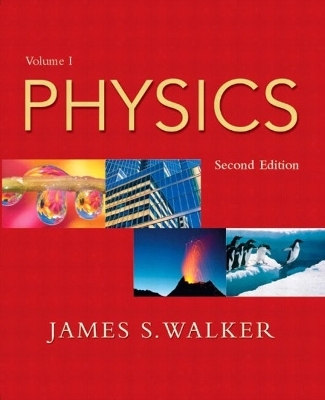
Physics, Volume 1
Pearson (Verlag)
978-0-13-140651-3 (ISBN)
- Titel erscheint in neuer Auflage
- Artikel merken
This text features a combination of unique pedagogical tools–Exercises, Worked Examples with solutions in 2-column format, Active Examples, Conceptual Checkpoints–that provide the right tool at the right time and place. This text employs each tool when and where it can contribute most to developing students' conceptual insight hand-in-hand with developing their problem-solving skills.
James S. Walker. James Walker obtained his Ph.D. in theoretical physics from the University of Washington in 1978. He subsequently served as a post-doc at the University of Pennsylvania, the Massachusetts Institute of Technology, and the University of California at San Diego before joining the physics faculty at Washington State University in 1983. Professor Walker's research interests include statistical mechanics, critical phenomena, and chaos. His many publications on the application of renormalization-group theory to systems ranging from absorbed monolayers to binary-fluid mixtures have appeared in Physical Review, Physical Review Letters, Physica, and a host of other publications. He has also participated in observations on the summit of Mauna Kea, looking for evidence of extra-solar planets. Jim Walker likes to work with students at all levels, from judging elementary school science fairs to writing research papers with graduate students, and has taught introductory physics for many years. His enjoyment of this course and his empathy for students have earned him a reputation as an innovative, enthusiastic, and effective teacher. Jim's educational publications include "Reappearing Phases" (Scientific American, May 1987) as well as articles in the American Journal of Physics and The Physics Teacher. In recognition of his contributions to the teaching of physics, Jim was named Boeing Distinguished Professor of Science and Mathematics Education for 2001-2003. When he is not writing, conducting research, teaching, or developing new classroom demonstrations and pedagogical materials, Jim enjoys amateur astronomy, bird watching, photography, juggling, unicycling, boogie boarding, and kayaking. Jim is also an avid jazz pianist and organist. He has served as ballpark organist for several Class A minor league baseball teams, including minor league affiliates of the Seattle Mariners and San Francisco Giants.
1. Introduction.
Physics and the Laws of Nature. Units of Length, Mass, and Time. Dimensional Analysis. Significant Figures. Converting Units. Order-of-Magnitude Calculations. Problem Solving in Physics.
I. MECHANICS.
2. One-Dimensional Kinematics.
Position, Distance, and Displacement. Average Speed and Velocity. Instantaneous Velocity. Acceleration. Motion with Constant Acceleration. Applications of the Equations of Motion. Freely Falling Objects.
3. Vectors in Physics.
Scalars versus Vectors. The Components of a Vector. Adding and Subtracting Vectors. Unit Vectors. Position, Displacement, Velocity, and Acceleration Vectors. Relative Motion.
4. Two-Dimensional Kinematics.
Motion in Two Dimensions. Projectile Motion: Basic Equations. Zero Launch Angle. General Launch Angle. Projectile Motion: Key Characteristics.
5. Newton's Laws of Motion.
Force and Mass. Newton's First Law of Motion. Newton's Second Law of Motion. Newton's Third Law of Motion. The Vector Nature of Forces: Forces in Two Dimensions. Weight. Normal Forces.
6. Applications of Newton's Laws.
Frictional Forces. Strings and Springs. Translational Equilibrium. Connected Objects. Circular Motion.
7. Work and Kinetic Energy.
Work Done by a Constant Force. Kinetic Energy and the Work-Energy Theorem. Work Done by a Variable Force. Power.
8. Potential Energy and Conservative Forces.
Conservative and Nonconservative Forces. Potential Energy and the Work Done by Conservative Forces. Conservation of Mechanical Energy. Work Done by Nonconservative Forces. Potential Energy Curves and Equipotentials.
9. Linear Momentum and Collisions.
Linear Momentum. Momentum and Newton's Second Law. Impulse. Conservation of Linear Momentum. Inelastic Collisions. Elastic Collisions. Center of Mass. Systems with Changing Mass: Rocket Propulsion.
10. Rotational Kinematics and Energy.
Angular Position, Velocity, and Acceleration. Rotational Kinematics. Connections between Linear and Rotational Quantities. Rolling Motion. Rotational Kinetic Energy and the Moment of Inertia. Conservation of Energy.
11. Rotational Dynamics and Static Equilibrium.
Torque. Torque and Angular Acceleration. Zero Torque and Static Equilibrium. Center of Mass and Balance. Dynamic Applications of Torque. Angular Momentum. Conservation of Angular Momentum. Rotational Work. The Vector Nature of Rotational Motion.
12. Gravity.
Newton's Law of Universal Gravitation. Gravitation Attraction of Spherical Bodies. Kepler's Law of Orbital Motion. Gravitational Potential Energy. Energy Conservation. Tides.
13. Oscillations about Equilibrium.
Periodic Motion. Simple Harmonic Motion. Connections between Uniform Circular Motion and Simple Harmonic Motion. The Period of a Mass on a Spring. Energy Conservation in Oscillatory Motion. The Pendulum. Damped Oscillations. Driven Oscillations and Resonance.
14. Waves and Sound.
Types of Waves. Waves on a String. Harmonic Wave Functions. Sound Waves. Sound Intensity. The Doppler Effect. Superposition and Interference. Standing Waves. Beats.
15. Fluids.
Density. Pressure. Static Equilibrium in Fluids: Pressure and Depth. Archimedes' Principle and Buoyancy. Applications of Archimedes' Principle. Fluid Flow and Continuity. Bernoulli's Equation. Applications of Bernoulli's Equation. Viscosity and Surface Tension.
II. THERMAL PHYSICS.
16. Temperature and Heat.
Temperature and the Zeroth Law of Thermodynamics. Temperature Scales. Thermal Expansion. Heat and Mechanical Work. Specific Heats. Conduction, Convection, and Radiation.
17. Phases and Phase Changes.
Ideal Gases. Kinetic Theory. Solids and Elastic Deformation. Phase Equilibrium and Evaporation. Latent Heats. Phase Changes and Energy Conservation.
18. The Laws of Thermodynamics.
The Zeroth Law of Thermodynamics. The First Law of Thermodynamics. Thermal Processes. Specific Heats for an Ideal Gas: Constant Pressure, Constant Volume. The Second Law of Thermodynamics. Heat Engines and the Carnot Cycle. Refrigerators, Air Conditioners, and Heat Pumps. Entropy. Order, Disorder, and Entropy. The Third Law of Thermodynamics.
| Erscheint lt. Verlag | 14.8.2003 |
|---|---|
| Sprache | englisch |
| Gewicht | 1337 g |
| Themenwelt | Naturwissenschaften ► Physik / Astronomie |
| ISBN-10 | 0-13-140651-5 / 0131406515 |
| ISBN-13 | 978-0-13-140651-3 / 9780131406513 |
| Zustand | Neuware |
| Informationen gemäß Produktsicherheitsverordnung (GPSR) | |
| Haben Sie eine Frage zum Produkt? |
aus dem Bereich