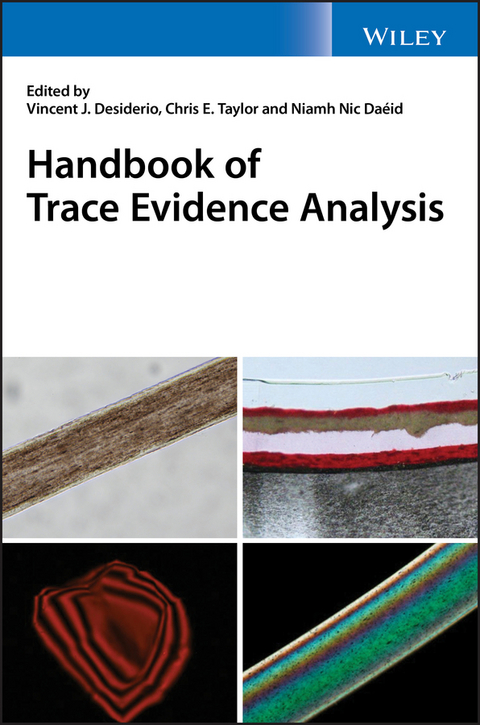
Handbook of Trace Evidence Analysis (eBook)
John Wiley & Sons (Verlag)
978-1-118-96209-1 (ISBN)
Covers new trace evidence techniques and expanding areas of analysis, along with key theory and applications
Developed around the need for updated information in the disciplines of trace evidence the Handbook of Trace Evidence Analysis focuses on the increasing awareness and need for validation, modern methods for addressing and controlling contamination, the shift towards incorporating statistical analyses into the interpretation phase and cutting edge research into new forensic science methods and their application.
Beginning with an overview of the topic and discussing the important role that information derived from trace materials can provide during investigations, the book then presents chapters on key techniques. The first being the critical nature of microscopy, and the methods employed for the recognition, collection, and preservation of trace evidence. Subsequent chapters review the core disciplines of trace evidence examination: paints and polymers, hairs, fibers and textiles and glass. Each chapter contains in-depth discussions on the origin of the materials involved, including any natural or synthetic processes involved in their production, the nuances involved in their detection, and the methods of analysis that are used to extract valuable information from samples. In addition, suggested workflows in method and testing selections, as well as addressing specific scientific challenges as well as the limitations of knowledge on the transfer, persistence and background abundance of trace materials are discussed. The book ends by examining the interpretation of trace evidence findings from a historical perspective and examining the methods that are currently being developed.
- Provides an in-depth introduction to the general area of trace evidence and discusses current and new techniques
- Consolidates trace evidence and materials categories of testing into one reference series
- Offers a detailed focus on technical approaches and guidelines to trace evidence
- Includes analytical schemes/workflows and valuable guides for the interpretation of data and results
The Handbook of Trace Evidence will appeal to forensic science academics, students, and practitioners in the trace evidence and materials science disciplines, as well as DNA analysts, toxicologists, forensic anthropologists, crime laboratory managers, criminal justice students and practitioners, and legal professionals. It would also be a valuable resource for every crime laboratory reference library.
Vincent J. Desiderio is the Hazardous Materials Program Specialist for the United States Postal Inspection Service-Security Group, Washington, D.C.
Chris E. Taylor is a Forensic Chemist at the Defense Forensic Science Center-US Army Criminal Investigation Laboratory in Forest Park, Georgia.
Niamh Nic Daéid, PhD, is Professor of Forensic Science and Director of the Leverhulme Research Centre for Forensic Science, School of Science and Engineering, University of Dundee, Scotland.
Covers new trace evidence techniques and expanding areas of analysis, along with key theory and applications Developed around the need for updated information in the disciplines of trace evidence the Handbook of Trace Evidence Analysis focuses on the increasing awareness and need for validation, modern methods for addressing and controlling contamination, the shift towards incorporating statistical analyses into the interpretation phase and cutting edge research into new forensic science methods and their application. Beginning with an overview of the topic and discussing the important role that information derived from trace materials can provide during investigations, the book then presents chapters on key techniques. The first being the critical nature of microscopy, and the methods employed for the recognition, collection, and preservation of trace evidence. Subsequent chapters review the core disciplines of trace evidence examination: paints and polymers, hairs, fibers and textiles and glass. Each chapter contains in-depth discussions on the origin of the materials involved, including any natural or synthetic processes involved in their production, the nuances involved in their detection, and the methods of analysis that are used to extract valuable information from samples. In addition, suggested workflows in method and testing selections, as well as addressing specific scientific challenges as well as the limitations of knowledge on the transfer, persistence and background abundance of trace materials are discussed. The book ends by examining the interpretation of trace evidence findings from a historical perspective and examining the methods that are currently being developed. Provides an in-depth introduction to the general area of trace evidence and discusses current and new techniques Consolidates trace evidence and materials categories of testing into one reference series Offers a detailed focus on technical approaches and guidelines to trace evidence Includes analytical schemes/workflows and valuable guides for the interpretation of data and results The Handbook of Trace Evidence will appeal to forensic science academics, students, and practitioners in the trace evidence and materials science disciplines, as well as DNA analysts, toxicologists, forensic anthropologists, crime laboratory managers, criminal justice students and practitioners, and legal professionals. It would also be a valuable resource for every crime laboratory reference library.
Vincent J. Desiderio is the Hazardous Materials Program Specialist for the United States Postal Inspection Service-Security Group, Washington, D.C. Chris E. Taylor is a Forensic Chemist at the Defense Forensic Science Center-US Army Criminal Investigation Laboratory in Forest Park, Georgia. Niamh Nic Daéid, PhD, is Professor of Forensic Science and Director of the Leverhulme Research Centre for Forensic Science, School of Science and Engineering, University of Dundee, Scotland.
List of Contributors
Preface
1. Trace Evidence Recognition, Collection and Preservation
2. Polarized Light Microscopy for the Trace Evidence Examiner
3. Paints & Polymers
4. Forensic Hair Microscopy
5. Fibers
6. Interpretation of glass evidence
7. Interpreting trace evidence
1
Trace Evidence Recognition, Collection, and Preservation
Ted R. Schwartz, Daniel S. Rothenberg, and Brandi L. Clark
Westchester County Forensic Science Laboratory, Valhalla, New York, USA
1.1 Introduction
Trace evidence is often not visible to the human eye, therefore it is typically the least understood and, unfortunately, the most overlooked form of evidence at the crime scene, and surprisingly even within the forensic laboratory. Some police officers, scene investigators, and laboratory personnel have a poor understanding of trace evidence. Proper knowledge is essential so that valuable trace evidence does not become lost, contaminated or accidentally transferred to another surface. Such incidents could severely hinder a successful criminal investigation. The goal of this chapter is to provide a foundation of knowledge that will enable successful processing of trace evidence in the forensic field. The following trace evidence principles will be discussed:
- theories of transfer and persistence
- proper trace evidence handling practices
- recognition, collection, and preservation of trace evidence at the crime scene
- recognition, collection, and preservation of trace evidence in the laboratory.
1.2 Theories of Transfer and Persistence
1.2.1 Locard's Exchange Principle
Edmond Locard (1877–1966), an early pioneer of forensic science, developed one of its most fundamental principles. His Exchange Principle theorizes that there will be a transfer of material every time contact is made between two surfaces, therefore during the commission of a crime, where contact is inevitable, it stands to reason that there will normally be some transfer of meaningful evidence. It could be in the form of hairs left by the perpetrator, either at the scene or on the victim. It might be fibers from a carpet at the scene or glass from a broken window that was transferred to the perpetrator's clothes. Crime scene events vary greatly and so will the theoretical transfers; thus explaining the difficulty in finding evidence of these transfers.
Another expression of Locard's Exchange Principle is this: When two surfaces make contact, material from one surface is transferred to the other surface and vice versa. Thus, there is always a potential for a two‐way transfer. At a crime scene, there should (in theory) be material transferred from the perpetrator to the scene, as well as material from the scene to the perpetrator. In reality, one of these types of transfers is more obvious than the other. Intuitively, it is easier to notice items/materials that may have transferred to the scene because they seem foreign or out of place. It is less obvious to consider what items/materials may have been taken away from the scene. A question that crime scene investigators or laboratory analysts often ask themselves is: “What material was transferred onto the surface of the item I am currently examining?” An area rug at a crime scene provides a good example. It is often not too difficult to see transferred material such as possible blood, broken glass or soil.
The more difficult and sometimes forgotten question has to do with the vice versa aspect of the Exchange Principle: “What may have come into contact with this item and caused a transfer from this item to another surface?” In the example of the area rug, there may be fibers from the rug that transferred to the shoes or clothing of any individual who came into contact with the rug. If so, then it is necessary to take known exemplar fibers from the rug. These exemplar fibers would be necessary for a comparison should relevant fibers be recovered from other items in the future.
When finding evidence of one item being transferred to another, there is always the question of what other potential items could have transferred that same material. One of the best trace evidence scenarios occurs when there is a two‐way transfer. In other words, when there are indications that trace evidence from one surface transferred to the other surface and vice versa. A good example of this sometimes develops in pedestrian hit‐and‐run collisions. Generally, the victim's clothing is searched for paint chips that may have been transferred from the striking vehicle (the vehicle to person transfer). Conversely, when a suspect vehicle is found, it is typically searched for hairs, fibers or other trace evidence that could have originated from the victim (the person to vehicle transfer). There are many cases in which paint chips are found on the victim's clothing that are similar to the paint on the suspect vehicle and fibers are found on the vehicle that are similar to the victim's clothing. When a two‐way transfer such as depicted in Figure 1.1 occurs and there is evidence that each surface/item was involved, the significance of the association is greatly increased.
1.2.2 Primary, Secondary, Tertiary, etc. Transfers
Establishing that a transfer may have occurred is only one aspect of trace evidence examination. The significance of this transfer can often be difficult to understand. Finding transferred evidence on an item of evidence does not necessarily mean that there was direct contact between the item and the source of the transferred material. The following section describes ways in which trace evidence can be transferred and an understanding of these concepts will lead to better assessments of any trace evidence found at a scene or in the laboratory.
A primary transfer occurs when trace evidence from a particular source is deposited directly onto another surface. For example, assume a woman is wearing a sweater composed of orange acrylic fibers that are easily shed. Her husband, who is wearing a blue sweater, gives her a hug. Numerous orange fibers from the wife's sweater are transferred to the husband's sweater. This is a primary transfer, since the transferred orange fibers on the husband's sweater were a result of direct contact with the wife's sweater.
A secondary transfer occurs when previously transferred trace evidence is transferred to yet another surface. Using the same example, assume that the husband now enters his vehicle and drives away. When he reaches his destination, he exits the vehicle, leaving some of the previously transferred orange fibers on the driver seat. Now assume that the orange fibers on the seat are compared to known fibers from the wife's sweater. What is the significance of a fiber match in this example? If one did not know that the husband was the driver of the vehicle, it might be theorized that the woman herself was in the driver seat due to the matching orange fibers. The orange fibers in the driver seat, however, were not transferred there as a result of direct contact with the source (the orange sweater), but rather as a result of a secondary transfer from the husband's clothing.
Figure 1.1 An example of a two‐way transfer. (a) An article of clothing being slammed into a board with wet paint. (b) Fibers transferred to the board. (c) Paint transferred to the fabric.
Continuing with the scenario, imagine a man breaking into the vehicle and stealing it. As he sits in the car, some of the orange fibers are yet again transferred, this time to his pants. When he gets to his destination, he exits the vehicle. An examination of his pants would likely reveal orange fibers. Again, there may be an assumption that this individual came into direct contact with the woman's sweater, despite knowing that was not the case. This is an example of a tertiary transfer, when evidence is transferred three times: an initial transfer and then twice more. If the car thief re‐deposits the orange fibers to yet another surface, that would be considered a quaternary transfer, and so on. These examples demonstrate that just because a potential source of trace evidence is established, it does not necessarily mean that two items were in direct contact with each other. The concept of multiple transfers should be explained to the police, the lawyers, and/or the triers of fact in a particular case so that they are able to arrive at proper conclusions.
Interestingly, the primary, secondary, and tertiary transfers in the presented scenario all followed Locard's Exchange Principle. However, the key point was whether or not the contact was made with the original source of the trace evidence. Only the primary transfer involved the original source (the wife's sweater in the example). Subsequent transfers occurred with other objects which happened to have the already transferred orange fibers on them.
1.2.3 Non‐contact Transfers
While Locard's Exchange Principle deals with contact between two surfaces, not all transfers occur due to direct contact. There are many instances in which trace evidence becomes airborne and then falls onto a surface. Think of breaking a window. Broken glass can travel several feet, potentially landing on any nearby surface (see Figure 1.2). If, for example, there was a jacket on the floor near the window, glass fragments might be deposited. If glass were to be found on the jacket in a subsequent laboratory examination, one might incorrectly conclude that whoever broke the window must have been wearing the jacket at the time.
Figure 1.2 A sheet of plate glass being broken by a hammer. The broken glass could...
| Erscheint lt. Verlag | 1.9.2020 |
|---|---|
| Sprache | englisch |
| Themenwelt | Naturwissenschaften ► Biologie |
| Naturwissenschaften ► Chemie | |
| Schlagworte | Analysis • Analytische Chemie / Forensik • Biowissenschaften • Chemie • Chemistry • Crime • crime analysis • criminal analysis • criminal investigation • criminal justice • criminal science • detection • Evidence • evidence examination • Forensics • Forensic Science • Forensik • Life Sciences • Materials analysis • Police Work • trace evidence |
| ISBN-10 | 1-118-96209-5 / 1118962095 |
| ISBN-13 | 978-1-118-96209-1 / 9781118962091 |
| Informationen gemäß Produktsicherheitsverordnung (GPSR) | |
| Haben Sie eine Frage zum Produkt? |
 EPUB (Adobe DRM)
Kopierschutz: Adobe-DRM
Adobe-DRM ist ein Kopierschutz, der das eBook vor Mißbrauch schützen soll. Dabei wird das eBook bereits beim Download auf Ihre persönliche Adobe-ID autorisiert. Lesen können Sie das eBook dann nur auf den Geräten, welche ebenfalls auf Ihre Adobe-ID registriert sind.
Details zum Adobe-DRM
Dateiformat: EPUB (Electronic Publication)
EPUB ist ein offener Standard für eBooks und eignet sich besonders zur Darstellung von Belletristik und Sachbüchern. Der Fließtext wird dynamisch an die Display- und Schriftgröße angepasst. Auch für mobile Lesegeräte ist EPUB daher gut geeignet.
Systemvoraussetzungen:
PC/Mac: Mit einem PC oder Mac können Sie dieses eBook lesen. Sie benötigen eine
eReader: Dieses eBook kann mit (fast) allen eBook-Readern gelesen werden. Mit dem amazon-Kindle ist es aber nicht kompatibel.
Smartphone/Tablet: Egal ob Apple oder Android, dieses eBook können Sie lesen. Sie benötigen eine
Geräteliste und zusätzliche Hinweise
Buying eBooks from abroad
For tax law reasons we can sell eBooks just within Germany and Switzerland. Regrettably we cannot fulfill eBook-orders from other countries.
aus dem Bereich