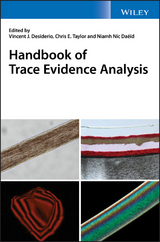
Handbook of Trace Evidence Analysis (eBook)
John Wiley & Sons (Verlag)
978-1-118-96210-7 (ISBN)
Covers new trace evidence techniques and expanding areas of analysis, along with key theory and applications
Developed around the need for updated information in the disciplines of trace evidence the Handbook of Trace Evidence Analysis focuses on the increasing awareness and need for validation, modern methods for addressing and controlling contamination, the shift towards incorporating statistical analyses into the interpretation phase and cutting edge research into new forensic science methods and their application.
Beginning with an overview of the topic and discussing the important role that information derived from trace materials can provide during investigations, the book then presents chapters on key techniques. The first being the critical nature of microscopy, and the methods employed for the recognition, collection, and preservation of trace evidence. Subsequent chapters review the core disciplines of trace evidence examination: paints and polymers, hairs, fibers and textiles and glass. Each chapter contains in-depth discussions on the origin of the materials involved, including any natural or synthetic processes involved in their production, the nuances involved in their detection, and the methods of analysis that are used to extract valuable information from samples. In addition, suggested workflows in method and testing selections, as well as addressing specific scientific challenges as well as the limitations of knowledge on the transfer, persistence and background abundance of trace materials are discussed. The book ends by examining the interpretation of trace evidence findings from a historical perspective and examining the methods that are currently being developed.
- Provides an in-depth introduction to the general area of trace evidence and discusses current and new techniques
- Consolidates trace evidence and materials categories of testing into one reference series
- Offers a detailed focus on technical approaches and guidelines to trace evidence
- Includes analytical schemes/workflows and valuable guides for the interpretation of data and results
The Handbook of Trace Evidence will appeal to forensic science academics, students, and practitioners in the trace evidence and materials science disciplines, as well as DNA analysts, toxicologists, forensic anthropologists, crime laboratory managers, criminal justice students and practitioners, and legal professionals. It would also be a valuable resource for every crime laboratory reference library.
Vincent J. Desiderio is the Hazardous Materials Program Specialist for the United States Postal Inspection Service-Security Group, Washington, D.C.
Chris E. Taylor is a Forensic Chemist at the Defense Forensic Science Center-US Army Criminal Investigation Laboratory in Forest Park, Georgia.
Niamh Nic Daéid, PhD, is Professor of Forensic Science and Director of the Leverhulme Research Centre for Forensic Science, School of Science and Engineering, University of Dundee, Scotland.
Covers new trace evidence techniques and expanding areas of analysis, along with key theory and applications Developed around the need for updated information in the disciplines of trace evidence the Handbook of Trace Evidence Analysis focuses on the increasing awareness and need for validation, modern methods for addressing and controlling contamination, the shift towards incorporating statistical analyses into the interpretation phase and cutting edge research into new forensic science methods and their application. Beginning with an overview of the topic and discussing the important role that information derived from trace materials can provide during investigations, the book then presents chapters on key techniques. The first being the critical nature of microscopy, and the methods employed for the recognition, collection, and preservation of trace evidence. Subsequent chapters review the core disciplines of trace evidence examination: paints and polymers, hairs, fibers and textiles and glass. Each chapter contains in-depth discussions on the origin of the materials involved, including any natural or synthetic processes involved in their production, the nuances involved in their detection, and the methods of analysis that are used to extract valuable information from samples. In addition, suggested workflows in method and testing selections, as well as addressing specific scientific challenges as well as the limitations of knowledge on the transfer, persistence and background abundance of trace materials are discussed. The book ends by examining the interpretation of trace evidence findings from a historical perspective and examining the methods that are currently being developed. Provides an in-depth introduction to the general area of trace evidence and discusses current and new techniques Consolidates trace evidence and materials categories of testing into one reference series Offers a detailed focus on technical approaches and guidelines to trace evidence Includes analytical schemes/workflows and valuable guides for the interpretation of data and results The Handbook of Trace Evidence will appeal to forensic science academics, students, and practitioners in the trace evidence and materials science disciplines, as well as DNA analysts, toxicologists, forensic anthropologists, crime laboratory managers, criminal justice students and practitioners, and legal professionals. It would also be a valuable resource for every crime laboratory reference library.
Vincent J. Desiderio is the Hazardous Materials Program Specialist for the United States Postal Inspection Service-Security Group, Washington, D.C. Chris E. Taylor is a Forensic Chemist at the Defense Forensic Science Center-US Army Criminal Investigation Laboratory in Forest Park, Georgia. Niamh Nic Daéid, PhD, is Professor of Forensic Science and Director of the Leverhulme Research Centre for Forensic Science, School of Science and Engineering, University of Dundee, Scotland.
Cover 1
Title Page 5
Copyright 6
Contents 9
List of Contributors 17
Preface 19
Chapter 1 Trace Evidence Recognition, Collection, and Preservation 21
1.1 Introduction 21
1.2 Theories of Transfer and Persistence 21
1.2.1 Locard's Exchange Principle 21
1.2.2 Primary, Secondary, Tertiary, etc. Transfers 22
1.2.3 Non?contact Transfers 24
1.2.4 Patterns Due to Contact 24
1.2.5 Factors Affecting the Likelihood of a Transfer 25
1.2.6 Factors Affecting Persistence 25
1.3 Proper Evidence Handling Practices 26
1.3.1 Proper Clothing to Wear and Why 27
1.3.2 Other Techniques to Avoid Contamination and Loss 27
1.4 Recognition, Collection, and Preservation of Trace Evidence at the Crime Scene 28
1.4.1 Searching for Relevant Trace Evidence 29
1.4.1.1 Visible Trace Evidence 29
1.4.1.2 Invisible Trace Evidence 29
1.4.2 Documentation 29
1.4.3 Collection 30
1.4.3.1 Collecting the Entire Item Containing Potential Trace Evidence 31
1.4.3.2 Picking with a Gloved Hand or Tweezers 33
1.4.3.3 Collecting Invisible Trace Evidence 34
1.4.3.4 Tape Lifting 34
1.4.3.5 Vacuum Sweeping 35
1.4.3.6 Tape Lifting vs. Vacuum Sweeping: Which Method to Use? 36
1.4.3.7 Other Techniques 36
1.4.4 Taking Known Exemplars and Alibi Samples 37
1.4.5 Collection of Trace Evidence from a Body 38
1.4.6 Preserving Evidence and Maintaining the Chain of Custody 39
Checklist: Crime Scene Procedures 39
Components of a Crime Scene Kit for Trace Evidence Collection 40
1.5 Recognition, Collection, and Preservation of Trace Evidence in the Laboratory 41
1.5.1 Workspace Preparation 41
Checklist: Preparation of Examination Area in the Laboratory 41
1.5.2 Evidence Examination Considerations 42
1.5.3 Initial Examination Considerations 42
A Note Regarding Evidence Handling and Potential DNA Contamination 42
1.5.4 Evidence Description 43
1.5.5 Macroscopic Evidence Examination 43
1.5.6 Stereomicroscopic Examination 43
1.5.7 Additional Documentation 44
1.5.8 The Collection of Trace Evidence from Items in the Laboratory 45
1.5.9 Collection Techniques 45
1.5.9.1 Picking off Observed Trace Evidence 45
1.5.9.2 Shaking/Scraping 46
1.5.9.3 Tape Lifting 47
1.5.9.4 Vacuum Sweeping 47
1.5.9.5 Combinations of the Above Methods 48
1.5.10 Taking Known Exemplar Samples 48
Checklist: Evidence Examination in the Laboratory 48
1.6 Summary 49
Acknowledgments 49
References 49
Further Reading 50
Chapter 2 Polarized Light Microscopy for the Trace Evidence Examiner 52
2.1 Introduction 53
2.2 The Nature of Light 54
2.2.1 Reflection 55
2.2.2 Refraction 56
2.2.3 Dispersion 60
2.2.4 Temperature Coefficient of Refractive Index 61
2.2.5 Absorption of Light 61
2.2.6 Other Interactions Between Light and Matter 61
2.3 Light Microscopy 62
2.3.1 Image Formation in a Compound Light Microscope 62
2.3.2 Numerical Aperture and Resolution 65
2.4 Introduction to Crystallography 75
2.4.1 Symmetry 75
2.4.2 Crystal Point Groups 77
2.4.3 Six Crystal Systems 78
2.4.3.1 Cubic (Isometric) System 78
2.4.3.2 Tetragonal System 80
2.4.3.3 Hexagonal System 80
2.4.3.4 Orthorhombic System 82
2.4.3.5 Monoclinic System 82
2.4.3.6 Triclinic System 83
2.4.4 Crystal Morphology 84
2.4.4.1 Miller Indices 85
2.4.4.2 Crystal Forms and Crystal Habit 87
2.4.4.3 Crystal Morphology Through the Light Microscope 88
2.5 Introduction to Optical Crystallography 89
2.5.1 Optics of Isotropic Substances 89
2.5.2 Optics of Uniaxial Substances 95
2.5.3 Optics of Biaxial Substances 104
2.5.3.1 Optic Axial Plane and Optic Normal 108
2.5.3.2 Acute Bisectrix, Obtuse Bisectrix, Optic Sign, and Optic Axial Angle 110
2.5.3.3 Optical Orientation 111
2.5.3.4 Dispersion in Biaxial Crystals 113
2.6 Measurement of Optical Properties 114
2.6.1 Measurement of Refractive Index Values: Isotropic Substances 115
2.6.1.1 Becke Line Immersion Method 117
2.6.1.2 Single Variation Method 119
2.6.1.3 Emmons Double Variation Method 120
2.6.2 Measurement of Refractive Indices in Uniaxial Substances 120
2.6.3 Measurement of Refractive Index in Biaxial Substances 125
2.6.4 Retardation 127
2.6.5 Birefringence 133
2.6.6 Extinction Characteristics 140
2.6.7 Use of Compensators and Sign of Elongation 149
2.6.8 Conoscopic Observations of Uniaxial Substances 154
2.6.9 Conoscopic Observations on Biaxial Substances 162
2.6.10 Updated Measurement of Refractive Index Values: Uniaxial Substances 170
2.6.11 Updated Measurement of Refractive Index Values: Biaxial Substances 171
2.6.12 The Spindle Stage 171
2.7 Identification of an Unknown Using Optical Properties 172
2.7.1 Applications of Light Microscopy to Trace Evidence 175
References 176
Chapter 3 Paints and Polymers 177
3.1 Introduction to the Paint and Polymer Discipline 177
3.2 Overview of Polymer Chemistry 179
3.2.1 Introduction to Polymers 179
3.2.2 Polymer Synthesis 179
3.3 Overview of Coatings 180
3.3.1 Chemistry and Terminology of Coatings 180
3.3.1.1 Binders 181
3.3.1.2 Pigments 181
3.3.1.3 Additives 183
3.3.1.4 Volatile Components 183
3.3.2 Manufacturing Considerations 183
3.3.3 Application Processes 184
3.3.3.1 Spraying 184
3.3.3.2 Dipping 185
3.3.3.3 Electrodeposition 185
3.3.4 Types of Coatings and End Uses 186
3.3.4.1 Automotive Coatings 186
3.3.4.2 Architectural Coatings 191
3.3.4.3 Vehicular Non?automotive Coatings 193
3.3.4.4 Tool Coatings 194
3.3.4.5 Other/Specialty Coatings 194
3.3.5 Other Polymeric Materials 197
3.3.5.1 Buttons, Hair Beads, Jewelry, and Synthetic Fingernails 197
3.3.5.2 Gasoline Cans 197
3.3.5.3 Plastic Bags 198
3.3.5.4 Gloves 198
3.3.5.5 Automotive Parts and Panels 198
3.3.5.6 Decals 198
3.3.5.7 Paintballs 199
3.3.5.8 Glitter 199
3.3.5.9 Foam 199
3.4 Forensic Examination 200
3.4.1 Recognition, Collection, and Preservation 200
3.4.1.1 Gross Examination 200
3.4.1.2 Visual Recovery and Collection 202
3.4.1.3 Recovery by Scraping 202
3.4.2 Analytical Scheme 204
3.4.2.1 Physical Fit 204
3.4.2.2 Comparison 205
3.4.2.3 Exposing of Layers 206
3.4.2.4 Physical Characteristics to Note 208
3.4.2.5 Further Testing 212
3.5 Paint Databases 219
3.5.1 The Royal Canadian Mounted Police Paint Data Query Database 220
3.6 Interpretation and Report Considerations 226
3.6.0 Disclaimer 230
3.6.0 Additional Reading 230
References 230
Chapter 4 Forensic Hair Microscopy 239
4.1 Introduction 239
4.1.1 History 239
4.2 Chemistry and Histology 241
4.2.1 Basic Chemistry 241
4.2.2 Basic Histology 242
4.2.3 Cuticle 243
4.2.4 Cortex 244
4.2.5 Medulla 245
4.2.6 Cell Membrane Complex 245
4.2.7 Follicle 245
4.3 Physiology 245
4.3.1 Hair Cycle 245
4.3.1.1 Timing 246
4.3.1.2 Shedding 247
4.3.2 Growth Rates 248
4.3.3 Changes with Age 248
4.3.3.1 Hair Color, Graying, and Baldness 249
4.4 Collection and Isolation 250
4.4.1 Questioned Samples 250
4.4.1.1 Techniques 250
4.4.1.2 Other Considerations 252
4.4.2 Known Samples 253
4.5 General Hair 255
4.5.1 Types of Hair 255
4.5.1.1 Human 255
4.5.1.2 Animal 256
4.5.2 Basic Microscopy 257
4.5.2.1 Cuticle 258
4.5.2.2 Cortex 259
4.5.2.3 Medulla 261
4.5.3 Basic Hair Identification 261
4.5.4 Human Versus Animal Hair 262
4.6 Human Hair Examinations 265
4.6.1 Somatic Origin 265
4.6.2 Ancestry 267
4.6.3 Cosmetic Treatment 269
4.6.4 Shaft Abnormalities 272
4.6.5 Hair End Morphology 274
4.6.5.1 Typical Root Morphology 274
4.6.5.2 General Significance 276
4.6.5.3 Suitability for DNA Testing 276
4.6.5.4 Postmortem Changes 277
4.6.5.5 Other Atypical Root Morphologies 279
4.6.5.6 Non?root Morphologies 279
4.6.6 Degradation 282
4.6.6.1 Weathering 282
4.6.6.2 Heat 284
4.6.6.3 Biodeterioration 285
4.6.6.4 Other General Changes 288
4.7 Human Hair Comparisons 288
4.7.1 Comparison Guidelines 289
4.7.1.1 Macroscopic Observations and Stereomicroscopy 289
4.7.1.2 Compound Light Microscopy 289
4.7.1.3 Comparison Microscopy 290
4.7.2 Conclusions and Interpretation 292
4.7.2.1 Association 292
4.7.2.2 Inconclusive 294
4.7.2.3 Exclusion 294
4.8 Transfer and Persistence 295
4.9 Animal Hair 299
4.9.1 Identification 300
4.9.2 Cats and Dogs 303
4.9.3 Textile Fur Fibers 306
4.10 Specialized Techniques 307
4.10.1 Examination of the Cuticular Surface 307
4.10.2 Transverse Cross?sections 309
4.10.3 Longitudinal Cross?sections 311
4.11 Practical Considerations 314
4.11.1 Training 314
4.11.2 Reference Collections 315
4.11.3 Examination Guidelines 316
4.11.4 Documentation, Report Writing, and Testimony 318
4.12 Criticisms 319
4.12.1 Probability 319
4.12.2 FBI Review 320
4.13 Summary: The Value of Forensic Hair Microscopy 321
4.13.0 Dedication 323
References 324
Chapter 5 Fibers 342
5.1 Introduction to Forensic Fiber Analysis 342
5.2 Fiber Overview 343
5.2.1 Textile Production: Fiber – Yarn/Cordage – Fabric 343
5.2.2 Fiber Types 348
5.2.2.1 Natural Fibers 348
5.2.2.2 Manufactured Fibers 352
5.2.3 Fiber/Textile Coloration 358
5.3 Forensic Fiber Examination Background 359
5.3.1 Transfer and Persistence 359
5.3.2 Collection 362
5.3.2.1 Recognition, Collection, and Preservation 362
5.3.2.2 Collection 363
5.3.2.3 Visual Recovery: Picking 363
5.3.2.4 Other Recovery Methods: Taping, Scraping, and Vacuuming 363
5.3.3 Identification 364
5.3.3.1 Natural Fiber Identification 365
5.3.4 Comparison 371
5.4 Microscopical Analysis 372
5.4.1 Stereomicroscopy 373
5.4.2 Brightfield Microscopy 374
5.4.3 Polarized Light Microscopy 374
5.4.4 Fluorescence Microscopy 375
5.4.5 Comparison Microscopy 375
5.4.6 Scanning Electron Microscopy 376
5.5 Instrumental Analysis 376
5.5.1 Microspectrophotmetry: UV?Visible 376
5.5.2 Fourier Transform Infrared Spectroscopy 377
5.5.3 Raman Spectroscopy 378
5.5.4 Other Analytical Techniques (Non?routine) 379
5.5.4.1 Thin?layer Chromatography 379
5.5.4.2 Pyrolysis?Gas Chromatography Mass Spectrometry and Pyrolysis?Mass Spectrometry 381
5.5.4.3 High?Performance Liquid Chromatography 381
5.5.4.4 Melting Point 381
5.6 Microscopic Characteristics to Note in Forensic Fiber Examinations 381
5.7 Optical Properties 381
5.8 Chemistry 382
5.8.1 Solubility Testing 382
5.9 Forensic Examination 383
5.9.1 Analytical Scheme 383
5.9.2 Fabric and Cordage Examinations 383
5.9.2.1 Fabric Damage 383
5.9.2.2 Cordage 388
5.10 Interpretation and Reporting 388
5.10.1 Interpretation 388
5.10.2 Report Writing 389
5.11 Testimony 390
References 390
Chapter 6 Interpretation of Glass Evidence 397
6.1 Introduction to Glass Examination 397
6.1.1 Composition, Manufacture, and Distribution 398
6.1.2 Forensic Examination Protocols 400
6.1.3 Refractive Index 400
6.1.4 Refractive Index Annealing 402
6.1.5 Elemental Analysis of Glass 402
6.1.5.1 SEM?EDS 403
6.1.5.2 Micro?X?Ray Fluorescence 403
6.1.5.3 ICP Methods 403
6.1.5.4 LIBS 405
6.1.6 Comparison of Discrimination Capabilities of the Methods of Analysis 406
6.2 Introduction to the Interpretation of Glass Evidence 407
6.2.1 Formulation of Working Propositions and Case Pre?assessment 408
6.2.2 Evaluation of Results Given Source Level Propositions 410
6.2.3 Evaluation of Results Given Activity Level Propositions 411
6.2.4 A Note on the Use of “Contact” or Pseudo?Activity Level Propositions 411
6.2.5 Evaluation of Results Given Offence Level Propositions 412
6.2.6 Evaluation of Results Given Source Level Propositions 413
6.2.7 The Two?Stage Approach 414
6.2.7.1 Interpretation Based on RI Measurements 414
6.2.7.2 Student's t?Test 417
6.2.7.3 Interpretation Based on Elemental Analysis Measurements 421
6.2.7.4 Match Steps for Elemental Analysis 422
6.2.7.5 Disadvantages of the Two?Stage Approach 424
6.2.8 The Continuous Approach 424
6.2.8.1 Interpretation Based on RI Measurements 425
6.2.8.2 Interpretation Based on Elemental Analysis Measurements 427
6.2.8.3 Evaluation of Results Given Activity Level Propositions 428
6.2.8.4 Example 1: One Group, One Control 429
6.2.9 Assigning Background and Transfer Probabilities 430
6.3 Concluding Remarks 432
References 433
Chapter 7 Interpreting Trace Evidence 441
7.1 What is Evidence Interpretation? 441
7.2 A Process of Uncertainties 442
7.3 Factors Affecting Evidence Interpretation 446
7.3.1 The Context of the Case 446
7.3.2 The Questions Directed to the Forensic Scientist and Hypothesis Formulation 447
7.3.3 Extent of Collected Analytical Information, Reliability, and Validity 449
7.3.4 The Degree of Similarity Between Compared Sets 451
7.4 Some Interpretive Issues: The Example of the Birmingham Six Bombing Case 452
7.4.1 Prosecutor's Fallacy or the Transposed Conditional 453
7.4.2 Inappropriate Level of Propositions 454
7.4.3 Misconception of the 99% 454
7.4.4 Non?consideration of Plausible Defense Arguments 455
7.5 The Bayesian Approach 456
7.6 Implications of Expert Conclusions from Comparative Examinations: An Example with Fiber Evidence 458
7.6.1 Conclusion 1: Factual Reporting 459
7.6.2 Conclusion 2: Consistent with, Cannot Be Excluded, and Reasonable Degree of Certainty 459
7.6.3 Conclusion 3: High Discriminating Procedure 459
7.6.4 Conclusion 4: Rarity Assessment of the Suspected Source 459
7.6.5 Conclusion 5: “Association Key” Verbal Scale 460
7.6.6 Conclusion 6: Likelihood Ratio Verbal Scale 462
7.7 Conclusion 466
Acknowledgments 467
References 467
Index 475
EULA 482
| Erscheint lt. Verlag | 18.8.2020 |
|---|---|
| Sprache | englisch |
| Themenwelt | Naturwissenschaften ► Biologie |
| Naturwissenschaften ► Chemie | |
| Schlagworte | Analysis • Analytische Chemie / Forensik • Biowissenschaften • Chemie • Chemistry • Crime • crime analysis • criminal analysis • criminal investigation • criminal justice • criminal science • detection • Evidence • evidence examination • Forensics • Forensic Science • Forensik • Life Sciences • Materials analysis • Police Work • trace evidence |
| ISBN-10 | 1-118-96210-9 / 1118962109 |
| ISBN-13 | 978-1-118-96210-7 / 9781118962107 |
| Informationen gemäß Produktsicherheitsverordnung (GPSR) | |
| Haben Sie eine Frage zum Produkt? |
 PDF (Adobe DRM)
Kopierschutz: Adobe-DRM
Adobe-DRM ist ein Kopierschutz, der das eBook vor Mißbrauch schützen soll. Dabei wird das eBook bereits beim Download auf Ihre persönliche Adobe-ID autorisiert. Lesen können Sie das eBook dann nur auf den Geräten, welche ebenfalls auf Ihre Adobe-ID registriert sind.
Details zum Adobe-DRM
Dateiformat: PDF (Portable Document Format)
Mit einem festen Seitenlayout eignet sich die PDF besonders für Fachbücher mit Spalten, Tabellen und Abbildungen. Eine PDF kann auf fast allen Geräten angezeigt werden, ist aber für kleine Displays (Smartphone, eReader) nur eingeschränkt geeignet.
Systemvoraussetzungen:
PC/Mac: Mit einem PC oder Mac können Sie dieses eBook lesen. Sie benötigen eine
eReader: Dieses eBook kann mit (fast) allen eBook-Readern gelesen werden. Mit dem amazon-Kindle ist es aber nicht kompatibel.
Smartphone/Tablet: Egal ob Apple oder Android, dieses eBook können Sie lesen. Sie benötigen eine
Geräteliste und zusätzliche Hinweise
Buying eBooks from abroad
For tax law reasons we can sell eBooks just within Germany and Switzerland. Regrettably we cannot fulfill eBook-orders from other countries.
aus dem Bereich