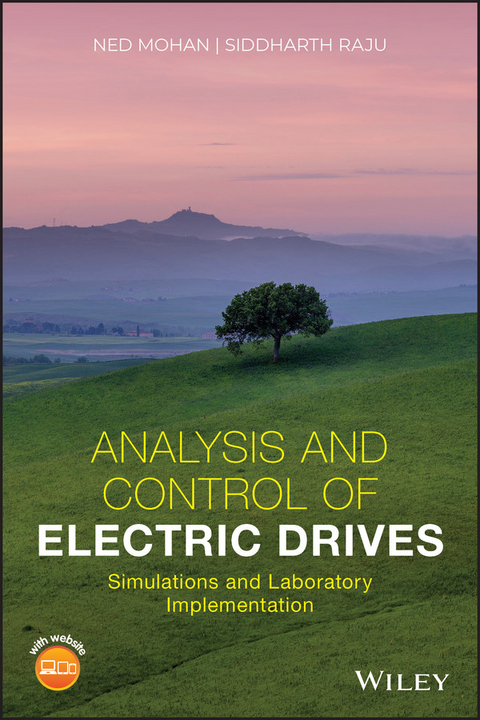
Analysis and Control of Electric Drives (eBook)
John Wiley & Sons (Verlag)
978-1-119-58455-1 (ISBN)
A guide to drives essential to electric vehicles, wind turbines, and other motor-driven systems
Analysis and Control of Electric Drives is a practical and comprehensive text that offers a clear understanding of electric drives and their industrial applications in the real-world including electric vehicles and wind turbines. The authors-noted experts on the topic-review the basic knowledge needed to understand electric drives and include the pertinent material that examines DC and AC machines in steady state using a unique physics-based approach. The book also analyzes electric machine operation under dynamic conditions, assisted by Space Vectors.
The book is filled with illustrative examples and includes information on electric machines with Interior Permanent Magnets. To enhance learning, the book contains end-of-chapter problems and all topics covered use computer simulations with MATLAB Simulink® and Sciamble® Workbench software that is available free online for educational purposes. This important book:
- Explores additional topics such as electric machines with Interior Permanent Magnets
- Includes multiple examples and end-of-chapter homework problems
- Provides simulations made using MATLAB Simulink® and Sciamble® Workbench, free software for educational purposes
- Contains helpful presentation slides and Solutions Manual for Instructors; simulation files are available on the associated website for easy implementation
- A unique feature of this book is that the simulations in Sciamble® Workbench software can seamlessly be used to control experiments in a hardware laboratory
Written for undergraduate and graduate students, Analysis and Control of Electric Drives is an essential guide to understanding electric vehicles, wind turbines, and increased efficiency of motor-driven systems.
NED MOHAN, PHD, is a member of the U.S. National Academy of Engineering, a Regents Professor, Oscar A. Schott Professor of Power Electronic Systems and Morse-Alumni Distinguished Professor at the University of Minnesota.
SIDDHARTH RAJU, PHD, is a Post-Doctoral Researcher at the University of Minnesota.
NED MOHAN, PHD, is a member of the U.S. National Academy of Engineering, a Regents Professor, Oscar A. Schott Professor of Power Electronic Systems and Morse-Alumni Distinguished Professor at the University of Minnesota. SIDDHARTH RAJU, PHD, is a Post-Doctoral Researcher at the University of Minnesota.
Preface xix
Acknowledgment xxi
About the Companion Site xxii
Part I Fundamentals of Electric Drives 1
1 Electric Drives: Introduction and Motivation 3
2 Understanding Mechanical System Requirements for Electric Drives 21
3 Basic Concepts in Magnetics and Electromechanical Energy Conversion 51
4 Basic Understanding of Switch-Mode Power Electronic Converters 95
5 Control in Electric Drives 129
Part II Steady-State Operation of ac Machines 163
6 Using Space Vectors to Analyze ac Machines 165
7 Space Vector Pulse-Width-Modulated (SV-PWM) Inverters 203
8 Sinusoidal Permanent-Magnet ac (PMAC) Drives in Steady State 217
9 Induction Motors in Sinusoidal Steady-State 241
10 Induction-Motor Drives: Speed Control 285
Part III Vector Control of ac Machines 315
11 Induction Machine Equations in Phase Quantities: Assisted by Space Vectors 317
12 Dynamic Analysis of Induction Machines in Terms of dq-Windings 341
13 Mathematical Description of Vector Control in Induction Machines 377
14 Speed-Sensorless Vector Control of Induction Motor 401
14-A Appendix 423
15 Analysis of Doubly Fed Generators (DFIGs) in Steady State and Their Vector Control 427
16 Direct Torque Control (DTC) and Encoder-Less Operation of Induction Motor Drives 453
17 Vector Control of Permanent-Magnet Synchronous Motor Drives 473
18 Reluctance Drives: Stepper-Motors and Switched-Reluctance Drives 501
Index 527
1
Electric Drives: Introduction and Motivation
Electric machines and electric drives are shown by their block diagrams in Fig. 1-1a and b. Electric machines were invented more than 150 years ago and have been in use ever since in increasing numbers in a variety of applications. As shown in Fig. 1-1a, electric machines convert energy from the electrical system to the mechanical system, and vice versa. In their motoring mode, where the machine is called a motor, the electric power Pelect from the electrical system at the certain voltage/current magnitude and frequency get converted to the mechanical power Pmech to the mechanical system at corresponding torque and speed. The opposite is true for a machine in its generator mode, where power from the mechanical system gets converted and is supplied to the electrical system. In machines, as shown in Fig. 1-1a, some of the quantities (voltage/current, torque/speed) are dictated by external sources, and no attempt is made to control the others.
Fig. 1-1 Block diagrams of (a) electric machines and (b) electric drives (motoring mode shown).
However, in certain applications, it is required that for given quantities on the electrical or the mechanical side, the other quantities be controlled, as in a wind turbine. This is made possible in electric drives shown by their block diagram in Fig. 1-1b. It should be noted that in the literature and in trade publications, electric drives sometimes refer only to the power electronic converter and its control, excluding the motor. In this textbook, however, electric drives refer to the entire block, which is shown dotted in Fig. 1-1b, that includes power electronic converter (power processing unit – PPU) and its control, as well as the electric machine, whether it is in its motoring or the generating mode. We should also note that we will be looking at only the ac machines, hence the title of the book is ac drives.
1‐1 THE CLIMATE CRISIS AND THE ENERGY‐SAVING OPPORTUNITIES
The climate crisis, caused by the burning of fossil fuels, is the greatest and an existential threat facing humanity. To reduce the emission of carbon dioxide, a necessary solution is first to convert our energy use to electricity, as much as possible, and then to produce that electricity using renewables such as solar and wind. As we will see in the subsequent sections in this chapter, electric drives play a significant role in generating and efficiently consuming electricity and providing ample opportunity for energy savings.
According to [1], “advances in integrated power electronics have the potential to develop a new generation of energy‐efficient, high‐power density, high‐speed motors and generators and, in turn, save significant energy.” In addition, a great deal of energy savings can be achieved by shifting from nearly constant speed motors to adjustable‐speed electric drives, as explained in this chapter.
Prior to looking at the energy‐saving potentials, we should understand the meaning of primary energy. According to [2], the “Primary Energy is energy in the form that it is first accounted for in a statistical energy balance, before any transformation to secondary or tertiary forms of energy. For example, coal can be converted to synthetic gas, which can be converted to electricity; in this example, coal is primary energy, synthetic gas is secondary energy, and electricity is tertiary energy.” Often, the primary energy and the savings in the primary energy are expressed in quads, where a quad equals 1015 BTUs and 10 000 BTUs equal approximately 2.93 kWh.
1‐2 ENERGY SAVINGS IN GENERATION OF ELECTRICITY
Nearly 99% of electricity is produced through electric machines. This percentage was nearly the same, approximately 98.6%, in the United States in 2018. According to the US Energy Information Administration [3], about 4171 billion kWh (or 4.17 trillion kWh) of electricity was generated at utility‐scale electricity generation facilities in the United States in 2018. About 64% of this electricity generation was from fossil fuels (coal, natural gas, petroleum, and other gases). About 19% was from nuclear energy, and approximately 17% was from renewable energy sources. Out of the renewable energy sources, only 1.4% of the total electricity generated was by photovoltaic systems (PVs) that do not use electric machines, whereas all other sources of electricity generation use electric machines. Therefore, any improvement in increasing the efficiency of machines and electric drives will be very consequential.
1‐2‐1 Energy‐Saving Potential in Harnessing of Wind Energy
One of the significant roles of electric drives is in harnessing wind energy. The block diagram for a wind‐electric system is shown in Fig. 1-2, where the variable‐frequency ac produced by the wind‐turbine‐driven generator is interfaced with the utility system through a power electronic converter (PPU). By letting the turbine speed vary with the wind speed, it is possible to recover a higher amount of energy in the wind compared to systems where the turbine essentially rotates at a constant speed due to the generator output being directly connected to the utility grid. The harnessing of wind energy involving ac drives is crucial for generating carbon‐free electricity [3], and this application is sure to grow rapidly.
Fig. 1-2 Electric drive for wind generators.
1‐3 ENERGY‐SAVING POTENTIAL IN THE END‐USE OF ELECTRICITY
According to [4], the United States consumed approximately 96 quadrillions BTU (quads) of primary energy in 2013 (it was nearly 100 quads in 2018), as shown in Fig. 1-3. Out of the total, 32% was consumed in the industrial sector and 39% in the residential and the commercial sectors combined.
Fig. 1-3 Primary energy consumption by end‐use sector in the United States in 2013.
1‐3‐1 Energy‐Saving Potential in the Process Industry
Traditionally, motors were operated uncontrolled, running at constant speeds, even in applications where efficient control over their speed could be very advantageous. For example, consider the process industry (e.g. oil refineries and chemical factories) where the flow rates of gases and fluids often need to be controlled. As Fig. 1-4a illustrates, in a pump driven at a constant speed, a throttling valve controls the flow rate. Mechanisms such as throttling valves are generally more complicated to implement in automated processes and waste large amounts of energy. In the process industry today, electronically controlled adjustable‐speed drives (ASDs), shown in Fig. 1-4b, control the pump speed to match the flow requirement. Systems with ASDs are much easier to automate and offer much higher energy efficiency and lower maintenance than the traditional systems with throttling valves.
Fig. 1-4 Traditional and ASD‐based flow control systems.
According to [1], the US industrial motor systems of all sizes and in all applications have the potential energy‐saving opportunity, as a percentage of the US end‐use electricity load, from 3.3 to 8.9%.
These improvements are not limited to the process industry. Electric drives for speed and position control are increasingly being used in a variety of manufacturing, heating, ventilating, and air conditioning (HVAC), and transportation systems, as we will see in the subsequent sections.
1‐3‐2 Energy‐Saving Potential in the Residential and Commercial Sectors
Out of the total, the residential and commercial end‐uses represent 39% of the total energy consumed, as depicted in Fig. 1-3. In the residential sector (Fig. 1-5a), the primary energy consumption of electric motor‐driven systems and components is 4.73 quads. In the commercial sector (Fig. 1-5b), it is 4.87 quads. Fig. 1-5a and b provide a breakdown of motor‐driven energy consumption by end‐use for the residential and commercial sectors, respectively. Thus, approximately 10% of the total primary energy consumed can be attributed to electric motor‐driven systems in the residential and commercial sectors.
Fig. 1-5 Energy usage in (a) residential sector and (b) commercial sector.
According to [4], the technical energy‐saving potential achievable through motor upgrades and variable speed technology is estimated to be 536 trillion BTU (0.54 quads) of the primary energy in the residential sector.
In the commercial sector, technical potential due to motor upgrades alone is 0.46 quads of the primary energy, whereas the potential savings resulting from the use of variable‐speed drives alone is 0.53 quads of the primary energy.
Therefore, the primary energy‐saving potential in the residential and the commercial sectors combined is approximately 1.53 quads. This, as a percentage of the total primary energy consumed, is approximately 1.5%. Assuming the efficiency by which the primary energy is converted to electricity to be 35%, the savings of 1.53 quads of the primary energy equals approximately 157 billion kWh of saved electricity. As a percentage of the total electricity...
| Erscheint lt. Verlag | 27.8.2020 |
|---|---|
| Sprache | englisch |
| Themenwelt | Naturwissenschaften ► Physik / Astronomie |
| Technik ► Elektrotechnik / Energietechnik | |
| Schlagworte | AC machines • applications of electric drives • Control Systems Technology • DC machines • Electrical & Electronics Engineering • Electric Vehicles • electric wind turbines • Elektroantrieb • Elektrotechnik u. Elektronik • Energie • Energieeffizienz • Energietechnik • Energy • energy efficiency • equations of electric drives • Guide to electric drives • physics and electric drives • Power Technology & Power Engineering • Regelungstechnik • text on electric drives • understanding electric drives |
| ISBN-10 | 1-119-58455-8 / 1119584558 |
| ISBN-13 | 978-1-119-58455-1 / 9781119584551 |
| Informationen gemäß Produktsicherheitsverordnung (GPSR) | |
| Haben Sie eine Frage zum Produkt? |
 EPUB (Adobe DRM)
Kopierschutz: Adobe-DRM
Adobe-DRM ist ein Kopierschutz, der das eBook vor Mißbrauch schützen soll. Dabei wird das eBook bereits beim Download auf Ihre persönliche Adobe-ID autorisiert. Lesen können Sie das eBook dann nur auf den Geräten, welche ebenfalls auf Ihre Adobe-ID registriert sind.
Details zum Adobe-DRM
Dateiformat: EPUB (Electronic Publication)
EPUB ist ein offener Standard für eBooks und eignet sich besonders zur Darstellung von Belletristik und Sachbüchern. Der Fließtext wird dynamisch an die Display- und Schriftgröße angepasst. Auch für mobile Lesegeräte ist EPUB daher gut geeignet.
Systemvoraussetzungen:
PC/Mac: Mit einem PC oder Mac können Sie dieses eBook lesen. Sie benötigen eine
eReader: Dieses eBook kann mit (fast) allen eBook-Readern gelesen werden. Mit dem amazon-Kindle ist es aber nicht kompatibel.
Smartphone/Tablet: Egal ob Apple oder Android, dieses eBook können Sie lesen. Sie benötigen eine
Geräteliste und zusätzliche Hinweise
Buying eBooks from abroad
For tax law reasons we can sell eBooks just within Germany and Switzerland. Regrettably we cannot fulfill eBook-orders from other countries.
aus dem Bereich