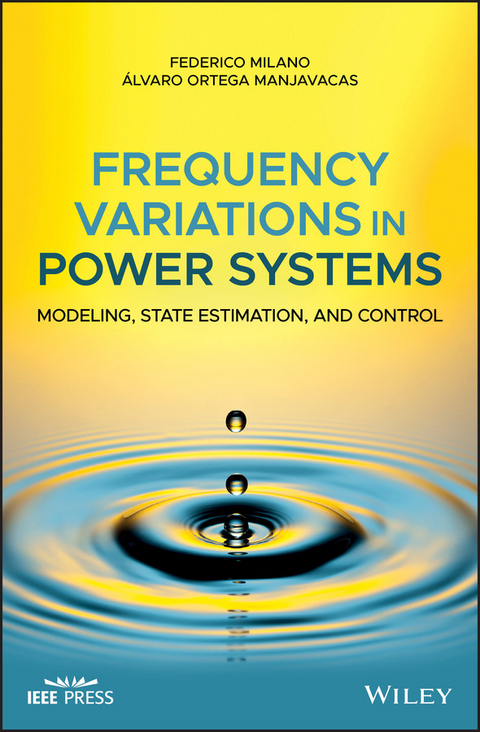
Frequency Variations in Power Systems (eBook)
360 Seiten
John Wiley & Sons (Verlag)
978-1-119-55187-4 (ISBN)
In addition, the authors include a discussion on the applications of the frequency divider in systems where part of the generation is not based on synchronous machines, but rather on converter-interfaced energy resources, such as wind and solar power plants. This important book:
* Offers a review that clearly defines and shows how the Frequency Divider Formula can be applied
* Discusses the link between frequency and energy in power systems
* Presents a unified vision that accurately reveals the common thread that links modelling, control and estimation
* Includes information on the many implications that "local frequency variations" have on power system dynamics and control
* Contains several numerical examples
Written for researchers, academic staff members, students, specialised consultants and professional software developers, Frequency Variations in Power Systems questions the conventional transient stability model of power system and proposes a new formulation.
FEDERICO MILANO is Professor of Power System Protections and Control and Head of Electrical Engineering with the University College Dublin, Ireland. ÁLVARO ORTEGA MANJAVACAS is Senior Power Systems Researcher with the Universidad Loyola Andalucía, Seville, Spain.
List of Figures xiii
List of Tables xix
Preface xxi
Acknowledgments xxvii
Acronyms and Abbreviations xxix
Notation xxxiii
Part I Background 1
1 Frequency in Power Systems 3
1.1 Conventional Definitions 3
1.2 Alternating Current 6
1.3 Reference Frequency 8
1.4 Transforms 13
2 Power System Model 39
2.1 Time Scales 39
2.2 Quasi-Steady-State Model 41
2.3 Differential Algebraic Equations 45
2.4 Conventional Devices 48
3 Dynamic State Estimation 77
3.1 Basic Concepts 77
3.2 Introducing Dynamics 84
3.3 Estimation of Bus Frequencies 89
4 Frequency Control 105
4.1 Introduction 105
4.2 Power Balancing 106
4.3 Power Oscillation Damping 115
4.4 Nonsynchronous Devices 125
Part II Theory 137
5 Frequency Divider Formula 139
5.1 Rationale 139
5.2 Derivation 141
5.3 Equivalent Networks 155
5.4 Inclusion of Measurements 159
5.5 Frequency Participation Factors 163
6 Frequency Makers and Frequency Takers 175
6.1 Introduction 175
6.2 Derivation 176
6.3 Taxonomy 178
6.4 Examples 187
Part III Applications 205
7 Frequency Control 207
7.1 Impact of Frequency Signals 207
7.2 Synthesis of Frequency Signals 216
8 Dynamic State Estimation 227
8.1 Machine Rotor Speeds 227
8.2 Center of Inertia 247
8.3 Applications of the RoCoP 256
9 Power System Model 261
9.1 Introduction 261
9.2 Frequency Dependent Model 262
9.3 Example 265
10 Frequency in Power Systems 269
10.1 Definitions 269
10.2 Final Remarks 269
Appendix A Data 273
A.1 Three-Bus System 273
A.2 WSCC System 273
A.3 IEEE 14-Bus System 278
A.4 New England System 281
Appendix B Irish Transmission System 291
Bibliography 293
Index 313
| Erscheint lt. Verlag | 7.7.2020 |
|---|---|
| Reihe/Serie | Wiley - IEEE | Wiley - IEEE |
| Sprache | englisch |
| Themenwelt | Naturwissenschaften ► Physik / Astronomie |
| Technik ► Elektrotechnik / Energietechnik | |
| Schlagworte | Electrical & Electronics Engineering • electric power systems • Elektrische Energietechnik • Elektrotechnik u. Elektronik • Energie • Energietechnik • Energy • Leistungselektronik • Power Electronics • Power Technology & Power Engineering |
| ISBN-10 | 1-119-55187-0 / 1119551870 |
| ISBN-13 | 978-1-119-55187-4 / 9781119551874 |
| Informationen gemäß Produktsicherheitsverordnung (GPSR) | |
| Haben Sie eine Frage zum Produkt? |
 EPUB (Adobe DRM)
Kopierschutz: Adobe-DRM
Adobe-DRM ist ein Kopierschutz, der das eBook vor Mißbrauch schützen soll. Dabei wird das eBook bereits beim Download auf Ihre persönliche Adobe-ID autorisiert. Lesen können Sie das eBook dann nur auf den Geräten, welche ebenfalls auf Ihre Adobe-ID registriert sind.
Details zum Adobe-DRM
Dateiformat: EPUB (Electronic Publication)
EPUB ist ein offener Standard für eBooks und eignet sich besonders zur Darstellung von Belletristik und Sachbüchern. Der Fließtext wird dynamisch an die Display- und Schriftgröße angepasst. Auch für mobile Lesegeräte ist EPUB daher gut geeignet.
Systemvoraussetzungen:
PC/Mac: Mit einem PC oder Mac können Sie dieses eBook lesen. Sie benötigen eine
eReader: Dieses eBook kann mit (fast) allen eBook-Readern gelesen werden. Mit dem amazon-Kindle ist es aber nicht kompatibel.
Smartphone/Tablet: Egal ob Apple oder Android, dieses eBook können Sie lesen. Sie benötigen eine
Geräteliste und zusätzliche Hinweise
Buying eBooks from abroad
For tax law reasons we can sell eBooks just within Germany and Switzerland. Regrettably we cannot fulfill eBook-orders from other countries.
aus dem Bereich