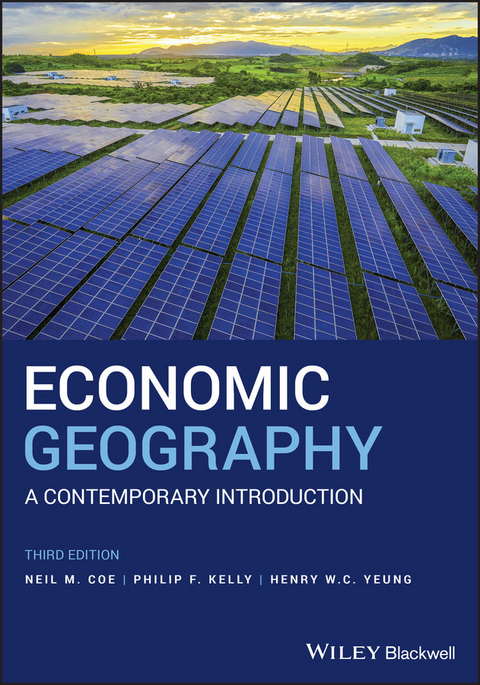
Economic Geography (eBook)
John Wiley & Sons (Verlag)
978-1-119-38958-3 (ISBN)
A revised and updated edition of the leading introductory text on the geography of economic life, from the local to the global
Economic Geography is an engaging and accessible introduction to the different ways modern economic geographers understand, analyze, and interpret economic processes. This comprehensive text addresses significant questions relevant to contemporary economic life, from the activities of transnational corporations to issues surrounding workplaces and consumption. It encourages readers to explore how spatial patterns, places, networks, and territories shape large-scale economic processes. Accessible, highly-illustrated material presents fresh insights from the field-complemented by relatable, real-world examples that help students understand the social, cultural, and political contexts underpinning global economic processes.
Now in its third edition, this extensively revised and updated textbook retains the features and thematic structure that have proved popular with students and instructors alike, while adding exciting new content. New chapters explore how the global economy and global development are institutionalized and governed, the economic geographies of global climate change, economic practices outside the capitalist mainstream, the role of migrants in labour markets, global production networks, and more.
- Introduces economic geography with a thematic approach including major concepts, current debates, and case studies
- Revised and updated to enhance international coverage, including three entirely new chapters on international development, alternative economies, and global climate change
- Substantial new content on labour migration, global production networks, and recent intellectual trends such as evolutionary economic geography
- Highly illustrated with diagrams and photographs closely integrated into the text
- Pedagogical aids including key case studies, learning objectives, text boxes, chapter essay questions, summaries, and further reading
- Core geographical concepts - such as place, networks and territory - are closely integrated into all chapters.
Economic Geography: A Contemporary Introduction is an invaluable source of up-to-date knowledge for students new to the field, for those requiring a solid foundation, as well as for a broader academic and public readership with interest in this area of study.
NEIL M. COE is Professor of Economic Geography at the National University of Singapore
PHILIP F. KELLY is Professor of Geography at York University, Canada
HENRY W.C. YEUNG is Distinguished Professor at the National University of Singapore
NEIL M. COE is Professor of Economic Geography at the National University of Singapore PHILIP F. KELLY is Professor of Geography at York University, Canada HENRY W.C. YEUNG is Distinguished Professor at the National University of Singapore
List of Figures
List of Tables
List of Boxes
Preface
Acknowledgements
Part I: Conceptual Foundations
1. Geography: How do we think spatially?
2. The Economy: What Does it Mean?
3. Dynamics of Capitalism: Why is Economic Growth so Uneven?
4. Networks: How is the World Economy Interconnected?
Part II: Key Economic Actors
5. Transnational corporations: how do they keep it all together?
6. Labour: Are Migrant Workers the New Normal?
7. Consumers - Who Decides What We Buy?
8. Finance: How has Capital Become so Powerful?
Part III: Governing the Economy
9. States: Who runs the Economy?
10. International Institutions: How do they govern and foster global development?
11. Environment: Does Global Climate Change Change Everything?
Part IV: Social and Cultural Dimensions
12. Clusters: Why does Proximity Matter?
13. Identities: Are Economies Gendered and Racialized?
14. Alternatives: Can We Create Diverse Economies?
Part V: Conclusion
15. Economic Geography: Intellectual Journeys and Future Horizons
Index
"This will be an exciting new edition and conceptually right up to date. It will weave together new thinking with essential knowledge of the field in a highly successful way. Students will find the structuring of the chapters around major topics attractive. Economic geography has been undergoing an intellectual transformation as it moves to incorporate new approaches and what is proposed here is very much in line with that. It will be highly suitable as a required text."
Nancy Ettlinger, Ohio State University
"I like the changes proposed for the latest edition. This text blends together a culturally aware analysis of economic geography with a clear sense of what the discipline is about and the international range of case studies is impressive. I have no doubts about the quality of this author team. Individually they are scholars and writers of distinction. Collectively they complement each other and work together extremely well."
Adam Tickell, University of Sussex
LIST OF FIGURES
| 1.1 | Bottled water for sale in a Toronto grocery store |
| 1.2 | Home or office delivery of bottled water in Guangzhou, China |
| 1.3 | Californian drought and water bottling in 2015 |
| 1.4 | US population density and water bottling plants, 2013 |
| 1.5 | The Perrier production facility in the village of Vergèze, France |
| 1.6 | Centre Wellington and Wellington County, in Ontario, Canada |
| 1.7 | Plastic bottles, sorted and compressed into bales and ready for recycling |
| 1.8 | A juvenile albatross sits amid piles of discarded trash that floated ashore |
| 1.9 | Key geographical concepts – uneven patterns, distinctive places, connecting networks, and territorial power |
| 2.1 | The economy as an organic entity |
| 2.2 | The world economy as seen through GDP figures |
| 2.3 | Raworth’s doughnut |
| 2.4 | Irving Fisher’s lecture hall apparatus, simulating the economy, c.1925 |
| 2.5 | The supply and demand curves |
| 2.6 | Many consumers, many sellers (a) in Jodhpur, Rajasthan and (b) online (Alibaba.com being viewed in Hong Kong) |
| 2.7 | The economic iceberg |
| 3.1 | China’s Pearl River Delta region |
| 3.2 | Uneven regional development in China |
| 3.3 | A landscape of contemporary capitalism in China: the Shenzhen skyline |
| 3.4 | Spatial divisions of labour |
| 3.5 | Waves of industrialization in East, Southeast, and South Asia, 1950–present |
| 3.6 | Industrial restructuring during the 1970s in the United States |
| 3.7 | The uneven economic landscape of US cities, by GDP, in 2016 |
| 3.8 | Abandoned residential buildings in Detroit, USA |
| 3.9 | Post‐industrial redevelopment of the Liverpool waterfront |
| 3.10 | Trajectories of regional development |
| 4.1 | Geography is a flavour at Starbucks |
| 4.2 | The basic commodity chain of our breakfast |
| 4.3 | The global map of coffee consumption, 2016 |
| 4.4 | The coffee production network – the changing institutional framework in Tanzania |
| 4.5 | Shipbreaking in Chittagong, Bangladesh |
| 5.1 | HSBC – ‘The world’s local bank’ |
| 5.2 | Apple iPhone 7 – its components and key suppliers |
| 5.3 | Different forms of organizing transnational operations |
| 5.4 | The BMW Group Headquarters tower in Munich, Germany |
| 5.5 | Spatial organization of transnational production units |
| 5.6 | BMW’s global production networks |
| 5.7 | Fast‐food franchise chains in the Caribbean |
| 6.1 | The United Arab Emirates and its major sources of migrant workers |
| 6.2 | UK Independence Party (UKIP) campaign poster from European elections, 2014 |
| 6.3 | Residents and non‐residents in Singapore’s labour force, 1990–2017 |
| 6.4 | Top global migration corridors (in millions) 2013 |
| 6.5 | A Shan migrant worker applies pesticides on a farm near Chiang Mai in Northern Thailand |
| 6.6 | Remittance flows to low‐ and middle‐income countries, compared to other global capital flows |
| 6.7 | Top remittance‐receiving countries, and countries with highest dependence on remittances, 2017 |
| 6.8 | The migration industry in Toronto, Canada |
| 7.1 | The global distribution of Wal‐Mart stores in 2018 |
| 7.2 | Tesco Lotus in Thailand |
| 7.3 | The development of Chicago’s suburban shopping centres, 1949–1974 |
| 7.4 | Britain’s largest shopping centres |
| 7.5 | Cheshire Oaks outlet mall |
| 7.6 | The Marina Bay Sands integrated resort, Singapore |
| 7.7 | Amazon’s growth trajectory |
| 7.8 | Amazon’s operations in Europe, early 2016 |
| 7.9 | Informal retailing |
| 7.10 | Urban and heritage tourism |
| 7.11 | Magical Kenya |
| 8.1 | Global network connectivity of major financial centres |
| 8.2 | The Occupy Wall Street movement in New York City |
| 8.3 | Global finance and the shifting relationship with local mortgage lending |
| 8.4 | The circuit of global financial centres in the Islamic banking and finance system |
| 9.1 | The US–Mexico border |
| 9.2 | China’s Belt and Road Initiative since 2013 |
| 9.3 | The number of independent states, 1816–2017 |
| 9.4 | The future mega city of NEOM, Saudi Arabia |
| 10.1 | Construction work along the road from Kamwenge to Fort Portal in western Uganda |
| 10.2 | The expansion of the European Union since 1957 |
| 10.3 | The United Nations’ 17 Sustainable Developmental Goals for 2030 |
| 10.4 | The AIIB: a new multilateral institution for global development |
| 10.5 | Investment instruments by multilateral development banks, 2014 |
| 11.1 | Map of Kiribati |
| 11.2 | Picture of Tarawa, Kiribati |
| 11.3 | Globally averaged greenhouse gas concentrations, 1800–present |
| 11.4 | Emissions of carbon dioxide by country/region, 2016 (MtCO2) |
| 11.5 | Emissions of carbon dioxide by country/region, 1960–2016 (MtCO2) |
| 11.6 | Observed climate change impacts on biophysical and human systems |
| 11.7 | Map of India showing the Deccan Plateau and Ghats |
| 11.8 | An open pit lithium mine in Australia |
| 11.9 | Automobile‐dependent suburban sprawl in Perth, Australia |
| 12.1 | Venture capitalists on Silicon Valley’s Sand Hill Road |
| 12.2 | Leading technology companies in Silicon Valley |
| 12.3 | Weber’s industrial location theory |
| 12.4 | Industrial districts in Italy |
| 12.5 | Just‐in‐time clustering in Toyota City, Japan |
| 12.6 | Call centres in Manila, the... |
| Erscheint lt. Verlag | 15.10.2019 |
|---|---|
| Sprache | englisch |
| Themenwelt | Naturwissenschaften ► Geowissenschaften ► Geografie / Kartografie |
| Schlagworte | Cultural geography • Economic Development • Economic Geography • Economic Life • Economics • Geographie • Geographie der Globalisierung • Geography • Geography of Globalization • Global Economy • Globalization • International Economics • International Studies • Labour • <p>economic geography • Political Geography • Regional studies • Social Geography • social sciences</p> • urban studies • Volkswirtschaftslehre • wirtschaftliche Entwicklung • Wirtschaftsgeographie |
| ISBN-10 | 1-119-38958-5 / 1119389585 |
| ISBN-13 | 978-1-119-38958-3 / 9781119389583 |
| Informationen gemäß Produktsicherheitsverordnung (GPSR) | |
| Haben Sie eine Frage zum Produkt? |
 EPUB (Adobe DRM)
Kopierschutz: Adobe-DRM
Adobe-DRM ist ein Kopierschutz, der das eBook vor Mißbrauch schützen soll. Dabei wird das eBook bereits beim Download auf Ihre persönliche Adobe-ID autorisiert. Lesen können Sie das eBook dann nur auf den Geräten, welche ebenfalls auf Ihre Adobe-ID registriert sind.
Details zum Adobe-DRM
Dateiformat: EPUB (Electronic Publication)
EPUB ist ein offener Standard für eBooks und eignet sich besonders zur Darstellung von Belletristik und Sachbüchern. Der Fließtext wird dynamisch an die Display- und Schriftgröße angepasst. Auch für mobile Lesegeräte ist EPUB daher gut geeignet.
Systemvoraussetzungen:
PC/Mac: Mit einem PC oder Mac können Sie dieses eBook lesen. Sie benötigen eine
eReader: Dieses eBook kann mit (fast) allen eBook-Readern gelesen werden. Mit dem amazon-Kindle ist es aber nicht kompatibel.
Smartphone/Tablet: Egal ob Apple oder Android, dieses eBook können Sie lesen. Sie benötigen eine
Geräteliste und zusätzliche Hinweise
Buying eBooks from abroad
For tax law reasons we can sell eBooks just within Germany and Switzerland. Regrettably we cannot fulfill eBook-orders from other countries.
aus dem Bereich