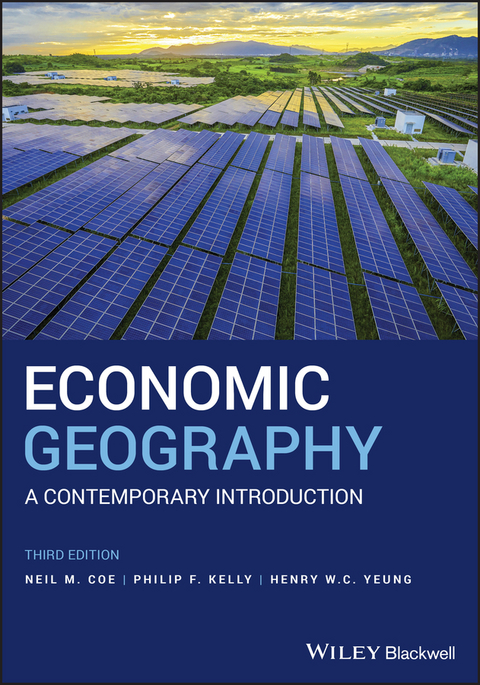
Economic Geography (eBook)
570 Seiten
Wiley-Blackwell (Verlag)
978-1-119-38954-5 (ISBN)

A revised and updated edition of the leading introductory text on the geography of economic life, from the local to the global
Economic Geography is an engaging and accessible introduction to the different ways modern economic geographers understand, analyze, and interpret economic processes. This comprehensive text addresses significant questions relevant to contemporary economic life, from the activities of transnational corporations to issues surrounding workplaces and consumption. It encourages readers to explore how spatial patterns, places, networks, and territories shape large-scale economic processes. Accessible, highly-illustrated material presents fresh insights from the field-complemented by relatable, real-world examples that help students understand the social, cultural, and political contexts underpinning global economic processes.
Now in its third edition, this extensively revised and updated textbook retains the features and thematic structure that have proved popular with students and instructors alike, while adding exciting new content. New chapters explore how the global economy and global development are institutionalized and governed, the economic geographies of global climate change, economic practices outside the capitalist mainstream, the role of migrants in labour markets, global production networks, and more.
- Introduces economic geography with a thematic approach including major concepts, current debates, and case studies
- Revised and updated to enhance international coverage, including three entirely new chapters on international development, alternative economies, and global climate change
- Substantial new content on labour migration, global production networks, and recent intellectual trends such as evolutionary economic geography
- Highly illustrated with diagrams and photographs closely integrated into the text
- Pedagogical aids including key case studies, learning objectives, text boxes, chapter essay questions, summaries, and further reading
- Core geographical concepts - such as place, networks and territory - are closely integrated into all chapters.
Economic Geography: A Contemporary Introduction is an invaluable source of up-to-date knowledge for students new to the field, for those requiring a solid foundation, as well as for a broader academic and public readership with interest in this area of study.
NEIL M. COE is Professor of Economic Geography at the National University of Singapore
PHILIP F. KELLY is Professor of Geography at York University, Canada
HENRY W.C. YEUNG is Distinguished Professor at the National University of Singapore
NEIL M. COE is Professor of Economic Geography at the National University of Singapore PHILIP F. KELLY is Professor of Geography at York University, Canada HENRY W.C. YEUNG is Distinguished Professor at the National University of Singapore
Cover 1
Title Page 5
Copyright Page 6
Contents 7
Detailed Contents 9
List of Figures 13
List of Tables 17
List of Boxes 19
Preface to the Third Edition 21
Acknowledgements 28
Part I Conceptual Foundations 31
Chapter 1 Geography: How do we think spatially? 33
1.1 Introduction: Message in a Bottle 33
1.2 Bottled Water: A Contentious Commodity 37
1.3 Location and Patterns in Space 41
1.4 The Uniqueness of Place 45
1.5 Connecting Across Space Through Networks 50
1.6 Defining and Controlling Space Through Territory 56
1.7 Summary 60
Notes on the references 62
Sample essay questions 62
Resources for further learning 63
References 63
Chapter 2 The Economy: What does it mean? 66
2.1 Introduction 66
2.2 What ‘Counts’ as the Economy? 68
2.3 A Brief History of ‘the Economy’ 74
2.4 Basic Economic Processes 80
2.5 From Economics to Economic Geography 85
2.6 Summary 95
Notes on the references 96
Sample essay questions 96
Further learning resources 97
References 97
Chapter 3 Dynamics of Capitalism: Why is economic growth so uneven? 99
3.1 Introduction 99
3.2 Uneven Development – Naturally! 103
3.3 Fundamentals of the Capitalist System 104
3.4 The Spaces and Scales of Uneven Geographical Development 112
3.5 Can Places and Regions Chart Their Own Futures? 123
3.6 Summary 128
Notes on the references 129
Sample essay questions 129
Resources for further learning 129
References 130
Chapter 4 Networks: How is the world economy interconnected? 132
4.1 Introduction 132
4.2 The Missing Relations Between Producers and Consumers? 135
4.3 Production Networks: Connecting Distant Places and Economies 138
4.4 Bringing Commodities Together: The Logistics Revolution 153
4.5 Where Does a Production Network End? From Waste to Commodities Again 157
4.6 Summary 159
Notes on the references 160
Sample essay questions 161
Resources for further learning 161
References 162
Part II Key Economic Actors 165
Chapter 5 Transnational Corporations: How do they keep it all together? 167
5.1 Introduction 167
5.2 The Myth of Being Everywhere, Effortlessly 169
5.3 The Changing Organization of TNCs 172
5.4 Organizing Transnational Economic Activities 1 – Intra-firm Relationships 176
5.5 Organizing Transnational Economic Activities 2 – Inter-firm Relationships 185
5.6 The Risks of Global Presence 194
5.7 Summary 197
Notes on the references 197
Resources for further learning 198
References 199
Chapter 6 Labour: Are migrant workers the new normal? 201
6.1 Introduction 201
6.2 Are Migrants the Problem? 204
6.3 Territorial Power and Migrant Types 208
6.4 Migrant Labour and Places of Settlement 213
6.5 Migrant Labour and Places of Origin 219
6.6 Organizing Migrant Labour 222
6.7 The Migration Industry 227
6.8 Summary 230
Notes on the references 232
Sample essay questions 232
Resources for further learning 232
References 233
Chapter 7 Consumers: Who decides what we buy? 236
7.1 Introduction 236
7.2 Towards Viewing Consumption as a Sociocultural Process 239
7.3 The Shifting Spatial Patterns of Retailing 243
7.4 Uneven Geographies of Consumption 262
7.5 Consuming Places: Travel and Tourism 268
7.6 Summary 273
Notes on the references 274
Sample essay questions 274
Resources for further learning 274
References 275
Chapter 8 Finance: How has capital become so powerful? 277
8.1 Introduction 277
8.2 How is the Real Economy Financed? 281
8.3 Deregulation and the Rise of Global Finance 283
8.4 Putting Global Finance in Its Place 287
8.5 Financialization: Circulating Global Capital 293
8.6 A Different Kind of Finance? 303
8.7 Summary 306
Notes on the references 307
Sample essay questions 308
Resources for further learning 308
References 308
Part III Governing the Economy 311
Chapter 9 States: Who runs the economy? 313
9.1 Introduction 313
9.2 Neo-liberal Globalization and the End of the State? 316
9.3 The State as the Architect of the National Economy 319
9.4 Varieties of Capitalisms and States 331
9.5 Graduated Sovereignty and the State 339
9.6 Summary 339
Notes on the references 340
Sample essay questions 341
Resources for further learning 341
References 342
Chapter 10 International Institutions: How do they govern and foster global development? 344
10.1 Introduction 344
10.2 A Market Mechanism for the ‘Global South’? 347
10.3 Governing the Global Economy 349
10.4 Fostering Development in the Global South 361
10.5 Bottom-Up? The Rise of Community-Based Development 369
10.6 Summary 370
Notes on the references 371
Sample essay questions 372
Resources for further learning 372
References 372
Chapter 11 Environment: Does global climate change change everything? 375
11.1 Introduction 375
11.2 Climate Complacency 378
11.3 Causes and Sources of Climate Change 381
11.4 The Impacts and Costs of Climate Change 386
11.5 Regulating Emissions 390
11.6 Geographies of the Green Economy 398
11.7 Should this Change Everything? 403
11.8 Summary 405
Notes on references 407
Sample essay questions 407
Resources for further learning 407
References 408
Part IV Social and Cultural Dimensions 411
Chapter 12 Clusters: Why does proximity matter? 413
12.1 Introduction 413
12.2 Industrial Location Theory 417
12.3 Towards a Typology of Clusters? 420
12.4 Binding Clusters Together: Agglomeration Economies 428
12.5 Untraded Interdependencies and Regional Cultures of Production 432
12.6 A Dynamic Approach to Clusters 439
12.7 Can Clusters Be Temporary? 442
12.8 Summary 445
Notes on the references 446
Sample essay questions 446
Resources for further learning 447
References 447
Chapter 13 Identities: Are economies gendered and racialized? 450
13.1 Introduction 450
13.2 Seeing Gender and Race in the Economy 452
13.3 Uneven Geographies of Gender and Work 455
13.4 Gender, Race, and the Labour Market 462
13.5 Identity and the Workplace 463
13.6 Ethnic Clusters and Networks 467
13.7 Intersecting Identities 476
13.8 Summary 478
Notes on the references 478
Sample essay questions 479
Resources for further learning 479
References 480
Chapter 14 Alternatives: Can we create diverse economies? 483
14.1 Introduction 483
14.2 Beyond a ‘Capitalocentric’ View of the Economy 486
14.3 Alternative Markets 491
14.4 Alternative Enterprises 495
14.5 Alternative Working 503
14.6 Alternative Property 507
14.7 The Limits to Diverse Economies? 511
14.8 Summary 515
Notes on the references 515
Sample essay questions 516
Resources for further learning 516
References 517
Part V Conclusion 519
Chapter 15 Economic Geography: Intellectual journeys and future horizons 521
15.1 Introduction 521
15.2 A Changing Field 523
15.3 A Changing World 535
15.4 Summary 540
Notes on the references 541
Sample essay questions 542
Resources for further learning 542
References 542
Index 545
EULA 570
"This will be an exciting new edition and conceptually right up to date. It will weave together new thinking with essential knowledge of the field in a highly successful way. Students will find the structuring of the chapters around major topics attractive. Economic geography has been undergoing an intellectual transformation as it moves to incorporate new approaches and what is proposed here is very much in line with that. It will be highly suitable as a required text."
Nancy Ettlinger, Ohio State University
"I like the changes proposed for the latest edition. This text blends together a culturally aware analysis of economic geography with a clear sense of what the discipline is about and the international range of case studies is impressive. I have no doubts about the quality of this author team. Individually they are scholars and writers of distinction. Collectively they complement each other and work together extremely well."
Adam Tickell, University of Sussex
| Erscheint lt. Verlag | 23.10.2019 |
|---|---|
| Sprache | englisch |
| Themenwelt | Naturwissenschaften ► Geowissenschaften ► Geografie / Kartografie |
| Schlagworte | Cultural geography • Economic Development • Economic Geography • Economic Life • Economics • Geographie • Geographie der Globalisierung • Geography • Geography of Globalization • Global Economy • Globalization • International Economics • International Studies • Labour • <p>economic geography • Political Geography • Regional studies • Social Geography • social sciences</p> • urban studies • Volkswirtschaftslehre • wirtschaftliche Entwicklung • Wirtschaftsgeographie |
| ISBN-10 | 1-119-38954-2 / 1119389542 |
| ISBN-13 | 978-1-119-38954-5 / 9781119389545 |
| Informationen gemäß Produktsicherheitsverordnung (GPSR) | |
| Haben Sie eine Frage zum Produkt? |
 PDF (Adobe DRM)
Kopierschutz: Adobe-DRM
Adobe-DRM ist ein Kopierschutz, der das eBook vor Mißbrauch schützen soll. Dabei wird das eBook bereits beim Download auf Ihre persönliche Adobe-ID autorisiert. Lesen können Sie das eBook dann nur auf den Geräten, welche ebenfalls auf Ihre Adobe-ID registriert sind.
Details zum Adobe-DRM
Dateiformat: PDF (Portable Document Format)
Mit einem festen Seitenlayout eignet sich die PDF besonders für Fachbücher mit Spalten, Tabellen und Abbildungen. Eine PDF kann auf fast allen Geräten angezeigt werden, ist aber für kleine Displays (Smartphone, eReader) nur eingeschränkt geeignet.
Systemvoraussetzungen:
PC/Mac: Mit einem PC oder Mac können Sie dieses eBook lesen. Sie benötigen eine
eReader: Dieses eBook kann mit (fast) allen eBook-Readern gelesen werden. Mit dem amazon-Kindle ist es aber nicht kompatibel.
Smartphone/Tablet: Egal ob Apple oder Android, dieses eBook können Sie lesen. Sie benötigen eine
Geräteliste und zusätzliche Hinweise
Buying eBooks from abroad
For tax law reasons we can sell eBooks just within Germany and Switzerland. Regrettably we cannot fulfill eBook-orders from other countries.
aus dem Bereich