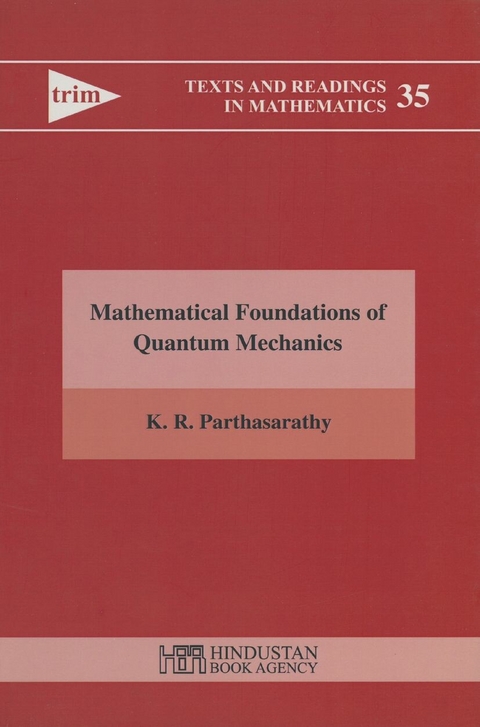
Mathematical Foundation of Quantum Mechanics (eBook)
178 Seiten
Hindustan Book Agency (Verlag)
978-93-86279-28-6 (ISBN)
This is a brief introduction to the mathematical foundations of quantum mechanics based on lectures given by the author to Ph.D.students at the Delhi Centre of the Indian Statistical Institute in order to initiate active research in the emerging field of quantum probability. The material in the first chapter is included in the author's book "e;An Introduction to Quantum Stochastic Calculus"e; published by Birkhauser Verlag in 1992 and the permission of the publishers to reprint it here is acknowledged. Apart from quantum probability, an understanding of the role of group representations in the development of quantum mechanics is always a fascinating theme for mathematicians. The first chapter deals with the definitions of states, observables and automorphisms of a quantum system through Gleason's theorem, Hahn-Hellinger theorem and Wigner's theorem. Mackey's imprimitivity theorem and the theorem of inducing representations of groups in stages are proved directly for projective unitary antiunitary representations in the second chapter. Based on a discussion of multipliers on locally compact groups in the third chapter all the well-known observables of classical quantum theory like linear momenta, orbital and spin angular momenta, kinetic and potential energies, gauge operators etc., are derived solely from Galilean covariance in the last chapter. A very short account of observables concerning a relativistic free particle is included. In conclusion, the spectral theory of Schrodinger operators of one and two electron atoms is discussed in some detail.
| Erscheint lt. Verlag | 15.10.2005 |
|---|---|
| Sprache | englisch |
| Themenwelt | Mathematik / Informatik ► Mathematik |
| Naturwissenschaften ► Physik / Astronomie ► Quantenphysik | |
| ISBN-10 | 93-86279-28-2 / 9386279282 |
| ISBN-13 | 978-93-86279-28-6 / 9789386279286 |
| Informationen gemäß Produktsicherheitsverordnung (GPSR) | |
| Haben Sie eine Frage zum Produkt? |
 PDF (Wasserzeichen)
Größe: 14,1 MB
DRM: Digitales Wasserzeichen
Dieses eBook enthält ein digitales Wasserzeichen und ist damit für Sie personalisiert. Bei einer missbräuchlichen Weitergabe des eBooks an Dritte ist eine Rückverfolgung an die Quelle möglich.
Dateiformat: PDF (Portable Document Format)
Mit einem festen Seitenlayout eignet sich die PDF besonders für Fachbücher mit Spalten, Tabellen und Abbildungen. Eine PDF kann auf fast allen Geräten angezeigt werden, ist aber für kleine Displays (Smartphone, eReader) nur eingeschränkt geeignet.
Systemvoraussetzungen:
PC/Mac: Mit einem PC oder Mac können Sie dieses eBook lesen. Sie benötigen dafür einen PDF-Viewer - z.B. den Adobe Reader oder Adobe Digital Editions.
eReader: Dieses eBook kann mit (fast) allen eBook-Readern gelesen werden. Mit dem amazon-Kindle ist es aber nicht kompatibel.
Smartphone/Tablet: Egal ob Apple oder Android, dieses eBook können Sie lesen. Sie benötigen dafür einen PDF-Viewer - z.B. die kostenlose Adobe Digital Editions-App.
Buying eBooks from abroad
For tax law reasons we can sell eBooks just within Germany and Switzerland. Regrettably we cannot fulfill eBook-orders from other countries.
aus dem Bereich