Sustainable Environmental Engineering (eBook)
John Wiley & Sons (Verlag)
978-1-119-08563-8 (ISBN)
The important resource that explores the twelve design principles of sustainable environmental engineering
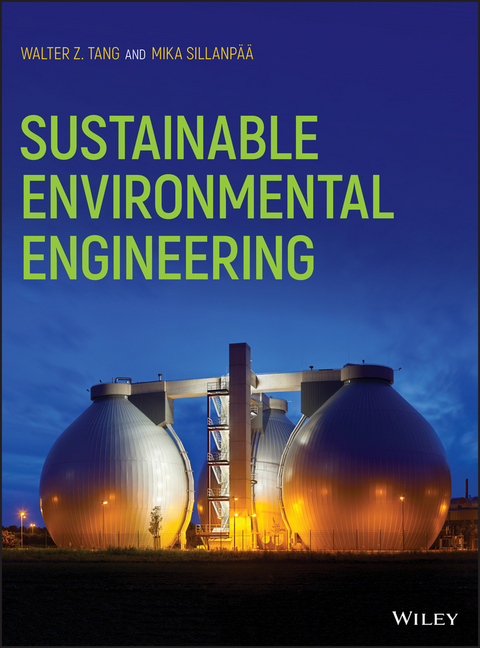
Sustainable Environmental Engineering (SEE) is to research, design, and build Environmental Engineering Infrastructure System (EEIS) in harmony with nature using life cycle cost analysis and benefit analysis and life cycle assessment and to protect human health and environments at minimal cost. The foundations of the SEE are the twelve design principles (TDPs) with three specific rules for each principle. The TDPs attempt to transform how environmental engineering could be taught by prioritizing six design hierarchies through six different dimensions. Six design hierarchies are prevention, recovery, separation, treatment, remediation, and optimization. Six dimensions are integrated system, material economy, reliability on spatial scale, resiliency on temporal scale, and cost effectiveness. In addition, the authors, two experts in the field, introduce major computer packages that are useful to solve real environmental engineering design problems.
The text presents how specific environmental engineering issues could be identified and prioritized under climate change through quantification of air, water, and soil quality indexes. For water pollution control, eight innovative technologies which are critical in the paradigm shift from the conventional environmental engineering design to water resource recovery facility (WRRF) are examined in detail. These new processes include UV disinfection, membrane separation technologies, Anammox, membrane biological reactor, struvite precipitation, Fenton process, photocatalytic oxidation of organic pollutants, as well as green infrastructure. Computer tools are provided to facilitate life cycle cost and benefit analysis of WRRF. This important resource:
• Includes statistical analysis of engineering design parameters using Statistical Package for the Social Sciences (SPSS)
• Presents Monte Carlos simulation using Crystal ball to quantify uncertainty and sensitivity of design parameters
• Contains design methods of new energy, materials, processes, products, and system to achieve energy positive WRRF that are illustrated with Matlab
• Provides information on life cycle costs in terms of capital and operation for different processes using MatLab
Written for senior or graduates in environmental or chemical engineering, Sustainable Environmental Engineering defines and illustrates the TDPs of SEE. Undergraduate, graduate, and engineers should find the computer codes are useful in their EEIS design. The exercise at the end of each chapter encourages students to identify EEI engineering problems in their own city and find creative solutions by applying the TDPs. For more information, please visit www.tang.fiu.edu.
WALTER Z. TANG, Ph.D., P.E., is an Associate Professor of Environmental Engineering in the Department of Civil and Environmental Engineering, College of Engineering and Computing at Florida International University, Miami, FL, USA.
MIKA SILLANPÄÄ, Ph.D., is a Professor in the Department of Green Chemistry, School of Engineering Science at the Lappeenranta University of Technology, Lappeenranta, Finland.
The important resource that explores the twelve design principles of sustainable environmental engineering Sustainable Environmental Engineering (SEE) is to research, design, and build Environmental Engineering Infrastructure System (EEIS) in harmony with nature using life cycle cost analysis and benefit analysis and life cycle assessment and to protect human health and environments at minimal cost. The foundations of the SEE are the twelve design principles (TDPs) with three specific rules for each principle. The TDPs attempt to transform how environmental engineering could be taught by prioritizing six design hierarchies through six different dimensions. Six design hierarchies are prevention, recovery, separation, treatment, remediation, and optimization. Six dimensions are integrated system, material economy, reliability on spatial scale, resiliency on temporal scale, and cost effectiveness. In addition, the authors, two experts in the field, introduce major computer packages that are useful to solve real environmental engineering design problems. The text presents how specific environmental engineering issues could be identified and prioritized under climate change through quantification of air, water, and soil quality indexes. For water pollution control, eight innovative technologies which are critical in the paradigm shift from the conventional environmental engineering design to water resource recovery facility (WRRF) are examined in detail. These new processes include UV disinfection, membrane separation technologies, Anammox, membrane biological reactor, struvite precipitation, Fenton process, photocatalytic oxidation of organic pollutants, as well as green infrastructure. Computer tools are provided to facilitate life cycle cost and benefit analysis of WRRF. This important resource: Includes statistical analysis of engineering design parameters using Statistical Package for the Social Sciences (SPSS) Presents Monte Carlos simulation using Crystal ball to quantify uncertainty and sensitivity of design parameters Contains design methods of new energy, materials, processes, products, and system to achieve energy positive WRRF that are illustrated with Matlab Provides information on life cycle costs in terms of capital and operation for different processes using MatLab Written for senior or graduates in environmental or chemical engineering, Sustainable Environmental Engineering defines and illustrates the TDPs of SEE. Undergraduate, graduate, and engineers should find the computer codes are useful in their EEIS design. The exercise at the end of each chapter encourages students to identify EEI engineering problems in their own city and find creative solutions by applying the TDPs. For more information, please visit www.tang.fiu.edu.
WALTER Z. TANG, Ph.D., P.E., is an Associate Professor of Environmental Engineering in the Department of Civil and Environmental Engineering, College of Engineering and Computing at Florida International University, Miami, FL, USA. MIKA SILLANPÄÄ, Ph.D., is a Professor in the Department of Green Chemistry, School of Engineering Science at the Lappeenranta University of Technology, Lappeenranta, Finland.
| Erscheint lt. Verlag | 1.8.2018 |
|---|---|
| Sprache | englisch |
| Themenwelt | Naturwissenschaften ► Chemie ► Technische Chemie |
| Technik ► Bauwesen | |
| Technik ► Umwelttechnik / Biotechnologie | |
| Schlagworte | analyze from six different dimensions of engineering design • and efficiency of renewable materials and energy</p> • Bauingenieur- u. Bauwesen • chemical engineering • Chemie • Chemische Verfahrenstechnik • Chemistry • Civil Engineering & Construction • Constructed wetlands • engineering systems for sewer collection • engineering systems for wastewater treatment plant • engineering systems for water distribution • engineering systems for water treatment plant • Environmental Engineering • establish the twelve design principles • green infrastructure rain harvest green • integrated and interconnected alternatives • <p>Define Sustainable Environmental Engineering • minimize environmental damages • minimize impacts of human social and economic activities on the natural environments • Nachhaltige u. Grüne Chemie • prioritize six different design hierarchies • provide MatLab codes for cost and analysis of different scale of WRRFs • quantify benchmarks of energy efficiency of water resource recovery facility (WRRF) • reliable on spatial scales • resilient on temporal scales • resource, research, develop, design, build, operate and maintain sustainable environmental engineering infrastructure • Sustainable Chemistry & Green Chemistry • Umwelttechnik |
| ISBN-10 | 1-119-08563-2 / 1119085632 |
| ISBN-13 | 978-1-119-08563-8 / 9781119085638 |
| Informationen gemäß Produktsicherheitsverordnung (GPSR) | |
| Haben Sie eine Frage zum Produkt? |
 PDF (Adobe DRM)
Kopierschutz: Adobe-DRM
Adobe-DRM ist ein Kopierschutz, der das eBook vor Mißbrauch schützen soll. Dabei wird das eBook bereits beim Download auf Ihre persönliche Adobe-ID autorisiert. Lesen können Sie das eBook dann nur auf den Geräten, welche ebenfalls auf Ihre Adobe-ID registriert sind.
Details zum Adobe-DRM
Dateiformat: PDF (Portable Document Format)
Mit einem festen Seitenlayout eignet sich die PDF besonders für Fachbücher mit Spalten, Tabellen und Abbildungen. Eine PDF kann auf fast allen Geräten angezeigt werden, ist aber für kleine Displays (Smartphone, eReader) nur eingeschränkt geeignet.
Systemvoraussetzungen:
PC/Mac: Mit einem PC oder Mac können Sie dieses eBook lesen. Sie benötigen eine
eReader: Dieses eBook kann mit (fast) allen eBook-Readern gelesen werden. Mit dem amazon-Kindle ist es aber nicht kompatibel.
Smartphone/Tablet: Egal ob Apple oder Android, dieses eBook können Sie lesen. Sie benötigen eine
Geräteliste und zusätzliche Hinweise
Buying eBooks from abroad
For tax law reasons we can sell eBooks just within Germany and Switzerland. Regrettably we cannot fulfill eBook-orders from other countries.
aus dem Bereich