Sustainable Environmental Engineering (eBook)
John Wiley & Sons (Verlag)
978-1-119-08558-4 (ISBN)
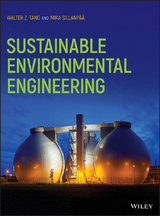
The important resource that explores the twelve design principles of sustainable environmental engineering
Sustainable Environmental Engineering (SEE) is to research, design, and build Environmental Engineering Infrastructure System (EEIS) in harmony with nature using life cycle cost analysis and benefit analysis and life cycle assessment and to protect human health and environments at minimal cost. The foundations of the SEE are the twelve design principles (TDPs) with three specific rules for each principle. The TDPs attempt to transform how environmental engineering could be taught by prioritizing six design hierarchies through six different dimensions. Six design hierarchies are prevention, recovery, separation, treatment, remediation, and optimization. Six dimensions are integrated system, material economy, reliability on spatial scale, resiliency on temporal scale, and cost effectiveness. In addition, the authors, two experts in the field, introduce major computer packages that are useful to solve real environmental engineering design problems.
The text presents how specific environmental engineering issues could be identified and prioritized under climate change through quantification of air, water, and soil quality indexes. For water pollution control, eight innovative technologies which are critical in the paradigm shift from the conventional environmental engineering design to water resource recovery facility (WRRF) are examined in detail. These new processes include UV disinfection, membrane separation technologies, Anammox, membrane biological reactor, struvite precipitation, Fenton process, photocatalytic oxidation of organic pollutants, as well as green infrastructure. Computer tools are provided to facilitate life cycle cost and benefit analysis of WRRF. This important resource:
• Includes statistical analysis of engineering design parameters using Statistical Package for the Social Sciences (SPSS)
• Presents Monte Carlos simulation using Crystal ball to quantify uncertainty and sensitivity of design parameters
• Contains design methods of new energy, materials, processes, products, and system to achieve energy positive WRRF that are illustrated with Matlab
• Provides information on life cycle costs in terms of capital and operation for different processes using MatLab
Written for senior or graduates in environmental or chemical engineering, Sustainable Environmental Engineering defines and illustrates the TDPs of SEE. Undergraduate, graduate, and engineers should find the computer codes are useful in their EEIS design. The exercise at the end of each chapter encourages students to identify EEI engineering problems in their own city and find creative solutions by applying the TDPs. For more information, please visit www.tang.fiu.edu.
WALTER Z. TANG, Ph.D., P.E., is an Associate Professor of Environmental Engineering in the Department of Civil and Environmental Engineering, College of Engineering and Computing at Florida International University, Miami, FL, USA.
MIKA SILLANPÄÄ, Ph.D., is a Professor in the Department of Green Chemistry, School of Engineering Science at the Lappeenranta University of Technology, Lappeenranta, Finland.
WALTER Z. TANG, Ph.D., P.E., is an Associate Professor of Environmental Engineering in the Department of Civil and Environmental Engineering, College of Engineering and Computing at Florida International University, Miami, FL, USA. MIKA SILLANPÄÄ, Ph.D., is a Professor in the Department of Green Chemistry, School of Engineering Science at the Lappeenranta University of Technology, Lappeenranta, Finland.
Preface
Sustainable Environmental Engineering (SEE) is to research, develop, design, build, operate, and maintain environmental engineering infrastructure systems (EEIS) that are economically feasible to reduce human health risk and minimize environmental damages so that man and the nature can coexist in harmony. EEIS include engineering systems of water distribution, sewer collection, water treatment plant (WTP) and wastewater treatment plant (WWTP), stormwater management gray infrastructure, and green infrastructure (GI). Twelve design principles (TDPs) have been developed to guide a designer to minimize footprint (FP) of human social and economic activities on the natural environments such as air, water, soil, and biosphere. FP on materials, energy, and water is typically quantified by life cycle assessment (LCA). In designing EEIS, a designer should apply the following TDPs: (i) integrated and interconnected alternatives, (ii) reliability on spatial scale, (iii) resiliency on temporal scales, (iv) economy of renewable materials, (v) efficiency of renewable energy, (vi) prevention strategies, (vii) recovery of materials and energy, (viii) early separation, (ix) effective treatment, (x) green retrofitting and remediation, (xi) optimization through modeling and simulation, and (xii) minimal life cycle costs and maximal benefits. The TDPs equip SEE designers with the knowledge and tools by quantifying uncertainty and sensitivity of the FP of EEIS alternatives. They provide a systematic and integrated approach to optimize the short‐term capital investments and long‐term operation cost while reducing the long‐term detrimental impacts on human and environments. It is hoped that the TDPs will guide the next generation of sustainable environmental engineers to think critically in developing innovative and sustainable alternatives of EEIS.
In the past, EEIS were not designed according to the TDPs. For example, traditional processes such as activated sludge (AS) severely violate the TDPs. In an AS process, biodegradable organic pollutants are oxidized with excessive amount of sludge produced as solid waste. The sludge has to been either dewatered mechanically or anaerobically digested. However, aeration is energy‐intensive process and consumes about one‐half energy of a WWTP, and sludge disposal consists about one‐third of WWTP operation cost. In fact, AS violates several TDPs because (i) organic pollutants in wastewater have their intrinsic energy content and should be utilized as energy resource and (ii) sludge incorporates free water into fixed cellular water, which is extremely energy intensive to be separated from the biosolids. Therefore, it should be avoided according to the fifth principle of prevention. One of retrofitting WWTP strategies is to divert biodegradable organic carbon to anaerobic digester to directly produce methane according to the seventh principle of recovery. Indeed, other tradition processes such as aluminum coagulation, lime neutralization, chlorination, and combined treatment of leachate with wastewater do not stand the test of the TDPs. After intensive research, development, and practice all over the world in the past decade, WWTP could have been retrofitted or designed as an energy‐positive recovery center (WRRF) to recover water, energy, nutrients, and materials. For example, WWTP treating 10 million gallon wastewater per day for population equivalency of 250 000 at Strass im Zillertal, Innsbruck, in Austria became energy positive after a decade‐long retrofitting effort in 2005. However, very few of 15 500 WWTPs in the United States and 4 800 WWTPs in China are currently energy neutral. The market sizes of retrofitting these WWTPs in the United States and China are estimated at 300 and 200 billion US dollars, respectively. In next three decades, paradigm will shift to design WWTPs as WRRFs at which water, energy, nutrients, and materials would be recovered to its maximal extent. It could be expected that a WRRF become energy production and material recovery center or even as a revenue generation asset rather than significant financial burden for a water utility. To successfully design WRRF, eight major design topics are covered to accelerate the paradigm shift toward new industrial trends in next decades. For example, Anammox and membrane biological reactor (MBR) are illustrated as the critical technology in designing energy‐positive WWTP. Advanced oxidation processes (AOPs) are important to replace separation processes. UV disinfection is presented as critical technology to achieve the US EPA second‐stage disinfectant/disinfection by‐product rules. Membrane filtration technologies such as microfiltration, nanofiltration, and reversed osmosis are key technologies in reclaiming water. To facilitate design of WRRF by using these technologies, Matlab codes for estimating capital and O&M costs of these technologies are presented for treatment, reclaiming, or recovery systems. As a result, life cycle cost and benefit of the design alternatives could be conducted.
Human has freely harnessed air, water, and food from the Earth and energy from the Sun in the past million years. In the modern society, however, the infrastructure to deliver water and electricity is expensive due to fit‐for‐all design philosophy in the past. Some of the flaws have not been challenged in the past hundred years since the first WWTP with AS was built. To meet these challenges and capture unique opportunities, these design flaws have to be corrected. The book starts with renewable resource and human FP in Chapter 1. Common environmental engineering (EE) issues such as air, water, and soil pollution under climate change are explained. Environmental quality indexes of air, water, and soil are defined and illustrated. Human FP and environmental laws are organized from the perspective of LCA. Chapter 2 shows how Crystal Ball could be applied to quantify the uncertainty and sensitivity during human health risk assessment using Monte Carlo simulation. Health risk of disinfection by‐products (DBPs) in drinking water is used as an example. Chapter 3 defines and establishes the TDP SEE to guide the designers of EEIS. The topics covered include green chemistry, green engineering, regenerative design of WWTPs, life cycle cost and benefit analysis, and decision principles and metrics. New design challenges of SEE are explained under the context of the United Nations 17 Sustainable Development Goals (SDGs) with market size analysis of the United States and China. From Chapters 4 to 15, each design principle and the associated computer tools are explained. Chapter 4 lays the foundation of planet, people, and profit as the ultimate SEE design goals. Integrated management and best management practice (BMP) of EEIS are defined. The design hierarchy is ranked in the order of prevention, reduction, reuse, recycle, treatment, recovery, disposal, and remediation. Chapter 5 explores reliability of an EEIS on spatial scales such as residential house, community, and city. It shows how SEE design principles could be applied at different spatial scales and how laboratory and pilot data should be accurately extrapolated to full‐scale treatment plants. Since UV disinfection is expected to replace chlorination in both WTP and WWTP, virus sensitivity index (VSI) and bacteria sensitivity index (BSI) are developed to estimate the UV fluence required by any given virus or bacteria from laboratory data through statistical analysis by SPSS. Chapter 6 focuses on resiliency on temporal scales. It demonstrates that population growth is the key element as unsteady flow and how to design an equalization tank to reduce the unsteady effect. Also, chemical kinetics and catalysts are discussed in detail to reduce reaction time. Chapter 7 emphasizes the economy of material using modern reactor design theory. Matlab codes are presented to compare the hydraulic characters of batch, continuous stirred tank reactor (CSTR), and plug‐flow reactor (PFR). Chapter 8 demonstrates how to balance the embodied energy vs. the energy required for operation and maintenance. The energy auditing of WWTP for retrofitting purpose is illustrated. Six design hierarchies are presented sequentially from Chapters 9 to 14. To demonstrate the effectiveness of prevention, Chapter 9 explains why prevention is the number one priority in SEE design. For example, GI holds the key to prevent nonpoint source pollution, while rain harvest may be the most effective way to prevent contamination due to stormwater runoff and to save precious tap water from irrigation. Other GI such as green roof, bioswale, rain garden, septic tanks, and constructed wetlands are equally important in designing smart cities or communities. Chapter 10 provides unit cost and benefit analysis tools for water reclaiming systems because water is the major product of the highest market price to be recovered with huge demand in terms of irrigation, reuse, or recharge of underground aquifer. Chapter 11 critically examines precipitation as an unsustainable design because it requires large amount of chemicals, such as bases or acids. Even worse, it incorporates free water, which should have been the product, into sludge as the secondary waste. To avoid adding chemicals, a better design may be ion exchange. Ultra‐, micro‐, and nano‐membrane filtrations are illustrated as an industrial trend to replace traditional tank processes such as coagulation, flocculation, and precipitation. Chapter 12 focuses on engineering design of AOP such as UV disinfection because it is expected that more and more UV disinfection will replace...
| Erscheint lt. Verlag | 1.8.2018 |
|---|---|
| Sprache | englisch |
| Themenwelt | Naturwissenschaften ► Chemie ► Technische Chemie |
| Technik ► Bauwesen | |
| Technik ► Umwelttechnik / Biotechnologie | |
| Schlagworte | analyze from six different dimensions of engineering design • and efficiency of renewable materials and energy</p> • Bauingenieur- u. Bauwesen • chemical engineering • Chemie • Chemische Verfahrenstechnik • Chemistry • Civil Engineering & Construction • Constructed wetlands • engineering systems for sewer collection • engineering systems for wastewater treatment plant • engineering systems for water distribution • engineering systems for water treatment plant • Environmental Engineering • establish the twelve design principles • green infrastructure rain harvest green • integrated and interconnected alternatives • <p>Define Sustainable Environmental Engineering • minimize environmental damages • minimize impacts of human social and economic activities on the natural environments • Nachhaltige u. Grüne Chemie • prioritize six different design hierarchies • provide MatLab codes for cost and analysis of different scale of WRRFs • quantify benchmarks of energy efficiency of water resource recovery facility (WRRF) • reliable on spatial scales • resilient on temporal scales • resource, research, develop, design, build, operate and maintain sustainable environmental engineering infrastructure • Sustainable Chemistry & Green Chemistry • Umwelttechnik |
| ISBN-10 | 1-119-08558-6 / 1119085586 |
| ISBN-13 | 978-1-119-08558-4 / 9781119085584 |
| Informationen gemäß Produktsicherheitsverordnung (GPSR) | |
| Haben Sie eine Frage zum Produkt? |
 EPUB (Adobe DRM)
Kopierschutz: Adobe-DRM
Adobe-DRM ist ein Kopierschutz, der das eBook vor Mißbrauch schützen soll. Dabei wird das eBook bereits beim Download auf Ihre persönliche Adobe-ID autorisiert. Lesen können Sie das eBook dann nur auf den Geräten, welche ebenfalls auf Ihre Adobe-ID registriert sind.
Details zum Adobe-DRM
Dateiformat: EPUB (Electronic Publication)
EPUB ist ein offener Standard für eBooks und eignet sich besonders zur Darstellung von Belletristik und Sachbüchern. Der Fließtext wird dynamisch an die Display- und Schriftgröße angepasst. Auch für mobile Lesegeräte ist EPUB daher gut geeignet.
Systemvoraussetzungen:
PC/Mac: Mit einem PC oder Mac können Sie dieses eBook lesen. Sie benötigen eine
eReader: Dieses eBook kann mit (fast) allen eBook-Readern gelesen werden. Mit dem amazon-Kindle ist es aber nicht kompatibel.
Smartphone/Tablet: Egal ob Apple oder Android, dieses eBook können Sie lesen. Sie benötigen eine
Geräteliste und zusätzliche Hinweise
Buying eBooks from abroad
For tax law reasons we can sell eBooks just within Germany and Switzerland. Regrettably we cannot fulfill eBook-orders from other countries.
aus dem Bereich