


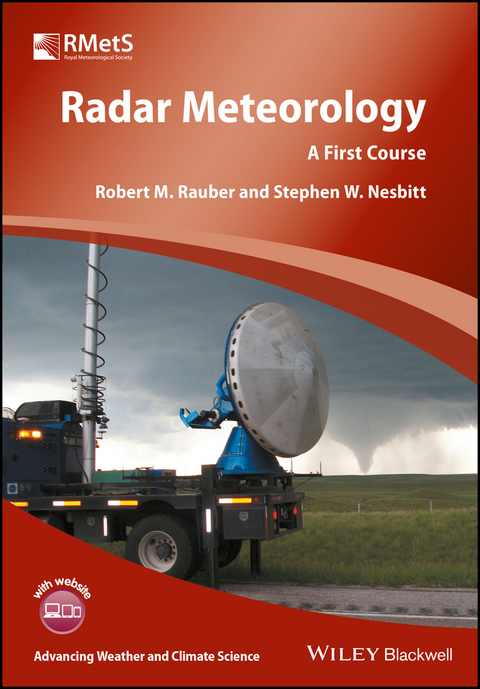
Radar Meteorology (eBook)
John Wiley & Sons (Verlag)
978-1-118-43265-5 (ISBN)
A comprehensive introduction to the current technology and application of radar in meteorology and atmospheric sciences
Written by leading experts in the field, Radar Meteorology, A first Course offers an introduction to meteorological radar systems and applications, with emphasis on observation and interpretation of physical processes in clouds and weather systems. This comprehensive introduction to the subject offers an overview of the quantities essential to radar meteorology including the radar reflectivity factor, and Doppler, dual-polarization, and multi-wavelength radar variables. The authors highlight wind retrieval from single and multiple Doppler radars, precipitation estimation and hydrometeorological applications, with chapters dedicated to interpretation of radar data from warm season mid-latitude severe weather, winter storms, tropical cyclones and more.
In addition, Radar Meteorology highlights research applications of this burgeoning technology, exploring dynamic applications such as space-borne and ground-based vertically pointing radar systems, and cloud, airborne and mobile radars. As meteorological radars are increasingly used professionally for weather observation, forecasting and warning, this much-needed text:
• Presents an introduction to the technical aspects and current application of radar as used in the meteorology and atmospheric sciences
• Contains full-colour illustrations that enhance the understanding of the material presented
• Examines the wide-range of meteorological applications of radar
• Includes problems at the end of each chapter as a helpful review of the contents
• Provides full instructor support with all illustrations and answers to problems available via the book's instructor website.
Radar Meteorology offers a much-needed introductory text to the study of radar as applied to meteorology. The text was designed for a one semester course based on the authors' own course in Radar Meteorology at the University of Illinois at Urbana-Champaign.
Robert M. Rauber, Professor of Atmospheric Sciences, University of Illinois, Urbana-Champaign, US.
Stephen W. Nesbitt, Professor of Atmospheric Sciences, University of Illinois, Urbana-Champaign, US.
Robert M. Rauber, Professor of Atmospheric Sciences, University of Illinois, Urbana-Champaign, USA. Stephen W. Nesbitt, Professor of Atmospheric Sciences, University of Illinois, Urbana-Champaign, USA.
Cover 1
Title Page 7
Copyright 8
Contents 11
Preface 19
Acknowledgments 23
About the Companion Website 25
Chapter 1 Properties of Electromagnetic Waves 27
1.1 Introduction 27
1.2 Electric and magnetic fields 28
1.2.1 The electric field 28
1.2.2 The magnetic field 30
1.2.3 Relating the electric and magnetic fields—a simple dipole antenna 31
1.2.4 Maxwell equations 32
1.3 The nature of electromagnetic radiation 34
1.3.1 The electromagnetic spectrum 34
1.3.2 Electromagnetic wave interactions 35
1.4 Interactions of electromagnetic waves with matter 37
1.4.1 Refraction 38
1.4.2 Reflection 38
1.4.3 Mie scattering 40
1.4.4 Bragg scattering 43
1.4.5 Absorption 44
1.5 Polarization of electromagnetic waves 44
Important terms 46
Review questions 47
Challenge problems 48
Chapter 2 Radar Hardware 49
2.1 Introduction 49
2.2 Frequency and wavelength 49
2.3 Components of a weather radar system 51
2.3.1 Transmitter section 52
2.3.2 Waveguides, rotary joints, polarization switching devices, and circulators 54
2.3.3 The antenna section 58
2.3.4 The receiver section 62
2.3.5 Magnetron transmitters 64
2.4 Specialized radar systems 66
2.4.1 Phased?array radars 66
2.4.2 Mobile and deployable radars 67
2.4.3 Airborne radars 69
2.4.4 Spaceborne radars 70
Important terms 72
Review questions 73
Challenge problems 73
Chapter 3 Radar Characteristics 75
3.1 Introduction 75
3.2 Range and range ambiguity 76
3.3 The transmitted and received signal 79
3.3.1 Pulse duration and pulse length 80
3.3.2 Power and the duty cycle 80
3.4 Radar geometry and types of displays 82
3.4.1 Common radar displays in spherical coordinates 82
Important terms 90
Review questions 90
Challenge problems 91
Chapter 4 The Path of a Radar Ray 92
4.1 Introduction 92
4.2 Ray propagation in an idealized atmosphere 93
4.2.1 Factors influencing radar ray paths 93
4.2.2 The path of a ray in an idealized atmosphere 95
4.2.3 The range and height of a pulse volume in space 98
4.3 Anomalous propagation 100
Important terms 104
Review questions 105
Challenge problems 106
chapter 5 Power and the Radar Reflectivity Factor 108
5.1 Introduction 108
5.2 Radar equation for a solitary target 109
5.2.1 Power flux density incident on a target 109
5.2.2 Power flux density scattered back to the radar 111
5.2.3 Backscattered power collected by the radar antenna 112
5.2.4 Implications of the radar equation 113
5.3 Radar equation for a distributed target 115
5.3.1 The contributing volume for distributed targets 115
5.3.2 The radar cross section of distributed targets 117
5.3.3 The radar equation for a distributed target 120
5.4 The weather radar equation 121
5.4.1 Radar cross section of a small dielectric sphere 121
5.4.2 The radar reflectivity factor 122
5.4.3 The weather radar equation 123
5.4.4 The validity of the Rayleigh approximation 124
5.5 Summary 126
Important terms 127
Review questions 127
Challenge problems 128
Chapter 6 Radial Velocity—The Doppler Effect 130
6.1 Introduction 130
6.2 Measurement of radial velocity 132
6.2.1 Phase measurements and radial velocity retrieval 133
6.2.2 Velocity ambiguities and their resolution 134
6.3 Doppler spectra 141
6.3.1 Doppler spectra of weather and other targets 142
6.3.2 Moments of the Doppler spectrum 143
6.4 Measurement of the Doppler moments 145
6.5 Summary 148
Important terms 149
Review questions 149
Challenge problems 150
Chapter 7 Dual?Polarization Radar 152
7.1 Introduction 152
7.2 The physical bases for radar polarimetry 153
7.3 Measuring polarimetric quantities 156
7.4 Reflectivity, differential reflectivity, and linear depolarization ratio 158
7.4.1 Reflectivity factor in the dual?polarization framework (ZHH and ZVV) 158
7.4.2 Differential reflectivity (ZDR) 159
7.4.3 Raindrop shapes and sizes 160
7.4.4 ZDR measurements in rain 164
7.4.5 ZDR measurements in ice and mixed?phase precipitation 167
7.4.6 Linear depolarization ratio (LDR) 171
7.5 Polarization and phase 175
7.5.1 Propagation differential phase shift (?DP) 176
7.5.2 Backscatter differential phase shift (?}) 178
7.5.3 Specific differential phase (KDP) 178
7.5.4 Retrieval of KDP 181
7.5.5 Co?polar correlation coefficient (?HV) 190
7.5.6 Using polarimetric variables together 194
7.5.7 Covariation of the polarimetric variables: an example at S? and C?band 194
7.5.8 Using dual?polarization variables to discern meteorological versus non?meteorological echo and non?uniform beam filling 196
7.5.9 Hydrometeor classification 198
Important terms 202
Review questions 207
Challenge problems 207
Chapter 8 Clear Air Echoes 209
8.1 Introduction 209
8.2 Ground clutter 210
8.2.1 Ground clutter characteristics 210
8.2.2 Sea clutter 211
8.2.3 Effects of anomalous propagation 214
8.2.4 Ground clutter mitigation 214
8.3 Echoes from biological sources 217
8.3.1 Insect echo 218
8.3.2 Birds and bats 219
8.4 Debris, dust, and smoke 221
8.5 Aircraft echoes and chaff 222
8.6 Other non?meteorological echo sources 224
8.6.1 The sun 225
8.6.2 Receiver noise 225
8.6.3 Radio interference 226
8.7 Bragg scattering 226
Important terms 229
Review questions 229
Challenge problems 230
Chapter 9 Propagation Effects: Attenuation and Refractivity 231
9.1 Introduction 231
9.2 Attenuation 232
9.2.1 Attenuation by atmospheric gases and measurement of water vapor 233
9.2.2 Attenuation by cloud droplets and measurement of liquid water content 238
9.2.3 Attenuation by rain and its correction 240
9.2.4 Attenuation by hail 245
9.2.5 Short?wavelength radars and attenuation 250
9.3 Refractivity 251
9.3.1 Basic principles 252
9.3.2 Measurement of the water vapor field 253
Important terms 255
Review questions 255
Challenge problems 256
Chapter 10 Operational Radar Networks 258
10.1 Introduction 258
10.2 The WSR?88D radar network 259
10.2.1 Network coverage 259
10.2.2 Radar characteristics and data distribution 260
10.2.3 Scanning strategies 262
10.2.4 Ground clutter suppression 266
10.2.5 Super resolution 266
10.2.6 Additional features 268
10.3 Terminal Doppler weather radars 268
10.3.1 Radar characteristics and data distribution 269
10.4 International operational radar networks 272
Important terms 274
Review questions 275
Challenge problems 275
Chapter 11 Doppler Velocity Patterns and Single?Radar Wind Retrieval 277
11.1 Introduction 277
11.2 Kinematic properties of the wind field 278
11.3 Doppler radial velocity patterns and the wind field 280
11.3.1 Large?scale flow patterns 281
11.3.2 Fronts 283
11.3.3 Convective scale flow patterns 285
11.4 Wind retrieval with profiling radars 287
11.4.1 Wind profilers 287
11.5 Velocity–azimuth display wind retrieval 290
11.5.1 VAD technique 290
11.5.2 Extended VAD analysis 298
Important terms 301
Chapter 12 Multiple Doppler Wind Retrieval 305
12.1 Introduction 305
12.2 Network design and deployment 305
12.2.1 Meteorological considerations 307
12.2.2 Sampling limitations 307
12.2.3 Siting and logistics 309
12.3 Characteristics of single Doppler data 310
12.3.1 Geographic location of a range gate 310
12.3.2 Characteristics of raw data 310
12.3.3 Ambiguities and Doppler radar data editing 313
12.4 Procedures for multiple Doppler syntheses 316
12.4.1 Interpolation of data from spherical to Cartesian coordinates 316
12.4.2 Transformation of radial velocities to orthogonal particle motion components 318
12.4.3 Calculation of vertical motion from orthogonal wind components 328
12.4.4 Uncertainty in vertical motion retrievals 330
12.5 Summary 332
Important terms 332
Review questions 333
Challenge problems 334
Chapter 13 Precipitation Estimation with Radar 336
13.1 Introduction 336
13.2 Measurement of precipitation rate, total precipitation, and particle size distributions 337
13.2.1 Precipitation gauges 337
13.2.2 Disdrometers 339
13.2.3 Optical array probes 341
13.3 Nature of particle size distributions 342
13.3.1 The exponential size distribution 344
13.3.2 The gamma size distribution 345
13.4 Radar remote sensing of precipitation 345
13.4.1 Determining Z–R relationships 348
13.4.2 Challenges in precipitation estimation with radar 349
13.5 Precipitation estimation using dual polarization 352
13.6 Winter precipitation 355
13.7 Measuring precipitation from space 356
13.7.1 Tropical Rainfall Measuring Mission 358
13.7.2 Global Precipitation Mission 358
Important terms 360
Review questions 360
Challenge problems 362
Chapter 14 Warm Season Convection 365
14.1 Introduction 365
14.2 Mesoscale convective systems 366
14.2.1 Radar?observed life cycle of an MCS 366
14.2.2 Conceptual model of an MCS as observed with a research radar 368
14.2.3 Radar signatures of hazardous weather in MCSs 370
14.2.4 Frontal squall lines 372
14.3 Supercell thunderstorms 376
14.3.1 Tornado detection 379
14.3.2 Radar signatures of supercells 381
14.3.3 Hail detection 383
14.4 Downbursts and wind shear 385
Important terms 385
Review questions 386
Challenge problems 386
Chapter 15 Extratropical Cyclones 388
15.1 Introduction 388
15.2 Radar approaches to monitor cyclone mesostructure 390
15.3 Mesoscale structures observable with radar 393
15.3.1 The comma?cloud tail 394
15.3.2 The comma?cloud head 398
Important terms 408
Review questions 408
Challenge problems 409
Chapter 16 Tropical Cyclones 410
16.1 Introduction 410
16.2 Airborne and satellite radar systems for tropical cyclone research and operations 413
16.2.1 NOAA WP?3D radar systems 413
16.2.2 Other airborne radars used in hurricane research 415
16.2.3 Satellite radars used in hurricane research 416
16.3 Tropical cyclone structure and kinematics 417
16.3.1 Eyewall and eye radar structure 422
16.3.2 Radar structure of principal band 426
16.3.3 Other bands within the hurricane vortex 431
16.4 Operational use of radar to detect tropical cyclone hazards 432
16.4.1 High winds and storm surge 432
16.4.2 Heavy precipitation and flooding 434
16.4.3 Tornadoes 436
Important terms 438
Review questions 438
Challenge problems 439
Chapter 17 Clouds and Vertical Motions 440
17.1 Introduction 440
17.2 Cloud radars 441
17.2.1 Advantages and disadvantages of cloud radars 442
17.2.2 Examples of data from cloud radars 444
17.3 Application of cloud radars 448
17.3.1 Determining vertical motions in clouds 448
17.3.2 Determining statistical cloud properties 451
17.3.3 Understanding atmospheric and storm structure 455
17.3.4 Understanding global cloud properties 459
Important terms 459
Review questions 460
Challenge problems 461
Appendix A List of Variables (and Chapters) 463
Appendix B Derivation of the Exact Equation for a Ray Path through a Spherically Stratified Atmosphere 469
Index 471
EULA 490
| Erscheint lt. Verlag | 5.4.2018 |
|---|---|
| Reihe/Serie | Advancing Weather and Climate Science |
| Advancing Weather and Climate Science | Advancing Weather and Climate Science |
| Sprache | englisch |
| Themenwelt | Naturwissenschaften ► Geowissenschaften ► Meteorologie / Klimatologie |
| Technik | |
| Schlagworte | Attenuation • Clear air Echoes • Clouds and Vertical Motions • Doppler Velocity Patterns • Dual Polarization Radar • earth sciences • Extratropical Cyclones • future of radar meteorology • Geowissenschaften • Guide to radar meteorology • history of radar meteorology • Meteorologie • meteorology • Multiple Doppler wind Retrieval • Operational Radar Networks • Path of a radar ray • Power and the Radar Reflectivity Factor • Precipitation Estimation With Radar • Propagation Effects • Properties of Electromagnetic Waves • Radar Characteristics • Radarmeteorologie • Radial Velocity • radio detection and ranging • reference to radar meteorology • Refractivity • research on radar meteorology • Single Radar Wind Retrieval • study of radar and meteorology • The Doppler Effect • Tropical Cyclones • understanding radar and meteorology • Warm Season Convection |
| ISBN-10 | 1-118-43265-7 / 1118432657 |
| ISBN-13 | 978-1-118-43265-5 / 9781118432655 |
| Informationen gemäß Produktsicherheitsverordnung (GPSR) | |
| Haben Sie eine Frage zum Produkt? |
 PDF (Adobe DRM)
Kopierschutz: Adobe-DRM
Adobe-DRM ist ein Kopierschutz, der das eBook vor Mißbrauch schützen soll. Dabei wird das eBook bereits beim Download auf Ihre persönliche Adobe-ID autorisiert. Lesen können Sie das eBook dann nur auf den Geräten, welche ebenfalls auf Ihre Adobe-ID registriert sind.
Details zum Adobe-DRM
Dateiformat: PDF (Portable Document Format)
Mit einem festen Seitenlayout eignet sich die PDF besonders für Fachbücher mit Spalten, Tabellen und Abbildungen. Eine PDF kann auf fast allen Geräten angezeigt werden, ist aber für kleine Displays (Smartphone, eReader) nur eingeschränkt geeignet.
Systemvoraussetzungen:
PC/Mac: Mit einem PC oder Mac können Sie dieses eBook lesen. Sie benötigen eine
eReader: Dieses eBook kann mit (fast) allen eBook-Readern gelesen werden. Mit dem amazon-Kindle ist es aber nicht kompatibel.
Smartphone/Tablet: Egal ob Apple oder Android, dieses eBook können Sie lesen. Sie benötigen eine
Geräteliste und zusätzliche Hinweise
Buying eBooks from abroad
For tax law reasons we can sell eBooks just within Germany and Switzerland. Regrettably we cannot fulfill eBook-orders from other countries.
aus dem Bereich


