


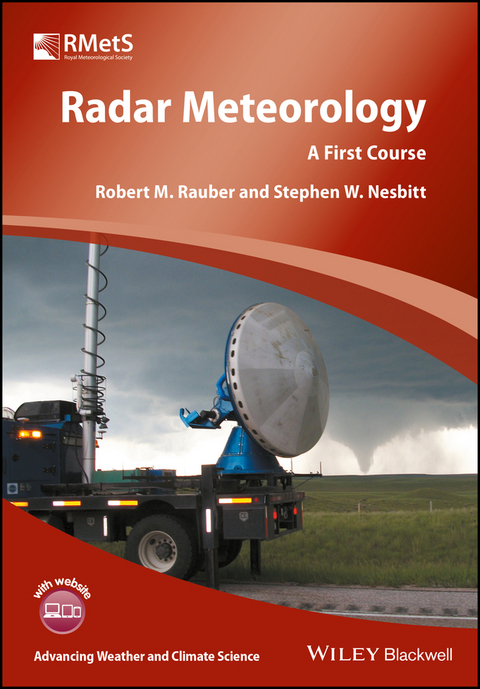
Radar Meteorology (eBook)
John Wiley & Sons (Verlag)
978-1-118-43263-1 (ISBN)
A comprehensive introduction to the current technology and application of radar in meteorology and atmospheric sciences
Written by leading experts in the field, Radar Meteorology, A first Course offers an introduction to meteorological radar systems and applications, with emphasis on observation and interpretation of physical processes in clouds and weather systems. This comprehensive introduction to the subject offers an overview of the quantities essential to radar meteorology including the radar reflectivity factor, and Doppler, dual-polarization, and multi-wavelength radar variables. The authors highlight wind retrieval from single and multiple Doppler radars, precipitation estimation and hydrometeorological applications, with chapters dedicated to interpretation of radar data from warm season mid-latitude severe weather, winter storms, tropical cyclones and more.
In addition, Radar Meteorology highlights research applications of this burgeoning technology, exploring dynamic applications such as space-borne and ground-based vertically pointing radar systems, and cloud, airborne and mobile radars. As meteorological radars are increasingly used professionally for weather observation, forecasting and warning, this much-needed text:
• Presents an introduction to the technical aspects and current application of radar as used in the meteorology and atmospheric sciences
• Contains full-colour illustrations that enhance the understanding of the material presented
• Examines the wide-range of meteorological applications of radar
• Includes problems at the end of each chapter as a helpful review of the contents
• Provides full instructor support with all illustrations and answers to problems available via the book's instructor website.
Radar Meteorology offers a much-needed introductory text to the study of radar as applied to meteorology. The text was designed for a one semester course based on the authors' own course in Radar Meteorology at the University of Illinois at Urbana-Champaign.
Robert M. Rauber, Professor of Atmospheric Sciences, University of Illinois, Urbana-Champaign, US.
Stephen W. Nesbitt, Professor of Atmospheric Sciences, University of Illinois, Urbana-Champaign, US.
Robert M. Rauber, Professor of Atmospheric Sciences, University of Illinois, Urbana-Champaign, USA. Stephen W. Nesbitt, Professor of Atmospheric Sciences, University of Illinois, Urbana-Champaign, USA.
Chapter 1
Properties of Electromagnetic Waves
Objectives
By the end of this chapter, you should understand the following:
- The basic nature of electric and magnetic fields and how these fields are related through Maxwell's equations;
- Electromagnetic waves consist of oscillating electric and magnetic fields propagating at the speed of light;
- The electromagnetic spectrum, and why radars use the microwave frequency part of the spectrum;
- Why the degree of absorption of electromagnetic waves by a medium such as air, water, or ice depends on the wave frequency;
- That electromagnetic radiation can be characterized as waves or as particles called photons;
- How radiation interacts with matter through processes of refraction, reflection, scattering, and absorption and how each of these relate to radar meteorology;
- What is meant by polarization of an electromagnetic wave.
1.1 Introduction
A radar transmits electromagnetic radiation, normally microwaves, and measures the properties of the radiation scattered back to its antenna by objects in the path of its beam. Radar meteorologists face an enormous challenge because a radar, at best, measures only six pieces of information: the amplitude, phase, and polarization state of the returned electromagnetic energy, the time the radiation took to travel to and from the objects, and the azimuth and elevation of the radar antenna at the time the radiation was transmitted. From this scant data, they must deduce meteorologically relevant information such as the location of precipitation, rainfall rate, precipitation type and wind speed, and from this information quickly report to the public the location of a flash flood, hail, or a tornado. How they accomplish that is the subject of this book. To understand how radars work and, more importantly, how the energy radars transmit and receive can be used to determine atmospheric properties, we must first develop a basic understanding of electromagnetic energy.
1.2 Electric and magnetic fields
As you sit reading this book, you are surrounded by electric and magnetic fields. The light entering your eyes as you stare at this page reaches your retina as propagating electromagnetic waves. Cell phone transmissions, the energy heating food in your microwave, medical X-rays, and sunlight are all forms of electromagnetic energy—electric and magnetic fields oscillating in time and space.
1.2.1 The electric field
To help understand electric fields, let us start by imagining two infinite, parallel horizontal plates separated by 1 m (Figure 1.1). Assume for the moment that a perfect vacuum exists between the plates and an excess positive charge density of 10−12 C m−2 exists on one of the plates (i.e., there are fewer electrons per square meter on the positively charged plate, where a coulomb is a unit of electric charge). An electric field exists in the presence of a charged body, so an electric field exists between the plates. The electric field intensity (), a vector quantity, has a magnitude and a direction. The magnitude of is proportional to the force acting on a unit positive charge at a point in the field. The direction of is the direction in which that force acts. The electric field intensity is measured in units of volts per meter, or even more fundamentally in J C−1 m−1. By convention, the electric field is directed away from positive and toward negative charges, so the electric field vector at any point between the plates in our experimental apparatus points from the positive to the negative plate.
Figure 1.1 The electric field (black arrows) and lines of constant voltage (green lines) between two infinite, parallel, oppositely-charged plates
We often represent by drawing lines of force, or “flux lines,” represented by a vector, , called the electric displacement vector. This term “displacement” comes about because there is a slight displacement of charges (atomic nuclei and electrons) that occur in a medium exposed to an electric field. The vector is related to by the equation:
where ϵ0 is called the permittivity of free space, χ is the susceptibility of the medium, and ϵr is the relative permittivity. The permittivity of free space is simply defined as the ratio of in a vacuum. In our apparatus in Figure 1.1, there is a vacuum, so there is no medium and χ = 0. A vacuum has a permittivity of ϵ0 = 8.85 × 10⁻¹² C2 J−1 m−1. Dry air at standard temperature and pressure has a relative permittivity of 1.000569.
The units of are coulomb per square meter. As, by the design of our experiment, there are exactly 10−12 C of charge per square meter, and and are parallel, in our vacuum
and therefore has a magnitude of 0.112 V m−1, implying that 0.112 joules of electrical potential energy are stored in the electric field.
The susceptibility of a medium describes the degree to which a medium becomes electrically polarized (the charges within the medium align) under the influence of an electric field. Let us suppose that air (containing nitrogen, oxygen, water vapor, and trace gases), all at standard sea level pressure and temperature, is inserted between the plates of our experiment replacing the vacuum. Would the electric field between the plates be stronger or weaker? If the charge on the plates remained the same, then the field would be weaker as ϵr > 1 in Eq. (1.1). Physically, the field becomes weaker because molecules that have polarized structure (which means they have a positive and negative end), particularly water vapor, align opposite the electric field, the negative side of the molecules pointing toward the positive plate. Polarized molecules have their own electric fields which, when added to the background field, reduce the background field's overall strength.
Electric fields can be visualized by drawing lines of constant . Figure 1.2 shows a dipole, a separation of positive and negative charges, in this case of equal and opposite sign. The electric field is parallel to lines of and its magnitude is proportional to the distance between lines. Lines of force along which charges in a medium will accelerate originate on positively charged bodies and terminate on negatively charged bodies.
Figure 1.2 The electric field of a simple dipole
1.2.2 The magnetic field
Magnetic fields develop in conjunction with electrical currents—moving charged particles—and produce a force that acts on other moving charged particles within the field. This statement seems at odds with common experience—small refrigerator magnets, for example, appear to have no electrical current. In fact, they do. In some natural metals such as iron, magnetic fields are generated by the movement of electrons within atoms of the material—an internal electric current within the atoms themselves. Natural magnets such as the ones on a refrigerator door act on other material—iron in particular—which support internal electric currents at the atomic level.
The force exerted by a magnetic field on a charge, q, moving at velocity, , within the field is a vector at right angles to the direction of and a vector , called the magnetic induction or magnetic flux density (i.e., ). Moving charges form a current, , that is measured in amperes or, more fundamentally, coulomb per second. Units of are J A−1 m−2. Lines of are parallel to the direction a compass needle points in a magnetic field. As shown in Figure 1.3, magnetic field lines are closed lines surrounding the currents that produced them. Lines of are everywhere parallel to lines of magnetic field intensity, . has units of ampere per meter. The magnitude of is proportional to the number of magnetic flux lines passing through a unit area perpendicular to the lines, so that
Figure 1.3 The magnetic field induction field (red arrows, B) associated with a current (I) and the force associated with the field (blue arrows). The right hand rule (force = I × B) can be used to determine the relationship between the vectors
where μ is called the magnetic permeability. The magnetic permeability is a measure of the ability of a material to store magnetic potential energy. A vacuum has a magnetic inductive capacity of μ0 = 1.26 × 10⁻⁶ J A−2 m−1. The ratio of the magnetic inductive capacity of air to a vacuum is unity everywhere in the atmosphere.
1.2.3 Relating the electric and magnetic fields—a simple dipole antenna
We have just learned that electric fields exist in the presence of charged particles, and magnetic fields exist in the presence of moving charged particles. The behavior of these fields with time is not independent—magnetic fields are generated by and influence changing electric fields and electric fields are generated by and influence changing magnetic fields. This indeed is the basis for electromagnetic waves. To understand how these fields influence each other, consider a simple dipole antenna, a device designed to...
| Erscheint lt. Verlag | 1.3.2018 |
|---|---|
| Reihe/Serie | Advancing Weather and Climate Science |
| Advancing Weather and Climate Science | Advancing Weather and Climate Science |
| Sprache | englisch |
| Themenwelt | Naturwissenschaften ► Geowissenschaften ► Meteorologie / Klimatologie |
| Technik | |
| Schlagworte | Attenuation • Clear air Echoes • Clouds and Vertical Motions • Doppler Velocity Patterns • Dual Polarization Radar • earth sciences • Extratropical Cyclones • future of radar meteorology • Geowissenschaften • Guide to radar meteorology • history of radar meteorology • Meteorologie • meteorology • Multiple Doppler wind Retrieval • Operational Radar Networks • Path of a radar ray • Power and the Radar Reflectivity Factor • Precipitation Estimation With Radar • Propagation Effects • Properties of Electromagnetic Waves • Radar Characteristics • Radarmeteorologie • Radial Velocity • radio detection and ranging • reference to radar meteorology • Refractivity • research on radar meteorology • Single Radar Wind Retrieval • study of radar and meteorology • The Doppler Effect • Tropical Cyclones • understanding radar and meteorology • Warm Season Convection |
| ISBN-10 | 1-118-43263-0 / 1118432630 |
| ISBN-13 | 978-1-118-43263-1 / 9781118432631 |
| Informationen gemäß Produktsicherheitsverordnung (GPSR) | |
| Haben Sie eine Frage zum Produkt? |
 EPUB (Adobe DRM)
Kopierschutz: Adobe-DRM
Adobe-DRM ist ein Kopierschutz, der das eBook vor Mißbrauch schützen soll. Dabei wird das eBook bereits beim Download auf Ihre persönliche Adobe-ID autorisiert. Lesen können Sie das eBook dann nur auf den Geräten, welche ebenfalls auf Ihre Adobe-ID registriert sind.
Details zum Adobe-DRM
Dateiformat: EPUB (Electronic Publication)
EPUB ist ein offener Standard für eBooks und eignet sich besonders zur Darstellung von Belletristik und Sachbüchern. Der Fließtext wird dynamisch an die Display- und Schriftgröße angepasst. Auch für mobile Lesegeräte ist EPUB daher gut geeignet.
Systemvoraussetzungen:
PC/Mac: Mit einem PC oder Mac können Sie dieses eBook lesen. Sie benötigen eine
eReader: Dieses eBook kann mit (fast) allen eBook-Readern gelesen werden. Mit dem amazon-Kindle ist es aber nicht kompatibel.
Smartphone/Tablet: Egal ob Apple oder Android, dieses eBook können Sie lesen. Sie benötigen eine
Geräteliste und zusätzliche Hinweise
Buying eBooks from abroad
For tax law reasons we can sell eBooks just within Germany and Switzerland. Regrettably we cannot fulfill eBook-orders from other countries.
aus dem Bereich


