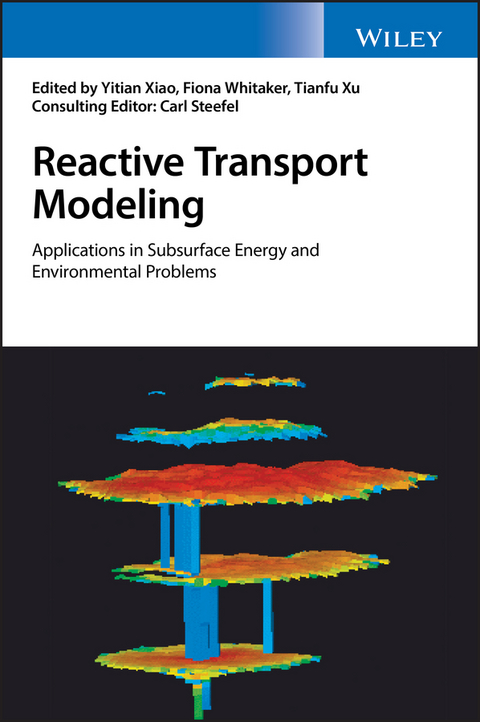
Reactive Transport Modeling (eBook)
John Wiley & Sons (Verlag)
978-1-119-06002-4 (ISBN)
Teaches the application of Reactive Transport Modeling (RTM) for subsurface systems in order to expedite the understanding of the behavior of complex geological systems
This book lays out the basic principles and approaches of Reactive Transport Modeling (RTM) for surface and subsurface environments, presenting specific workflows and applications. The techniques discussed are being increasingly commonly used in a wide range of research fields, and the information provided covers fundamental theory, practical issues in running reactive transport models, and how to apply techniques in specific areas. The need for RTM in engineered facilities, such as nuclear waste repositories or CO2 storage sites, is ever increasing, because the prediction of the future evolution of these systems has become a legal obligation. With increasing recognition of the power of these approaches, and their widening adoption, comes responsibility to ensure appropriate application of available tools. This book aims to provide the requisite understanding of key aspects of RTM, and in doing so help identify and thus avoid potential pitfalls.
Reactive Transport Modeling covers: the application of RTM for CO2 sequestration and geothermal energy development; reservoir quality prediction; modeling diagenesis; modeling geochemical processes in oil & gas production; modeling gas hydrate production; reactive transport in fractured and porous media; reactive transport studies for nuclear waste disposal; reactive flow modeling in hydrothermal systems; and modeling biogeochemical processes. Key features include:
- A comprehensive reference for scientists and practitioners entering the area of reactive transport modeling (RTM)
- Presented by internationally known experts in the field
- Covers fundamental theory, practical issues in running reactive transport models, and hands-on examples for applying techniques in specific areas
- Teaches readers to appreciate the power of RTM and to stimulate usage and application
Reactive Transport Modeling is written for graduate students and researchers in academia, government laboratories, and industry who are interested in applying reactive transport modeling to the topic of their research. The book will also appeal to geochemists, hydrogeologists, geophysicists, earth scientists, environmental engineers, and environmental chemists.
Yitian Xiao, PhD is Senior Geological Advisor, ExxonMobil Upstream Research Company, USA.
Fiona Whitaker, PhD is Professor of Earth Sciences, University of Bristol, UK.
Tianfu Xu, PhD is Director at Institute of Subsurface Energy and Waste Disposal, Jilin University, China.
Carl Steefel, PhD is Senior Scientist and Geochemistry Department Head, Earth Science Division, Lawrence Berkeley National Laboratory, USA.
Teaches the application of Reactive Transport Modeling (RTM) for subsurface systems in order to expedite the understanding of the behavior of complex geological systems This book lays out the basic principles and approaches of Reactive Transport Modeling (RTM) for surface and subsurface environments, presenting specific workflows and applications. The techniques discussed are being increasingly commonly used in a wide range of research fields, and the information provided covers fundamental theory, practical issues in running reactive transport models, and how to apply techniques in specific areas. The need for RTM in engineered facilities, such as nuclear waste repositories or CO2 storage sites, is ever increasing, because the prediction of the future evolution of these systems has become a legal obligation. With increasing recognition of the power of these approaches, and their widening adoption, comes responsibility to ensure appropriate application of available tools. This book aims to provide the requisite understanding of key aspects of RTM, and in doing so help identify and thus avoid potential pitfalls. Reactive Transport Modeling covers: the application of RTM for CO2 sequestration and geothermal energy development; reservoir quality prediction; modeling diagenesis; modeling geochemical processes in oil & gas production; modeling gas hydrate production; reactive transport in fractured and porous media; reactive transport studies for nuclear waste disposal; reactive flow modeling in hydrothermal systems; and modeling biogeochemical processes. Key features include: A comprehensive reference for scientists and practitioners entering the area of reactive transport modeling (RTM) Presented by internationally known experts in the field Covers fundamental theory, practical issues in running reactive transport models, and hands-on examples for applying techniques in specific areas Teaches readers to appreciate the power of RTM and to stimulate usage and application Reactive Transport Modeling is written for graduate students and researchers in academia, government laboratories, and industry who are interested in applying reactive transport modeling to the topic of their research. The book will also appeal to geochemists, hydrogeologists, geophysicists, earth scientists, environmental engineers, and environmental chemists.
Editors: Yitian Xiao, PhD is Senior Geoscience Advisor, ExxonMobil Upstream Research Company, USA. Fiona Whitaker, PhD is Professor of Earth Sciences, University of Bristol, UK. Tianfu Xu, PhD is Director of Key Laboratory of Groundwater Resources and Environment, Jilin University, China. Consulting Editor: Carl Steefel, PhD is Senior Scientist and Geochemistry Department Head, Earth Science Division, Lawrence Berkeley National Laboratory, USA.
Preface
Reactive transport modeling is a highly multidisciplinary area of research that has seen rapid advances in the past 20 years. The field encompasses a number of diverse disciplines including hydrology, geochemistry, geology, biology, engineering, environmental and computational sciences. Reactive transport in the subsurface can result in a wide variety of geochemical processes, including rock/mineral alteration in natural diagenetic systems and in response to injection of CO2 and acid gases, enhanced oil and gas recovery, transport and storage of radiogenic and toxic waste products in geological formations, as well as biogeochemical. Reactive transport models are thus important engineering tools which, as this summary of the state of the art demonstrates, have already had significant impact in some disciplines and offer promise in many more. However, at a higher level they also offer the potential to provide the ‘dynamic glue’ with which to integrate fundamental process‐based research into the study of complex natural Earth systems.
This book assimilates contributions from leading experts from universities and national and industrial research institutes around the world, who authoritatively discuss recent applications of reactive transport modeling to a wide range of subsurface and environmental problems. As such, the book is a timely reference and can be used as an advanced text book with relevance to a broad geoscience and engineering audience from both academia and industry. It spans the application of reactive transport models to a range of engineering and environmental fields, from understanding interactions between fluids, solutes and minerals to better manage extraction of energy resources and subsurface storage of waste, to incorporation of geobiology and addressing the challenges of modeling at a range of spatial and temporal scales.
CO2 sequestration and geothermal energy: Large‐scale carbon capture and sequestration (CCS) and geothermal energy are potential solutions to reduce CO2 emissions and provide alternative and renewable energy. These processes involve a complex interplay of multiphase flow, capillary trapping, diffusion, convection, and chemical reactions that may have significant impacts on both injection performance and storage security. In Chapters 1 and 2, Xu et al. from Jilin University, China, and Audigane et al. from the French Geological Survey and other institutions in the EU, evaluate the applications of reactive transport modeling to CO2 geological sequestration and the development of geothermal energy. These discussions elucidate the basic theory of reactive transport modeling and its application in understanding interactions among gases, liquids, solutes and minerals, and the implications for CO2 geological sequestration and geothermal energy development. The modeling results help to identify the short‐ and long‐term storage capacities of sedimentary formations and the geochemical processes associated with CO2 leakage during storage, including near‐well phenomena and impacts on groundwater, as well as performance issues associated with enhanced geothermal energy. The authors also discuss the current capabilities and limitations of reactive transport models for simulating the geochemical processes associated with CO2 geological storage.
Diagenesis and reservoir quality: The key challenge in reservoir characterization is predicting the spatial distribution of diagenesis, which is often a critical control on reservoir quality heterogeneity and thus producibility of oil and gas. In Chapters 3 and 4, Whitaker from the University of Bristol, UK, Frazer from Chevron, USA, and Xiao and Jones from ExxonMobil, USA, review and discuss a wide range of geoscience applications pertinent to reservoir quality prediction. These include simulation of syn‐depositional diagenesis of carbonate rocks controlled by interactions between episodes of submarine deposition of reactive sediment, and rapid changes in hydrological and biogeochemical conditions in response to changes in sea‐level. Diagenesis continues to alter reservoir quality during burial, when fault‐controlled flows play an increasingly important role, for example in hydrothermal fluid flow and illitization. Finally, at an operational time‐scale, reservoirs can be altered by acid gas and steam injection. Reactive transport models are used to examine how key natural variables impact different styles of diagenesis and reservoir porosity evolution, and provide insight on a range of important issues, such as the occurrence and distribution of karstic and dolomite geobodies which can give rise to high permeability ‘super‐k’ zones, calcite and anhydrite cements, and the impact on reservoir quality of fault‐controlled fluid flow during both early and burial diagenesis. They are also used to provide rule sets in developing a coupling forward stratigraphic and diagenetic model for carbonate platform development. The authors discuss frameworks and examples to link fundamental geochemical processes, integrate with traditional methods, and calibrate with field and production data that have the potential to significantly improve the ability to predict carbonate and siliciclastic reservoir quality.
Enhanced oil recovery: During petroleum production, enhanced oil recovery (EOR) methods such as CO2 flooding, acid stimulation, steam injection and in situ combustion can cause chemical reactions between the injected fluids and the reservoir rocks (artificial diagenesis) that may be either beneficial or detrimental to enhanced oil recovery. In Chapter 5, Zhang et al. from Shell, USA, discuss enhanced production from conventional hydrocarbon reservoirs which are characterized by high temperature, high pressure, high salinity and highly reducing conditions (4‐high). Injection to and/or production from these reservoirs can induce significant geochemical reactions due to the high contrast between geochemical conditions in the reservoir and those of the invading fluids, or between the reservoir and the surface conditions, introducing risks for hydrocarbon (HC) recovery. Risk evaluation and management require thorough understanding and modeling of these geochemical systems. Potential geochemical reactions taking place in 4‐high reservoirs during HC recovery are discussed, based on the characterization of the reservoirs. Quantitative description, modeling approaches, tool and examples of real cases are presented in this chapter.
Of the approximately 9 − 11 trillion barrels of crude oil resources in the world, about two‐thirds are unconventional heavy oil and bitumen. Thermal processes, using heat to reduce oil viscosity in situ, have been the most successful methods of recovery. In Chapter 6, Jia et al. from the University of Calgary, Canada, cover current modeling approaches to dynamic heat and mass transfer in several heavy oil recovery processes, such as SAGD, hybrid steam‐solvent, and steam‐solvent‐gas co‐injection. The respective contribution of conduction and convection to the viscosity reduction of heavy oil is analysed. In addition, the effects of heterogeneous reservoir properties and the impact on heavy oil recovery efficiency are discussed.
Acid gas injection and groundwater contamination: One potential risk of geological storage of CO2 is the leakage of CO2 and deep brines from a deep storage formation into overlying shallow, potable groundwater aquifers. In Chapter 7, Zheng and Spycher from Lawrence Berkeley National Laboratory, USA, discuss results from reactive transport models used to investigate the potential impact of acid gas injection and brine leakage on shallow groundwater, particularly the fate of trace metals and organics and the environmental consequences. Their simulation results provide insight into acid gas injection site selection and operational feasibility to ensure the safety of drinking‐water resources near these locations.
Nuclear waste disposal in geological formations: Large amounts of nuclear waste around the world need to be disposed of in repository sites that can ensure the safety and security of the waste for millennia. In Chapter 8, Claret et al. from the French Geological Survey discuss the grand challenge of long‐term safe storage of nuclear waste in geological formations. They cover the framework of modeling the long‐term stability of multi‐barrier systems, which consist of waste overpacks (e.g. metal canisters, concrete), engineered barriers such as bentonite, and natural barriers such as clay rocks. They summarize recent improvements and discuss future challenges in the application of reactive transport modeling to nuclear repository systems in order to understand how a repository system will evolve due to thermal, hydraulic, mechanical, chemical and radiological processes.
Sustainable constructed wetlands: Constructed wetlands are sustainable, environmentally friendly solutions to engineering problems such as wastewater treatment, which involve a large number of physical, chemical, and biological processes. In Chapter 9, Langergraber from the University of Natural Resources and Life Sciences Vienna (BOKU), Austria, and Simunek from the University of California Riverside, USA, discuss their mechanistic modeling approach for saturated/unsaturated water flow and the application of the convection‐dispersion equation for heat and solute transport, transformation and degradation processes of the pollutants, plants taking up nutrients and releasing organic matter and nutrients, and clogging that would...
| Erscheint lt. Verlag | 14.3.2018 |
|---|---|
| Mitarbeit |
Berater: Carl Steefel |
| Sprache | englisch |
| Themenwelt | Naturwissenschaften ► Chemie |
| Naturwissenschaften ► Geowissenschaften ► Geologie | |
| Schlagworte | ab initio methods for atmospheric reactions • ab initio methods for fluid-rock interactions • application of RTM for CO2 sequestration and geothermal energy development • Bodenchemie • Boden- u. Geochemie • Carbonate sedimentology • Carbonate sediments • Carbon Capture & Storage • Chemie • Chemistry • CO2-Sequestrierung • diagenesis • earth sciences • Energie • Energy • Environmental Chemistry • fundamental geology • Geochemistry • geofluids • Geological Sequestration • Geologie • Geologie u. Geophysik • Geology & Geophysics • Geophysics • geosystems • geothermal energy development • Geowissenschaften • Kohlenstoff-Abscheidung u. -Speicherung • modeling biogeochemical processes • modeling diagenesis • modeling gas hydrate production • modeling geochemical processes in oil & gas production • multiphase non-isothermal fluid flow • Petroleum Geochemistry • porosity-permeability • reactive flow modeling in hydrothermal systems • reactive transport in fractured and porous media • reactive transport in unsaturated and saturated porous media • reactive transport modeling • Reactive Transport Modeling: Applications in Subsurface Energy and Environmental Problems • reactive transport studies for nuclear waste disposal • reservoir quality prediction • RTM • Soil & Geochemistry |
| ISBN-10 | 1-119-06002-8 / 1119060028 |
| ISBN-13 | 978-1-119-06002-4 / 9781119060024 |
| Informationen gemäß Produktsicherheitsverordnung (GPSR) | |
| Haben Sie eine Frage zum Produkt? |
 EPUB (Adobe DRM)
Kopierschutz: Adobe-DRM
Adobe-DRM ist ein Kopierschutz, der das eBook vor Mißbrauch schützen soll. Dabei wird das eBook bereits beim Download auf Ihre persönliche Adobe-ID autorisiert. Lesen können Sie das eBook dann nur auf den Geräten, welche ebenfalls auf Ihre Adobe-ID registriert sind.
Details zum Adobe-DRM
Dateiformat: EPUB (Electronic Publication)
EPUB ist ein offener Standard für eBooks und eignet sich besonders zur Darstellung von Belletristik und Sachbüchern. Der Fließtext wird dynamisch an die Display- und Schriftgröße angepasst. Auch für mobile Lesegeräte ist EPUB daher gut geeignet.
Systemvoraussetzungen:
PC/Mac: Mit einem PC oder Mac können Sie dieses eBook lesen. Sie benötigen eine
eReader: Dieses eBook kann mit (fast) allen eBook-Readern gelesen werden. Mit dem amazon-Kindle ist es aber nicht kompatibel.
Smartphone/Tablet: Egal ob Apple oder Android, dieses eBook können Sie lesen. Sie benötigen eine
Geräteliste und zusätzliche Hinweise
Buying eBooks from abroad
For tax law reasons we can sell eBooks just within Germany and Switzerland. Regrettably we cannot fulfill eBook-orders from other countries.
aus dem Bereich