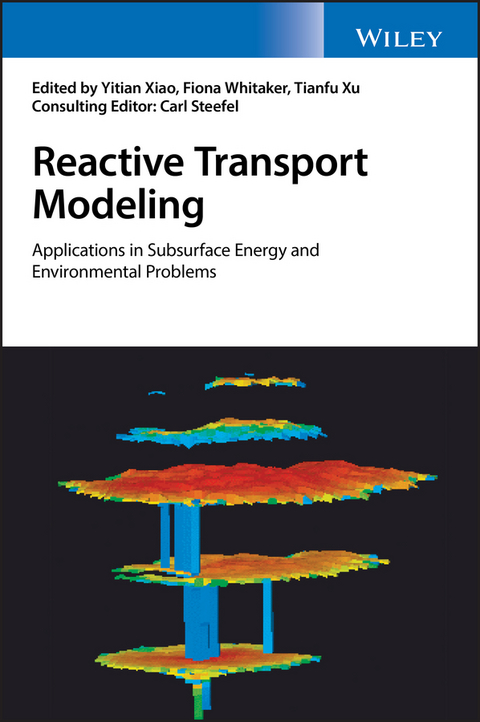
Reactive Transport Modeling (eBook)
John Wiley & Sons (Verlag)
978-1-119-06001-7 (ISBN)
Teaches the application of Reactive Transport Modeling (RTM) for subsurface systems in order to expedite the understanding of the behavior of complex geological systems
This book lays out the basic principles and approaches of Reactive Transport Modeling (RTM) for surface and subsurface environments, presenting specific workflows and applications. The techniques discussed are being increasingly commonly used in a wide range of research fields, and the information provided covers fundamental theory, practical issues in running reactive transport models, and how to apply techniques in specific areas. The need for RTM in engineered facilities, such as nuclear waste repositories or CO2 storage sites, is ever increasing, because the prediction of the future evolution of these systems has become a legal obligation. With increasing recognition of the power of these approaches, and their widening adoption, comes responsibility to ensure appropriate application of available tools. This book aims to provide the requisite understanding of key aspects of RTM, and in doing so help identify and thus avoid potential pitfalls.
Reactive Transport Modeling covers: the application of RTM for CO2 sequestration and geothermal energy development; reservoir quality prediction; modeling diagenesis; modeling geochemical processes in oil & gas production; modeling gas hydrate production; reactive transport in fractured and porous media; reactive transport studies for nuclear waste disposal; reactive flow modeling in hydrothermal systems; and modeling biogeochemical processes. Key features include:
- A comprehensive reference for scientists and practitioners entering the area of reactive transport modeling (RTM)
- Presented by internationally known experts in the field
- Covers fundamental theory, practical issues in running reactive transport models, and hands-on examples for applying techniques in specific areas
- Teaches readers to appreciate the power of RTM and to stimulate usage and application
Reactive Transport Modeling is written for graduate students and researchers in academia, government laboratories, and industry who are interested in applying reactive transport modeling to the topic of their research. The book will also appeal to geochemists, hydrogeologists, geophysicists, earth scientists, environmental engineers, and environmental chemists.
Editors:
Yitian Xiao, PhD is Senior Geoscience Advisor, ExxonMobil Upstream Research Company, USA.
Fiona Whitaker, PhD is Professor of Earth Sciences, University of Bristol, UK.
Tianfu Xu, PhD is Director of Key Laboratory of Groundwater Resources and Environment, Jilin University, China.
Consulting Editor:
Carl Steefel, PhD is Senior Scientist and Geochemistry Department Head, Earth Science Division, Lawrence Berkeley National Laboratory, USA.
Teaches the application of Reactive Transport Modeling (RTM) for subsurface systems in order to expedite the understanding of the behavior of complex geological systems This book lays out the basic principles and approaches of Reactive Transport Modeling (RTM) for surface and subsurface environments, presenting specific workflows and applications. The techniques discussed are being increasingly commonly used in a wide range of research fields, and the information provided covers fundamental theory, practical issues in running reactive transport models, and how to apply techniques in specific areas. The need for RTM in engineered facilities, such as nuclear waste repositories or CO2 storage sites, is ever increasing, because the prediction of the future evolution of these systems has become a legal obligation. With increasing recognition of the power of these approaches, and their widening adoption, comes responsibility to ensure appropriate application of available tools. This book aims to provide the requisite understanding of key aspects of RTM, and in doing so help identify and thus avoid potential pitfalls. Reactive Transport Modeling covers: the application of RTM for CO2 sequestration and geothermal energy development; reservoir quality prediction; modeling diagenesis; modeling geochemical processes in oil & gas production; modeling gas hydrate production; reactive transport in fractured and porous media; reactive transport studies for nuclear waste disposal; reactive flow modeling in hydrothermal systems; and modeling biogeochemical processes. Key features include: A comprehensive reference for scientists and practitioners entering the area of reactive transport modeling (RTM) Presented by internationally known experts in the field Covers fundamental theory, practical issues in running reactive transport models, and hands-on examples for applying techniques in specific areas Teaches readers to appreciate the power of RTM and to stimulate usage and application Reactive Transport Modeling is written for graduate students and researchers in academia, government laboratories, and industry who are interested in applying reactive transport modeling to the topic of their research. The book will also appeal to geochemists, hydrogeologists, geophysicists, earth scientists, environmental engineers, and environmental chemists.
Editors: Yitian Xiao, PhD is Senior Geoscience Advisor, ExxonMobil Upstream Research Company, USA. Fiona Whitaker, PhD is Professor of Earth Sciences, University of Bristol, UK. Tianfu Xu, PhD is Director of Key Laboratory of Groundwater Resources and Environment, Jilin University, China. Consulting Editor: Carl Steefel, PhD is Senior Scientist and Geochemistry Department Head, Earth Science Division, Lawrence Berkeley National Laboratory, USA.
| Erscheint lt. Verlag | 12.3.2018 |
|---|---|
| Mitarbeit |
Berater: Carl Steefel |
| Sprache | englisch |
| Themenwelt | Naturwissenschaften ► Chemie |
| Naturwissenschaften ► Geowissenschaften ► Geologie | |
| Schlagworte | ab initio methods for atmospheric reactions • ab initio methods for fluid-rock interactions • application of RTM for CO2 sequestration and geothermal energy development • Bodenchemie • Boden- u. Geochemie • Carbonate sedimentology • Carbonate sediments • Carbon Capture & Storage • Chemie • Chemistry • CO2-Sequestrierung • diagenesis • earth sciences • Energie • Energy • Environmental Chemistry • fundamental geology • Geochemistry • geofluids • Geological Sequestration • Geologie • Geologie u. Geophysik • Geology & Geophysics • Geophysics • geosystems • geothermal energy development • Geowissenschaften • Kohlenstoff-Abscheidung u. -Speicherung • modeling biogeochemical processes • modeling diagenesis • modeling gas hydrate production • modeling geochemical processes in oil & gas production • multiphase non-isothermal fluid flow • Petroleum Geochemistry • porosity-permeability • reactive flow modeling in hydrothermal systems • reactive transport in fractured and porous media • reactive transport in unsaturated and saturated porous media • reactive transport modeling • Reactive Transport Modeling: Applications in Subsurface Energy and Environmental Problems • reactive transport studies for nuclear waste disposal • reservoir quality prediction • RTM • Soil & Geochemistry |
| ISBN-10 | 1-119-06001-X / 111906001X |
| ISBN-13 | 978-1-119-06001-7 / 9781119060017 |
| Informationen gemäß Produktsicherheitsverordnung (GPSR) | |
| Haben Sie eine Frage zum Produkt? |
 PDF (Adobe DRM)
Kopierschutz: Adobe-DRM
Adobe-DRM ist ein Kopierschutz, der das eBook vor Mißbrauch schützen soll. Dabei wird das eBook bereits beim Download auf Ihre persönliche Adobe-ID autorisiert. Lesen können Sie das eBook dann nur auf den Geräten, welche ebenfalls auf Ihre Adobe-ID registriert sind.
Details zum Adobe-DRM
Dateiformat: PDF (Portable Document Format)
Mit einem festen Seitenlayout eignet sich die PDF besonders für Fachbücher mit Spalten, Tabellen und Abbildungen. Eine PDF kann auf fast allen Geräten angezeigt werden, ist aber für kleine Displays (Smartphone, eReader) nur eingeschränkt geeignet.
Systemvoraussetzungen:
PC/Mac: Mit einem PC oder Mac können Sie dieses eBook lesen. Sie benötigen eine
eReader: Dieses eBook kann mit (fast) allen eBook-Readern gelesen werden. Mit dem amazon-Kindle ist es aber nicht kompatibel.
Smartphone/Tablet: Egal ob Apple oder Android, dieses eBook können Sie lesen. Sie benötigen eine
Geräteliste und zusätzliche Hinweise
Buying eBooks from abroad
For tax law reasons we can sell eBooks just within Germany and Switzerland. Regrettably we cannot fulfill eBook-orders from other countries.
aus dem Bereich