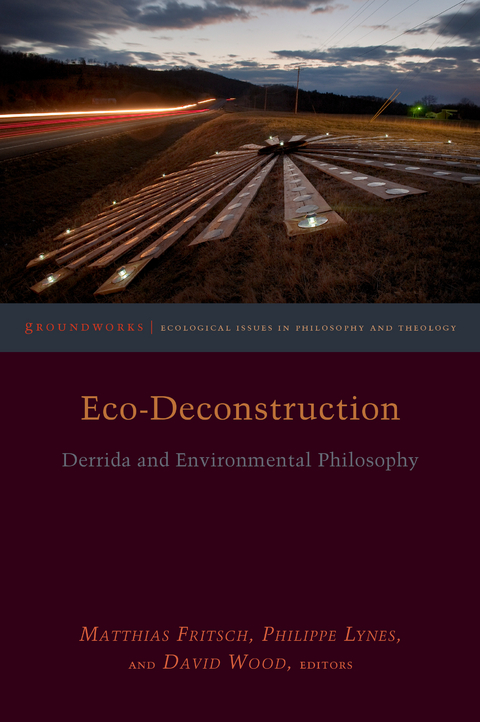
Eco-Deconstruction (eBook)
Fordham University Press (Verlag)
978-0-8232-7952-4 (ISBN)
lt;b>Matthias Fritsch (Edited By)
Matthias Fritsch is Professor of Philosophy at Concordia University, Montréal. He is the author of The Promise of Memory: History and Politics in Marx, Benjamin, and Derrida and Taking Turns with Earth: Ways to Intergenerational Justice through Phenomenology and Deconstruction and co-translator of Heidegger’s The Phenomenology of Religious Life.
Philippe Lynes (Edited By)
Philippe Lynes is Fulbright Canada Visiting Research Chair in Environmental Humanities at the University of California, Irvine. He is the translator of Derrida’s Advances.
David Wood (Edited By)
David Wood is W. Alton Jones Professor of Philosophy at Vanderbilt University. His most recent book is Deep Time, Dark Times: On Being Geologically Human.
Abbreviations for Works by Jacques Derrida
Introduction
Matthias Fritsch, Philippe Lynes, and David Wood
Part I. Diagnosing the Present
1. The Eleventh Plague: Thinking Ecologically after Derrida
David Wood
2. Thinking after the World: Deconstruction and Last Things
Ted Toadvine
3. Scale as a Force of Deconstruction
Timothy Clark
Part II. Ecologies
4. The Posthuman Promise of the Earth
Philippe Lynes
5. Un/limited Ecologies
Vicki Kirby
6. Ecology as Event
Michael Marder
7. Writing Home: Eco-choro-spectrography
John Llewelyn
Part III. Nuclear and Other Biodegradabilitie
8. E-phemera: Of Deconstruction, Biodegradability, and Nuclear War
Michael Naas
9. Troubling Time/s and Ecologies of Nothingness: On the Im/Possibilities of Living and Dying in the Void
Karen Barad
10. Responsibility and the Non(bio)degradable
Michael Peterson
11. Extinguishing Ability: How we Became Post-Extinction Persons
Claire Colebrook
Part IV. Environmental Ethics
12. An Eco-Deconstructive Account of the Emergence of Normativity in “Nature”
Matthias Fritsch
13. Opening ethics onto the other shore of another heading
Dawne McCance
14. Wallace Stevens’s Birds, or, Derrida and Ecological Poetics
Cary Wolfe
15. Earth: Love It or Leave It
Kelly Oliver
List of Contributors
Index
| Erscheint lt. Verlag | 27.3.2018 |
|---|---|
| Reihe/Serie | Groundworks: Ecological Issues in Philosophy and Theology |
| Co-Autor | Karen Barad, Timothy Clark, Claire Colebrook, Vicki Kirby, John Llewelyn, Philippe Lynes, Michael Marder, Dawne McCance, Michael Naas, Kelly Oliver, Michael Peterson, Ted Toadvine, Cary Wolfe, David Wood |
| Zusatzinfo | 2 |
| Verlagsort | New York |
| Sprache | englisch |
| Maße | 150 x 150 mm |
| Themenwelt | Geisteswissenschaften ► Philosophie ► Philosophie der Neuzeit |
| Geisteswissenschaften ► Sprach- / Literaturwissenschaft ► Anglistik / Amerikanistik | |
| Geisteswissenschaften ► Sprach- / Literaturwissenschaft ► Literaturwissenschaft | |
| Naturwissenschaften | |
| Schlagworte | Anthropocene • Deconstruction • Derrida • eco-criticism • Eco-phenomenology • Environmental Ethics • environmental philosophy • New Materialism • posthumanism |
| ISBN-10 | 0-8232-7952-9 / 0823279529 |
| ISBN-13 | 978-0-8232-7952-4 / 9780823279524 |
| Informationen gemäß Produktsicherheitsverordnung (GPSR) | |
| Haben Sie eine Frage zum Produkt? |
 EPUB (Adobe DRM)
Kopierschutz: Adobe-DRM
Adobe-DRM ist ein Kopierschutz, der das eBook vor Mißbrauch schützen soll. Dabei wird das eBook bereits beim Download auf Ihre persönliche Adobe-ID autorisiert. Lesen können Sie das eBook dann nur auf den Geräten, welche ebenfalls auf Ihre Adobe-ID registriert sind.
Details zum Adobe-DRM
Dateiformat: EPUB (Electronic Publication)
EPUB ist ein offener Standard für eBooks und eignet sich besonders zur Darstellung von Belletristik und Sachbüchern. Der Fließtext wird dynamisch an die Display- und Schriftgröße angepasst. Auch für mobile Lesegeräte ist EPUB daher gut geeignet.
Systemvoraussetzungen:
PC/Mac: Mit einem PC oder Mac können Sie dieses eBook lesen. Sie benötigen eine
eReader: Dieses eBook kann mit (fast) allen eBook-Readern gelesen werden. Mit dem amazon-Kindle ist es aber nicht kompatibel.
Smartphone/Tablet: Egal ob Apple oder Android, dieses eBook können Sie lesen. Sie benötigen eine
Geräteliste und zusätzliche Hinweise
Buying eBooks from abroad
For tax law reasons we can sell eBooks just within Germany and Switzerland. Regrettably we cannot fulfill eBook-orders from other countries.
aus dem Bereich