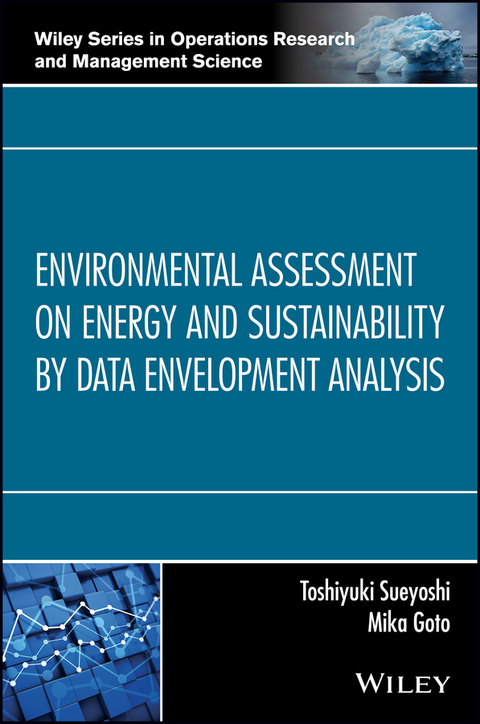
Environmental Assessment on Energy and Sustainability by Data Envelopment Analysis (eBook)
John Wiley & Sons (Verlag)
978-1-118-97933-4 (ISBN)
Introduces a bold, new model for energy industry pollution prevention and sustainable growth
Balancing industrial pollution prevention with economic growth is one of the knottiest problems faced by industry today. This book introduces a novel approach to using data envelopment analysis (DEA) as a powerful tool for achieving that balance in the energy industries-the world's largest producers of greenhouse gases. It describes a rigorous framework that integrates elements of the social sciences, corporate strategy, regional economics, energy economics, and environmental policy, and delivers a methodology and a set of strategies for promoting green innovation while solving key managerial challenges to greenhouse gas reduction and business growth.
In writing this book the authors have drawn upon their pioneering work and considerable experience in the field to develop an unconventional, holistic approach to using DEA to assess key aspects of sustainability development. The book is divided into two sections, the first of which lays out a conventional framework of DEA as the basis for new research directions. In the second section, the authors delve into conceptual and methodological extensions of conventional DEA for solving problems of environmental assessment in all contemporary energy industry sectors.
- Introduces a powerful new approach to using DEA to achieve pollution prevention, sustainability, and business growth
- Covers the fundamentals of DEA, including theory, statistical models, and practical issues of conventional applications of DEA
- Explores new statistical modeling strategies and explores their economic and business implications
- Examines applications of DEA to environmental analysis across the complete range of energy industries, including coal, petroleum, shale gas, nuclear energy, renewables, and more
- Summarizes important studies and nearly 800 peer reviewed articles on energy, the environment, and sustainability
Environmental Assessment on Energy and Sustainability by Data Envelopment Analysis is must-reading for researchers, academics, graduate students, and practitioners in the energy industries, as well as government officials and policymakers tasked with regulating the environmental impacts of industrial pollution.
TOSHIYUKI SUEYOSHI, PhD, is a full professor at New Mexico Institute of Mining and Technology, Soccorro, New Mexico, USA. Dr. Sueyoshi has published more than 300 articles in well-known international (SCI/SSCI listed) journals.
MIKA GOTO, PhD, is a full professor at Tokyo Institute of Technology, Tokyo, Japan. Dr. Goto has published more than 100 articles in well-known international (SCI/SSCI listed) journals.
Introduces a bold, new model for energy industry pollution prevention and sustainable growth Balancing industrial pollution prevention with economic growth is one of the knottiest problems faced by industry today. This book introduces a novel approach to using data envelopment analysis (DEA) as a powerful tool for achieving that balance in the energy industries the world s largest producers of greenhouse gases. It describes a rigorous framework that integrates elements of the social sciences, corporate strategy, regional economics, energy economics, and environmental policy, and delivers a methodology and a set of strategies for promoting green innovation while solving key managerial challenges to greenhouse gas reduction and business growth. In writing this book the authors have drawn upon their pioneering work and considerable experience in the field to develop an unconventional, holistic approach to using DEA to assess key aspects of sustainability development. The book is divided into two sections, the first of which lays out a conventional framework of DEA as the basis for new research directions. In the second section, the authors delve into conceptual and methodological extensions of conventional DEA for solving problems of environmental assessment in all contemporary energy industry sectors. Introduces a powerful new approach to using DEA to achieve pollution prevention, sustainability, and business growth Covers the fundamentals of DEA, including theory, statistical models, and practical issues of conventional applications of DEA Explores new statistical modeling strategies and explores their economic and business implications Examines applications of DEA to environmental analysis across the complete range of energy industries, including coal, petroleum, shale gas, nuclear energy, renewables, and more Summarizes important studies and nearly 800 peer reviewed articles on energy, the environment, and sustainability Environmental Assessment on Energy and Sustainability by Data Envelopment Analysis is must-reading for researchers, academics, graduate students, and practitioners in the energy industries, as well as government officials and policymakers tasked with regulating the environmental impacts of industrial pollution.
TOSHIYUKI SUEYOSHI, PhD, is a full professor at New Mexico Institute of Mining and Technology, Soccorro, New Mexico, USA. Dr. Sueyoshi has published more than 300 articles in well-known international (SCI/SSCI listed) journals. MIKA GOTO, PhD, is a full professor at Tokyo Institute of Technology, Tokyo, Japan. Dr. Goto has published more than 100 articles in well-known international (SCI/SSCI listed) journals.
TITLE PAGE 5
COPYRIGHT PAGE 6
CONTENTS 7
PREFACE 17
SECTION I DATA ENVELOPMENT ANALYSIS (DEA) 21
CHAPTER 1 GENERAL DESCRIPTION 23
1.1 INTRODUCTION 23
1.2 STRUCTURE 24
1.3 CONTRIBUTIONS IN SECTIONS I AND II 30
1.4 ABBREVIATIONS AND NOMENCLATURE 33
1.4.1 Abbreviations Used in This Book 33
1.4.2 Nomenclature Used in This Book 38
1.4.3 Mathematical Concerns 43
1.5 SUMMARY 44
CHAPTER 2 OVERVIEW 45
2.1 INTRODUCTION 45
2.2 WHAT IS DEA? 46
2.3 REMARKS 53
2.4 REFORMULATION FROM FRACTIONAL PROGRAMMING TO LINEAR PROGRAMMING 55
2.5 REFERENCE SET 58
2.6 EXAMPLE FOR COMPUTATIONAL DESCRIPTION 59
2.7 SUMMARY 64
CHAPTER 3 HISTORY 65
3.1 INTRODUCTION 65
3.2 ORIGIN OF L1 REGRESSION 66
3.3 ORIGIN OF GOAL PROGRAMMING 70
3.4 ANALYTICAL PROPERTIES OF L1 REGRESSION 73
3.5 FROM L1 REGRESSION TO L2 REGRESSION AND FRONTIER ANALYSIS 75
3.5.1 L2 Regression 75
3.5.2 L1-Based Frontier Analyses 75
3.6 ORIGIN OF DEA 79
3.7 RELATIONSHIPS BETWEEN GP AND DEA 81
3.8 HISTORICAL PROGRESS FROM L1 REGRESSION TO DEA 84
3.9 SUMMARY 84
CHAPTER 4 RADIAL MEASUREMENT 87
4.1 INTRODUCTION 87
4.2 RADIAL MODELS: INPUT-ORIENTED 90
4.2.1 Input-Oriented RM(v) under Variable RTS 90
4.2.2 Underlying Concept 92
4.2.3 Input-Oriented RM(c) under Constant RTS 94
4.3 RADIAL MODELS: DESIRABLE OUTPUT-ORIENTED 95
4.3.1 Desirable Output-oriented RM(v) under Variable RTS 95
4.3.2 Desirable Output-oriented RM(c) under Constant RTS 97
4.4 COMPARISON BETWEEN RADIAL MODELS 99
4.4.1 Comparison between Input-Oriented and Desirable Output-Oriented Radial Models 99
4.4.2 Hybrid Radial Model: Modification 101
4.5 MULTIPLIER RESTRICTION AND CROSS-REFERENCE APPROACHES 102
4.5.1 Multiplier Restriction Methods 102
4.5.2 Cone Ratio Method 104
4.5.3 Cross-reference Method 106
4.6 COST ANALYSIS 108
4.6.1 Cost Efficiency Measures 108
4.6.2 Type of Efficiency Measures in Production and Cost Analyses 109
4.6.3 Illustrative Example 111
4.7 SUMMARY 114
CHAPTER 5 NON-RADIAL MEASUREMENT 115
5.1 INTRODUCTION 115
5.2 CHARACTERIZATION AND CLASSIFICATION ON DMUs 117
5.3 RUSSELL MEASURE 119
5.4 ADDITIVE MODEL 123
5.5 RANGE-ADJUSTED MEASURE 125
5.6 SLACK-ADJUSTED RADIAL MEASURE 126
5.7 SLACK-BASED MEASURE 128
5.8 METHODOLOGICAL COMPARISON: AN ILLUSTRATIVE EXAMPLE 131
5.9 SUMMARY 133
CHAPTER 6 DESIRABLE PROPERTIES 135
6.1 INTRODUCTION 135
6.2 CRITERIA FOR OE 137
6.3 SUPPLEMENTARY DISCUSSION 139
6.4 PREVIOUS STUDIES ON DESIRABLE PROPERTIES 140
6.5 STANDARD FORMULATION FOR RADIAL AND NON-RADIAL MODELS 142
6.6 DESIRABLE PROPERTIES FOR DEA MODELS 146
6.6.1 Aggregation 146
6.6.2 Frontier Shift Measurability 148
6.6.3 Invariance to Alternate Optima 151
6.6.4 Formal Definitions on Other Desirable Properties 152
6.6.5 Efficiency Requirement 153
6.6.6 Homogeneity 154
6.6.7 Strict Monotonicity 156
6.6.8 Unique Projection for Efficiency Comparison 157
6.6.9 Unit Invariance 158
6.6.10 Translation Invariance 159
6.7 SUMMARY 160
APPENDIX 162
Proof of Proposition 6.1 162
Proof of Proposition 6.6 163
Proof of Proposition 6.7 165
Proof of Proposition 6.8 166
Proof of Proposition 6.10 167
Proof of Proposition 6.11 167
CHAPTER 7 STRONG COMPLEMENTARY SLACKNESS CONDITIONS 169
7.1 INTRODUCTION 169
7.2 COMBINATION BETWEEN PRIMAL AND DUAL MODELS FOR SCSCs 170
7.3 THREE ILLUSTRATIVE EXAMPLES 174
7.3.1 First Example 175
7.3.2 Second Example 178
7.3.3 Third Example 181
7.4 THEORETICAL IMPLICATIONS OF SCSCs 182
7.5 GUIDELINE FOR NON-RADIAL MODELS 187
7.6 SUMMARY 187
CHAPTER 8 RETURNS TO SCALE 193
8.1 INTRODUCTION 193
8.2 UNDERLYING CONCEPTS 194
8.3 PRODUCTION-BASED RTS MEASUREMENT 198
8.4 COST-BASED RTS MEASUREMENT 202
8.5 SCALE EFFICIENCIES AND SCALE ECONOMIES 205
8.6 SUMMARY 208
CHAPTER 9 CONGESTION 209
9.1 INTRODUCTION 209
9.2 AN ILLUSTRATIVE EXAMPLE 211
9.3 FUNDAMENTAL DISCUSSIONS 215
9.4 SUPPORTING HYPERPLANE 220
9.4.1 Location of Supporting Hyperplane 220
9.4.2 Visual Description of Congestion and RTS 221
9.5 CONGESTION IDENTIFICATION 224
9.5.1 Slack Adjustment for Projection 224
9.5.2 Congestion Identification on Projected Point 226
9.6 THEORETICAL LINKAGE BETWEEN CONGESTION AND RTS 227
9.7 DEGREE OF CONGESTION 229
9.8 ECONOMIC IMPLICATIONS 231
9.9 SUMMARY 232
CHAPTER 10 NETWORK COMPUTING 235
10.1 INTRODUCTION 235
10.2 NETWORK COMPUTING ARCHITECTURE 236
10.3 NETWORK COMPUTING FOR MULTI?STAGE PARALLEL PROCESSES 238
10.3.1 Theoretical Preliminary 238
10.3.2 Computational Strategy for Network Computing 241
10.3.3 Network Computing in Multi?Stage Parallel Processes 241
10.4 SIMULATION STUDY 249
10.5 SUMMARY 261
CHAPTER 11 DEA-DISCRIMINANT ANALYSIS 263
11.1 INTRODUCTION 263
11.2 TWO MIP APPROACHES FOR DEA?DA 265
11.2.1 Standard MIP Approach 265
11.2.2 Two-stage MIP Approach 268
11.2.3 Differences between Two MIP Approaches 274
11.2.4 Differences between DEA and DEA-DA 275
11.3 CLASSIFYING MULTIPLE GROUPS 275
11.4 ILLUSTRATIVE EXAMPLES 279
11.4.1 First Example 279
11.4.2 Second Example 279
11.5 FRONTIER ANALYSIS 281
11.6 SUMMARY 283
CHAPTER 12 LITERATURE STUDY FOR SECTION I 285
12.1 INTRODUCTION 285
12.2 COMPUTER CODES 285
12.3 PEDAGOGICAL LINKAGE FROM CONVENTIONAL USE TO ENVIRONMENTAL ASSESSMENT 288
REFERENCES FOR SECTION I 290
SECTION II DEA ENVIRONMENTAL ASSESSMENT 301
CHAPTER 13 WORLD ENERGY 303
13.1 INTRODUCTION 303
13.2 GENERAL TREND 304
13.3 PRIMARY ENERGY 306
13.3.1 Fossil Fuel Energy 306
13.3.2 Non-fossil Energy 313
13.4 SECONDARY ENERGY (ELECTRICITY) 317
13.5 PETROLEUM PRICE AND WORLD TRADE 319
13.6 ENERGY ECONOMICS 320
13.7 SUMMARY 323
CHAPTER 14 ENVIRONMENTAL PROTECTION 325
14.1 INTRODUCTION 325
14.2 EUROPEAN UNION 326
14.2.1 General Description 326
14.2.2 Environmental Action Program 328
14.3 JAPAN 330
14.4 CHINA 331
14.5 THE UNITED STATES OF AMERICA 335
14.5.1 General Description 335
14.5.2 Regional Comparison between PJM and California ISO 337
14.5.3 Federal Regulation on PJM and California ISO 338
14.5.4 Local Regulation on PJM 339
14.5.5 Local Regulation on California ISO 340
14.6 SUMMARY 342
CHAPTER 15 CONCEPTS 345
15.1 INTRODUCTION 345
15.2 ROLE OF DEA IN MEASURING UNIFIED PERFORMANCE 347
15.3 SOCIAL SUSTAINABILITY VERSUS CORPORATE SUSTAINABILITY 351
15.3.1 Why Is Social Sustainability Important? 352
15.3.2 Why Is Corporate Sustainability Important? 353
15.4 STRATEGIC ADAPTATION 356
15.5 TWO DISPOSABILITY CONCEPTS 359
15.6 UNIFIED EFFICIENCY UNDER NATURAL AND MANAGERIAL DISPOSABILITY 361
15.7 DIFFICULTY IN DEA ENVIRONMENTAL ASSESSMENT 363
15.8 UNDESIRABLE CONGESTION AND DESIRABLE CONGESTION 365
15.9 COMPARISON WITH PREVIOUS DISPOSABILITY CONCEPTS 366
15.9.1 Weak and Strong Disposability 367
15.9.2 Null-joint Relationship (Assumption on “Byproducts”) 367
15.10 SUMMARY 370
CHAPTER 16 NON-RADIAL APPROACH FOR UNIFIED EFFICIENCY MEASURES 371
16.1 INTRODUCTION 371
16.2 UNIFIED EFFICIENCY 372
16.2.1 Formulation 372
16.2.2 Visual Implications of UE 377
16.3 UNIFIED EFFICIENCY UNDER NATURAL DISPOSABILITY 380
16.4 UNIFIED EFFICIENCY UNDER MANAGERIAL DISPOSABILITY 382
16.5 PROPERTIES OF NON-RADIAL APPROACH 384
16.6 NATIONAL AND INTERNATIONAL FIRMS IN PETROLEUM INDUSTRY 386
16.6.1 Business Structure 386
16.6.2 National and International Oil Companies 387
16.6.3 UE Measures 387
16.6.4 UE Measures under Natural Disposability 389
16.6.5 UE Measures under Managerial Disposability 389
16.7 SUMMARY 393
CHAPTER 17 RADIAL APPROACH FOR UNIFIED EFFICIENCY MEASURES 395
17.1 INTRODUCTION 395
17.2 UNIFIED EFFICIENCY 396
17.3 RADIAL UNIFICATION BETWEEN DESIRABLE AND UNDESIRABLE OUTPUTS 398
17.4 UNIFIED EFFICIENCY UNDER NATURAL DISPOSABILITY 401
17.5 UNIFIED EFFICIENCY UNDER MANAGERIAL DISPOSABILITY 403
17.6 COAL-FIRED POWER PLANTS IN THE UNITED STATES 405
17.6.1 ISO and RTO 405
17.6.2 Data 407
17.6.3 Unified Efficiency 408
17.6.4 Unified Efficiency under Natural Disposability 410
17.6.5 Unified Efficiency under Managerial Disposability 411
17.7 SUMMARY 412
APPENDIX 413
CHAPTER 18 SCALE EFFICIENCY 415
18.1 INTRODUCTION 415
18.2 SCALE EFFICIENCY UNDER NATURAL DISPOSABILITY: NON-RADIAL APPROACH 416
18.3 SCALE EFFICIENCY UNDER MANAGERIAL DISPOSABILITY: NON-RADIAL APPROACH 419
18.4 SCALE EFFICIENCY UNDER NATURAL DISPOSABILITY: RADIAL APPROACH 421
18.5 SCALE EFFICIENCY UNDER MANAGERIAL DISPOSABILITY: RADIAL APPROACH 423
18.6 UNITED STATES COAL-FIRED POWER PLANTS 424
18.6.1 The Clean Air Act 424
18.6.2 Production Factors 426
18.6.3 Research Concerns 427
18.6.4 Unified Efficiency Measures of Power Plants 430
18.6.5 Mean Tests 430
18.7 SUMMARY 434
CHAPTER 19 MEASUREMENT IN TIME HORIZON 437
19.1 INTRODUCTION 437
19.2 MALMQUIST INDEX 438
19.3 FRONTIER SHIFT IN TIME HORIZON 439
19.3.1 No Occurrence of Frontier Crossover 439
19.3.2 Occurrence of Frontier Crossover 442
19.4 FORMULATIONS FOR NATURAL DISPOSABILITY 444
19.4.1 No Occurrence of Frontier Crossover 445
19.4.2 Occurrence of Frontier Crossover 448
19.5 FORMULATIONS UNDER MANAGERIAL DISPOSABILITY 450
19.5.1 No Occurrence of Frontier Crossover 450
19.5.2 Occurrence of Frontier Crossover 452
19.6 ENERGY MIX OF INDUSTRIAL NATIONS 455
19.7 SUMMARY 457
APPENDIX 460
CHAPTER 20 RETURNS TO SCALE AND DAMAGES TO SCALE 463
20.1 INTRODUCTION 463
20.2 UNDERLYING CONCEPTS 464
20.2.1 Scale Elasticity 464
20.2.2 Differences between RTS and DTS 465
20.3 NON-RADIAL APPROACH 467
20.3.1 Scale Economies and RTS under Natural Disposability 467
20.3.2 Scale Damages and DTS under Managerial Disposability 470
20.4 RADIAL APPROACH 471
20.4.1 Scale Economies and RTS under Natural Disposability 471
20.4.2 Scale Damages and DTS under Managerial Disposability 474
20.5 JAPANESE CHEMICAL AND PHARMACEUTICAL FIRMS 475
20.6 SUMMARY 481
CHAPTER 21 DESIRABLE AND UNDESIRABLE CONGESTIONS 483
21.1 INTRODUCTION 483
21.2 UC AND DC 484
21.3 UNIFIED EFFICIENCY AND UC UNDER NATURAL DISPOSABILITY 489
21.4 UNIFIED EFFICIENCY AND DC UNDER MANAGERIAL DISPOSABILITY 493
21.5 COAL-FIRED POWER PLANTS IN UNITED STATES 496
21.5.1 Data 496
21.5.2 Occurrence of Congestion 497
21.6 SUMMARY 497
CHAPTER 22 MARGINAL RATE OF TRANSFORMATION AND RATE OF SUBSTITUTION 503
22.1 INTRODUCTION 503
22.2 CONCEPTS 505
22.2.1 Desirable Congestion 505
22.2.2 MRT and RSU 505
22.3 A POSSIBLE OCCURRENCE OF DESIRABLE COnGESTION (DC) 509
22.4 MEASUREMENT OF MRT AND RSU UNDER DC 511
22.5 MULTIPLIER RESTRICTION 512
22.6 EXPLORATIVE ANALYSIS 513
22.7 INTERNATIONAL COMPARISON 515
22.8 SUMMARY 523
CHAPTER 23 RETURNS TO DAMAGE AND DAMAGES TO RETURN 525
23.1 INTRODUCTION 525
23.2 CONGESTION, RETURNS TO DAMAGE AND DAMAGES TO RETURN 526
23.2.1 Undesirable Congestion (UC) and Desirable Congestion (DC) 526
23.2.2 Returns to Damage (RTD) under Undesirable Congestion (UC) 528
23.2.3 Damages to Return (DTR) under Desirable Congestion (DC) 530
23.2.4 Possible Occurrence of Undesirable Congestion (UC) and Desirable Congestion (DC) 531
23.3 CONGESTION IDENTIFICATION UNDER NATURAL DISPOSABILITY 532
23.3.1 Possible Occurrence of Undesirable Congestion (UC) 532
23.3.2 RTD Measurement under the Possible Occurrence of UC 536
23.4 CONGESTION IDENTIFICATION UNDER MANAGERIAL DISPOSABILITY 539
23.4.1 Possible Occurrence of Desirable Congestion (DC) 539
23.4.2 DTR Measurement under the Possible Occurrence of DC 542
23.5 ENERGY AND SOCIAL SUSTAINABILITY IN CHINA 544
23.5.1 Data 544
23.6 SUMMARY 554
CHAPTER 24 DISPOSABILITY UNIFICATION 557
24.1 INTRODUCTION 557
24.2 UNIFICATION BETWEEN DISPOSABILITY CONCEPTS 558
24.3 NON-RADIAL APPROACH FOR DISPOSABILITY UNIFICATION 560
24.4 RADIAL APPROACH FOR DISPOSABILITY UNIFICATION 565
24.5 COMPUTATIONAL FLOW FOR DISPOSABILITY UNIFICATION 569
24.6 US PETROLEUM INDUSTRY 571
24.6.1 Data 571
24.6.2 Unified Efficiency Measures 574
24.6.3 Scale Efficiency 577
24.7 SUMMARY 578
CHAPTER 25 COMMON MULTIPLIERS 581
25.1 INTRODUCTION 581
25.2 COMPUTATIONAL FRAMEWORK 584
25.3 COMPUTATIONAL PROCESS 584
25.4 RANK SUM TEST 591
25.5 JAPANESE ELECTRIC POWER INDUSTRY 591
25.5.1 Underlying Concepts 591
25.5.2 Empirical Results 593
25.6 SUMMARY 600
CHAPTER 26 PROPERTY OF TRANSLATION INVARIANCE TO HANDLE ZERO AND NEGATIVE VALUES 601
26.1 INTRODUCTION 601
26.2 TRANSLATION INVARIANCE 602
26.3 ASSESSMENT IN TIME HORIZON 605
26.3.1 Formulations under Natural Disposability 605
26.3.2 Formulations under Managerial Disposability 608
26.3.3 Efficiency Growth 608
26.4 EFFICIENCY MEASUREMENT FOR FUEL MIX STRATEGY 610
26.4.1 Unified Efficiency Measures 611
26.4.2 Fuel Mix Strategy 615
26.5 SUMMARY 618
CHAPTER 27 HANDLING ZERO AND NEGATIVE VALUES IN RADIAL MEASUREMENT 621
27.1 INTRODUCTION 621
27.2 DISAGGREGATION 622
27.3 UNIFIED EFFICIENCY MEASUREMENT 623
27.3.1 Conceptual Review of Disposability Unification 623
27.3.2 Unified Efficiency under Natural Disposability with Disaggregation 626
27.3.3 Unified Efficiency under Managerial Disposability with Disaggregation 627
27.4 POSSIBLE OCCURRENCE OF DESIRABLE CONGESTION 629
27.4.1 Unified Efficiency under Natural and Managerial Disposability (UENM) 629
27.4.2 UENM with Desirable Congestion 630
27.4.3 Investment Rule 633
27.4.4 Computation Summary 634
27.5 US INDUSTRIAL SECTORS 635
27.6 SUMMARY 642
CHAPTER 28 LITERATURE STUDY FOR DEA ENVIRONMENTAL ASSESSMENT 645
28.1 INTRODUCTION 645
28.2 APPLICATIONS IN ENERGY AND ENVIRONMENT 646
28.3 ENERGY 648
28.3.1 Electricity 648
28.3.2 Oil, Coal, Gas and Heat 651
28.3.3 Renewable Energies 653
28.4 ENERGY EFFICIENCY 654
28.5 ENVIRONMENT 657
28.6 OTHER APPLICATIONS 659
28.7 SUMMARY 660
REFERENCES IN SECTION II 661
INDEX 705
EULA 720
| Erscheint lt. Verlag | 2.2.2018 |
|---|---|
| Reihe/Serie | Wiley Series in Operations Research and Management Science | Wiley Series in Operations Research and Management Science |
| Sprache | englisch |
| Themenwelt | Geisteswissenschaften ► Geschichte |
| Mathematik / Informatik ► Mathematik ► Statistik | |
| Naturwissenschaften ► Biologie ► Ökologie / Naturschutz | |
| Technik ► Elektrotechnik / Energietechnik | |
| Wirtschaft ► Betriebswirtschaft / Management ► Unternehmensführung / Management | |
| Schlagworte | Betriebswirtschaft • Betriebswirtschaft u. Operationsforschung • Business & Management • coal industry environmental analysis • controlling greenhouse gas emissions • Data envelopment analysis • data envelopment analysis for pollution prevention • data envelopment analysis for sustainable economic growth • data envelopment analysis models for sustainable economic growth</p> • economic development for sustainability • electricity production environmental analysis • Energie • Energiewirtschaft • Energiewirtschaft u. -politik • Energy • Energy Economics & Policy • energy, environment, and social sustainability • energy industry environmental analysis • energy industry environmental impact • energy industry pollution prevention • Environmental Analysis • environmentally friendly industry • Environmental Science • Environmental Studies • green industry case studies • green industry examples • Green Innovation • <p>industrial pollution • Management Science/Operational Research • nuclear energy environmental analysis • oil industry environmental analysis • pollution prevention and sustainable growth • preventing greenhouse gases • preventing greenhouse gas pollution • shale gas environmental analysis • Sustainable Economic Development • Sustainable Industry • Umweltforschung • Umweltwissenschaften • Wirtschaft u. Management |
| ISBN-10 | 1-118-97933-8 / 1118979338 |
| ISBN-13 | 978-1-118-97933-4 / 9781118979334 |
| Informationen gemäß Produktsicherheitsverordnung (GPSR) | |
| Haben Sie eine Frage zum Produkt? |
 PDF (Adobe DRM)
Kopierschutz: Adobe-DRM
Adobe-DRM ist ein Kopierschutz, der das eBook vor Mißbrauch schützen soll. Dabei wird das eBook bereits beim Download auf Ihre persönliche Adobe-ID autorisiert. Lesen können Sie das eBook dann nur auf den Geräten, welche ebenfalls auf Ihre Adobe-ID registriert sind.
Details zum Adobe-DRM
Dateiformat: PDF (Portable Document Format)
Mit einem festen Seitenlayout eignet sich die PDF besonders für Fachbücher mit Spalten, Tabellen und Abbildungen. Eine PDF kann auf fast allen Geräten angezeigt werden, ist aber für kleine Displays (Smartphone, eReader) nur eingeschränkt geeignet.
Systemvoraussetzungen:
PC/Mac: Mit einem PC oder Mac können Sie dieses eBook lesen. Sie benötigen eine
eReader: Dieses eBook kann mit (fast) allen eBook-Readern gelesen werden. Mit dem amazon-Kindle ist es aber nicht kompatibel.
Smartphone/Tablet: Egal ob Apple oder Android, dieses eBook können Sie lesen. Sie benötigen eine
Geräteliste und zusätzliche Hinweise
Buying eBooks from abroad
For tax law reasons we can sell eBooks just within Germany and Switzerland. Regrettably we cannot fulfill eBook-orders from other countries.
aus dem Bereich