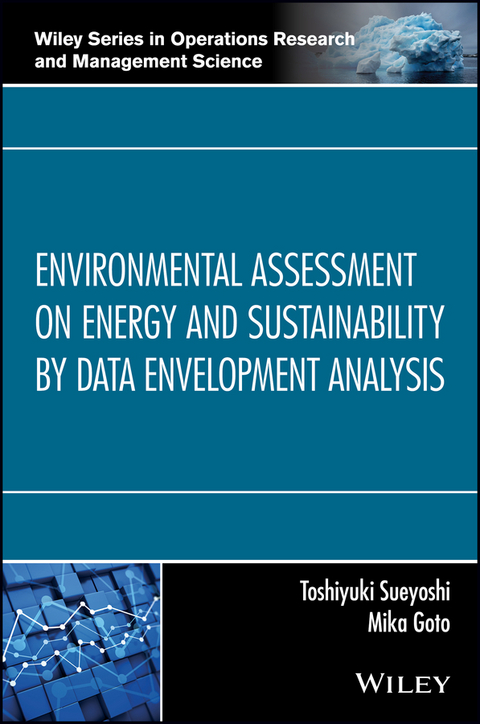
Environmental Assessment on Energy and Sustainability by Data Envelopment Analysis (eBook)
John Wiley & Sons (Verlag)
978-1-118-97929-7 (ISBN)
Introduces a bold, new model for energy industry pollution prevention and sustainable growth
Balancing industrial pollution prevention with economic growth is one of the knottiest problems faced by industry today. This book introduces a novel approach to using data envelopment analysis (DEA) as a powerful tool for achieving that balance in the energy industries-the world's largest producers of greenhouse gases. It describes a rigorous framework that integrates elements of the social sciences, corporate strategy, regional economics, energy economics, and environmental policy, and delivers a methodology and a set of strategies for promoting green innovation while solving key managerial challenges to greenhouse gas reduction and business growth.
In writing this book the authors have drawn upon their pioneering work and considerable experience in the field to develop an unconventional, holistic approach to using DEA to assess key aspects of sustainability development. The book is divided into two sections, the first of which lays out a conventional framework of DEA as the basis for new research directions. In the second section, the authors delve into conceptual and methodological extensions of conventional DEA for solving problems of environmental assessment in all contemporary energy industry sectors.
- Introduces a powerful new approach to using DEA to achieve pollution prevention, sustainability, and business growth
- Covers the fundamentals of DEA, including theory, statistical models, and practical issues of conventional applications of DEA
- Explores new statistical modeling strategies and explores their economic and business implications
- Examines applications of DEA to environmental analysis across the complete range of energy industries, including coal, petroleum, shale gas, nuclear energy, renewables, and more
- Summarizes important studies and nearly 800 peer reviewed articles on energy, the environment, and sustainability
Environmental Assessment on Energy and Sustainability by Data Envelopment Analysis is must-reading for researchers, academics, graduate students, and practitioners in the energy industries, as well as government officials and policymakers tasked with regulating the environmental impacts of industrial pollution.
TOSHIYUKI SUEYOSHI, PhD, is a full professor at New Mexico Institute of Mining and Technology, Soccorro, New Mexico, USA. Dr. Sueyoshi has published more than 300 articles in well-known international (SCI/SSCI listed) journals.
MIKA GOTO, PhD, is a full professor at Tokyo Institute of Technology, Tokyo, Japan. Dr. Goto has published more than 100 articles in well-known international (SCI/SSCI listed) journals.
Introduces a bold, new model for energy industry pollution prevention and sustainable growth Balancing industrial pollution prevention with economic growth is one of the knottiest problems faced by industry today. This book introduces a novel approach to using data envelopment analysis (DEA) as a powerful tool for achieving that balance in the energy industries the world s largest producers of greenhouse gases. It describes a rigorous framework that integrates elements of the social sciences, corporate strategy, regional economics, energy economics, and environmental policy, and delivers a methodology and a set of strategies for promoting green innovation while solving key managerial challenges to greenhouse gas reduction and business growth. In writing this book the authors have drawn upon their pioneering work and considerable experience in the field to develop an unconventional, holistic approach to using DEA to assess key aspects of sustainability development. The book is divided into two sections, the first of which lays out a conventional framework of DEA as the basis for new research directions. In the second section, the authors delve into conceptual and methodological extensions of conventional DEA for solving problems of environmental assessment in all contemporary energy industry sectors. Introduces a powerful new approach to using DEA to achieve pollution prevention, sustainability, and business growth Covers the fundamentals of DEA, including theory, statistical models, and practical issues of conventional applications of DEA Explores new statistical modeling strategies and explores their economic and business implications Examines applications of DEA to environmental analysis across the complete range of energy industries, including coal, petroleum, shale gas, nuclear energy, renewables, and more Summarizes important studies and nearly 800 peer reviewed articles on energy, the environment, and sustainability Environmental Assessment on Energy and Sustainability by Data Envelopment Analysis is must-reading for researchers, academics, graduate students, and practitioners in the energy industries, as well as government officials and policymakers tasked with regulating the environmental impacts of industrial pollution.
TOSHIYUKI SUEYOSHI, PhD, is a full professor at New Mexico Institute of Mining and Technology, Soccorro, New Mexico, USA. Dr. Sueyoshi has published more than 300 articles in well-known international (SCI/SSCI listed) journals. MIKA GOTO, PhD, is a full professor at Tokyo Institute of Technology, Tokyo, Japan. Dr. Goto has published more than 100 articles in well-known international (SCI/SSCI listed) journals.
1
GENERAL DESCRIPTION
1.1 INTRODUCTION
It is important to keep in mind that the purpose and interest of this book are not a conventional use of data envelopment analysis (DEA) for efficiency measurement and performance analysis. Rather, this book will direct our research attention and concerns toward a new use of DEA on environment assessment and sustainability development. This chapter1 is designed to discuss a new research direction for DEA.
This book consists of two sections (I and II). As an initial step, this chapter starts by reviewing fundamental research concepts for a conventional use of DEA. Such a conventional use will be discussed in all chapters of Section I. Then, Section II will extend it from the perspective of policy and business implications concerning environmental assessment and sustainability development. The methodology used for the newly proposed research is referred to as “DEA environmental assessment.” In addition to the environmental assessment, this book focuses upon energy sectors in the world because they are closely associated with various types of industrial pollution. An important environmental issue to be discussed in this book is how to challenge global warming and climate change in the world. Of course, we clearly understand that it is not easy to solve these climate issues by using only the proposed DEA environmental assessment and its applications to energy sectors. Rather, this book will attempt to investigate the global difficulty from the perspectives of business, policy and economics, so that we can assist technology development to avoid serious consequences such as heat waves, droughts, floods and food crisis, as well as other damage to human, social and economic systems. Thus, we will challenge various issues due to the climate change by utilizing the analytical capabilities of DEA environmental assessment, newly proposed in this book. This book will also attempt to change the profit‐driven business logic used in a conventional use of DEA in such a manner that it can fit within the global trend for developing a sustainable society.
This chapter is organized in the following manner: Section 1.2 describes the structure of this book. Section 1.3 summarizes contributions on Sections I and II. Section 1.4 specifies abbreviations and nomenclature used in this book. Finally, Section 1.5 summarizes this chapter.
1.2 STRUCTURE
First of all, we need to mention that DEA is not a perfect methodology, rather it is an approximation approach for the performance assessment of many organizations in the public and private sectors. See Chapter 6 for methodical comparisons between conventional DEA models. However, it is true that DEA can provide corporate leaders and policy makers with an empirical guideline to assist their decision makings. Such a guideline is very important in assessing environmental issues and sustainability developments. To attain the research direction discussed here, the two sections of this book (Sections I and II) contain the following chapters:
Section I: Conventional DEA
- Chapter 1 (General Description): This chapter provides a general description on the structure of this book.
- Chapter 2 (Overview): This chapter conveys the message that DEA can serve as a very useful methodology in terms of not only conventional performance assessment but also practical and academic purposes in guiding organizations in public and private sectors. However, it is true that DEA is not a perfect methodology, rather being an approximation approach for performance assessment. The review in this chapter provides us with an intuitive description, or rationale, concerning why various DEA applications can be used for examining performance assessment.
- Chapter 3 (History): This chapter returns to the eighteenth century to describe the origin of L1 regression and its analytical linkage to DEA. It is possible for us to consider that various DEA models are methodologies for multi‐objective optimization which have been originated from the development of goal programming (GP). The history of GP started from the development of L1 regression. Thus, this chapter describes an analytical linkage among L1 regression, GP and DEA.
- Chapter 4 (Radial Measurement): This chapter discusses two radial models that are used to measure a level of operational efficiency based on the Debreu–Farrell criterion. These models are classified into two categories under variable or constant returns to scale (RTS).
- Chapter 5 (Non‐radial Measurement): This chapter discusses non‐radial models and their variations, as methodological alternatives to the two radial models, based on the Pareto–Koopmans criterion.
- Chapter 6 (Desirable Properties): This chapter discusses nine desirable properties for the measurement of operational efficiency. It is better for each DEA model to satisfy such desirable properties from the perspective of production economics and optimization. Seven radial and non‐radial models are theoretically compared from the perspective of nine criteria.
- Chapter 7 (Strong Complementary Slackness Conditions): It is widely known that DEA has four difficulties in the applications. First, multiple projections occur in DEA. Second, multiple references occur in DEA, as well. Third, DEA cannot handle zero and/or negative values in a data set. Finally, an occurrence of zero may be usually found in dual variables. The occurrence of the fourth problem indicates that production factors, corresponding to dual variables with zero, are not fully utilized in DEA assessment. This chapter discusses the new use of strong complementary slackness conditions (SCSCs) to deal with the first, second and fourth difficulties related to DEA. The third difficulty will be discussed in Chapters 26 and 27, later.
- Chapter 8 (Returns to Scale): This chapter discusses the concept and type of RTS in a unified framework of DEA production and cost analyses under the assumption of a unique optimal solution (e.g., a unique projection and a unique reference set). Dual relationships between production‐based and cost‐based RTS measures are discussed in this chapter.
- Chapter 9 (Congestion): A possible occurrence of congestion serves as a very important concept for environmental assessment. Therefore, this chapter reviews the implication of the occurrence within a conventional framework of DEA. The occurrence of congestion indicates a capacity limit on part or all of a whole production facility. This chapter reassesses previous discussions on a possible occurrence of congestion. The concept discussed in this chapter will be later extended into a new development on eco‐technology innovation in Chapter 21.
- Chapter 10 (Network Computing): To deal with a large data set on various DEA assessments, this chapter highlights the architecture of network computing that is designed to coordinate a simultaneous use of multiple personal computers and other types of computing devices. This chapter provides a DEA‐based computational structure and algorithmic uniqueness. The proposed network computing can fit with modern computer technology, or a super computer, that has multi‐processors for parallel computation.
- Chapter 11 (DEA‐Discriminant Analysis): Discriminant analysis (DA) is a classification method that can predict the group membership of a newly sampled observation. This chapter discusses a new type of non‐parametric DA approach to provide a set of weights for a discriminant function, consequently yielding an evaluation score for group memberships. The non‐parametric DA is referred to as data envelopment analysis–discriminant analysis (DEA‐DA) because it maintains a discriminant capability by incorporating the non‐parametric feature of DEA into DA. DEA‐DA is very useful in assessing financial performance in the private sector.
- Chapter 12 (Literature Study on DEA): This chapter lists previous research efforts on DEA, along with a link to environmental assessment. This chapter also summarizes software sources that can be used for the computation of DEA.
Section II: DEA Environmental Assessment
- Chapter 13 (World Energy): This chapter describes a recent world‐wide energy trend. Energy is separated into primary and secondary categories. Primary energy is classified into fossil and non‐fossil fuels. The fossil fuels include oil, natural gas and coal, while the non‐fossil ones include nuclear and renewable energies (e.g., solar, wind, biomass, water and others). In this chapter, electricity is considered as a representative of secondary energy.
- Chapter 14 (Environmental Protection): This chapter discusses a historical review of various policy efforts to prevent industrial pollution in the four regions: the European Union, Japan, China and the United States. This review of environmental issues is important in understanding a historical reason concerning why we are now facing different types of industrial pollution (e.g., air, water, soil and others) and serious pollution issues (e.g., the global warming and climate change) along with their industrial development and economic growth in the world.
- Chapter 15 (Concepts): This chapter describes conceptual...
| Erscheint lt. Verlag | 29.1.2018 |
|---|---|
| Reihe/Serie | Wiley Series in Operations Research and Management Science |
| Wiley Series in Operations Research and Management Science | Wiley Series in Operations Research and Management Science |
| Sprache | englisch |
| Themenwelt | Geisteswissenschaften ► Geschichte |
| Mathematik / Informatik ► Mathematik ► Statistik | |
| Naturwissenschaften ► Biologie ► Ökologie / Naturschutz | |
| Technik ► Elektrotechnik / Energietechnik | |
| Wirtschaft ► Betriebswirtschaft / Management ► Unternehmensführung / Management | |
| Schlagworte | Betriebswirtschaft • Betriebswirtschaft u. Operationsforschung • Business & Management • coal industry environmental analysis • controlling greenhouse gas emissions • Data envelopment analysis • data envelopment analysis for pollution prevention • data envelopment analysis for sustainable economic growth • data envelopment analysis models for sustainable economic growth</p> • economic development for sustainability • electricity production environmental analysis • Energie • Energiewirtschaft • Energiewirtschaft u. -politik • Energy • Energy Economics & Policy • energy, environment, and social sustainability • energy industry environmental analysis • energy industry environmental impact • energy industry pollution prevention • Environmental Analysis • environmentally friendly industry • Environmental Science • Environmental Studies • green industry case studies • green industry examples • Green Innovation • <p>industrial pollution • Management Science/Operational Research • nuclear energy environmental analysis • oil industry environmental analysis • pollution prevention and sustainable growth • preventing greenhouse gases • preventing greenhouse gas pollution • shale gas environmental analysis • Sustainable Economic Development • Sustainable Industry • Umweltforschung • Umweltwissenschaften • Wirtschaft u. Management |
| ISBN-10 | 1-118-97929-X / 111897929X |
| ISBN-13 | 978-1-118-97929-7 / 9781118979297 |
| Informationen gemäß Produktsicherheitsverordnung (GPSR) | |
| Haben Sie eine Frage zum Produkt? |
 EPUB (Adobe DRM)
Kopierschutz: Adobe-DRM
Adobe-DRM ist ein Kopierschutz, der das eBook vor Mißbrauch schützen soll. Dabei wird das eBook bereits beim Download auf Ihre persönliche Adobe-ID autorisiert. Lesen können Sie das eBook dann nur auf den Geräten, welche ebenfalls auf Ihre Adobe-ID registriert sind.
Details zum Adobe-DRM
Dateiformat: EPUB (Electronic Publication)
EPUB ist ein offener Standard für eBooks und eignet sich besonders zur Darstellung von Belletristik und Sachbüchern. Der Fließtext wird dynamisch an die Display- und Schriftgröße angepasst. Auch für mobile Lesegeräte ist EPUB daher gut geeignet.
Systemvoraussetzungen:
PC/Mac: Mit einem PC oder Mac können Sie dieses eBook lesen. Sie benötigen eine
eReader: Dieses eBook kann mit (fast) allen eBook-Readern gelesen werden. Mit dem amazon-Kindle ist es aber nicht kompatibel.
Smartphone/Tablet: Egal ob Apple oder Android, dieses eBook können Sie lesen. Sie benötigen eine
Geräteliste und zusätzliche Hinweise
Buying eBooks from abroad
For tax law reasons we can sell eBooks just within Germany and Switzerland. Regrettably we cannot fulfill eBook-orders from other countries.
aus dem Bereich