


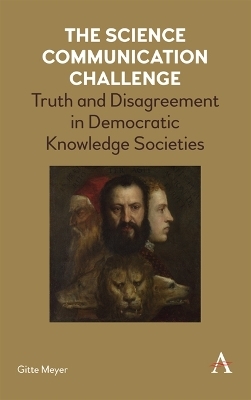
The Science Communication Challenge
Truth and Disagreement in Democratic Knowledge Societies
Seiten
2018
Anthem Press (Verlag)
978-1-78308-753-2 (ISBN)
Anthem Press (Verlag)
978-1-78308-753-2 (ISBN)
‘The Science Communication Challenge’ explores and discusses the whys – as distinct from the hows – of science communication. Arguing that the dominant science communication paradigm is didactic, and tracing the origins of that paradigm, it makes the case for a political category of science communication, aimed at furthering discussions of science-related public affairs.
The Science Communication Challenge explores and discusses the whys – as distinct from the hows – of science communication. Arguing that the dominant science communication paradigm is didactic, it makes the case for a political category of science communication, aimed at furthering discussions of science-related public affairs and making room for civilized and reasonable exchanges between different points of view. As civil societies and knowledge societies, modern democratic societies are confronted with the challenge of accommodating both the scientific logic of truth-seeking and the classical political logic of pluralism. The didactic science communication paradigm, however, is unsuited to dealing with substantial disagreement. Therefore, it is also unsuited to facilitate communication about the steadily increasing number of science-related political issues. Using insights from an array of academic fields, The Science Communication Challenge explores the possible origins of the didactic paradigm, connecting it to particular understandings of knowledge, politics and the public and to the widespread assumption of a science-versus-politics dichotomy. The book offers a critique of that assumption and suggests that science and politics be seen as substantially different activities, suited to dealing with different kinds of questions – and to different varieties of science communication.
The Science Communication Challenge explores and discusses the whys – as distinct from the hows – of science communication. Arguing that the dominant science communication paradigm is didactic, it makes the case for a political category of science communication, aimed at furthering discussions of science-related public affairs and making room for civilized and reasonable exchanges between different points of view. As civil societies and knowledge societies, modern democratic societies are confronted with the challenge of accommodating both the scientific logic of truth-seeking and the classical political logic of pluralism. The didactic science communication paradigm, however, is unsuited to dealing with substantial disagreement. Therefore, it is also unsuited to facilitate communication about the steadily increasing number of science-related political issues. Using insights from an array of academic fields, The Science Communication Challenge explores the possible origins of the didactic paradigm, connecting it to particular understandings of knowledge, politics and the public and to the widespread assumption of a science-versus-politics dichotomy. The book offers a critique of that assumption and suggests that science and politics be seen as substantially different activities, suited to dealing with different kinds of questions – and to different varieties of science communication.
Gitte Meyer was a journalist, concentrating on science- and technology-related issues, for 25 years (1975–2000) before turning to academics. Using a multidisciplinary approach to researching and writing, she focuses on the interplay between science and wider society. Meyer has been affiliated with the University of Copenhagen, Aalborg University and Copenhagen Business School.
List of Snapshots; Acknowledgements; 1. Science Communication in Democratic Knowledge Societies; 2. Science as ’Universal Light’; 3. The Elusive Concept of the Modern Public; 4. The Elusive Concept of Modern Politics; 5. A Political Category of Science Communication; Notes; Bibliography; Index.
| Erscheinungsdatum | 03.08.2018 |
|---|---|
| Verlagsort | London |
| Sprache | englisch |
| Maße | 153 x 229 mm |
| Gewicht | 454 g |
| Themenwelt | Naturwissenschaften |
| ISBN-10 | 1-78308-753-6 / 1783087536 |
| ISBN-13 | 978-1-78308-753-2 / 9781783087532 |
| Zustand | Neuware |
| Informationen gemäß Produktsicherheitsverordnung (GPSR) | |
| Haben Sie eine Frage zum Produkt? |
Mehr entdecken
aus dem Bereich



aus dem Bereich
Wie die Mathematik unsere Welt verändert hat
Buch | Hardcover (2024)
Librero b.v. (Verlag)
CHF 27,90


