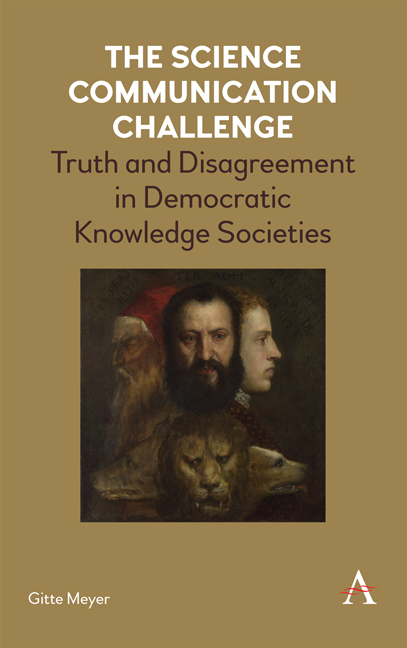
The Science Communication Challenge (eBook)
192 Seiten
NBN International - Anthem Press (Verlag)
978-1-78308-755-6 (ISBN)

‘The Science Communication Challenge’ explores and discusses the whys – as distinct from the hows – of science communication. Arguing that the dominant science communication paradigm is didactic, and tracing the origins of that paradigm, it makes the case for a political category of science communication, aimed at furthering discussions of science-related public affairs.
Current knowledge societies tend to be based on an understanding of science as an all-purpose problem-solver and include the expansion of scientific methods and frameworks of thought to ever more areas of life. Such development is less pragmatic and down-to- earth than it may appear at first glance. It is accompanied by a relentless expansion of the domain of a logic of universal truth and its technical equivalent: correct solutions, and is tied to a general understanding of science communication as a didactic enterprise aimed at disseminating scientific ways of thinking and responses to problems to a lay public of non-knowers.
Potentially, it seems, science can provide answers to all questions. Disagreement appears as no more than a symptom of immature science and has no place within the didactic science communication paradigm. As a consequence, democratic knowledge societies are challenged as political entities in the classical, pluralist sense, characterized by continuous discussion among different points of view and ways of reasoning on societal issues and using disagreement as a vehicle for discussions, negotiations and compromises.
Against such a background, ‘The Science Communication Challenge’ suggests that the didactic approaches to science communication be supplemented with a political category of science communication, suited to practical-political issues and featuring citizens on an equal footing – some of them scientists – who represent different points of view and ways of reasoning and share responsibility for public affairs. The possible gain, it is argued, may be the maintenance of knowledge societies as political entities with room for a civil society of multiple positions and perspectives that has served as a fertile ground for the development of science as an intellectual endeavour and as a body of knowledge and rational methodology.
Drawing on insights from an array of academic fields and disciplines, ‘The Science Communication Challenge’ explores the possible origins of the didactic paradigm, connecting it to particular understandings of knowledge, politics and the public and to the seemingly widespread assumption of a science-versus-politics dichotomy, taking science and politics to be competing activities that are concerned with similar questions in different ways. Inspired by classical political thought it is argued that science and politics be seen as substantially different activities, suited to dealing with different kinds of questions – and to different varieties of science communication.
lt;p>Gitte Meyer was a journalist, concentrating on science- and technology-related issues, for 25 years (1975–2000) before turning to academics. Using a multidisciplinary approach to researching and writing, she focuses on the interplay between science and wider society. Meyer has been affiliated with the University of Copenhagen, Aalborg University and Copenhagen Business School.
List of Snapshots; Acknowledgements; 1. Science Communication in Democratic Knowledge Societies; 2. Science as ’Universal Light’; 3. The Elusive Concept of the Modern Public; 4. The Elusive Concept of Modern Politics; 5. A Political Category of Science Communication; Notes; Bibliography; Index.
| Erscheint lt. Verlag | 26.3.2018 |
|---|---|
| Verlagsort | London |
| Sprache | englisch |
| Maße | 150 x 150 mm |
| Gewicht | 454 g |
| Themenwelt | Geisteswissenschaften ► Philosophie |
| ISBN-10 | 1-78308-755-2 / 1783087552 |
| ISBN-13 | 978-1-78308-755-6 / 9781783087556 |
| Informationen gemäß Produktsicherheitsverordnung (GPSR) | |
| Haben Sie eine Frage zum Produkt? |
 EPUB (Adobe DRM)
Kopierschutz: Adobe-DRM
Adobe-DRM ist ein Kopierschutz, der das eBook vor Mißbrauch schützen soll. Dabei wird das eBook bereits beim Download auf Ihre persönliche Adobe-ID autorisiert. Lesen können Sie das eBook dann nur auf den Geräten, welche ebenfalls auf Ihre Adobe-ID registriert sind.
Details zum Adobe-DRM
Dateiformat: EPUB (Electronic Publication)
EPUB ist ein offener Standard für eBooks und eignet sich besonders zur Darstellung von Belletristik und Sachbüchern. Der Fließtext wird dynamisch an die Display- und Schriftgröße angepasst. Auch für mobile Lesegeräte ist EPUB daher gut geeignet.
Systemvoraussetzungen:
PC/Mac: Mit einem PC oder Mac können Sie dieses eBook lesen. Sie benötigen eine
eReader: Dieses eBook kann mit (fast) allen eBook-Readern gelesen werden. Mit dem amazon-Kindle ist es aber nicht kompatibel.
Smartphone/Tablet: Egal ob Apple oder Android, dieses eBook können Sie lesen. Sie benötigen eine
Geräteliste und zusätzliche Hinweise
Buying eBooks from abroad
For tax law reasons we can sell eBooks just within Germany and Switzerland. Regrettably we cannot fulfill eBook-orders from other countries.
aus dem Bereich