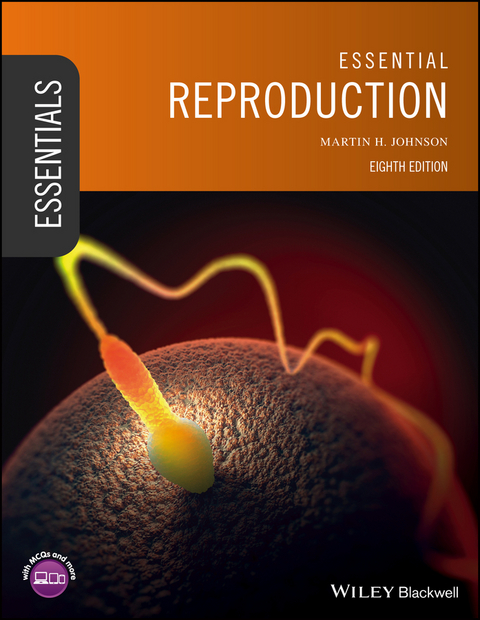
Essential Reproduction (eBook)
John Wiley & Sons (Verlag)
978-1-119-24647-3 (ISBN)
Essential Reproduction provides an accessible account of the fundamentals of reproduction within the context of cutting-edge knowledge and examples of its application. The eighth edition of this internationally best-selling title provides a multidisciplinary approach integrating anatomy, physiology, genetics, behaviour, biochemistry, molecular biology and clinical science, to give thorough coverage of the study of mammalian reproduction.
Key features:
- Contains discussion of the latest on conceptual, informational and applied aspects of reproduction
- New pedagogical features such as clinical case studies at the end of each chapter
- Better use of boxed material to improve separation of narrative text from ancillary information
- Highlighted key words for ease of reference relate to summary of key points
- Introduction now split into two sections
- Expanded content in Fetal challenges, and Society and reproduction
- Substantial rearrangement and updating in Making sperm, Controlling fertility, and Restoring fertility
Martin H. Johnson MA, PhD, FRCOG, FRSB, FMedSci, FRS
Emeritus Professor of Reproductive Sciences, Department of Physiology, Development and Neuroscience, University of Cambridge; Fellow of Christ's College, Cambridge, UK; Honorary Academic Fellow of St Paul's College, Sydney, NSW, Australia
Essential Reproduction provides an accessible account of the fundamentals of reproduction within the context of cutting-edge knowledge and examples of its application. The eighth edition of this internationally best-selling title provides a multidisciplinary approach integrating anatomy, physiology, genetics, behaviour, biochemistry, molecular biology and clinical science, to give thorough coverage of the study of mammalian reproduction. Key features: Contains discussion of the latest on conceptual, informational and applied aspects of reproduction New pedagogical features such as clinical case studies at the end of each chapter Better use of boxed material to improve separation of narrative text from ancillary information Highlighted key words for ease of reference relate to summary of key points Introduction now split into two sections Expanded content in Fetal challenges, and Society and reproduction Substantial rearrangement and updating in Making sperm, Controlling fertility, and Restoring fertility
Martin H. Johnson MA, PhD, FRCOG, FRSB, FMedSci, FRS Emeritus Professor of Reproductive Sciences, Department of Physiology, Development and Neuroscience, University of Cambridge; Fellow of Christ's College, Cambridge, UK; Honorary Academic Fellow of St Paul's College, Sydney, NSW, Australia
Contributors vii
Preface viii
How to use this book x
Acknowledgements xi
About the companion website xii
Part 1: Introduction 1
1 What is reproduction? 3
2 The infrastructure of reproduction 13
Part 2: Making women and men 35
3 Sex 37
4 Sexual maturation 53
5 Gender 72
6 Sexual selection 88
Part 3: Preparing for pregnancy 107
7 Making sperm 109
8 Men 128
9 Making eggs 139
10 Women 158
Part 4: Making an embryo 181
11 Sperm and eggs 183
12 Fertilization 197
13 Initiating pregnancy 215
Part 5: Maintaining a pregnancy 237
14 Supporting the embryo and fetus 239
15 Growing the fetus 257
16 Fetal challenges 270
Part 6: A new individual 289
17 Preparing for birth 291
18 Giving birth 301
19 Lactation 318
20 Postnatal care 330
Part 7: Manipulating reproduction 345
21 Controlling fertility 347
22 Restoring fertility 363
23 Society and reproduction 383
Index 395
CHAPTER 1
What is reproduction?
The ability to reproduce is a defining feature of all living organisms. Through reproduction, we pass our genes to a new generation. Each new generation in turn reproduces or dies out. The survivors are ‘selected’, by disease resistance and by successful competition for resources and mates, for their ‘fitness’ to live and to reproduce. In this way, the gene pool of surviving species is constantly adapting to the prevailing environment to provide the best available ‘fit’. Thus, reproduction has been central to our evolution as the species Homo sapiens.
However, humans transmit more than simply their genes across generations. Humans have evolved high levels of sociability through which cultures are formed. Cultural practices are also transmitted across generations, and reproduction itself lies at the very heart of many of our cultural practices and taboos (see Chapters 5, 6, 20 and 23). Human society, by influencing socially and/or medically who survives to reproduce and with whom, is itself now part of the ‘selection’ process. This pivotal position of reproduction in our culture makes it a sensitive subject for study. Indeed, scientific enquiry into human reproduction was relatively late to the modern research scene and even today can provoke hostility, embarrassment or distress.
In this opening chapter, human reproduction is introduced and contextualized: in relation to other species – reproductive strategies, and in relation to time – the reproductive life cycle.
Reproductive strategies
Most organisms reproduce asexually (or vegetatively). For example, many unicellular organisms reproduce themselves mitotically, just like the individual cells of our body (Figure 1.1). Mitotic divisions generate two offspring that are genetically identical to each other and to their single parent. Among multicellular organisms, some shed cells or even body parts from which another genetically identical individual can be generated – a process called regeneration. Others, including some complex vertebrates such as lizards, reproduce themselves by setting aside a special population of egg cells that can differentiate into conceptuses in the absence of a fertilizing spermatozoon. This type of asexual reproduction is called parthenogenesis, and generates a completely new organism with the same gene complement as its parent.
Figure 1.1 Mitosis and meiosis in human cells. Each human cell contains 23 pairs of homologous chromosomes, making 46 chromosomes in total. Each set of 23 chromosomes is called a haploid set. When a cell has two complete sets, it is described as being diploid. In this figure, we show at the top a single schematized human cell with just two of the 23 homologous pairs of chromosomes illustrated, each being individually colour‐coded. Between divisions, the cell is in interphase, during which it grows and duplicates both its centriole and the DNA in each of its chromosomes. As a result of the DNA replication, each chromosome consists of two identical chromatids joined at the centromere. Interphase chromosomes are not readily visible, being long, thin and decondensed (but are shown in this figure in a more condensed form for simplicity of representation).
Lower left panel: In mitotic prophase, the two chromatids become distinctly visible under the light microscope as each shortens and thickens by a spiralling contraction; at the end of prophase the nucleoli and nuclear membrane break down. In mitotic metaphase, microtubules form a mitotic spindle between the two centrioles and the chromosomes lie on its equator. In mitotic anaphase, the centromere of each chromosome splits and the two chromatids in each chromosome migrate to opposite poles of the spindle (karyokinesis). During mitotic telophase division of the cytoplasm into two daughters (known as cytokinesis) along with breakdown of the spindle and the reformation of nuclear membranes and nucleoli occurs, as does the decondensation of chromosomes so that they are no longer visible under the light microscope. Two genetically identical daughter cells now exist where one existed before. Mitosis is a non‐sexual or vegetative form of reproduction.
Lower right panel: Meiosis involves two sequential divisions. The first meiotic prophase (prophase 1) is lengthy and can be divided into several sequential steps: (1) leptotene chromosomes are long and thin; (2) during zygotene, homologous pairs of chromosomes from each haploid set come to lie side by side along parts of their length; (3) in pachytene, chromosomes start to thicken and shorten and become more closely associated in pairs along their entire length at which time synapsis, crossing over and chromatid exchange take place and nucleoli disappear; (4) in diplotene and diakinesis, chromosomes shorten further and show evidence of being closely linked to their homologue at the chiasmata where crossing over and the reciprocal exchange of DNA sequences have occurred, giving a looped or cross‐shaped appearance. In meiotic metaphase 1, the nuclear membrane breaks down, and homologous pairs of chromosomes align on the equator of the spindle. In meiotic anaphase 1, homologous chromosomes move in opposite directions. In meiotic telophase 1, cytokinesis occurs; the nuclear membrane may re‐form temporarily, although this does not always happen, yielding two daughter cells each with half the number of chromosomes (only one member of each homologous pair), but each chromosome consisting of two genetically unique chromatids (because of the crossing‐over at chiasmata). In the second meiotic division, these chromatids then separate much as in mitosis, to yield a total of four haploid offspring from the original cell, each containing only one complete set of chromosomes. Due to chromatid exchange and the random segregation of homologous chromosomes, each haploid cell is genetically unique. At fertilization, two haploid cells will come together to yield a new diploid zygote.
Mammals reproduce sexually
Parthenogenesis is simply not an option available to mammals. Thus, although it is possible to activate a mammalian egg (including a human egg) in the complete absence of a spermatozoon, such that it undergoes the early processes of development and may even implant in the uterus, these parthenogenetic conceptuses always fail and die eventually (see page 10 for an explanation as to why this is).
Reproduction in mammals is invariably sexual. Sex is defined formally in biology as a process whereby a genetically novel individual is formed as a result of the mixing of genes from two individuals. So, the essential feature of mammalian sexual reproduction is that each new individual receives its chromosomes in two roughly equal portions: half carried in a male gamete, the spermatozoon (see Chapter 7), and half in a female gamete, the oocyte (see Chapter 9). These gametes come together at fertilization (see Chapter 12) to form the genetically novel zygote. In order to reproduce subsequently, the individual formed from that zygote must transmit only half its own chromosomes to the new zygotes of the next generation. In sexually reproducing species, therefore, a special population of germ cells is set aside. These cells undergo the division process of meiosis, during which the chromosomal content of the germ cells is reduced by half and the genetic composition of each chromosome is modified as a result of the exchange of pieces of homologous chromosomes (Figure 1.1). The increased genetic diversity that is generated within a sexually reproducing population offers a richer and more varied source of material on which natural selection can operate. The population therefore shows greater resilience in the face of environmental challenge. In Chapters 3 and 4, we examine how the two sexes are formed and matured.
Both natural and sexual selection operate in mammals
Asexually reproducing organisms do not need to find a sexual partner. Whether or not they reproduce depends entirely on their survival – natural selection operates simply at this level. Sexual reproduction introduces a complication since it involves two individuals. These have to come together and synchronize their egg and sperm production and shedding: spatial and temporal coordination is highly desirable to optimize fertility. The conjunction of two sexes also provides opportunities for mate selection. For...
| Erscheint lt. Verlag | 12.1.2018 |
|---|---|
| Reihe/Serie | Essentials |
| Essentials | Essentials |
| Sprache | englisch |
| Themenwelt | Medizin / Pharmazie ► Medizinische Fachgebiete ► Innere Medizin |
| Studium ► 1. Studienabschnitt (Vorklinik) ► Histologie / Embryologie | |
| Naturwissenschaften ► Biologie ► Zoologie | |
| Veterinärmedizin | |
| Schlagworte | Abortion • Allgemeine u. Innere Medizin • anatomy • Birth • Conception • Contraception • Egg • Embryo • Family • Fertilisation • fertility • Fetus • foetus • Gender • General & Internal Medicine • Genetics • Gynaecology • Implantation • Labour • <br /> • Mammalian reproduction • MAN • medical education • Medical Science • Medicine • Medizin • Medizinstudium • Obstetrics • Physiology • postnatal • Pregnancy • Reproduction • Reproductive system • Sex • sexual maturation • Sexual Medicine • Sexualmedizin • Sexual Selection • Sperm • Woman |
| ISBN-10 | 1-119-24647-4 / 1119246474 |
| ISBN-13 | 978-1-119-24647-3 / 9781119246473 |
| Informationen gemäß Produktsicherheitsverordnung (GPSR) | |
| Haben Sie eine Frage zum Produkt? |
 EPUB (Adobe DRM)
Kopierschutz: Adobe-DRM
Adobe-DRM ist ein Kopierschutz, der das eBook vor Mißbrauch schützen soll. Dabei wird das eBook bereits beim Download auf Ihre persönliche Adobe-ID autorisiert. Lesen können Sie das eBook dann nur auf den Geräten, welche ebenfalls auf Ihre Adobe-ID registriert sind.
Details zum Adobe-DRM
Dateiformat: EPUB (Electronic Publication)
EPUB ist ein offener Standard für eBooks und eignet sich besonders zur Darstellung von Belletristik und Sachbüchern. Der Fließtext wird dynamisch an die Display- und Schriftgröße angepasst. Auch für mobile Lesegeräte ist EPUB daher gut geeignet.
Systemvoraussetzungen:
PC/Mac: Mit einem PC oder Mac können Sie dieses eBook lesen. Sie benötigen eine
eReader: Dieses eBook kann mit (fast) allen eBook-Readern gelesen werden. Mit dem amazon-Kindle ist es aber nicht kompatibel.
Smartphone/Tablet: Egal ob Apple oder Android, dieses eBook können Sie lesen. Sie benötigen eine
Geräteliste und zusätzliche Hinweise
Buying eBooks from abroad
For tax law reasons we can sell eBooks just within Germany and Switzerland. Regrettably we cannot fulfill eBook-orders from other countries.
aus dem Bereich