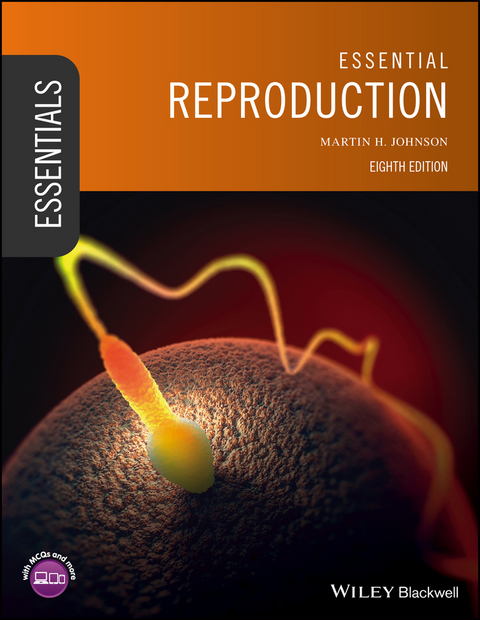
Essential Reproduction (eBook)
John Wiley & Sons (Verlag)
978-1-119-24645-9 (ISBN)
Essential Reproduction provides an accessible account of the fundamentals of reproduction within the context of cutting-edge knowledge and examples of its application. The eighth edition of this internationally best-selling title provides a multidisciplinary approach integrating anatomy, physiology, genetics, behaviour, biochemistry, molecular biology and clinical science, to give thorough coverage of the study of mammalian reproduction.
Key features:
- Contains discussion of the latest on conceptual, informational and applied aspects of reproduction
- New pedagogical features such as clinical case studies at the end of each chapter
- Better use of boxed material to improve separation of narrative text from ancillary information
- Highlighted key words for ease of reference relate to summary of key points
- Introduction now split into two sections
- Expanded content in Fetal challenges, and Society and reproduction
- Substantial rearrangement and updating in Making sperm, Controlling fertility, and Restoring fertility
Martin H. Johnson MA, PhD, FRCOG, FRSB, FMedSci, FRS
Emeritus Professor of Reproductive Sciences, Department of Physiology, Development and Neuroscience, University of Cambridge; Fellow of Christ's College, Cambridge, UK; Honorary Academic Fellow of St Paul's College, Sydney, NSW, Australia
Essential Reproduction provides an accessible account of the fundamentals of reproduction within the context of cutting-edge knowledge and examples of its application. The eighth edition of this internationally best-selling title provides a multidisciplinary approach integrating anatomy, physiology, genetics, behaviour, biochemistry, molecular biology and clinical science, to give thorough coverage of the study of mammalian reproduction. Key features: Contains discussion of the latest on conceptual, informational and applied aspects of reproduction New pedagogical features such as clinical case studies at the end of each chapter Better use of boxed material to improve separation of narrative text from ancillary information Highlighted key words for ease of reference relate to summary of key points Introduction now split into two sections Expanded content in Fetal challenges, and Society and reproduction Substantial rearrangement and updating in Making sperm, Controlling fertility, and Restoring fertility
Martin H. Johnson MA, PhD, FRCOG, FRSB, FMedSci, FRS Emeritus Professor of Reproductive Sciences, Department of Physiology, Development and Neuroscience, University of Cambridge; Fellow of Christ's College, Cambridge, UK; Honorary Academic Fellow of St Paul's College, Sydney, NSW, Australia
Title Page 5
Copyright Page 6
Contents 7
Contributors 9
Preface 10
How to use this book 12
Acknowledgements 13
About the companion website 14
Part 1 Introduction 15
Chapter 1 What is reproduction? 17
Reproductive strategies 18
Reproductive life cycles 22
Conclusions 25
Key learning points 25
Clinical vignette 26
Further reading 26
Chapter 2 The infrastructure of reproduction 27
The reproductive hardware 28
The brain, hypothalamus and pituitary 29
Reproductive messengers 30
General features of reproductive hormones 41
Conclusions 45
Key learning points 45
Clinical vignette 46
Further reading 46
Part 2 Making women and men 49
Chapter 3 Sex 51
The genetic determinant of sex is located on the Y chromosome 52
When, where and how does Sry act? 53
Sexual differentiation within the gonads 57
Sexually dimorphic somatic differentiation depends on the endocrine activity of the fetal testis 58
Conclusions 63
Key learning points 64
Clinical vignette 64
Further reading 65
Chapter 4 Sexual maturation 67
Prepubertal development 68
Puberty and adolescence 71
A distinctive pattern of hormonal changes underlies puberty 75
The central nervous system plays a key role in the onset of puberty 76
Conclusions 83
Key learning points 84
Further reading 85
Chapter 5 Gender 86
Gender is a system of classification based on sex 87
Gender stereotypes and gender identities 88
The brain and behavioural dimorphism 90
Might the underlying basis for sex and gender differences in humans be hormonal? 96
Gender development may form part of social learning in humans 96
Gender and reproduction 98
Conclusions 99
Key learning points 99
Clinical vignette 100
Further reading 100
Chapter 6 Sexual selection 102
Sexuality 103
Eliciting male sexual interest and arousal 107
Female sexual behaviour 108
The brain, hormones and sexual behaviour 113
Social factors influence sexual behaviour in higher primates 114
Selecting sexual partners 115
Conclusions 117
Key learning points 118
Clinical vignette 119
Further reading 119
Part 3 Preparing for pregnancy 121
Chapter 7 Making sperm 123
Testicular organization 124
Spermatogenesis has three main phases 124
Spermatogenesis is highly organized both temporally and spatially 132
Conclusions 139
Key learning points 139
Clinical vignette 140
Further reading 140
Chapter 8 Men 142
Testicular hormones 143
Spermatogenesis is dependent on endocrine support 144
Testicular hormones modulate the output of pituitary hormones 146
Androgens play an essential role in the fecund male 147
Conclusions 149
Key learning points 151
Clinical vignette 152
Further reading 152
Chapter 9 Making eggs 153
The adult ovary consists of follicles and interstitial tissue 154
The follicle is the fundamental reproductive element of the ovary 154
Ovulation 161
The corpus luteum is the postovulatory ‘follicle’ 165
Conclusions 167
Key learning points 169
Clinical vignette 170
Further reading 171
Chapter 10 Women 172
Follicular development and the ovarian cycle 173
Ovarian hormones regulate gonadotrophin secretion 175
Feedback by steroid hormones and the inhibins regulates the menstrual cycle 177
Positive and negative feedback are mediated at the level of both the hypothalamus and pituitary 179
The ovarian cycle in relation to the oestrous and menstrual cycles 182
Conclusions 191
Further reading 193
Part 4 Making an embryo 195
Chapter 11 Sperm and eggs 197
Spermatozoa require a period of epididymal maturation 198
Semen is made up of spermatozoa and seminal plasma 200
Coition 202
Gamete transport through the female genital tract 206
Conclusions 207
Key learning points 209
Clinical vignette 209
Further reading 210
Chapter 12 Fertilization 211
Spermatozoa gain their full fertilizing capacity in the female tract 212
Penetrating the egg investments 213
Spermatozoal–oocyte interactions 217
Fertilization completion 217
Anomalous fertilization 221
Conclusions 224
Key learning points 225
Clinical vignette 225
Further reading 226
Chapter 13 Initiating pregnancy 229
The preimplantation conceptus 230
Early development is ‘embryogenic’ 230
Implantation 235
The molecular conversations at implantation 238
Summary 244
The prolongation of luteal life 244
Conclusions 246
Key learning points 246
Clinical vignette 247
Further reading 248
Part 5 Maintaining a pregnancy 251
Chapter 14 Supporting the embryo and fetus 253
Nutritional strategies 254
Endocrine support strategies 263
Conclusions 267
Key learning points 268
Clinical vignette 269
Further reading 269
Chapter 15 Growing the fetus 271
Patterns of fetal growth 272
Placental transport 274
Conclusions 281
Key learning points 281
Clinical vignette 282
Further reading 283
Chapter 16 Fetal challenges 284
Pregnancy loss 285
Fetomaternal immune relations 289
Fetal hypoxia 293
Developmental programming 296
Conclusions 298
Key learning points 299
Clinical vignette 299
Further reading 300
Part 6 A new individual 303
Chapter 17 Preparing for birth 305
Fetal systems develop and mature in preparation for postnatal life 306
Fetal hormones orchestrate development and preparations for birth 311
Conclusions 313
Key learning points 313
Clinical vignette 313
Further reading 314
Chapter 18 Giving birth 315
Parturition 316
Labour 316
Endocrine control of parturition 325
Atypical births 328
Conclusions 328
Key learning points 329
Clinical vignette 329
Further reading 330
Chapter 19 Lactation 332
Lactation 333
The milk ejection reflex (MER) 338
Fertility is reduced during lactation 339
Cessation of lactation 339
Milk 340
Conclusions 341
Key learning points 342
Clinical vignette 342
Further reading 343
Chapter 20 Postnatal care 344
Patterns of maternal behaviour vary amongst mammals 345
Genetics and maternal care 352
Conclusions 355
Key learning points 355
Clinical vignette 355
Further reading 356
Part 7 Manipulating reproduction 359
Chapter 21 Controlling fertility 361
Fertility, fecundibility and fecundity 363
Artificial control of fertility 363
Pregnancy termination 373
Conclusions 373
Key learning points 374
Clinical vignette 375
Further reading 375
Chapter 22 Restoring fertility 377
Causes of subfertility 378
Approaches to subfertility treatment 382
Assisted reproductive technologies (ART) 389
Conclusions 393
Key learning points 393
Clinical vignette 394
Further reading 394
Chapter 23 Society and reproduction 397
Social constraints on fertility 398
Biological constraints on fertility 399
Society and the infertile 400
Reproduction, sexuality and ethics 404
Conclusions 405
Key learning points 405
Clinical vignette 406
Further reading 406
Index 409
EULA 427
| Erscheint lt. Verlag | 11.1.2018 |
|---|---|
| Reihe/Serie | Essentials |
| Essentials | Essentials |
| Sprache | englisch |
| Themenwelt | Medizin / Pharmazie ► Medizinische Fachgebiete ► Innere Medizin |
| Studium ► 1. Studienabschnitt (Vorklinik) ► Histologie / Embryologie | |
| Naturwissenschaften ► Biologie ► Zoologie | |
| Veterinärmedizin | |
| Schlagworte | Abortion • Allgemeine u. Innere Medizin • anatomy • Birth • Conception • Contraception • Egg • Embryo • Family • Fertilisation • fertility • Fetus • foetus • Gender • General & Internal Medicine • Genetics • Gynaecology • Implantation • Labour • <br /> • Mammalian reproduction • MAN • medical education • Medical Science • Medicine • Medizin • Medizinstudium • Obstetrics • Physiologie • Physiology • postnatal • Pregnancy • Reproduction • Reproductive system • Sex • sexual maturation • Sexual Selection • Sperm • Woman |
| ISBN-10 | 1-119-24645-8 / 1119246458 |
| ISBN-13 | 978-1-119-24645-9 / 9781119246459 |
| Informationen gemäß Produktsicherheitsverordnung (GPSR) | |
| Haben Sie eine Frage zum Produkt? |
 PDF (Adobe DRM)
Kopierschutz: Adobe-DRM
Adobe-DRM ist ein Kopierschutz, der das eBook vor Mißbrauch schützen soll. Dabei wird das eBook bereits beim Download auf Ihre persönliche Adobe-ID autorisiert. Lesen können Sie das eBook dann nur auf den Geräten, welche ebenfalls auf Ihre Adobe-ID registriert sind.
Details zum Adobe-DRM
Dateiformat: PDF (Portable Document Format)
Mit einem festen Seitenlayout eignet sich die PDF besonders für Fachbücher mit Spalten, Tabellen und Abbildungen. Eine PDF kann auf fast allen Geräten angezeigt werden, ist aber für kleine Displays (Smartphone, eReader) nur eingeschränkt geeignet.
Systemvoraussetzungen:
PC/Mac: Mit einem PC oder Mac können Sie dieses eBook lesen. Sie benötigen eine
eReader: Dieses eBook kann mit (fast) allen eBook-Readern gelesen werden. Mit dem amazon-Kindle ist es aber nicht kompatibel.
Smartphone/Tablet: Egal ob Apple oder Android, dieses eBook können Sie lesen. Sie benötigen eine
Geräteliste und zusätzliche Hinweise
Buying eBooks from abroad
For tax law reasons we can sell eBooks just within Germany and Switzerland. Regrettably we cannot fulfill eBook-orders from other countries.
aus dem Bereich