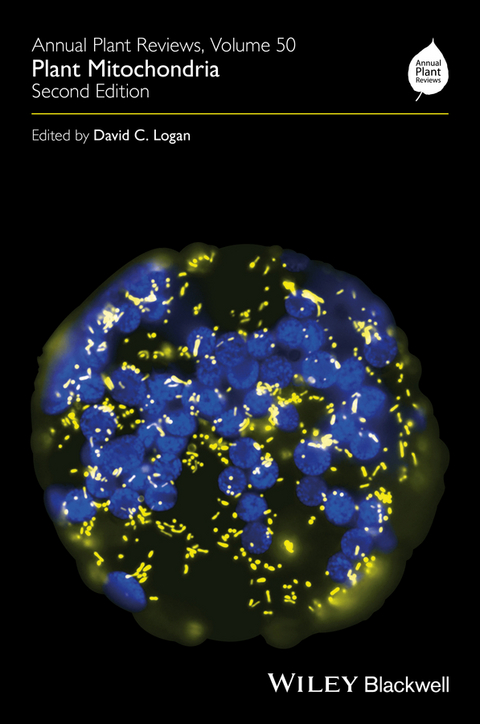
Annual Plant Reviews, Plant Mitochondria (eBook)
John Wiley & Sons (Verlag)
978-1-118-90660-6 (ISBN)
This long-awaited second edition covers the major changes that have occurred in the field over the last decade
Completely revised with the most up-to-date research and including brand new chapters, Annual Plant Reviews, Volume 50: Plant Mitochondria, 2nd Edition presents the multifaceted roles of mitochondria in plants. The book starts with a short history of plant mitochondrial research; discusses how coevolution shaped plant mitochondrial gene expression; explains control of number, shape, size, and motility of mitochondria; delves into stress responses and roles in stress alleviation in mitochondrial biochemistry; covers the damage repair pathway of the Calvin-Benson cycle; and more.
Containing sections written by many of the world's leading researchers in this area, this book brings together and reviews for the first time many recent advances. It offers chapters on: Bioblasts, Cytomikrosomen & Chondriosomes; The Crosstalk Between Genomes; The Dynamic Chondriome; Metal Homeostasis in Plant Mitochondria; RNA Metabolism and Transcript Regulation; Mitochondrial Regulation and Signalling in the Photosynthetic Cell; Mitochondrial Biochemistry; Ecophysiology of Plant Respiration; Photorespiration; and Mitochondria and Cell Death.
Annual Plant Reviews, Volume 50: Plant Mitochondria, 2nd Edition is an extremely important and timely book that will be of great use and interest to plant scientists, cell and molecular biologists, and biochemists.
David C. Logan, PhD
Institut de Recherche en Horticulture et Semences, Université d'Angers, France.
This long-awaited second edition covers the major changes that have occurred in the field over the last decade Completely revised with the most up-to-date research and including brand new chapters, Annual Plant Reviews, Volume 50: Plant Mitochondria, 2nd Edition presents the multifaceted roles of mitochondria in plants. The book starts with a short history of plant mitochondrial research; discusses how coevolution shaped plant mitochondrial gene expression; explains control of number, shape, size, and motility of mitochondria; delves into stress responses and roles in stress alleviation in mitochondrial biochemistry; covers the damage repair pathway of the Calvin-Benson cycle; and more. Containing sections written by many of the world s leading researchers in this area, this book brings together and reviews for the first time many recent advances. It offers chapters on: Bioblasts, Cytomikrosomen & Chondriosomes; The Crosstalk Between Genomes; The Dynamic Chondriome; Metal Homeostasis in Plant Mitochondria; RNA Metabolism and Transcript Regulation; Mitochondrial Regulation and Signalling in the Photosynthetic Cell; Mitochondrial Biochemistry; Ecophysiology of Plant Respiration; Photorespiration; and Mitochondria and Cell Death. Annual Plant Reviews, Volume 50: Plant Mitochondria, 2nd Edition is an extremely important and timely book that will be of great use and interest to plant scientists, cell and molecular biologists, and biochemists.
David C. Logan, PhD Institut de Recherche en Horticulture et Semences, Université d'Angers, France.
TITLE PAGE 5
COPYRIGHT PAGE 6
CONTENTS 11
LIST OF CONTRIBUTORS 17
PREFACE 19
CHAPTER 1 BIOBLASTS, CYTOMIKROSOMEN AND CHONDRIOSOMES: A SHORT INCOMPLETE HISTORY OF PLANT MITOCHONDRIAL RESEARCH 23
1.1 Discovery 23
1.2 Complexity of nomenclature 24
1.2.1 Discoveries of mitochondria in plants 24
1.3 Mitochondria are dynamic 25
1.4 Mitochondrial function and outputs 26
1.4.1 Vital staining of mitochondria with Janus green B and identification of mitochondria as sites of redox 27
1.5 Mitochondrial DNA 28
1.6 Mitochondria, photosynthesis and carbon cycling 29
1.7 A trigger for death 29
1.8 Known knowns, known unknowns and unknown unknowns of mitochondrial biology 30
References 31
CHAPTER 2 MITOCHONDRIAL DNA REPAIR AND GENOME EVOLUTION 33
2.1 Plant mitochondrial genomes are large and variable 33
2.1.1 Low mutation rates in genes 33
2.1.2 Genome Organization 34
2.1.3 Genome replication 35
2.2 The mutational burden hypothesis 35
2.2.1 Problems with the MBH and mutation rate measurements 35
2.3 DNA repair-based hypothesis 38
2.4 Additional mechanisms of DNA repair 41
2.4.1 Mismatch repair and MSH1 42
2.4.2 Nucleotide excision repair 44
2.5 Outcomes of DNA repair 44
2.6 How repair processes affect genome evolution 45
2.7 Unanswered questions 46
Acknowledgements 47
References 48
CHAPTER 3 THE CROSS-TALK BETWEEN GENOMES: HOW CO-EVOLUTION SHAPED PLANT MITOCHONDRIAL GENE EXPRESSION 55
3.1 Introduction 55
3.2 Evidence showing the versatility of factors involved in plant mitochondria gene expression 57
3.2.1 Transcription 57
3.2.2 RNA maturation 60
3.2.3 RNA editing 63
3.2.4 Intron splicing 66
3.3 Mitochondrial gene expression: co-evolution makes sense 68
3.3.1 Co-evolution of cytoplasmic male sterility 68
3.3.2 Most Rf genes encode PPR proteins 70
3.4 Co-evolution scenarios 72
3.5 Conclusion and perspectives 76
References 76
CHAPTER 4 THE DYNAMIC CHONDRIOME: CONTROL OF NUMBER, SHAPE, SIZE AND MOTILITY OF MITOCHONDRIA 89
4.1 Introduction 89
4.2 Motility 90
4.2.1 Actin-mediated displacement 90
4.2.2 Microtubules 92
4.3 Number 93
4.3.1 Division 93
4.3.2 A dynamin-independent division mechanism? 102
4.3.3 Fusion 103
4.4 The chondriostat: mitochondrial dynamics during development and following modification of cell environment 108
4.5 Mitochondrial quality control and regulation of dynamics to enable selective degradation of mitochondria 110
4.5.1 The mitophagy apparatus 111
4.5.2 FRIENDLY/Clu-type proteins 114
4.6 Case study: mitochondrial dynamics during germination 116
4.6.1 The germination process 116
4.6.2 The chondriome during germination 118
4.7 Conclusions 121
Acknowledgements 121
References 121
CHAPTER 5 METAL HOMEOSTASIS IN PLANT MITOCHONDRIA 133
5.1 Introduction 133
5.2 Iron 136
5.2.1 Heme and Fe?S clusters 136
5.2.2 Fe binding proteins 139
5.2.3 Fe transport 141
5.3 Copper 143
5.4 Zinc 145
5.5 Manganese 147
5.6 Trace metals in plant mitochondria 150
5.7 Metallome perturbation within mitochondria 151
5.8 Conclusions 154
Acknowledgements 154
References 155
CHAPTER 6 RNA METABOLISM AND TRANSCRIPT REGULATION 165
6.1 Introduction 165
6.2 The mitochondrial transcription machinery 167
6.2.1 Analyses of mitochondrial promoter regions 168
6.2.2 RNA polymerases 169
6.2.3 Co-factors of the mitochondria transcription machinery 170
6.3 Post-transcriptional RNA processing 173
6.3.1 Trimming, RNA end-processing and decay in plant mitochondria 173
6.3.2 RNA editing 177
6.3.3 Splicing of mitochondrial group II introns 181
Acknowledgements 190
References 190
CHAPTER 7 MITOCHONDRIAL REGULATION AND SIGNALLING IN THE PHOTOSYNTHETIC CELL: PRINCIPLES AND CONCEPTS 207
7.1 Introduction 207
7.2 Regulation of protein functions within plant mitochondria 209
7.2.1 Regulation of transcription and translation within mitochondria 210
7.2.2 Regulation of nuclear gene expression 211
7.2.3 Regulation of cytosolic translation and protein import into mitochondria 214
7.2.4 Regulation of protein turnover within mitochondria 216
7.2.5 Regulation of function and activity of mitochondrial proteins by post-translational modifications and small molecules 217
7.2.6 Regulation of mitochondrial number and organization as set by motility, fission, fusion and mitophagy 229
7.3 Integration of chloroplast and mitochondrial regulation and signalling 231
7.3.1 Mitochondria and chloroplasts make up a joint operational unit in the light 231
7.3.2 Operational integration of mitochondria and chloroplasts requires interdependent regulation 232
7.3.3 Does the concept of ‘mitochondrial retrograde signalling’ need rethinking for green plant cells? 233
Acknowledgements 236
References 236
CHAPTER 8 MITOCHONDRIAL BIOCHEMISTRY: STRESS RESPONSES AND ROLES IN STRESS ALLEVIATION 249
8.1 Introduction 249
8.2 Plant mitochondrial oxidative stress 250
8.2.1 Accumulation of ROS in mitochondria 250
8.2.2 ROS-induced lipid peroxidation in mitochondria 252
8.2.3 Metallome changes during oxidative stress 253
8.2.4 Proteome changes during oxidative stress 254
8.3 Plant mitochondrial roles in harsh environments and in a changing climate 256
8.3.1 Mitochondrial roles under temperature stress 258
8.3.2 The roles of mitochondria in mediating drought tolerance 259
8.3.3 Mitochondrial respiration and salinity stress 262
8.4 Stress-dissipating roles of plant mitochondrial metabolism and products 265
8.4.1 Mitochondrial impact on photosynthetic functions during environmental stress 265
8.4.2 Root-specific mitochondrial processes mediating tolerance to unfavourable soil conditions 267
8.4.3 Cellular survival during and following stress requires mitochondrial metabolism and its products 268
8.5 Future perspectives 269
Acknowledgements 269
References 269
CHAPTER 9 ECOPHYSIOLOGY OF PLANT RESPIRATION 291
9.1 Introduction 291
9.2 What is respiration? 291
9.3 The CO2/O2 paradigm 293
9.4 O2 consumption 295
9.4.1 Measuring O2 uptake of organs 295
9.4.2 The regulation of O2 uptake 296
9.4.3 Plant respiration at the ecosystem scale 299
9.5 CO2 production 300
9.5.1 Measuring organ CO2 production 300
9.5.2 IRGA 301
9.5.3 Environmental effects on CO2 measurement 302
9.5.4 Plant and ecosystem scale 303
9.5.5 Open top chambers (small-community studies) 303
9.5.6 Free-air CO2 enrichment 304
9.6 Carbon balance 305
9.6.1 Ecosystem carbon balance (eddies) 305
9.6.2 Global carbon balance 306
References 306
CHAPTER 10 PHOTORESPIRATION – DAMAGE REPAIR PATHWAY OF THE CALVIN–BENSON CYCLE 315
10.1 Introduction 315
10.2 Photorespiration prevents potential damage from a side reaction of RuBP carboxylase 317
10.3 Plant photorespiratory carbon metabolism 318
10.3.1 Glycolate 2-phosphate becomes dephosphorylated to glycolate 319
10.3.2 Glycolate is converted into glycine in the peroxisome 322
10.3.3 Glycolate oxidation 323
10.3.4 H2O2 degradation 324
10.3.5 Transamination of glyoxylate to glycine 325
10.3.6 Mitochondrial reactions combine two molecules of glycine to form serine and CO2 327
10.3.7 Back in the peroxisome, hydroxypyruvate is produced from serine and becomes oxidized to glycerate 338
10.3.8 Back in the chloroplast, 3PGA is formed to replenish the Calvin–Benson cycle 339
10.4 Interaction of photorespiration with other aspects of metabolism 340
10.4.1 Plant photorespiratory nitrogen cycle 340
10.4.2 TCA cycle and oxidative phosphorylation 343
10.5 Improving photosynthesis 344
Acknowledgement 345
References 346
CHAPTER 11 MITOCHONDRIA AND CELL DEATH 365
11.1 Introduction 365
11.2 Conservation of mitochondrial PCD pathways in plants 366
11.3 The role of mitochondrial ROS in plant PCD 369
11.4 Non-ROS-related molecules and plant PCD 372
11.5 An update on the mitochondrial permeability transition pore 373
11.6 Senescence, autophagy and PCD 376
11.7 Interactions between mitochondria and chloroplasts during PCD 377
11.8 Conclusions 379
Acknowledgements 381
References 382
INDEX 395
SUPPLEMENTAL IMAGES 400
EULA 418
| Erscheint lt. Verlag | 7.12.2017 |
|---|---|
| Reihe/Serie | Annual Plant Reviews |
| Annual Plant Reviews | Annual Plant Reviews |
| Sprache | englisch |
| Themenwelt | Naturwissenschaften ► Biologie ► Botanik |
| Schlagworte | Annual Plant Reviews, Volume 50: Plant Mitochondria</p> • bioblasts • biochemistry • Biowissenschaften • Botanik • Botanik / Physiologie • Cell & Molecular Biology • chondriomes • chondriosomes • cytomikrosomen • ecophysiology of plant respiration • Genome sequencing • Life Sciences • <p>plant mitochondria • manipulate gene expression in plants • metabolic regulation of eukaryotic organisms • metal homeostasis in plant mitochondria • mitochondria • mitochondria and cell death • mitochondrial biochemistry • Mitochondrial dynamics • mitochondrial signaling in the photosynthetic cell • mitochondriate eukaryote • mitogenomes • Molecular Biology • Organelles • Photorespiration • Plant Biology • Plant genome sequencing • plant mitochondrial biology • plant mitochondrial gene expression • Plant Physiology • plants • RNA Metabolism • RNA mitochondrial regulation in the photosynthetic cell • Zell- u. Molekularbiologie |
| ISBN-10 | 1-118-90660-8 / 1118906608 |
| ISBN-13 | 978-1-118-90660-6 / 9781118906606 |
| Informationen gemäß Produktsicherheitsverordnung (GPSR) | |
| Haben Sie eine Frage zum Produkt? |
 PDF (Adobe DRM)
Kopierschutz: Adobe-DRM
Adobe-DRM ist ein Kopierschutz, der das eBook vor Mißbrauch schützen soll. Dabei wird das eBook bereits beim Download auf Ihre persönliche Adobe-ID autorisiert. Lesen können Sie das eBook dann nur auf den Geräten, welche ebenfalls auf Ihre Adobe-ID registriert sind.
Details zum Adobe-DRM
Dateiformat: PDF (Portable Document Format)
Mit einem festen Seitenlayout eignet sich die PDF besonders für Fachbücher mit Spalten, Tabellen und Abbildungen. Eine PDF kann auf fast allen Geräten angezeigt werden, ist aber für kleine Displays (Smartphone, eReader) nur eingeschränkt geeignet.
Systemvoraussetzungen:
PC/Mac: Mit einem PC oder Mac können Sie dieses eBook lesen. Sie benötigen eine
eReader: Dieses eBook kann mit (fast) allen eBook-Readern gelesen werden. Mit dem amazon-Kindle ist es aber nicht kompatibel.
Smartphone/Tablet: Egal ob Apple oder Android, dieses eBook können Sie lesen. Sie benötigen eine
Geräteliste und zusätzliche Hinweise
Buying eBooks from abroad
For tax law reasons we can sell eBooks just within Germany and Switzerland. Regrettably we cannot fulfill eBook-orders from other countries.
aus dem Bereich