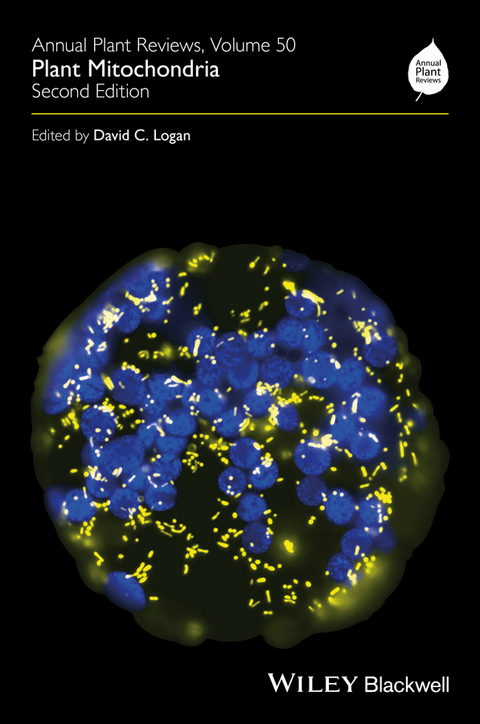
Annual Plant Reviews, Plant Mitochondria (eBook)
John Wiley & Sons (Verlag)
978-1-118-90659-0 (ISBN)
This long-awaited second edition covers the major changes that have occurred in the field over the last decade
Completely revised with the most up-to-date research and including brand new chapters, Annual Plant Reviews, Volume 50: Plant Mitochondria, 2nd Edition presents the multifaceted roles of mitochondria in plants. The book starts with a short history of plant mitochondrial research; discusses how coevolution shaped plant mitochondrial gene expression; explains control of number, shape, size, and motility of mitochondria; delves into stress responses and roles in stress alleviation in mitochondrial biochemistry; covers the damage repair pathway of the Calvin-Benson cycle; and more.
Containing sections written by many of the world's leading researchers in this area, this book brings together and reviews for the first time many recent advances. It offers chapters on: Bioblasts, Cytomikrosomen & Chondriosomes; The Crosstalk Between Genomes; The Dynamic Chondriome; Metal Homeostasis in Plant Mitochondria; RNA Metabolism and Transcript Regulation; Mitochondrial Regulation and Signalling in the Photosynthetic Cell; Mitochondrial Biochemistry; Ecophysiology of Plant Respiration; Photorespiration; and Mitochondria and Cell Death.
Annual Plant Reviews, Volume 50: Plant Mitochondria, 2nd Edition is an extremely important and timely book that will be of great use and interest to plant scientists, cell and molecular biologists, and biochemists.
David C Logan, PhD, Institut de Recherche en Horticulture et Semences, Université d'Angers, France.
This long-awaited second edition covers the major changes that have occurred in the field over the last decade Completely revised with the most up-to-date research and including brand new chapters, Annual Plant Reviews, Volume 50: Plant Mitochondria, 2nd Edition presents the multifaceted roles of mitochondria in plants. The book starts with a short history of plant mitochondrial research; discusses how coevolution shaped plant mitochondrial gene expression; explains control of number, shape, size, and motility of mitochondria; delves into stress responses and roles in stress alleviation in mitochondrial biochemistry; covers the damage repair pathway of the Calvin-Benson cycle; and more. Containing sections written by many of the world s leading researchers in this area, this book brings together and reviews for the first time many recent advances. It offers chapters on: Bioblasts, Cytomikrosomen & Chondriosomes; The Crosstalk Between Genomes; The Dynamic Chondriome; Metal Homeostasis in Plant Mitochondria; RNA Metabolism and Transcript Regulation; Mitochondrial Regulation and Signalling in the Photosynthetic Cell; Mitochondrial Biochemistry; Ecophysiology of Plant Respiration; Photorespiration; and Mitochondria and Cell Death. Annual Plant Reviews, Volume 50: Plant Mitochondria, 2nd Edition is an extremely important and timely book that will be of great use and interest to plant scientists, cell and molecular biologists, and biochemists.
David C. Logan, PhD Institut de Recherche en Horticulture et Semences, Université d'Angers, France.
PREFACE
Welcome to the second edition of Plant Mitochondria. The first edition was published in 2007, which, perhaps depending on your age, was either a long time ago or almost as if it were yesterday. While we can accept differences in human perception of the passage of time, it becomes more conceptually difficult to understand that time is not an absolute: two people moving through time at different speeds will experience events in that timeline at different relative times. The publication of Albert Einstein’s 1905 paper ‘On the electrodynamics of moving bodies’, which became known as his special relativity paper, was a seminal moment for physics, and science in general (Einstein, 1905). However, at the same time, the organelles fuelling Einstein’s extraordinary thinking did not have an agreed name (Cowdry, 1918), nor, indeed, did we know that the fuelling was even performed by organelles, of whatever name: identification of mitochondria as the site of oxidative metabolism took another 40+ years. Research in physics operates at a pace and scale different to that of biology!
As biologists, we use time, in our experiments, all the time. We are interested in the rate of change of an activity or behaviour. And central to all biology is evolution, which is change over time. As Theodosius Dobzhansky famously wrote in his essay of the same title, ‘Nothing in biology makes sense except in the light of evolution’ (Dobzhansky, 1973). A true statement cannot be more true, just as a falsehood is a lie, but in the case of mitochondria, we can say the statement is particularly apt; indeed, perhaps the corollary is valid, and nothing in the evolution of life on earth makes sense without considering mitochondria?
The world at the time of publication of the first edition of this book was very different from the world of 2017. The first iPhone was released in 2007, cloud computing took off in 2007 (for example, Dropbox was started in 2007), Google introduced Android, and Amazon introduced the Kindle. These advances changed the way many of us interact with the world around us, with parallel developments in social media: Facebook had only opened up to individuals with private email addresses in September 2006, and Twitter, launched in July 2006, was showing traffic of 400 000 tweets per quarter in 2007, rising to 50 million per day in February 2010, and now stands at 500 million tweets per day! Social media has revolutionized the way many people communicate science. However, 2007 also marked the end of a period of economic growth and optimism that culminated in a massive loss of optimism and a global financial crash from which the world still reels. This led to ‘austerity’, budget cuts and drastic reductions in the funding of basic scientific research, as the reduced funds available are earmarked to support research some believe is more likely to lead to economic recovery.
Despite years of austerity for fundamental plant biology research funding, we have seen major breakthroughs in our understanding of plant mitochondria, and thus a new edition of this book was timely. The evolving story of the mitochondrion, the story of the evolving mitochondrion, is the longest in the history of the eukaryotic cell. To paraphrase Roy Batty, the mitochondrion has seen things other organelles wouldn’t believe. But, in what ways has our understanding of plant mitochondria advanced in 10 years?
We have seen dramatic advances in next‐generation sequencing since 2007, and use of this technology has had a profound influence on our understanding of the evolution of mitochondrial genomes. The availability of sequence data and bioinformatic advances were also critical to the discovery of PPR proteins as editing factors, and subsequently, the amino acid code they use for RNA recognition (Barkan et al., 2012). And, more recently, advances in genome sequencing led to the discovery of the first mitochondriate eukaryote, amongst over 300 mitogenomes analysed, to lack complex I (Skippington et al., 2015).
We have seen fresh views on the photorespiratory pathway, which enables continued operation of the Calvin–Benson cycle, rather than being a wasteful process. And interactions between the two processes apparently include regulatory feedback between glycine decarboxylation in the mitochondrion and CO2 fixation in the chloroplast (Hagemann & Bauwe, 2016).
Our understanding of other signalling processes between mitochondria and other cell components, and how these signals regulate mitochondrial activity, has increased apace in the past 10 years. We have also seen advances in our understanding of retrograde signalling, for example via NAC transcription factors (de Clercq et al., 2013; Ng et al., 2013), and there is growing evidence for retrograde signalling as a means to regulate nutrition, with a potential role for mitochondria as nutrient sensors (Vigani and Briat, 2015).
Signals induce changes in activity and one means to alter protein activity is by protein modification, but until recently we knew little about modification to mitochondrial proteins. However, lysine acetylation has now been identified as a common modification of mitochondrial proteins, and Arabidopsis sirtuin 2 was identified as the first plant mitochondrial lysine deacytylase (Finkemeier et al., 2011; König et al., 2014).
Finally, I end this preface with microscopy, the scientific tool first used to investigate mitochondria in the late 19th century. Our knowledge of mitochondrial cell biology has advanced dramatically since 2007, aided by the development of better imaging systems and the relatively massive computing power at our disposal to drive image analysis. These have allowed precise quantitative analysis of changes in the dynamics and, even more excitingly, the physiology of each individual mitochondrion, in real time. These advances have underpinned work identifying energy transients in individual mitochondria within living plant cells, in situ, and components of mitochondrial calcium regulation (Schwarzländer and Finkemeier, 2013; Schwarzländer et al., 2012a, b, 2014; Wagner et al., 2015).
Advances in our understanding of plant mitochondria are made through the actions of research scientists, and communicating those advances is a vital part of their job. The purpose of this book is to communicate to you some of the most important aspects of plant mitochondrial biology, and who better to serve as the conduit for that communication than the researchers responsible for those very advances? The chapter authors are experts in their field – many of the advances in plant mitochondrial biology over the past 10 years arise from the primary research output of these authors or members of their teams. I would like to thank them all for their excellent contributions to plant mitochondrial biology, for staying with this project through its long gestation and, in many cases, for being great friends to have within the community.
David C. Logan
June 2017
Tusson, France
References
- Barkan A, Rojas M, Fujii S, Yap A, Chong YS, Bond CS, Small I (2012) A combinatorial amino acid code for RNA recognition by pentatricopeptide repeat proteins. PLoS Genet 8: e1002910
- Cowdry EV (1918) The mitochondrial constituents of protoplasm. Contrib Embryol Carnegie Inst 25: 39–160
- De Clercq I, Vermeirssen V, van Aken O, et al. (2013) The membrane‐bound NAC transcription factor ANAC013 functions in mitochondrial retrograde regulation of the oxidative stress response in Arabidopsis. Plant Cell 25: 3472–3490
- Dobzhansky T (1973) Nothing in biology makes sense except in the light of evolution. Am Biol Teach 35: 125–129
- Einstein A (1905) On the electrodynamics of moving bodies. Ann der Phys 17: 891–921 www.fourmilab.ch/etexts/einstein/specrel/www/
- Finkemeier I, Laxa M, Miguet L, Howden AJM, Sweetlove LJ (2011) Proteins of diverse function and subcellular location are lysine acetylated in Arabidopsis. Plant Physiol 155: 1779–1790
- Hagemann M, Bauwe H (2016) Photorespiration and the potential to improve photosynthesis. Curr Opin Chem Biol 35: 109–116
- König AC, Hartl M, Pham PA, et al. (2014) The Arabidopsis class II sirtuin is a lysine deacetylase and interacts with mitochondrial energy metabolism. Plant Physiol 164: 1401–1414
- Ng S, Ivanova A, Duncan O, et al. (2013) A membrane‐bound NAC transcription factor, ANAC017, mediates mitochondrial retrograde signaling in Arabidopsis. Plant Cell 25: 3450–3471
- Schwarzländer M, Finkemeier I (2013) Mitochondrial energy and redox signaling in plants. Antioxidants Redox Signal 18: 2122–2144
- Schwarzländer M, Logan DC, Johnston IG, Jones NS, Meyer AJ, Fricker MD, Sweetlove LJ (2012a) Pulsing of membrane potential in individual mitochondria: a stress‐induced mechanism to regulate respiratory bioenergetics in Arabidopsis. Plant Cell 24: 1188–1201
- Schwarzländer M, Murphy MP, Duchen MR, et al. (2012b) Mitochondrial 'flashes': a radical concept repHined. Trends Cell Biol 22: 503–508
- Schwarzländer M, Wagner S, Ermakova YG, et al. (2014) The ‘mitoflash’ probe cpYFP does not respond to superoxide. Nature 514: E12–E14
- Skippington E, Barkman TJ, Rice DW, Palmer JD (2015) Miniaturized mitogenome of the parasitic plant Viscum...
| Erscheint lt. Verlag | 7.12.2017 |
|---|---|
| Reihe/Serie | Annual Plant Reviews |
| Annual Plant Reviews | Annual Plant Reviews |
| Sprache | englisch |
| Themenwelt | Naturwissenschaften ► Biologie ► Botanik |
| Schlagworte | Annual Plant Reviews, Volume 50: Plant Mitochondria</p> • bioblasts • biochemistry • Biowissenschaften • Botanik • Botanik / Physiologie • Cell & Molecular Biology • chondriomes • chondriosomes • cytomikrosomen • ecophysiology of plant respiration • Genome sequencing • Life Sciences • <p>plant mitochondria • manipulate gene expression in plants • metabolic regulation of eukaryotic organisms • metal homeostasis in plant mitochondria • mitochondria • mitochondria and cell death • mitochondrial biochemistry • Mitochondrial dynamics • mitochondrial signaling in the photosynthetic cell • mitochondriate eukaryote • mitogenomes • Molecular Biology • Organelles • Photorespiration • Plant Biology • Plant genome sequencing • plant mitochondrial biology • plant mitochondrial gene expression • Plant Physiology • plants • RNA Metabolism • RNA mitochondrial regulation in the photosynthetic cell • Zell- u. Molekularbiologie |
| ISBN-10 | 1-118-90659-4 / 1118906594 |
| ISBN-13 | 978-1-118-90659-0 / 9781118906590 |
| Informationen gemäß Produktsicherheitsverordnung (GPSR) | |
| Haben Sie eine Frage zum Produkt? |
 EPUB (Adobe DRM)
Kopierschutz: Adobe-DRM
Adobe-DRM ist ein Kopierschutz, der das eBook vor Mißbrauch schützen soll. Dabei wird das eBook bereits beim Download auf Ihre persönliche Adobe-ID autorisiert. Lesen können Sie das eBook dann nur auf den Geräten, welche ebenfalls auf Ihre Adobe-ID registriert sind.
Details zum Adobe-DRM
Dateiformat: EPUB (Electronic Publication)
EPUB ist ein offener Standard für eBooks und eignet sich besonders zur Darstellung von Belletristik und Sachbüchern. Der Fließtext wird dynamisch an die Display- und Schriftgröße angepasst. Auch für mobile Lesegeräte ist EPUB daher gut geeignet.
Systemvoraussetzungen:
PC/Mac: Mit einem PC oder Mac können Sie dieses eBook lesen. Sie benötigen eine
eReader: Dieses eBook kann mit (fast) allen eBook-Readern gelesen werden. Mit dem amazon-Kindle ist es aber nicht kompatibel.
Smartphone/Tablet: Egal ob Apple oder Android, dieses eBook können Sie lesen. Sie benötigen eine
Geräteliste und zusätzliche Hinweise
Buying eBooks from abroad
For tax law reasons we can sell eBooks just within Germany and Switzerland. Regrettably we cannot fulfill eBook-orders from other countries.
aus dem Bereich