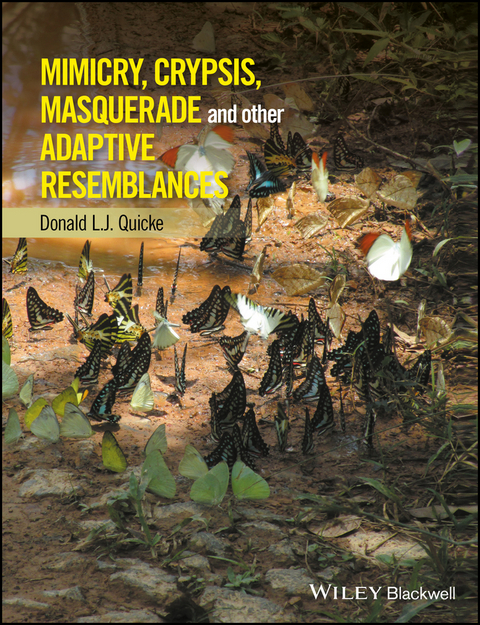
Mimicry, Crypsis, Masquerade and other Adaptive Resemblances (eBook)
John Wiley & Sons (Verlag)
978-1-118-93152-3 (ISBN)
Deals with all aspects of adaptive resemblance
- Full colour
- Covers everything from classic examples of Batesian, Mullerian, aggressive and sexual mimicries through to human behavioural and microbial molecular deceptions
- Highlights areas where additonal work or specific exeprimentation could be fruitful
- Includes, animals, plants, micro-organisms and humans
Donald L.J. Quicke retired in 2013 to live in Thailand where he is a Visiting Professor at Chulalongkorn University. He studied zoology at Oxford University where he became especially interested in mimicry. After graduating in 1976 he travelled to Kenya to explore tropical biodiversity and there his work on insect systematics and colouration fertilised his interests including on parasitoid wasps which were to become one of his lifelong passions and major research interest. From then on he kept abreast of the increasingly experimental and theoretical developments in the field even though his academic research took him in diverse other directions. Having now retired he has been able devote his time, in addition to bird watching and butterfly photography, to synthesising and extending his interest in this topic. Mimicry, Crypsis, Masquerade and other Adaptive Resemblances is the result of this work.
Deals with all aspects of adaptive resemblance Full colour Covers everything from classic examples of Batesian, Mullerian, aggressive and sexual mimicries through to human behavioural and microbial molecular deceptions Highlights areas where additonal work or specific exeprimentation could be fruitful Includes, animals, plants, micro-organisms and humans
Donald L.J. Quicke retired in 2013 to live in Thailand where he is a Visiting Professor at Chulalongkorn University. Hestudied zoology at Oxford University where he became especially interested in mimicry. In 1976 he travelled to Kenya to experience tropical biodiversity and more of the diversity of life and his work there on insect coloration fertilised his interests as well as on parasitoid wasps, another of his many passions. From then on he kept abreast of the increasingly experimental and theoretical developments in the field even though his academic research took him in diverse other directions. Having now retired he has been able devote his time, in addition to bird watching and butterfly photography, to synthesising and extending his interest in this topic. Mimicry, Crypsis, Masquerade and other Adaptive Resemblances is the result of this work.
Preface, xiii
1 INTRODUCTION AND CLASSIFICATION OF MIMICRY SYSTEMS, 1
2 CAMOUFLAGE: CRYPSIS AND DISRUPTIVE COLOURATION IN ANIMALS, 19
3 CAMOUFLAGE: MASQUERADE, 87
4 APOSEMATISM AND ITS EVOLUTION, 103
5 ANTI?]PREDATOR MIMICRY. I. MATHEMATICAL MODELS, 171
6 ANTI?]PREDATOR MIMICRY. II. EXPERIMENTAL TESTS, 191
7 ANTI?]PREDATOR MIMICRY. III. BATESIAN AND MULLERIAN EXAMPLES, 213
8 ANTI?]PREDATOR MIMICRY. ATTACK DEFLECTION, SCHOOLING, ETC., 259
9 ANTI?]HERBIVORY DECEPTIONS, 289
10 AGGRESSIVE DECEPTIONS, 305
11 SEXUAL MIMICRIES IN ANIMALS (INCLUDING HUMANS), 353
12 REPRODUCTIVE MIMICRIES IN PLANTS, 371
13 INTRA?] AND INTERSPECIFIC COOPERATION, COMPETITION AND HIERARCHIES, 399
14 ADAPTIVE RESEMBLANCES AND DISPERSAL: SEEDS, SPORES AND EGGS, 409
15 MOLECULAR MIMICRY: PARASITES, PATHOGENS AND PLANTS, 421
PREFACE
The ever expanding field of mimicry requires a clear, but very elastic, definition which avoids hair splitting but allows for the constant stream of new examples and concepts.
Miriam Rothschild 1981
This book started almost 40 years ago with discussions with my old friend and fellow undergraduate Peter Kirby at Oxford University and subsequently in Derby and Nottingham, to whom I am greatly indebted for many a valuable discussion and pint of beer. Since then it has expanded due to discussions with many people. As things do, plans got shelved and occasionally revisited, and shelved again. This whole period has seen a remarkable increase in interest in various forms of mimicry and adaptive resemblance with a huge body of more experimental work in addition to theory supplementing the already vast number of casual and sometimes insightful descriptions of mimicry systems around the world.
Ever since Henry Bates (1825–92), an English naturalist working in tropical South America from 18481 to 1859, realised that some butterflies were not what they might at first appear to be, and interpreted this as being due to palatable species looking like unpalatable models (Bates 1862, 1864), mimetic phenomena have fascinated professional and amateur biologists alike, including Charles Darwin, whose theory of evolution had been part of Bates’ inspiration (Moon 1976, Stearn 1981). As time passed the literature on the topic grew as more and more examples were described and as Holling (1963) said, “A small mountain of information about mimicry has been collected since Bates”.
Unfortunately though, after a while this fascination became been tinged with rather negative views among some academic biologists who for some while tended to dismiss it as a quaint set of observations that are easily explained and not worth dwelling over in any great detail – though it was still used for its ‘wow factor’ in undergraduate lectures. Vane‐Wright (1981) also lists some of the negative or simply dismissive views that were put forward, especially soon after Bates’ publication, including that the resemblances described were just coincidental and therefore pointless to investigate. However, some researchers continued to investigate mimicry both theoretically and experimentally and, with clearer thought emerging about the detailed processes involved, mimicry (and camouflage) have had a resurgence of scientific interest with the result that many new examples have come to light in recent years and many new insights are continuing to emerge. Large‐scale studies are becoming increasingly common; molecular techniques are allowing the evolution of mimicries and other adaptive resemblances to be viewed from a phylogenetic perspective; and increasingly sophisticated use of computer games allows testing of theories that are relatively new to the scene. Lichter‐Marck et al.’s (2014) 4‐year study of caterpillar predation in a temperate project is a nice example that combines all of these aspects and enabled comparison of the effectiveness of warning and camouflage strategies.
This book sets out to survey mimicry and camouflage (and the related topic of how aposematism evolved in the first place) and to place these in the context of results of the growing numbers of experimental tests that have been conducted. It further seeks to explain key and relevant models and experimental set‐ups in a way intelligible to everyone and not just scientists. All of this draws on a wide range of examples from animals, plants, fungi and even protists, covering different modalities such as behaviour, colouration, bioluminescence, structure, chemistry and sound. Most examples are of the whole organism type but mimicry is also relevant to the success of various disease agents, so bacteria are also included. It also covers adaptive resemblances which have evolved for protection from predation or herbivory, to obtain prey (aggressive mimicries), to obtain matings or, more precisely, fertilisations (sexual mimicry), to disperse seeds or spores, to avoid aggression from conspecifics and to protect from host immune systems, some of which lead to unfortunate autoimmunity consequences.
I have tried to combine as much interesting biology related to the topic as reasonable, and also to explain how mathematical models of various degrees of sophistication give new insights into how mimicry systems work and why warning signals and mimicry evolve under some circumstances and not others. I also touch on aspects such as the genetics underlying wing pattern polymorphisms in various insects, notably in the genus Heliconius and the sex‐limited cases among swallowtails, which should at least give an in‐road into the relevant booming genomics literature. Where enough data exist I have tried to separate out the more mathematical parts from descriptions of the mimetic systems themselves and also to some extent I have separated out some of the basic experimental tests of mimetic advantage when there are enough of them to make a separate coherent section. It is one thing to think that a harmless dronefly has evolved to resemble and mimic a stinging honey bee because of the potential protection that would afford it, but quite another to actually demonstrate that this is what has happened. Indeed, one could ask, why haven’t honey bees evolved to look like wasps, or vice versa? Well, in some ways they do resemble one another, and as nearly all entomologists can vouch, a large number of non‐biologists do confuse them. Indeed, in many languages there is no separate word for them – maybe they are just some sort of stinging insect or, maybe, Hymenoptera‐like insect. And yet honey bees, despite many an illustration in children’s books, are not normally boldly banded black and yellow; they may have orangey bands, but they are hardly highly conspicuous (see Fig. 7.24a). Not surprisingly, humans are also quite bad at distinguishing harmless hoverfly mimics from potentially stinging bees and wasps (Golding et al. 2005a). The fact that humans often do not distinguish wasps from bees does not mean that many insectivores do not, and indeed, the amazing similarities between some models and their mimics is testament to the amazing discriminatory powers of predators that have shaped and coloured them over evolutionary time. Wickler (1968), with rather fewer examples and far less experimental evidence, gives some lovely descriptions of many cases discussed here. His book was also beautifully and inspiringly illustrated so, although I have tried to obtain photographs to illustrate most systems, his work provides lots of informative pictures that I have cited where I could not find better.
For the vast majority of supposed cases of mimicry there have been no experimental tests, and for quite a few there is very little by way of field observations, perhaps just assumptions based upon museum specimens. Thus, I rather think that Vane‐Wright’s (1971) note with regard to his discussion of mimicry: “In this discussion such words as ‘possibly’, ‘perhaps’, ‘presumably’ are frequently omitted for convenience, where strictly they ought to be employed” could be applied to many examples herein. Certainly some suggested instances of mimicry could be considered as verging on the fanciful and some have been subsequently disproven. However, there is probably truth in the vast majority of cases. Applications of more modern techniques, such as visual modelling of potential predators, sometimes reveal things that human eyes miss, and may provide clearer explanation. As Grim (2013) points out, actually demonstrating that some feature has evolved due to mimicry is extremely difficult and proof positive can only be achieved by manipulatory experiments. Sometimes what human observers perceive as close resemblance may simply reflect our own limitations in discriminatory ability, and not necessarily those of the organisms involved. Nevertheless, although some suspected instances have turned out not to involve mimicry, I feel that the vast majority of described cases will be verified in due course. Further, as numbers of system types are subjected to experimental studies we might be justified in allowing some degree of inclusivity in terms of individual examples studied – after all, it is unrealistic to test experimentally, say, all cases of, for example, snakes using tails to lure prey – if it is found proven in a few species it seems likely that it will be true also of at least the majority of other species.
Where possible, I have included photographs to illustrate the main types of resemblances and adaptations that are discussed, though sadly space does not permit everything. In discussing individual examples, it also soon becomes clear that many adaptive resemblances serve dual functions (e.g. Gomez & Thery 2007). A bright yellow and black wasp once in the hand, so to speak, is clearly aposematic, but from a distance against a dry, yellow African savanna it may be hard to spot; similarly, bright red wasps against red lateritised tropical soils. The similarity of a flower mantis to a flower or cluster of flowers is both a device that helps it to avoid being detected by, and probably also positively attracts, the butterflies and bees upon which it feeds, but it also conceals it from avian or other predators; thus it is both a protective and an aggressive mimicry and it seems impossible to know which came first. Particularly convoluted is the case of ‘cuckoos’ and their hosts. Their eggs are typically very similar to those of the host bird, and that...
| Erscheint lt. Verlag | 2.8.2017 |
|---|---|
| Sprache | englisch |
| Themenwelt | Naturwissenschaften ► Biologie ► Ökologie / Naturschutz |
| Naturwissenschaften ► Biologie ► Zoologie | |
| Schlagworte | Adaptive Resemblance • Batesian • Behavior & Behavioral Ecology • Biologie • Biowissenschaften • Camouflage • Coloration • countershading • Crypsis • Entomologie • Entomology • Evolution • Eyespot • insect • Life Sciences • mimicry • Mimikry • Muellerian • Orchid • Tarnung • Verhalten • Verhalten, Verhaltensökologie |
| ISBN-10 | 1-118-93152-1 / 1118931521 |
| ISBN-13 | 978-1-118-93152-3 / 9781118931523 |
| Informationen gemäß Produktsicherheitsverordnung (GPSR) | |
| Haben Sie eine Frage zum Produkt? |
 EPUB (Adobe DRM)
Kopierschutz: Adobe-DRM
Adobe-DRM ist ein Kopierschutz, der das eBook vor Mißbrauch schützen soll. Dabei wird das eBook bereits beim Download auf Ihre persönliche Adobe-ID autorisiert. Lesen können Sie das eBook dann nur auf den Geräten, welche ebenfalls auf Ihre Adobe-ID registriert sind.
Details zum Adobe-DRM
Dateiformat: EPUB (Electronic Publication)
EPUB ist ein offener Standard für eBooks und eignet sich besonders zur Darstellung von Belletristik und Sachbüchern. Der Fließtext wird dynamisch an die Display- und Schriftgröße angepasst. Auch für mobile Lesegeräte ist EPUB daher gut geeignet.
Systemvoraussetzungen:
PC/Mac: Mit einem PC oder Mac können Sie dieses eBook lesen. Sie benötigen eine
eReader: Dieses eBook kann mit (fast) allen eBook-Readern gelesen werden. Mit dem amazon-Kindle ist es aber nicht kompatibel.
Smartphone/Tablet: Egal ob Apple oder Android, dieses eBook können Sie lesen. Sie benötigen eine
Geräteliste und zusätzliche Hinweise
Buying eBooks from abroad
For tax law reasons we can sell eBooks just within Germany and Switzerland. Regrettably we cannot fulfill eBook-orders from other countries.
aus dem Bereich