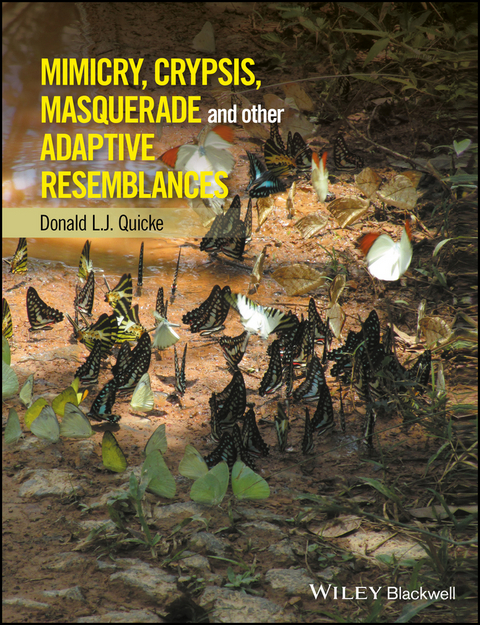
Mimicry, Crypsis, Masquerade and other Adaptive Resemblances (eBook)
John Wiley & Sons (Verlag)
978-1-118-93151-6 (ISBN)
Deals with all aspects of adaptive resemblance
- Full colour
- Covers everything from classic examples of Batesian, Mullerian, aggressive and sexual mimicries through to human behavioural and microbial molecular deceptions
- Highlights areas where additonal work or specific exeprimentation could be fruitful
- Includes, animals, plants, micro-organisms and humans
Donald L.J. Quicke retired in 2013 to live in Thailand where he is a Visiting Professor at Chulalongkorn University. Hestudied zoology at Oxford University where he became especially interested in mimicry. In 1976 he travelled to Kenya to experience tropical biodiversity and more of the diversity of life and his work there on insect coloration fertilised his interests as well as on parasitoid wasps, another of his many passions. From then on he kept abreast of the increasingly experimental and theoretical developments in the field even though his academic research took him in diverse other directions. Having now retired he has been able devote his time, in addition to bird watching and butterfly photography, to synthesising and extending his interest in this topic. Mimicry, Crypsis, Masquerade and other Adaptive Resemblances is the result of this work.
Deals with all aspects of adaptive resemblance Full colour Covers everything from classic examples of Batesian, Mullerian, aggressive and sexual mimicries through to human behavioural and microbial molecular deceptions Highlights areas where additonal work or specific exeprimentation could be fruitful Includes, animals, plants, micro-organisms and humans
Donald L.J. Quicke retired in 2013 to live in Thailand where he is a Visiting Professor at Chulalongkorn University. Hestudied zoology at Oxford University where he became especially interested in mimicry. In 1976 he travelled to Kenya to experience tropical biodiversity and more of the diversity of life and his work there on insect coloration fertilised his interests as well as on parasitoid wasps, another of his many passions. From then on he kept abreast of the increasingly experimental and theoretical developments in the field even though his academic research took him in diverse other directions. Having now retired he has been able devote his time, in addition to bird watching and butterfly photography, to synthesising and extending his interest in this topic. Mimicry, Crypsis, Masquerade and other Adaptive Resemblances is the result of this work.
Title Page 5
Copyright Page 6
Contents 9
Preface 15
Acknowledgements 19
Chapter 1 Introduction and Classification of Mimicry Systems 21
A brief history 22
On definitions of ‘mimicry’ and adaptive resemblance 23
The concept of ‘adaptive resemblance’ 28
The classification of mimicry systems, 29
Wickler’s system 29
Vane-Wright’s system 30
Georges Pasteur (1930–2015) 31
Other approaches 33
Endler 33
Zabka & Tembrock
Maran 34
Mimicry as demonstration of evolution 34
Chapter 2 Camouflage: Crypsis and Disruptive Colouration in Animals 39
Introduction 40
Distinguishing crypsis from masquerade 40
Crypsis examples 44
Countershading 44
Experimental tests of concealment by countershading 47
Bioluminescent counter-illumination 48
Background matching 49
Visual sensitivity of predators 50
To make a perfect match or compromise 51
Colour polymorphism 52
Seasonal colour polymorphism 52
Butterfly pupal colour polymorphism 52
Winter pelage: pelts and plumage 55
Melanism 57
Industrial melanism 57
Fire melanism 60
Background selection 61
Orientation and positioning 63
Transparency 65
Reflectance and silvering 67
Adaptive colour change 69
Caterpillars and food plant colouration 70
Daily and medium?paced changes 74
Rapid colour change 76
Chameleons 76
Cephalopod chromatophores and dermal papillae 77
Bird eggs and their backgrounds 78
Disguising your eyes 81
Disruptive and distractive markings 81
Edge-intercepting patches 81
Distractive markings 83
Zebra stripes and tsetse flies 86
Stripes and motion dazzle – more zebras, kraits and tigers 89
Computer graphics experiments with human subjects 89
Observations on real animals 89
Comparative analysis 91
Dual signals 92
Protective crypsis in non-visual modalities 93
Apostatic and antiapostatic selection 93
Search images 94
Experimental tests of search image 96
Gestalt perception 96
Effect of cryptic prey variability 97
Reflexive selection and aspect diversity 97
Searching for cryptic prey – mathematical models 100
Ontogenetic changes and crypsis 101
Hiding the evidence 102
Petiole clipping by caterpillars 102
Exogenous crypsis 102
Military camouflage and masquerade 105
Chapter 3 Camouflage: Masquerade 107
Introduction 108
Classic examples 108
Twigs as models 108
Leaves (alive or dead) as models 108
Bird dropping resemblances 109
Spider web stabilimenta 113
Tubeworms, etc. 114
Experimental tests of survival value of masquerade 114
Ontogenetic changes and masquerade 117
Thanatosis (death feigning) 117
Feign or flee? The trade-offs of thanatosis 120
Other aspects of death mimicry 120
Seedless seeds and seedless fruit 120
Chapter 4 Aposematism and its Evolution 123
Introduction 124
Initial evolution of aposematism 128
Associations of unpalatable experience with place 129
Mathematical models and ideas of warning colouration evolution 132
Kin selection models 132
Green beard selection 132
Family selection models 133
Individual selection models 133
Spatial models and metapopulations 136
Handicap and signal honesty 137
Early warnings – reflex bleeding, vomiting and other noxious secretions 140
Longevity of aposematic protected taxa 141
Macroevolutionary consequences 141
Experimental studies 141
Tough aposematic prey and individual selection 141
Pyrazine and other early warnings 143
Learning and memorability 144
Strength of obnoxiousness 146
Is the nature of the protective compound important? 146
Neophobia and the role of novelty 147
Innate responses of predators 150
Aposematism and gregariousness 152
Phylogenetic analysis of aposematism and gregariousness 154
Behaviour of protected aposematic animals 155
Of birds and butterflies 155
Evolution of sluggishness 159
Origins of protective compounds 160
Plant-derived toxins 160
Cardiac glycosides 161
Pyrrolizidine alkaloids 164
De novo synthesis of protective compounds 165
Obtaining toxins from animal sources 167
Costs of chemical defence 169
Aposematism with non-chemical defence 170
Escape speed and low profitability 170
Parasitoids and aposematic insects 172
Diversity of aposematic forms 172
Egg load assessment 174
Proof of aposematism 174
Bioluminescence as a warning signal 175
Warning sounds 175
Warning colouration in mammals 177
Weapon advertisement 178
Mutualistic aposematism 180
Aposematism induced by a parasite 181
Aposematic commensalism 181
Polymorphism and geographic variation in aposematic species 181
Aposematism in plants 183
Synergistic selection of unpalatability in plants 185
Aposematism in fungi 186
Why are some unpalatable organisms aposematic and others not? 187
Chapter 5 Anti-Predator Mimicry. I. Mathematical Models 191
Introduction 192
Properties of models, rewards, learning rates and numerical relationships 192
Simple models and their limitations 193
Müller’s original model 193
Simple models of Batesian and Müllerian mimicry 193
Are Batesian and Müllerian mimicry different? 194
An information theory model 196
Monte-Carlo simulations 197
More refined models – time, learning, forgetting and sampling 200
Importance of alternative prey 201
Signal detection theory 201
Genetic and evolutionary models 202
Coevolutionary chases 205
Models involving population dynamics 205
Neural networks and evolution of Batesian mimicry 208
Automimicry in Batesian/Müllerian mimicry 208
Predator’s dilemma with potentially harmful prey 210
Chapter 6 Anti-predator mimicry. II. Experimental tests 211
Introduction 212
Experimental tests of mimetic advantage 212
How similar do mimics need to be? 214
Is a two-step process necessary? 218
Relative abundances of models and mimics in nature 218
Sex-limited mimicries and mimetic load 218
Mimetic load 223
Apostatic selection and Batesian mimicry 224
Müllerian mimicry and unequal defence 224
Imperfect (satyric) mimicry 226
Chapter 7 Anti-predator Mimicry. III. Batesian and Müllerian Examples 233
Introduction 234
Types of model 234
Mimicry of slow flight in butterflies 234
The Batesian/Müllerian spectrum 235
Famous butterflies: ecology, genetics and supergenes 236
Heliconius 236
Hybrid zones 237
Wing pattern genetics 239
Modelling polymorphism 240
Danaus and Hypolimnas 240
Papilio dardanus 241
Papilio glaucus 243
Papilio memnon 243
Supergenes and their origins 243
Mimicry between caterpillars 244
Some specific types of model among insects 245
Wasp (and bee) mimicry 245
How to look like a wasp 248
Time of appearance of aculeate mimics 248
Pseudostings and pseudostinging behaviour 250
Wasmannian (or ant) mimicry 251
Ant mimicry as defence against predation 251
Ant mimicry by spiders 254
Spiders that feed on ants 256
How to look like an ant or an ant carrying something? 256
Myrmecomorphy by caterpillars 257
Ant chemical mimicry by parasitoid wasps 257
Protective mimicries among vertebrates 259
Fish 259
Batesian mimicry among fish 259
Müllerian mimicry among fish 259
Batesian and Müllerian mimicry among terrestrial vertebrates 259
The coral snake problem – Emsleyan (or Mertensian) mimicry 260
Other snakes, zig-zag markings and head shape 264
Mimicry of invertebrates by terrestrial vertebrates 266
Inaccurate (satyric) mimics 268
Mimicry of model behaviour 269
Aide mémoire mimicry 270
Batesian–Poultonian (predator) mimicry 271
Mimicry within predator–prey and host–parasite systems 273
Bluff and appearing larger than you are 273
Collective mimicry including an aggressive mimicry 275
Jamming 275
Man as model – the case of the samurai crab 278
Chapter 8 Anti-predator Mimicry. Attack Deflection, Schooling, etc. 279
Introduction 280
Attack deflection devices 280
Eyespots 280
Experimental tests of importance of eyespot features 282
Eyespots in butterflies 286
Wing marginal eyespots 287
Eyes with sparkles 287
Eyespots on caterpillars 289
Importance of eyespot conspicuousness 289
Eyespots and fish 289
Not just an eyespot but a whole head, winking and other enhancements 291
Reverse mimicry 291
Insects 291
Reverse mimicry in flight 295
Reverse mimicry in terrestrial vertebrates 295
Other deflectors 297
Injury feigning in nesting birds 297
Tail-shedding (urotomy) in lizards and snakes 297
Flash and startle colouration 300
Intimidating displays and bizarre mimicries 303
Schooling, flocking and predator confusion 304
‘Social’ mimicry in birds and fish 306
Alarm call mimicry for protection 307
Chapter 9 Anti-herbivory deceptions 309
Introduction 310
Crypsis as protection in plants 310
Leaf mottling and variegation for crypsis 311
Mistletoes and lianas 313
Fruit masquerade by leaves 314
Protective Batesian and Müllerian mimicry in plants 315
False indicators of damage or likely future damage 316
Conspicuousness of leafmines 317
Dark central florets in some Apiaceae 317
Mimicry of silk or fungal hyphae 319
Insect egg mimics 319
Defensive aphid and caterpillar mimicry in plants 320
Aphid deterrence by alarm pheromone mimicry 320
Ant mimicry in plants 321
Of orchids and bees 321
Carrion mimicry as defence 322
Algae and corals 322
Plant galls 322
Experimental evidence for plant aposematism and Batesian mimetic potential in plants 322
Chapter 10 Aggressive deceptions 325
Introduction 326
Cryptic versus alluring features 327
Crypsis and masquerade by predators 327
Stealth 327
Shadowing 328
Seasonal polymorphisms in predators 328
Why seabirds are black and white (and grey) 329
Chemical crypsis by a predatory fish 329
Alluring mimicries 330
Flower mimicry 332
Rain mimicry 335
Physical lures 335
Angling fish 335
Caudal (and tongue) lures in reptiles 337
Caudal lure in a dragonfly 338
Death feigning as a lure 338
Other prey and food mimicry 339
The case of the German cockroach 339
Wolves in sheeps’ clothing 339
Vulture-like hawks 339
Cleaner fish and their mimics 340
Mingling with an innocuous crowd 342
Duping by mimicry of competitors 343
Seeming to be conspecific 344
Getting close 345
Appearing to be a potential mate 345
Pheromone lures 346
Mimicking danger as a flushing device 348
Human use of aggressive mimicry 348
Cuckoldry, inquilines and brood parasitism 349
Cuckoldry in birds 349
Gentes and ‘cuckoo’ eggs 352
Cues for egg rejection 355
Mimicry by chicks – genetic and substantive differences 358
Cuckoo chick appearance 358
Begging calls 359
Cuckoo and host coevolution 360
Mimicry between adult cuckoos and their hosts 360
Hawk mimicry by adult cuckoos 360
Mimicry of harmless birds by adult cuckoos 362
Brood parasitism and inquilinism in social insects 362
Cuckoo bees and cuckoo wasps 362
Kleptoparasites of bees 366
Myrmecophily 366
Acquired chemical mimicry in social parasites and inquilines 366
Brood-parasitic and slave-making ants 368
Chemical mimicry and ant and termite inquilines 369
A brood-parasitic aphid 369
Ants and aphid trophallaxis 369
Aphidiine parasitoids of ant?attended aphids 370
Does aggressive mimicry occur in plants? 370
Chapter 11 Sexual Mimicries in Animals (Including Humans) 373
Introduction 374
Mimicking the opposite sex 374
Female mimicry by males 374
Avoiding aggression from competing males 377
Mate guarding through distracting other males 377
Androchromatism and male mimicry by females 378
Egg dummies on fish 380
Food dummies and sex 382
Mimicry by sperm-dependent all-female lineages 383
Female genital mimicry in a female 383
Energy-saving cheating for sex 384
Behavioural deceptions in higher vertebrates 384
Polygynous birds 384
Deceptive use of alarm calls and paternity protection 385
Female–female mounting behaviour in mammals and birds 385
Mimicry in humans 387
Make-up, clothes and silicone 387
Cryptic oestrus in humans 388
Flirting in humans 388
Chapter 12 Reproductive mimicries in plants 391
Introduction 392
Pollinator deception 392
Pollinator sex pheromone mimicry 396
Food deception 402
Specific floral mimicry 402
Generalised floral mimicry 406
Mimicry of a fungus-infected plant 408
Brood-site/oviposition-site deception 408
Shelter mimicry 412
Flower similarity over time 412
Flower automimicry – intraspecific food deception (bakerian mimicry) 413
Mathematical modelling of sexual deception by plants 414
Pollinator guild syndromes 414
Bird-pollinated systems 414
Chapter 13 Intra- and Interspecific Cooperation, Competition and Hierarchies 419
Introduction 420
Remaining looking young 420
Delayed plumage maturation 420
Interspecific social dominance mimicry 421
Bird song and alarm call mimicry – deceptive acquisition of resources 421
Wicklerian mimicry – mimicry of opposite sex to reduce aggression 423
Female resemblance in male primates 423
Social appeasement by female mimicry in an insect 424
Hyperfemininity in prereproductive adolescent primates 424
Mimicry of male genitalia by females 424
The case of the spotted hyaena 424
Mimicry of male genitalia in other mammals 424
Phallic mimicry by males 425
Appetitive (foraging) mimicry 426
Appetitive mimicry and deceptive use of alarm calls 426
Beau Geste and seeming to be more than you are 428
Appearing older than you are 428
Weapon automimicry 428
Chapter 14 Adaptive Resemblances and Dispersal: Seeds, Spores and Eggs 429
Introduction 430
Fruit and seed dispersal by birds 430
Warningly coloured fruit 434
Fruit mimicry by seeds 434
Seed dispersal by humans, arable weeds and Vavilovian mimicry 434
Seed elaiosomes and their insect mimics 435
Mimicry by parasites to facilitate host finding 435
The trematode and the snail 435
The trematode and the fish 436
Pocketbook clams and fish 436
‘Termite balls’ 437
Pseudoflowers, pseudo-anthers and pseudo-pollen 437
Truffles 438
Mimicry of dead flesh by fungi and mosses 439
Deception of dung beetles by fruit 439
Chapter 15 Molecular Mimicry: Parasites, Pathogens and Plants 441
Introduction 442
Macro-animal systems 442
Anemone fish 442
Parasitic helminthes 442
Platyhelminthes (Trematoda) 442
Tapeworms (Platyhelminthes: Cestoda) 443
Parasitic nematodes 443
Parasitoid wasp eggs 444
Pathogenic fungi 444
Protista 444
Chagas’ disease 444
Microbial systems 444
Bacterial chemical mimicry and autoimmune responses 444
Helicobacter pylori 445
Campylobacter jejuni 445
Mimicry by plant-pathogenic bacteria 445
Viruses 445
Plants 445
Sugar, toxin and satiation mimicry 445
Phytoecdysteroids – plant chemicals that mimic insect moulting hormone 447
Plant oestrogens – phyto-contraceptives 447
Extended glossary 449
References 465
Author index 535
General index 553
Taxonomic index 559
EULA 578
| Erscheint lt. Verlag | 2.8.2017 |
|---|---|
| Sprache | englisch |
| Themenwelt | Naturwissenschaften ► Biologie ► Ökologie / Naturschutz |
| Naturwissenschaften ► Biologie ► Zoologie | |
| Schlagworte | Adaptive Resemblance • Batesian • Behavior & Behavioral Ecology • Biologie • Biowissenschaften • Camouflage • Coloration • countershading • Crypsis • Entomologie • Entomology • Evolution • Eyespot • insect • Life Sciences • mimicry • Mimikry • Muellerian • Orchid • Tarnung • Verhalten • Verhalten, Verhaltensökologie |
| ISBN-10 | 1-118-93151-3 / 1118931513 |
| ISBN-13 | 978-1-118-93151-6 / 9781118931516 |
| Informationen gemäß Produktsicherheitsverordnung (GPSR) | |
| Haben Sie eine Frage zum Produkt? |
 PDF (Adobe DRM)
Kopierschutz: Adobe-DRM
Adobe-DRM ist ein Kopierschutz, der das eBook vor Mißbrauch schützen soll. Dabei wird das eBook bereits beim Download auf Ihre persönliche Adobe-ID autorisiert. Lesen können Sie das eBook dann nur auf den Geräten, welche ebenfalls auf Ihre Adobe-ID registriert sind.
Details zum Adobe-DRM
Dateiformat: PDF (Portable Document Format)
Mit einem festen Seitenlayout eignet sich die PDF besonders für Fachbücher mit Spalten, Tabellen und Abbildungen. Eine PDF kann auf fast allen Geräten angezeigt werden, ist aber für kleine Displays (Smartphone, eReader) nur eingeschränkt geeignet.
Systemvoraussetzungen:
PC/Mac: Mit einem PC oder Mac können Sie dieses eBook lesen. Sie benötigen eine
eReader: Dieses eBook kann mit (fast) allen eBook-Readern gelesen werden. Mit dem amazon-Kindle ist es aber nicht kompatibel.
Smartphone/Tablet: Egal ob Apple oder Android, dieses eBook können Sie lesen. Sie benötigen eine
Geräteliste und zusätzliche Hinweise
Buying eBooks from abroad
For tax law reasons we can sell eBooks just within Germany and Switzerland. Regrettably we cannot fulfill eBook-orders from other countries.
aus dem Bereich