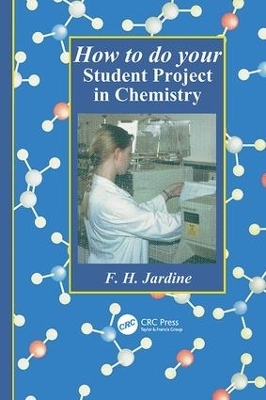
How to do your Student Project in Chemistry
CRC Press (Verlag)
978-1-138-41030-5 (ISBN)
This book is for undergraduate and diploma chemistry students who are about to begin their project work. Student projects are now an essential part of most undergraduate and diploma chemistry courses in the UK, and are an important component of the later years of chemistry degree courses in Australia, South Africa and New Zealand. The book covers all aspects of project work, from choosing a suitable topic and supervisor to communicating research results effectively. There is advice on the best way to use libraries and on how to gather relevant references. Students are taught how to work safely and effectively, and to present their results in report, seminar or conference poster form. Additionally, the author offers guidance on engaging a keyboard operator, on how to prepare artwork and visual aids, and coaching tips on effective communication. The work is a distillation of the author's many years of experience of guiding students of all abilities to success in their project work. This book should be of interest to second and third year undergraduates and diploma students in chemistry.
Fred Jardine is Senior Lecturer in the Department of Environmental Sciences at the University of East London UK
Preface -- 1 Why projects? -- 2 Choice of project -- 2.1 Project title -- 2.2 Supervision -- 2.3 The time available -- 2.4 The facilities available -- 2.5 Making your final choice -- 3 Using the library -- 3.1 Searching the literature -- 3.2 Reference collation -- 4 Safety -- 4.1 Becoming your own safety officer -- 4.2 Control of Substances Hazardous to Health Regulations -- 5 Carrying out the project -- 5.1 Research strategy -- 5.2 The methodical approach -- 5.3 Treatment of results -- 5.4 When things go wrong -- 5.5 Periodic reports -- 5.6 Meeting project deadlines -- 6 Writing your project report -- 6.1 Hierarchy of headings -- 6.2 Principal sections -- 6.3 Presentation -- 6.4 Conventions 7 Producing your project report -- 7.1 Typing your own report -- 7.2 Employing a typist -- 7.3 Thetext -- 7.4 Tables -- 7.5 Graphs -- 7.6 Reaction schemes and other figures -- 7.7 Photographs -- 7.8 Instrument output -- 7.9 Proofreading -- 8 The project talk -- 8.1 Building your confidence -- 8.2 Writing the script -- 8.3 Visual aids -- 8.4 Delivering your lecture -- 9 Poster presentations -- -- Applying your project skills -- Index -- Appendix.
| Erscheinungsdatum | 07.08.2017 |
|---|---|
| Verlagsort | London |
| Sprache | englisch |
| Maße | 152 x 229 mm |
| Gewicht | 453 g |
| Themenwelt | Naturwissenschaften ► Biologie |
| Naturwissenschaften ► Chemie | |
| ISBN-10 | 1-138-41030-6 / 1138410306 |
| ISBN-13 | 978-1-138-41030-5 / 9781138410305 |
| Zustand | Neuware |
| Informationen gemäß Produktsicherheitsverordnung (GPSR) | |
| Haben Sie eine Frage zum Produkt? |
aus dem Bereich