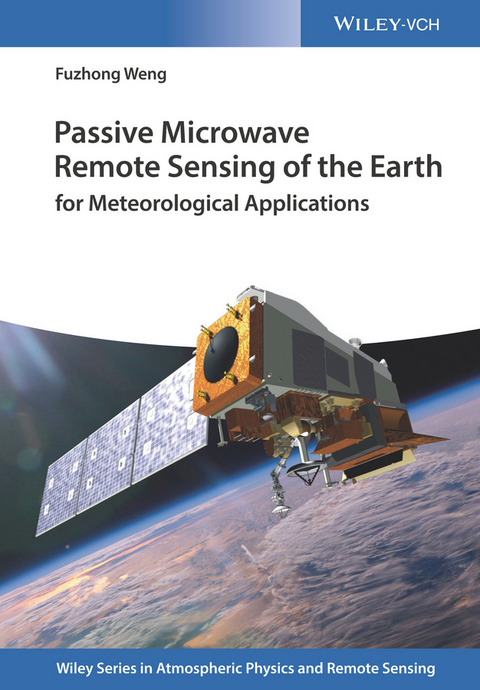
Passive Microwave Remote Sensing of the Earth (eBook)
Wiley-VCH Verlag GmbH & Co. KGaA
978-3-527-33630-2 (ISBN)
Dr. Fuzhong Weng received his PhD degree in 1992 from Department of Atmospheric Science, Colorado State University (CSU), Fort Collins, Colorado, USA. He joined NOAA in 1998 as a physical scientist and then managed the US Joint Center for Satellite Data Assimilation Program (JCSDA) from 2002-2005. He served as the chief of sensor physics branch at NOAA/NESDIS from 2005-2010. From 2011 to 2017, Dr. Weng was appointed as the chief of Satellite Meteorology and Climatology of NOAA/NESDIS/Center for Satellite Applications and Research, JCSDA Senior Scientist and Joint Polar Satellite System (JPSS) Sensor Science Chair. He won a number of awards including the first winner of the 2000 NOAA David Johnson Award for his outstanding contributions to satellite microwave remote sensing fields and the utilization of satellite data in the NWP models, US Department of Commerce Gold Medal Award in 2005 for his achievement in satellite data assimilation, NOAA bronze medal for leading successful NOAA-18 instrument calibration, and NOAA Administrator's Award for developing new and powerful radiative transfer models to assimilate advanced satellite data in 2009 and NOAA Administrator's Award for leadership in developing a state-of-the art satellite instrument health monitoring system enabling corrective actions to extend instrument life. He published over 160 papers in US and other international journals.
Dr. Fuzhong Weng received his PhD degree in 1992 from Department of Atmospheric Science, Colorado State University (CSU), Fort Collins, Colorado, USA. He joined NOAA in 1998 as a physical scientist and then managed the US Joint Center for Satellite Data Assimilation Program (JCSDA) from 2002-2005. He served as the chief of sensor physics branch at NOAA/NESDIS from 2005-2010. From 2011 to 2017, Dr. Weng was appointed as the chief of Satellite Meteorology and Climatology of NOAA/NESDIS/Center for Satellite Applications and Research, JCSDA Senior Scientist and Joint Polar Satellite System (JPSS) Sensor Science Chair. He won a number of awards including the first winner of the 2000 NOAA David Johnson Award for his outstanding contributions to satellite microwave remote sensing fields and the utilization of satellite data in the NWP models, US Department of Commerce Gold Medal Award in 2005 for his achievement in satellite data assimilation, NOAA bronze medal for leading successful NOAA-18 instrument calibration, and NOAA Administrator's Award for developing new and powerful radiative transfer models to assimilate advanced satellite data in 2009 and NOAA Administrator's Award for leadership in developing a state-of-the art satellite instrument health monitoring system enabling corrective actions to extend instrument life. He published over 160 papers in US and other international journals.
Chapter 1: Introduction
*Review of US and international operational satellite programs that have microwave imagers and sounders on board and their major mission goals in the Earth environmental monitoring
Chapter 2: Satellite Microwave Radiometer System
Introduce microwave radiometer system components,
Radiometric linear and nonlinear calibration,
Antenna theory including characterization of APC gain, spill-over from side-lobe and polarization,
Backus-Gilbert resampling for noise reduction and foot print matching
On-orbit absolute calibration from GPSRO data, and characterization of scan angle correction.
Chapter 3: Atmospheric Absorption and Scattering
Optical parameters used in atmospheric remote sensing
Absorption spectrum from oxygen and water vapor, Zeeman splitting
Scattering properties from cloud hydrometeors and approximation form on phase matrix and Rayleigh approximation,
Chapter 4: Microwave Radiative Transfer Theory
Requirements for microwave radiative transfer (e.g. full vector model)
General radiative transfer modeling and discrete ordinate method
Approximation leading to emission and scattering based radiative transfer used for remote sensing
Ocean surface emissivity model (two-scale approximation)
Land surface emissivity model including snow dense medium approach
Chapter 5: Microwave Atmospheric and Environmental Remote Sensing
Atmospheric temperature and water profile, cloud liquid/ice,
Land surface parameters including surface emissivity, temperature, soil moisture and snow cover
Ocean surface parameters including SST and SSW, sea ice concentration
Global radio-frequency interference (RFI) using normalized PCA and double NPCA
Chapter 6: Applications of Microwave Data in Weather Event Monitoring and Forecasts
Hurricane and typhoon warm core analysis
Balanced wind analysis from microwave sounders
Satellite data assimilation and quality control
Impacts of satellite data assimilation on hurricane track and intensity forecasts
Flood monitoring
Chapter 7: Applications of Microwave Data in Climate Research
Requirements for monitoring climate trends from satellites
Cross calibration of microwave data for fundamental climate data record
Analysis of climate trend of microwave sounder and imager
Chapter 1
Introduction
Microwave remote sensing infers the physical parameters from satellite radiometers that operate at wavelengths ranging from millimeters to centimeters (1.0 mm to 20.0 cm). The microwave radiometers are generally of two types: imagers that have channels in the window regions of the spectrum to monitor surface, cloud, and precipitation; and sounders that have channels in opaque spectral regions to profile atmospheric temperature and water vapor under all weather conditions. All the current and planned instruments are flown aboard low Earth-orbiting satellites. The vantage point of the geosynchronous orbit would be valuable for obtaining the synoptic and continuous views of the atmosphere provided by optical and infrared sensors.
This chapter introduces some fundamental parameters used in microwave remote sensing.
1.1 A Microwave Radiometer System
A typical microwave radiometer uses the so-called heterodyne principle applied at radio frequencies. A heterodyne receiver is one in which the received signal, called the radio frequency (RF) signal, is translated to a different and usually lower frequency (the intermediate-frequency (IF)) signal before it is detected. The simplest heterodyne radiometer is shown in Figure 1.1. It is an example of a total-power radiometer and illustrates the features common to most microwave radiometers. As a signal at some frequency is incident upon the antenna of the radiometer, it couples the RF signal into a transmission line (a waveguide, for example), the function of which is to carry the RF signal to and from the various elements of the circuit. In the example, this signal is introduced directly into a mixer, which is a nonlinear circuit element in which the RF signal is combined with a constant-frequency signal produced at the output of this element because of its nonlinearity. These products include a signal whose frequency is the difference between the RF and local oscillator (LO) frequencies. This signal has the important property that its power is proportional to the power in the RF signal under the condition that the latter is much weaker than the LO signal. It is then filtered to exclude the unwanted products of the mixing and amplified to produce the IF output signal.
Figure 1.1 Schematic of a microwave radiometer with a circuit that produces an output voltage proportional to the received signal power.
The total-power radiometer produces an output voltage , which is a polynomial function of the input current :
For a perfect square-law detector, the last two terms vanish. After integration over time and considering the current as a sinusoidal function of time, the average voltage is a function of the current squared:
Using the Nyquist theorem, this current squared is related to the total power input to the IF system, which is the sum of the thermal radiation from the measurement target and the noise :
where , , , and are the temperature of the measurement target, amplifier gain, bandwidth, and noise temperature, respectively, and is the Boltzmann constant.
It is seen from Eq. (1.3) that for the total-power radiometer, the amplifier gain and noise affect the mean voltage. In order to reduce the effect of the internal amplifier noise on the output stability, Dicke [1] introduced a radiometer circuit that can eliminate the noise term through differentiating the signals from the measuring target and an internal load with a known temperature during one integration cycle. The Dicke radiometer was a great invention and was used to measure the low power levels associated with thermal microwave radiation. The use of an internal noise diode injecting noise at a known temperature into the receiver can also reduce the effects of the gain instability and internal noise on the output of the total-power radiometer.
Combining Eqs. (1.2) and (1.3) results in
where is the nonlinear parameter, and and are the parameters that can be directly determined from two-point calibration. They are mathematically expressed as
1.2 Blackbody Emission
A blackbody is an object that absorbs light at a certain wavelength and also emits radiation at the same wavelength. The total amount of energy radiated by a blackbody can be described through Planck's law in a special function. The function is valid for electromagnetic radiation pervading any medium, regardless of its constitution, that is in thermodynamic equilibrium at a definite temperature. If the medium is homogeneous and isotropic, then the radiation is homogeneous, isotropic, unpolarized, and incoherent. The law is named after Max Planck, who originally proposed it in 1900. It is a pioneer result of modern physics and quantum theory. For a wave number υ, Planckian radiation or spectral radiance (in unit: W/m2/sr/cm) is expressed as
where the Planck constant ; the Boltzmann constant ; c is the speed of light, , and .
It should be pointed out that the Planck function can be expressed in terms of wavelength or frequency, but the resultant unit is different. When the energy is integrated within a wavelength, wave number, or frequency domain, the unit for the radiance should be all the same (W/m2/sr). For example, in a frequency domain f,
which represents the energy in W/m2/sr/Hz. Alternatively, it can be written in terms of the wavelength λ, as
which represents the energy in W/m2/sr/cm.
An integration for radiance within a spectrum can be derived using any function from Eqs. (1.5)–(1.7) with a relationship to the frequency, wavelength, and wave number for changing the limits in the integration. For instance, we can use Eq. (1.6) with and
Thus, we can also understand the equivalence of the Planck function expressed as Eqs. (1.5)–(1.7), which are interchangeable through
1.3 Linearized Planck Function
Assuming , the exponential term in the Planck function can be expressed as a Taylor series:
Substituting the first-order approximation of the given Taylor expansion into Eq. (1.5), one obtains the following linear relationship between the blackbody temperature (T) and radiance , which is also referred to as the Rayleigh–Jeans (RJ) approximation:
The accuracy of the radiance calculated from Eq. (1.5) and the linear approximation Eq. (1.13) varies with the frequency and temperature. Figure 1.2 shows the relative accuracy of the first-order approximation of the Planck function with respect to temperature at four arbitrarily selected frequencies of 23.8, 53.6, 89.0, and 190.3 GHz. At a fixed temperature, the higher the frequency, the larger the error. Alternatively, at a fixed frequency, the lower the temperature, the larger the error. At a high frequency near 190.3 GHz, there is a 4.5% error in radiance. The error decreases rapidly with an increase in temperature. More analyses of the RJ approximation can be found in Weng and Zou [2].
Figure 1.2 (a) Relative and (b) absolute variations of the brightness temperature with blackbody temperature varying from 100 to 300 K at frequencies 23.8, 53.6, 89.0, and 190.3 GHz.
(Weng and Zou 2013 [2]. Reproduced with permission of Optical Society of America.)
1.4 Stokes Vector and Its Transformation
When an electromagnetic wave propagates in space, both its electric and magnetic fields are expressed as vectors, and they travel through space by exciting the field of each other. As a result, the radiation field is a Stokes vector with four elements which are related to the amplitudes of the electric field in the form
or
where
where and are the horizontal and vertical components of the electric field, respectively, the star () denotes the conjugate of a complex value, and the angular brackets indicate the time average over an interval longer than the oscillation period of the electric field.
The component expressed by Eq. (1.15a) also represents the total energy from the electromagnetic field and thus is also referred to as the radiation intensity. In the microwave remote sensing field, the subscripts and are often replaced with h and v in the first two Stokes components. Thus, in this textbook, we use the following notations for the Stokes brightness temperature components:
where the superscripts (3, 4) are used in the brightness temperature components in Eq. (1.16) to replace the third and fourth Stokes components in Eqs. (1.15c) and (1.15d) for avoiding the repetition of the superscripts used in the first two components. The four brightness temperature components are related to the Stokes parameters in Eq. (1.15) through the Planck...
| Erscheint lt. Verlag | 14.7.2017 |
|---|---|
| Reihe/Serie | Wiley Series in Atmospheric Physics and Remote Sensing |
| Wiley Series in Atmospheric Physics and Remote Sensing | Wiley Series in Atmospheric Physics and Remote Sensing |
| Sprache | englisch |
| Themenwelt | Naturwissenschaften ► Chemie |
| Naturwissenschaften ► Geowissenschaften ► Geografie / Kartografie | |
| Naturwissenschaften ► Geowissenschaften ► Geologie | |
| Naturwissenschaften ► Geowissenschaften ► Meteorologie / Klimatologie | |
| Naturwissenschaften ► Physik / Astronomie ► Atom- / Kern- / Molekularphysik | |
| Schlagworte | atomic and molecular physics • Atom- u. Molekülphysik • Chemie • Chemistry • climate research, weather, data acquisition, observation • earth sciences • Environmental Chemistry • environmental physics • Fernerkundung • Geowissenschaften • GIS & Remote Sensing • GIS u. Fernerkundung • Klimatologie • Meteorologie • meteorology • Physics • Physik • Umweltchemie • Umweltphysik |
| ISBN-10 | 3-527-33630-3 / 3527336303 |
| ISBN-13 | 978-3-527-33630-2 / 9783527336302 |
| Informationen gemäß Produktsicherheitsverordnung (GPSR) | |
| Haben Sie eine Frage zum Produkt? |
 EPUB (Adobe DRM)
Kopierschutz: Adobe-DRM
Adobe-DRM ist ein Kopierschutz, der das eBook vor Mißbrauch schützen soll. Dabei wird das eBook bereits beim Download auf Ihre persönliche Adobe-ID autorisiert. Lesen können Sie das eBook dann nur auf den Geräten, welche ebenfalls auf Ihre Adobe-ID registriert sind.
Details zum Adobe-DRM
Dateiformat: EPUB (Electronic Publication)
EPUB ist ein offener Standard für eBooks und eignet sich besonders zur Darstellung von Belletristik und Sachbüchern. Der Fließtext wird dynamisch an die Display- und Schriftgröße angepasst. Auch für mobile Lesegeräte ist EPUB daher gut geeignet.
Systemvoraussetzungen:
PC/Mac: Mit einem PC oder Mac können Sie dieses eBook lesen. Sie benötigen eine
eReader: Dieses eBook kann mit (fast) allen eBook-Readern gelesen werden. Mit dem amazon-Kindle ist es aber nicht kompatibel.
Smartphone/Tablet: Egal ob Apple oder Android, dieses eBook können Sie lesen. Sie benötigen eine
Geräteliste und zusätzliche Hinweise
Buying eBooks from abroad
For tax law reasons we can sell eBooks just within Germany and Switzerland. Regrettably we cannot fulfill eBook-orders from other countries.
aus dem Bereich