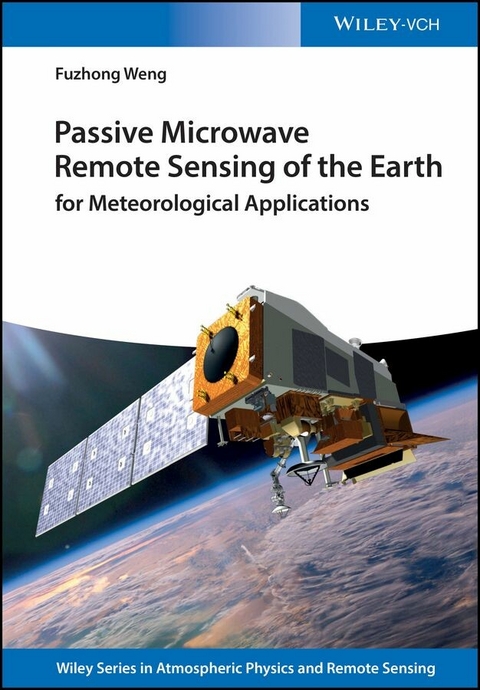
Passive Microwave Remote Sensing of the Earth (eBook)
Wiley-VCH Verlag GmbH & Co. KGaA
978-3-527-33629-6 (ISBN)
Dr. Fuzhong Weng received his PhD degree in 1992 from Department of Atmospheric Science, Colorado State University (CSU), Fort Collins, Colorado, USA. He joined NOAA in 1998 as a physical scientist and then managed the US Joint Center for Satellite Data Assimilation Program (JCSDA) from 2002-2005. He served as the chief of sensor physics branch at NOAA/NESDIS from 2005-2010. From 2011 to 2017, Dr. Weng was appointed as the chief of Satellite Meteorology and Climatology of NOAA/NESDIS/Center for Satellite Applications and Research, JCSDA Senior Scientist and Joint Polar Satellite System (JPSS) Sensor Science Chair. He won a number of awards including the first winner of the 2000 NOAA David Johnson Award for his outstanding contributions to satellite microwave remote sensing fields and the utilization of satellite data in the NWP models, US Department of Commerce Gold Medal Award in 2005 for his achievement in satellite data assimilation, NOAA bronze medal for leading successful NOAA-18 instrument calibration, and NOAA Administrator's Award for developing new and powerful radiative transfer models to assimilate advanced satellite data in 2009 and NOAA Administrator's Award for leadership in developing a state-of-the art satellite instrument health monitoring system enabling corrective actions to extend instrument life. He published over 160 papers in US and other international journals.
Dr. Fuzhong Weng received his PhD degree in 1992 from Department of Atmospheric Science, Colorado State University (CSU), Fort Collins, Colorado, USA. He joined NOAA in 1998 as a physical scientist and then managed the US Joint Center for Satellite Data Assimilation Program (JCSDA) from 2002-2005. He served as the chief of sensor physics branch at NOAA/NESDIS from 2005-2010. From 2011 to 2017, Dr. Weng was appointed as the chief of Satellite Meteorology and Climatology of NOAA/NESDIS/Center for Satellite Applications and Research, JCSDA Senior Scientist and Joint Polar Satellite System (JPSS) Sensor Science Chair. He won a number of awards including the first winner of the 2000 NOAA David Johnson Award for his outstanding contributions to satellite microwave remote sensing fields and the utilization of satellite data in the NWP models, US Department of Commerce Gold Medal Award in 2005 for his achievement in satellite data assimilation, NOAA bronze medal for leading successful NOAA-18 instrument calibration, and NOAA Administrator's Award for developing new and powerful radiative transfer models to assimilate advanced satellite data in 2009 and NOAA Administrator's Award for leadership in developing a state-of-the art satellite instrument health monitoring system enabling corrective actions to extend instrument life. He published over 160 papers in US and other international journals.
Cover 1
Title Page 5
Copyright 6
Dedication 7
Contents 9
Preface 15
Chapter 1 Introduction 17
1.1 A Microwave Radiometer System 17
1.2 Blackbody Emission 19
1.3 Linearized Planck Function 20
1.4 Stokes Vector and Its Transformation 21
1.5 Microwave Spectrum 23
1.6 Spectral Response Function 24
1.7 Microwave Antenna Gain and Distribution Function 26
1.8 Microwave Instrument Scan Geometry 27
1.9 Microwave Data Records and Their Terminology 29
Chapter 2 Atmospheric Absorption and Scattering 31
2.1 Introduction 31
2.2 Microwave Gaseous Absorption 32
2.2.1 Absorption Line and Shape 32
2.2.2 Oxygen Absorption 34
2.2.3 Water Vapor Absorption 38
2.2.4 Nitrogen and Ozone Absorption 39
2.2.5 Line-by-Line Radiative Transfer Model (LBLRTM) 39
2.2.6 Zeeman Splitting Absorption 40
2.2.7 Parameterized Transmittance Model 44
2.3 Cloud Absorption and Scattering 48
2.3.1 Scattering Parameters 48
2.3.2 Particle Size Distribution 50
2.3.3 Rayleigh Approximation 54
2.3.4 Henyey-Greenstein and Rayleigh Phase Matrix 58
2.4 Summary and Conclusions 60
Chapter 3 Radiative Transfer Modeling at Microwave Frequencies 61
3.1 Introduction 61
3.2 Radiative Transfer Equation 61
3.3 Vector Discrete-Ordinate Method 63
3.4 Radiance Gradient or Jacobians 69
3.5 Benchmark Tests 71
3.6 The Zeroth-Order Approximation to Radiative Transfer Solution 76
3.7 The First-Order Approximation to Radiative Transfer Solution 78
3.8 Ocean Emissivity Model 78
3.8.1 Ocean Roughness Phenomena 78
3.8.2 Approximation of Water Dielectric Constant 80
3.8.3 Ocean Roughness Heights and Spectrum 83
3.8.4 Foam Coverage 89
3.8.5 Surface Emissivity Vector 90
3.9 Land Emissivity Model 94
3.9.1 Theoretical Approach for Land Emission 94
3.9.2 Optical Parameters of Vegetation Canopy 97
3.9.3 Optical Parameters of Snow 99
3.9.4 Surface Reflection at Layer Interfaces 101
3.9.5 Soil Dielectric Constant 103
3.9.6 Simulated Surface Emissivity Spectra 103
3.10 Summary and Conclusions 104
Chapter 4 Microwave Radiance Simulations 107
4.1 Introduction 107
4.2 Fast Radiative Transfer Simulations 108
4.3 Calculations of Antenna Brightness Temperatures 112
4.4 Simulations of ATMS Sounding Channels Using Global Forecast Model Outputs 115
4.5 Simulations of ATMS Sounding Channels Using GPSRO Data 121
4.5.1 Collocation of GPS RO and ATMS Data 121
4.5.2 ATMS Bias with Respect to GPS RO Data 123
4.6 Uses of TRMM-Derived Hydrometeor Data in Radiative Transfer Simulations 125
4.6.1 Collocation of ATMS and TRMM Data 125
4.6.2 ATMS Biases With Respect to TRMM-Derived Simulations 128
4.7 Advanced Radiative Transfer Simulations 133
4.8 Summary and Conclusions 136
Chapter 5 Calibration of Microwave Sounding Instruments 139
5.1 Introduction 139
5.2 Calibration Concept 140
5.3 ATMS Instrument Description 140
5.4 ATMS Radiometric Calibration 144
5.5 Impacts of ATMS Antenna Emission on Two-Point Calibration 149
5.6 Retrieval of Reflector Emissivity Using ATMS Pitch-Over Data 151
5.7 ATMS Noise-Equivalent Difference Temperature (NEDT) 154
5.8 Conversion from Antenna to Sensor Brightness Temperature 159
5.9 Summary and Conclusion 163
Chapter 6 Detection of Interference Signals at Microwave Frequencies 167
6.1 Introduction 167
6.2 Microwave Imaging Radiometers and Data Sets 168
6.3 Radio-Frequency Interference Signals in Microwave Data 170
6.4 Detection of RFI over Land 171
6.4.1 Double Principal Component Analysis (DPCA) 171
6.4.2 Spectral Difference Method 176
6.5 RFI Detection over Oceans 178
6.6 Summary and Conclusions 191
Chapter 7 Microwave Remote Sensing of Surface Parameters 193
7.1 Introduction 193
7.2 Remote Sensing of Ocean Surface Parameters 194
7.2.1 Retrievals of Surface Wind Vector 194
7.2.2 Simultaneous Retrieval of Sea Surface Temperature and Wind Speed 199
7.3 Remote Sensing of Land Surface Parameters 206
7.3.1 Retrievals of Land Surface Temperature 206
7.3.2 Retrieval of Land Surface Emissivity 211
7.3.3 Error Sensitivity of Land Surface Emissivity 214
7.3.4 Fast Land Emissivity Algorithms 218
7.4 Summary and Conclusions 221
Chapter 8 Remote Sensing of Clouds from Microwave Sounding Instruments 223
8.1 Introduction 223
8.2 Remote Sensing of Cloud Liquid Water 224
8.2.1 Principle of Microwave Remote Sensing of Clouds 224
8.2.2 Cloud Liquid Water Algorithm 226
8.3 Remote Sensing of Cloud Ice Water 229
8.3.1 Microwave Scattering from Ice-Phase Cloud 229
8.3.2 Cloud Ice Water Retrieval Algorithm 232
8.4 Cloud Vertical Structures from Microwave Double Oxygen Bands 240
8.4.1 FY-3C Microwave Sounding Instruments and Their Channel Pairing 241
8.4.2 Typhoon Neoguri Observed by MWHS and MWTS 243
8.4.3 The Cloud Emission and Scattering Index (CESI) 246
8.5 Summary and Conclusions 248
Chapter 9 Microwave Remote Sensing of Atmospheric Profiles 251
9.1 Introduction 251
9.2 Microwave Sounding Principle 252
9.3 Regression Algorithms 255
9.4 One-Dimensional Variational (1DVAR) Theory 260
9.5 Multiple 1DVARs for All-Weather Profiles 263
9.6 Microwave Integrated Retrieval System (MIRS) 267
9.7 Summary and Conclusions 273
Chapter 10 Assimilation of Microwave Data in Regional NWP Models 275
10.1 Introduction 275
10.2 NCEP GSI Analysis System 276
10.3 ATMS Data Assimilation in HWRF 278
10.3.1 Hurricane Weather Research and Forecast (HWRF) System 278
10.3.2 Hurricane Events in 2012 280
10.3.3 ATMS Data Quality Control 282
10.3.4 Comparison between (o - B) and (o - A) Statistics 288
10.3.5 Impact of ATMS Data on Forecasting Track and Intensity 288
10.4 SSMIS Data Assimilation 298
10.4.1 SSMIS Instrument 298
10.4.2 SSMIS Data Quality Control 303
10.4.3 SSMIS Bias Correction 304
10.4.4 Impacts from SSMIS and AMSU-A Data Assimilation 309
10.4.5 Impact of SSMIS LAS Data on GFS Operational Forecasts 312
10.5 Summary and Conclusions 312
Chapter 11 Applications of Microwave Data in Climate Studies 315
11.1 Introduction 315
11.2 Climate Trend Theory 316
11.3 A Long-Term Climate Data Record from SSM/I 319
11.3.1 Simultaneous Conical Overpassing (SCO) Method 320
11.3.2 Bias Characterization of Specific SSM/I Instrument 323
11.3.3 RADCAL Beacon Interference with F15 SSM/I 324
11.3.4 SSM/I Intersensor Bias Correction 326
11.3.5 Impact of Cross-Calibration on SSM/I SDR 329
11.3.6 Impacts of SSM/I Intersensor Calibration on TPW 331
11.4 A Long-Term Climate Data Record from MSU/AMSU 336
11.4.1 Impacts of Clouds and Precipitation on AMSU-A Trends 339
11.4.2 Emission and Scattering Effect on AMSU-A 339
11.4.3 AMSU-A Brightness Temperature Trend 342
11.5 Atmospheric Temperature Trend from 1DVar Retrieval 346
11.5.1 Climate Applications of 1DVar 346
11.5.2 MSU and AMSU-A Cross-Calibration 347
11.5.3 Cloud Detection Algorithm for MSU Applications 347
11.5.4 Temperature Trend from 1DVar 350
11.6 Summary and Conclusions 353
References 357
Index 375
EULA 380
| Erscheint lt. Verlag | 14.7.2017 |
|---|---|
| Reihe/Serie | Wiley Series in Atmospheric Physics and Remote Sensing |
| Wiley Series in Atmospheric Physics and Remote Sensing | Wiley Series in Atmospheric Physics and Remote Sensing |
| Sprache | englisch |
| Themenwelt | Naturwissenschaften ► Geowissenschaften ► Geografie / Kartografie |
| Naturwissenschaften ► Geowissenschaften ► Meteorologie / Klimatologie | |
| Naturwissenschaften ► Physik / Astronomie ► Atom- / Kern- / Molekularphysik | |
| Schlagworte | atomic and molecular physics • Atom- u. Molekülphysik • Chemie • Chemistry • climate research, weather, data acquisition, observation • earth sciences • Environmental Chemistry • environmental physics • Fernerkundung • Geowissenschaften • GIS & Remote Sensing • GIS u. Fernerkundung • Klimatologie • Meteorologie • meteorology • Physics • Physik • Umweltchemie • Umweltphysik |
| ISBN-10 | 3-527-33629-X / 352733629X |
| ISBN-13 | 978-3-527-33629-6 / 9783527336296 |
| Informationen gemäß Produktsicherheitsverordnung (GPSR) | |
| Haben Sie eine Frage zum Produkt? |
 PDF (Adobe DRM)
Kopierschutz: Adobe-DRM
Adobe-DRM ist ein Kopierschutz, der das eBook vor Mißbrauch schützen soll. Dabei wird das eBook bereits beim Download auf Ihre persönliche Adobe-ID autorisiert. Lesen können Sie das eBook dann nur auf den Geräten, welche ebenfalls auf Ihre Adobe-ID registriert sind.
Details zum Adobe-DRM
Dateiformat: PDF (Portable Document Format)
Mit einem festen Seitenlayout eignet sich die PDF besonders für Fachbücher mit Spalten, Tabellen und Abbildungen. Eine PDF kann auf fast allen Geräten angezeigt werden, ist aber für kleine Displays (Smartphone, eReader) nur eingeschränkt geeignet.
Systemvoraussetzungen:
PC/Mac: Mit einem PC oder Mac können Sie dieses eBook lesen. Sie benötigen eine
eReader: Dieses eBook kann mit (fast) allen eBook-Readern gelesen werden. Mit dem amazon-Kindle ist es aber nicht kompatibel.
Smartphone/Tablet: Egal ob Apple oder Android, dieses eBook können Sie lesen. Sie benötigen eine
Geräteliste und zusätzliche Hinweise
Buying eBooks from abroad
For tax law reasons we can sell eBooks just within Germany and Switzerland. Regrettably we cannot fulfill eBook-orders from other countries.
aus dem Bereich