


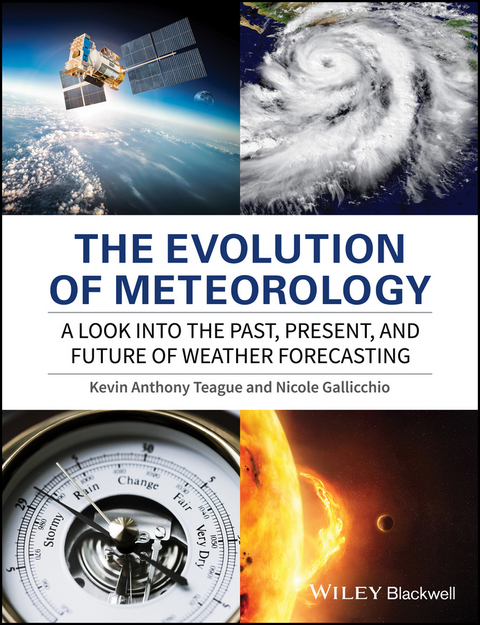
The Evolution of Meteorology (eBook)
John Wiley & Sons (Verlag)
978-1-119-13616-3 (ISBN)
The essential guide to the history, current trends, and the future of meteorology
This comprehensive review explores the evolution of the field of meteorology, from its infancy in 3000 bc, through the birth of fresh ideas and the naming of the field as a science, to the technology boom, to today. The Evolution of Meteorology reveals the full story of where meteorology was then to where it is now, where the field is heading, and what needs to be done to get the field to levels never before imagined. Authored by experts of the topic, this book includes information on forecasting technologies, organizations, governmental agencies, and world cooperative projects.
The authors explore the ancient history of the first attempts to understand and predict weather and examine the influence of the very early birth of television, computers, and technologies that are useful to meteorology. This modern-day examination of meteorology is filled with compelling research, statistics, future paths, ideas, and suggestions. This vital resource:
- Examines current information on climate change and recent extreme weather events
- Starts with the Ancient Babylonians and ends with the largest global agreement of any kind with the Paris Agreement
- Includes current information on the most authoritative research in the field of meteorology
- Contains data on climate change theories and understanding, as well as extreme weather statistics and histories
This enlightening text explores in full the history of the study of meteorology in order to bring awareness to the overall path and future prospects of meteorology.
Kevin A. Teague and Nicole Gallicchio are the cofounders of Forecasting Consultants LLC, a private weather forecasting and forensic company geared towards a multitude of industries and users. Their business has allowed the authors to grow and expand their knowledge base in all aspects of atmospheric science.
The essential guide to the history, current trends, and the future of meteorology This comprehensive review explores the evolution of the field of meteorology, from its infancy in 3000 bc, through the birth of fresh ideas and the naming of the field as a science, to the technology boom, to today. The Evolution of Meteorology reveals the full story of where meteorology was then to where it is now, where the field is heading, and what needs to be done to get the field to levels never before imagined. Authored by experts of the topic, this book includes information on forecasting technologies, organizations, governmental agencies, and world cooperative projects. The authors explore the ancient history of the first attempts to understand and predict weather and examine the influence of the very early birth of television, computers, and technologies that are useful to meteorology. This modern-day examination of meteorology is filled with compelling research, statistics, future paths, ideas, and suggestions. This vital resource: Examines current information on climate change and recent extreme weather events Starts with the Ancient Babylonians and ends with the largest global agreement of any kind with the Paris Agreement Includes current information on the most authoritative research in the field of meteorology Contains data on climate change theories and understanding, as well as extreme weather statistics and histories This enlightening text explores in full the history of the study of meteorology in order to bring awareness to the overall path and future prospects of meteorology.
Kevin A. Teague and Nicole Gallicchio are the cofounders of Forecasting Consultants LLC, a private weather forecasting and forensic company geared towards a multitude of industries and users. Their business has allowed the authors to grow and expand their knowledge base in all aspects of atmospheric science.
1
Ancient Civilizations, Philosophical Theories, and Folklore (3000 BC–AD 1400)
Kevin Anthony Teague
Understanding the history of meteorology and weather forecasting can only be accomplished just as any other subject: by learning the building blocks and uncovering the pioneers and the technological advancements of the field. Meteorology is the study of the atmosphere and its phenomena. What is known today about weather forecasting and meteorology is tremendously more comprehensive and complex than what was understood during ancient times, but at the same time is lacking and insufficient when looking at what is possible in the future. To first understand where we are today and where we may lead to in the coming years, we first have to look at where we came from. Although full sections or full texts could be dedicated to each of the following topics covered in this section – as well as many of the examples not even included – a solid foundation for the beginning of meteorology will be discussed, starting with one of earth’s first‐known civilizations and advancing to the brink of the first meteorological inventions.
1.1 Ancient Babylonians
Some of earth’s earliest‐known civilizations in ancient Mesopotamia first began record keeping and attempting to understand the skies dating back to 3000 BC. Calendars were created based on the lunar cycle, eventually leading to the development of a 360‐day calendar, which was later adjusted to match the seasons based more on the solar cycle by King Hammurabi (1792–1750 BC) of Babylon. This was one of history’s first acknowledgments of seasons and weather. Advancements continued, all based on the sun, moon, and stars. By the eighth century BC the ancient Babylonians, under King Nabû‐nās&c.dotbl;ir (747–734 BC), began to regularly keep records of the observations that were made of the sky. While mostly involving astronomy, these were some of the first recorded observations in history, and included time intervals of the rising and setting of the sun, eclipses, and position of the moon. To the Babylonians, much of what was observed was done by the supernatural; even so, they used these observations to begin to calculate when certain celestial events would occur in the future (Teresi, 2002, pp. 115–123).
A common technique used in their predictions was observing the halo around the moon (and sun). Certain halo conditions signified to the Babylonians that specific weather events, as well as other phenomena, would occur. One example was a report by King Nabû‐šuma‐iškun, (mid‐eighth century BC) that “a halo (in the area) of Virgo portends rain and flood in winter,” and a second states, “if the moon is surrounded by a black halo: the month holds rain, variant: clouds will be gathered” (Verderame, 2014, p. 100). These relate astrology to meteorology, and are a common theme throughout the Ancient Babylonian civilization. It was this type of data collection and observation that led the Babylonians to create some of the earliest versions of calendars and time keeping, as well as being among the earliest to predict and anticipate weather and natural events that could impact their world.
1.2 Ancient Chinese
The Chinese were believed to have begun keeping minimal records based on actual weather, including temperature, dating back to 1400 BC. Around 1216 BC, rainfall was recorded, as well as type of precipitation, whether it was sleet, rain, or snow, along with wind and wind direction. While the Chinese also believed that the supernatural was responsible for the types of weather conditions that occurred, such as bad weather meaning the gods were angry, the Chinese were still able to begin to understand the hydrological cycle. During the Han dynasty, (206 BC–AD 220), the understanding of the hydrological cycle went from the idea of qi, or the energy of the earth and heavens, to the understanding that clouds were created from the rising waters due to evaporation. By the ninth century AD, the Chinese figured out a way to measure the amount of moisture in the air, by weighing charcoal as it absorbs moisture in the air. The Chinese also began to understand tides and past floods by locating water fossils on high land areas not commonly associated with water (Teresi, 2002, pp. 246–247, 257).
As the Chinese developed socially, their version of meteorology did as well. One example was the developing Chinese belief in the forces of yin and yang, which need to be in balance for the world, health, and morality to be in agreement. The yin and yang have tremendous influence, even today, especially in areas such as health and medicine. The Chinese also related the yin and yang to weather, needing perfect balance of the yin (clouds and rain – earthbound elements) with the yang (fire and heat of the sun – celestial elements). Certain weather events were believed to have occurred because one of the elements was more dominant than the others at those specific times (Hamblyn, 2001, p. 23).
The Chinese based their calendars on the moon, sun, and the weather dating back to the Qin (221–206 BC) and Han dynasties. The Chinese almanac still acknowledges this thinking, and divides the year up into 24 seasons, or festivals, each about 15 days long. These seasons mark weather events that typically took place during specific parts of the year. From “The Beginning of Spring” to “The Waking of the Insects,” “Corn Rain,” and “Great Cold,” each season marked their own effects on the Chinese agricultural lifestyle (LaFleur, 2010, pp. 425–426). These seasons, at the time, showed an accurate interpretation of the weather that occurred or was to occur, and each season can be viewed as an early style of climatology and weather forecasting.
1.3 Aristotle and Meteorologica
Perhaps the most influential early contributor to the beginning of meteorology is the Ancient Greek philosopher Aristotle, 384–322 BC. Aristotle is universally thought to be one of the world’s greatest thinkers. One of his most important pieces of work was his treatise Meteorologica. While this work includes chapters on astronomy, water, physics, and more, Meteorologica has very important sections on weather. He studied meteorology as part of his investigation of physics. Physics, to Aristotle, was the equivalent to what would now be called natural philosophy, or the study of nature (Hollar, 2013, p. 14).
In a sense, some of Aristotle’s views involved the supernatural, and didn’t always go into root causes of some phenomena. Instead, Aristotle stated that there were four bodies – fire, air, earth, and water – that related to four principles – hot, cold, dry, and moist. Aristotle held fire as the highest body and earth as the lowest, and stated that they were the “material causes of the events in this world” (Webster, 1955, p. 339a). He took this supernatural viewpoint and then put his own spin on what he observed. Aristotle based a lot of his viewpoints on the sun, going as far as saying the reason the night is calmer than day is due to the absence of the sun.
Inside Meteorologica, Aristotle acknowledges the understanding of warm air rising and cooler air falling. This relates greatly to today’s understanding of warm air being less dense and rising and expanding, while cooler air is more dense, and is therefore falling and condensing. This idea of hot and cold is connected also with Aristotle’s early interpretation of a lower and upper level of the atmosphere, lower being the surface and upper where the clouds are located. He also describes precipitation as being broken down into three types: rain, snow, and hail. These precipitation types are then correlated to the upper or lower atmosphere. He explains that snow and frost are one and the same, the only difference being snow is in the upper region and is when clouds freeze, and frost is in the lower region and is when vapors freeze. He states that rain and dew are the same – the only difference being that rain occurs in the upper region and is in greater quantity than dew, which occurs in the lower region. The third, hail, Aristotle explains, is ice that forms mainly in the spring and autumn in warmer locations, and occurs only in the upper region, but very close to the surface and not high in the clouds. His reasoning for this was based on the fact that hail is often large, jagged, and non‐circular. Aristotle felt that if hail were to have fallen from high up in the upper region the colliding stones would have broken themselves up into round and smaller stones and not the large angular ones that occur (Webster, 1955, pp. 346b–348b).
As for winds, Aristotle states that north winds are cold and south are warm. He states that east winds are warmer than west winds due to the origin of the sun in the east. Aristotle even goes as far as to combine the west winds with the north and east winds with the south. This shows that the basis of Aristotle’s understanding of wind heavily relies on theories revolving around hot and cold. Aristotle’s depth of wind includes theories on hurricanes as well, explaining that hurricanes are created by the converging of winds, which then begin to veer around and fall in on each other, which is his explanation for the eye of a...
| Erscheint lt. Verlag | 12.5.2017 |
|---|---|
| Sprache | englisch |
| Themenwelt | Naturwissenschaften ► Geowissenschaften ► Meteorologie / Klimatologie |
| Technik | |
| Schlagworte | advanced warnings for tornado activity • advancements in weather forecasting • and wildfires • Climatology & Palaeoclimatology • covering major storms • current weather technologies • Cyclones • data assimilation system and weather forecasting • development of weather radar • Droughts • earth sciences • ensemble prediction system and weather forecasting • floods • Geowissenschaften • global forecasting weather forecasting system • Guide to basics of meteorology • Hurricane Andrew • hurricane Katrina and Sandy • Inventions of Weather Instruments • Kevin A. Teague • Klimatologie • Klimatologie u. Paläoklimatologie • Meteorologie • meteorology • meteorology and computers • meteorology and early television forecasting • meteorology and radar • meteorology and satellites • Modern Meteorology • monthly and seasonal weather forecasting system • Nicole Gallicchio • ocean wave model • Present and Future of Weather Forecasting • social media and weather forecasting • Storm Chasing • The Evolution of Meteorology: A Look into the Past • Tornadoes • weather forecasting and computer models • Wettervorhersage |
| ISBN-10 | 1-119-13616-4 / 1119136164 |
| ISBN-13 | 978-1-119-13616-3 / 9781119136163 |
| Informationen gemäß Produktsicherheitsverordnung (GPSR) | |
| Haben Sie eine Frage zum Produkt? |
 EPUB (Adobe DRM)
Kopierschutz: Adobe-DRM
Adobe-DRM ist ein Kopierschutz, der das eBook vor Mißbrauch schützen soll. Dabei wird das eBook bereits beim Download auf Ihre persönliche Adobe-ID autorisiert. Lesen können Sie das eBook dann nur auf den Geräten, welche ebenfalls auf Ihre Adobe-ID registriert sind.
Details zum Adobe-DRM
Dateiformat: EPUB (Electronic Publication)
EPUB ist ein offener Standard für eBooks und eignet sich besonders zur Darstellung von Belletristik und Sachbüchern. Der Fließtext wird dynamisch an die Display- und Schriftgröße angepasst. Auch für mobile Lesegeräte ist EPUB daher gut geeignet.
Systemvoraussetzungen:
PC/Mac: Mit einem PC oder Mac können Sie dieses eBook lesen. Sie benötigen eine
eReader: Dieses eBook kann mit (fast) allen eBook-Readern gelesen werden. Mit dem amazon-Kindle ist es aber nicht kompatibel.
Smartphone/Tablet: Egal ob Apple oder Android, dieses eBook können Sie lesen. Sie benötigen eine
Geräteliste und zusätzliche Hinweise
Buying eBooks from abroad
For tax law reasons we can sell eBooks just within Germany and Switzerland. Regrettably we cannot fulfill eBook-orders from other countries.
aus dem Bereich


