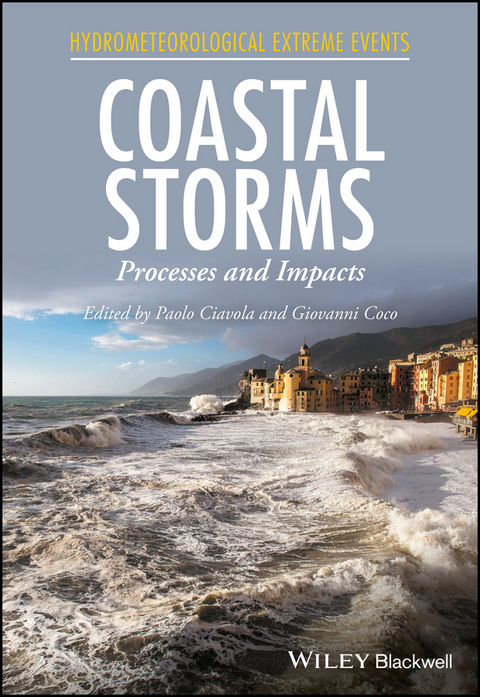
Coastal Storms (eBook)
John Wiley & Sons (Verlag)
978-1-118-93707-5 (ISBN)
A comprehensive introduction to coastal storms and their associated impacts
Coastal Storms offers students and professionals in the field a comprehensive overview and groundbreaking text that is specifically devoted to the analysis of coastal storms. Based on the most recent knowledge and contributions from leading researchers, the text examines coastal storms' processes and characteristics, the main hazards (such as overwash, inundation and flooding, erosion, structures overtopping), and how to monitor and model storms. The authors include information on the most advanced innovations in forecasting, prediction, and early warning, which serves as a foundation for accurate risk evaluation and developing adequate coastal indicators and management options.
In addition, structural overtopping and damage are explained, taking into account the involved hydrodynamic and morphodynamic processes. The monitoring methods of coastal storms are analyzed based on recent results from research projects in Europe and the United States. Methods for vulnerability and risk evaluation are detailed, storm impact indicators are suggested for different hazards and coastal management procedures analyzed. This important resource includes:
- Comprehensive coverage of storms and associated impacts, including meteorological coastal storm definitions and related potential consequences
- A state-of-the-art reference for advanced students, professionals and researchers in the field
- Chapters on monitoring methods of coastal storms, their prediction, early warning systems, and modeling of consequences
- Explorations of methods for vulnerability and risk evaluation and suggestions for storm impact indicators for different hazards and coastal management procedures
Coastal Storms is a compilation of scientific and policy-related knowledge related to climate-related extreme events. The authors are internationally recognized experts and their work reflects the most recent science and policy advances in the field.
A comprehensive introduction to coastal storms and their associated impacts Coastal Storms offers students and professionals in the field a comprehensive overview and groundbreaking text that is specifically devoted to the analysis of coastal storms. Based on the most recent knowledge and contributions from leading researchers, the text examines coastal storms processes and characteristics, the main hazards (such as overwash, inundation and flooding, erosion, structures overtopping), and how to monitor and model storms. The authors include information on the most advanced innovations in forecasting, prediction, and early warning, which serves as a foundation for accurate risk evaluation and developing adequate coastal indicators and management options. In addition, structural overtopping and damage are explained, taking into account the involved hydrodynamic and morphodynamic processes. The monitoring methods of coastal storms are analyzed based on recent results from research projects in Europe and the United States. Methods for vulnerability and risk evaluation are detailed, storm impact indicators are suggested for different hazards and coastal management procedures analyzed. This important resource includes: Comprehensive coverage of storms and associated impacts, including meteorological coastal storm definitions and related potential consequences A state-of-the-art reference for advanced students, professionals and researchers in the field Chapters on monitoring methods of coastal storms, their prediction, early warning systems, and modeling of consequences Explorations of methods for vulnerability and risk evaluation and suggestions for storm impact indicators for different hazards and coastal management procedures Coastal Storms is a compilation of scientific and policy-related knowledge related to climate-related extreme events. The authors are internationally recognized experts and their work reflects the most recent science and policy advances in the field.
Paolo Ciavola is an Associate Professor of Geomorphology at the University of Ferrara, where he teaches courses of geomorphology and coastal risk. He holds an MSc in Geology from the University of Bologna (Italy) and a PhD in Marine Sciences from the University of Algarve (Portugal). He has an interest in coastal processes and risk from extreme storms. Giovanni Coco is an Associate Professor in the School of Environment at the University of Auckland, where he teaches courses on modelling environmental systems. He holds a PhD in Marine Studies from the University of Plymouth (UK). His interests range from coastal processes to machine learning and pattern formation.
Chapter 1
Coastal Storm Definition
Mitchell Harley
Water Research Laboratory, School of Civil and Environmental Engineering, UNSW Sydney, Manly Vale, NSW, Australia
1.1 Introduction
Storms represent nature in one of its most energetic and violent states. The word “storm” is synonymous with images of destruction – strong winds lashing at trees and buildings, intense precipitation flooding towns or dumping meters of snow, large seas eroding beaches and coastal properties, and rapid surges in ocean levels inundating entire islands and vast lowland areas. At the same time, storms are essential to human life and an integral part of the global weather and natural ecosystems. Storms help break droughts by delivering much needed water to drought-stricken areas, thereby recharging reservoirs, river systems and underground aquifers. Many ecosystems are also reliant on the episodic arrival of large storms for their rejuvenation after extended periods of calm, stable conditions (e.g. the flushing of hypersaline lagoons due to hurricanes, Tunnell, 2002).
Globally, storms rank as one of the deadliest of all natural hazards (International Federation of Red Cross and Red Crescent Societies, 2014). In the decade spanning the years 2004–2013, storms were responsible for over 180,000 deaths worldwide – second in terms of lives lost only to those of earthquakes and tsunamis (Table 1.1). Flooding, including marine flooding as a result of waves and storm surge, were meanwhile responsible for over 60,000 deaths worldwide and rank fourth on this list. In the United States, storms have contributed to the vast majority of monetary losses resulting from natural hazards over the last half century. Hurricanes and tropical storms alone have overwhelmingly been the most costly of all natural hazards, having resulted in a total of US$ 267 billion in monetary losses between the years 1960 and 2014 (Figure 1.1). Severe weather, flooding, tornadoes and miscellaneous coastal hazards (loosely defined as hazards including rip currents, coastal flooding, coastal erosion, strong winds, etc.) have also caused combined losses of US$ 364 billion (Hazards and Vulnerability Research Institute, 2015).
Table 1.1 Total number of people killed globally by natural disasters between 2004 and 2013 according to disaster type
| Rank | Disaster Type | Total number of people killed |
| 1 | Earthquakes/tsunamis | 650,321 |
| 2 | Storms | 183,457 |
| 3 | Extreme temperatures | 72,088 |
| 4 | Floods* | 63,207 |
| 5 | Mass movement: wet | 8,739 |
| 6 | Forest/scrub fires | 705 |
| 7 | Droughts/food insecurity | 384 |
| 8 | Volcanic eruptions | 363 |
| 9 | Mass movement: dry | 273 |
| Total | 979,537 |
* includes wave and surge events
(Source: International Federation of Red Cross and Red Crescent Societies, 2014, p. 226)
Figure 1.1 Total hazard losses in the United States (1960–2014) by hazard type
(Source: Hazards and Vulnerability Research Institute, 2015).
There are few regions more vulnerable to storms than the narrow ribbon of the Earth's surface that constitutes the coastal zone. Situated at the interface between land and large water bodies such as oceans, seas and lakes, the coastal zone is a region in constant flux as consolidated and unconsolidated sediments are constantly shaped and re-shaped by Earth's forces. As these forces – winds, waves and currents – interact with coastal sediments, energy is dissipated to such a degree that under normal everyday conditions, their short-term effects on the adjacent coastal hinterland are minimal. During destructive storm conditions, however, the elevated energy and/or water levels may well be beyond the capacity of the coastal zone to dissipate, potentially exposing the backshore and coastal hinterland to unusually large forces and hazardous conditions.
Given the low-lying nature as well as the sheer density of people living close to the coast (with an estimated 23% of the world's population and population densities greater than three times the global average, Small & Nicholls, 2003), the exposure to elevated water levels, waves and currents that may occur during storm conditions can have devastating effects. Some historical examples of extreme storms striking the coast include the 1900 hurricane in Galveston, Texas that claimed the lives of an estimated 8000–12,000 people and is recognized even today as the deadliest natural disaster in the United States' history (Blake & Gibney, 2011). In 1953, a large storm surge in the North Sea inundated tens of thousands of hectares of coastal hinterland in the Netherlands, Belgium and the United Kingdom and claimed over 2500 lives. In Bangladesh, the Bhola cyclone of 1970 is considered one of the worst natural disasters of all time, generating a 10 m storm surge that killed up to 500,000 people and left a huge toll on the country's population and economy. Such devastation was repeated in the same region 21 years later, when another tropical cyclone caused a surge that extended 160 km inland and resulted in 138,000 deaths (Haque, 1997).
In more recent years, coastal storms have received considerable attention as access to news and information via the Internet has grown exponentially and the world has become more aware of the dangers associated with climate change. A particularly significant event that has remained in the conscience of many people was that of Hurricane Katrina that struck the Louisiana coastline in 2005. Hurricane Katrina demonstrated that even in an age of significant advancements in scientific understanding, technology and computer forecasts, nations can still be caught off-guard by the arrival of coastal storms. Hurricane Katrina also highlighted that when coastal storms do occur, it is often the most vulnerable people of a society that are affected the most (Laska & Morrow, 2006). Some other recent examples of coastal storms include Cyclone Sidr in Bangladesh (2007), the Xynthia cyclone in France (2010), Hurricane Sandy in the Caribbean, New Jersey and New York (2012), Typhoon Haiyan in the Philippines (2013), the 2013/2014 winter storms in the United Kingdom and Tropical Cyclone Pam in Vanuatu (2015). Figure 1.2 indicates a rare occurrence of three concurrent tropical cyclones close to the coastline that was observed in southern hemisphere waters in March 2015.
Figure 1.2 A composite image taken from the NASA of three tropical cyclones occurring simultaneously in the southern hemisphere in March, 2015. Tropical Cyclone Pam to the right of the image struck the island of Vanuatu and is considered one of the worst natural disasters in the island's history
(Source: NASA Earth Observatory: http://earthobservatory.nasa.gov/).
Considering their destructiveness and relevance to today's world, surprisingly few books have dealt specifically with the subject of coastal storms and no overarching definition presently exists to assist in their identification. Indeed a degree of confusion surrounding the use of the term coastal storm is evident. An inspection of Table 1.1, for example, indicates that coastal storms fall into the category of both storms and floods, but are not recognized as a category on their own. This is in spite of the fact that the processes governing the formation and development of coastal storms are very different from those of, for instance, river floods. Figure 1.1, meanwhile, highlights the variety of ways in which coastal storms are classified in the commonly-used SHELDUS database for US disaster statistics, with hurricane/tropical storms and coastal hazards treated separately.
As this chapter discusses, the lack of clarity when it comes to defining coastal storms stems from the complexities surrounding the ways in which storm energy is generated, transported and interacts with the coastline. A robust definition of a coastal storm is, however, necessary if we want to answer important societal questions, such as:
- How vulnerable are coastal communities and ecosystems to coastal storms?
- Are coastal storms becoming more frequent or increasing in magnitude?
- What influence is climate change having on coastal storms?
- How near to the coast can we safely build infrastructure away from the influence of coastal storms?
- How can we design coastal structures to withstand coastal storm forces?
This chapter begins by first summarizing the challenges of defining coastal storms. These challenges are then taken into consideration to form a general qualitative coastal storm definition that can be applied to all coastlines. Section 1.2 follows by describing the most common synoptic conditions associated with coastal storms. Section 1.3 then presents the various approaches taken to identify coastal storm events from observational records and summarizes ways of quantifying coastal storm severity.
1.1.1 The challenge of defining coastal storms
The term storm is defined as:...
| Erscheint lt. Verlag | 30.3.2017 |
|---|---|
| Reihe/Serie | Hydrometeorological Extreme Events | Hydrometeorological Extreme Events |
| Sprache | englisch |
| Themenwelt | Naturwissenschaften ► Biologie ► Ökologie / Naturschutz |
| Naturwissenschaften ► Geowissenschaften ► Geografie / Kartografie | |
| Naturwissenschaften ► Geowissenschaften ► Hydrologie / Ozeanografie | |
| Naturwissenschaften ► Geowissenschaften ► Meteorologie / Klimatologie | |
| Technik | |
| Schlagworte | analysis of coastal storms • Climatology & Palaeoclimatology • coastal storm management options • coastal storms • coastal storms accurate risk evaluation • coastal storms characteristics • coastal storms early warning • coastal storms erosion • coastal storms flooding • coastal storms inundation • coastal storms main hazards • coastal storms overwash • coastal storms processes • coastal storms structures overtopping • damage from coastal storms • developing adequate coastal storm indicators • earth sciences • Geowissenschaften • Giovanni Coco • hydrodynamics and coastal storms • Hydrological Sciences • Hydrologie • innovations in forecasting coastal storms • Klimatologie u. Paläoklimatologie • Klimatologie u. Paläoklimatologie • Meteorologie • meteorology • modeling coastal storms • monitoring coastal storms • morphodynamic processes and coastal storms • overview of coastal storms • Paolo Ciavola • Predicting coastal storms • research on coastal storms • resource on coastal storms • risk evaluation of coastal storms |
| ISBN-10 | 1-118-93707-4 / 1118937074 |
| ISBN-13 | 978-1-118-93707-5 / 9781118937075 |
| Informationen gemäß Produktsicherheitsverordnung (GPSR) | |
| Haben Sie eine Frage zum Produkt? |
 EPUB (Adobe DRM)
Kopierschutz: Adobe-DRM
Adobe-DRM ist ein Kopierschutz, der das eBook vor Mißbrauch schützen soll. Dabei wird das eBook bereits beim Download auf Ihre persönliche Adobe-ID autorisiert. Lesen können Sie das eBook dann nur auf den Geräten, welche ebenfalls auf Ihre Adobe-ID registriert sind.
Details zum Adobe-DRM
Dateiformat: EPUB (Electronic Publication)
EPUB ist ein offener Standard für eBooks und eignet sich besonders zur Darstellung von Belletristik und Sachbüchern. Der Fließtext wird dynamisch an die Display- und Schriftgröße angepasst. Auch für mobile Lesegeräte ist EPUB daher gut geeignet.
Systemvoraussetzungen:
PC/Mac: Mit einem PC oder Mac können Sie dieses eBook lesen. Sie benötigen eine
eReader: Dieses eBook kann mit (fast) allen eBook-Readern gelesen werden. Mit dem amazon-Kindle ist es aber nicht kompatibel.
Smartphone/Tablet: Egal ob Apple oder Android, dieses eBook können Sie lesen. Sie benötigen eine
Geräteliste und zusätzliche Hinweise
Buying eBooks from abroad
For tax law reasons we can sell eBooks just within Germany and Switzerland. Regrettably we cannot fulfill eBook-orders from other countries.
aus dem Bereich