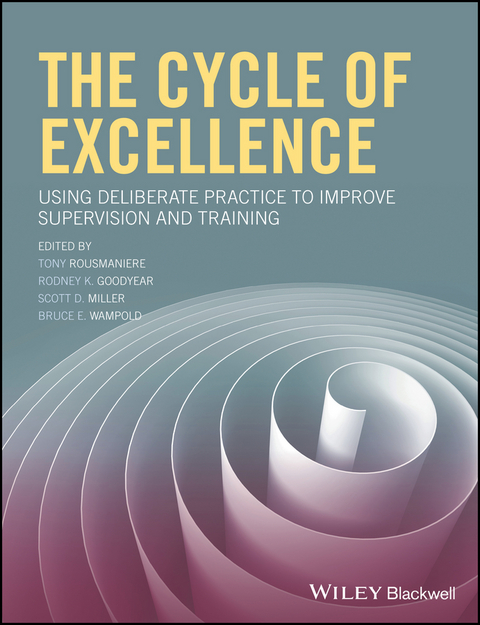
The Cycle of Excellence (eBook)
John Wiley & Sons (Verlag)
978-1-119-16558-3 (ISBN)
How do the good become great? Practice! From musicians and executives to physicians and drivers, aspiring professionals rely on deliberate practice to attain expertise. Recently, researchers have explored how psychotherapists can use the same processes to enhance the effectiveness of psychotherapy supervision for career-long professional development. Based on this empirical research, this edited volume brings together leading supervisors and researchers to explore a model for supervision based on behavioral rehearsal with continuous corrective feedback. Demonstrating how this model complements and enhances a traditional, theory-based approach, the authors explore practical methods that readers can use to improve the effectiveness of their own psychotherapy training and supervision.
This book is the 2018 Winner of the American Psychological Association Supervision & Training Section's Outstanding Publication of the Year Award.
Tony Rousmaniere, PsyD, is on the Clinical Faculty at the University of Washington in Seattle, where he also maintains a private practice. He provides consultation and training for therapists around the world.
Rodney K. Goodyear, PhD, is Professor and Chair of the Department of Counseling and Human Services at the University of Redlands, and Emeritus Professor at the University of Southern California.
Scott D. Miller, PhD, is the founder of the International Center for Clinical Excellence, a consortium of clinicians, researchers, and educators dedicated to promoting excellence in behavioral health services.
Bruce E. Wampold, PhD, is Emeritus Professor of Counseling Psychology at the University of Wisconsin-Madison, and Director of the Research Institute at Modum Bad Psychiatric Center, Norway.
How do the good become great? Practice! From musicians and executives to physicians and drivers, aspiring professionals rely on deliberate practice to attain expertise. Recently, researchers have explored how psychotherapists can use the same processes to enhance the effectiveness of psychotherapy supervision for career-long professional development. Based on this empirical research, this edited volume brings together leading supervisors and researchers to explore a model for supervision based on behavioral rehearsal with continuous corrective feedback. Demonstrating how this model complements and enhances a traditional, theory-based approach, the authors explore practical methods that readers can use to improve the effectiveness of their own psychotherapy training and supervision.This book is the 2018 Winner of the American Psychological Association Supervision & Training Section's Outstanding Publication of the Year Award.
Tony Rousmaniere, PsyD, is on the Clinical Faculty at the University of Washington in Seattle, where he also maintains a private practice. He provides consultation and training for therapists around the world. Rodney K. Goodyear, PhD, is Professor and Chair of the Department of Counseling and Human Services at the University of Redlands, and Emeritus Professor at the University of Southern California. Scott D. Miller, PhD, is the founder of the International Center for Clinical Excellence, a consortium of clinicians, researchers, and educators dedicated to promoting excellence in behavioral health services. Bruce E. Wampold, PhD, is Emeritus Professor of Counseling Psychology at the University of Wisconsin-Madison, and Director of the Research Institute at Modum Bad Psychiatric Center, Norway.
Cover 1
Title Page 5
Copyright 6
Contents 9
About the Editors 11
List of Contributors 13
Part I: The Cycle of Excellence 17
Chapter 1: Introduction 19
The Overall Effectiveness of Psychotherapy 20
Opportunity for Improvement 20
Current Strategies for Improving Effectiveness 21
The Science of Expertise 23
The Cycle of Excellence 23
How Much Practice Is Enough? 24
Bringing the Science of Expertise to Psychotherapy 27
Sources of Motivation to Engage in Deliberate Practice 29
About This Book 29
Questions from John Norcross, PhD 30
References 33
Chapter 2: Professional Development: From Oxymoron to Reality 39
Learning from Experts 41
Application of Deliberate Practice in Psychotherapy 44
Making Professional Development a Reality 51
Questions from the Editors 53
References 55
Chapter 3: What Should We Practice?: A Contextual Model for How Psychotherapy Works 65
Contextual Model 66
Characteristics and Actions of Effective Therapists 72
Conclusions 76
Questions from the Editors 76
References 77
Chapter 4: Helping Therapists to Each Day Become a Little Better than They Were the Day Before: The Expertise-Development Model of Supervision and Consultation 83
Concepts and Context for the Expertise-Development Model 84
Expertise-Development Model of Supervision and Consultation 88
Additional Issues Related to Implementing the Expertise-Development Model 101
Conclusion 103
Questions from the Editors 103
References 105
Part II: Tracking Performance 113
Chapter 5: Qualitative Methods for Routine Outcome Measurement 115
What Is Qualitative Methodology? 116
Rationale for Qualitative Outcome Assessment 116
Using Qualitative Feedback and Outcome Data Collection Methods in Routine Clinical Practice 118
Conclusion: Issues and Challenges in Using Qualitative Outcome and Process Instruments to Inform Deliberate Practice 128
Questions from the Editors 130
References 133
Chapter 6: Quantitative Performance Systems: Feedback-Informed Treatment 139
Overview of Select ROM Systems 140
Using Client Feedback for Clinical Improvement 147
Conclusion 153
Questions from the Editors 153
References 156
Chapter 7: Routine Outcome Monitoring in Child and Adolescent Mental Health in the United Kingdom at the Individual and Systems Levels: Learning from the Child Outcomes Research Consortium 161
Making Routine Outcome Monitoring a Central Part of Direct Work with Clients 162
Making Routine Outcome Monitoring a Central Part of Practitioner Development 166
Making Routine Outcome Monitoring a Central Part of System-Level Quality Improvement 173
Conclusion 173
Questions from the Editors 174
References 175
Part III: Applications for Integrating Deliberate Practice into Supervision 177
Chapter 8: Some Effective Strategies for the Supervision of Psychodynamic Psychotherapy 179
Techniques/Processes Associated with Outcome in Psychodynamic Psychotherapy 179
Techniques/Processes Associated with Therapeutic Alliance in Psychodynamic Psychotherapy 182
Empirical Research on Graduate Trainees Learning Psychodynamic Psychotherapy 184
Methods for Training Therapists in Psychodynamic Psychotherapy 186
Conclusion 195
Questions from the Editors 196
References 199
Chapter 9: Nurturing Therapeutic Mastery in Cognitive Behavioral Therapy and Beyond: An Interview with Donald Meichenbaum 205
Interview 206
References 212
Chapter 10: Nurturing Expertise at Mental Health Agencies 215
Calgary Counselling Centre 216
Changes in Outcomes at CCC over Time 222
Costs to Implement 225
Summary and Conclusion: A Culture of Excellence 228
Questions from the Editors 229
References 231
Chapter 11: The Ongoing Evolution of Continuing Education: Past, Present, and Future 235
Laying the Groundwork 235
Continuing Professional Development: Early Groundwork 237
Contemporary Landscape of Continuing Professional Development 238
Continuing Education Worldwide 243
Redesigning Continuing Professional Development 244
Illustration of Effective Continuing Professional Development 252
Concluding Remarks 254
Questions from the Editors 254
References 258
Chapter 12: Advances in Medical Education from Mastery Learning and Deliberate Practice 265
History of U.S. Medical Education 266
Mastery Learning with Deliberate Practice 269
Translational Outcomes from Medical Education 273
Coda 275
Questions from the Editors 275
References 277
Part IV: Recommendations 281
Chapter 13: Improving Psychotherapy Outcomes: Guidelines for Making Psychotherapist Expertise Development Routine and Expected 283
Training Programs 283
Regulatory Boards and Agencies: Overseeing Initial and Ongoing Rights to Practice 285
Supervisors and Consultants 287
Administrators of Clinics, Agencies, and Mental Health Systems 287
Professional Associations 288
Research 288
Practicing Psychotherapists 289
References 289
Index 293
EULA 307
| Erscheint lt. Verlag | 7.4.2017 |
|---|---|
| Sprache | englisch |
| Themenwelt | Geisteswissenschaften ► Psychologie |
| Medizin / Pharmazie ► Gesundheitsfachberufe | |
| Medizin / Pharmazie ► Medizinische Fachgebiete ► Psychiatrie / Psychotherapie | |
| Naturwissenschaften ► Chemie | |
| Schlagworte | Clinical psychology • clinical psychology supervision and training • clinical psychology training • counseling psychology evidence-based practices • counseling psychology improvement • counseling psychology metrics • counseling psychology supervision • counseling psychology training • deliberate practice in clinical training • improving mental health outcomes • improving psychotherapy outcomes • increase the effectiveness of psychotherapy • international center for clinical excellence • Klinische Psychologie • <p>psychotherapy training • mental health training • mental health training and supervision • Psychologie • Psychology • Psychotherapie • Psychotherapie u. Beratung • psychotherapist deliberate practice improvement • psychotherapist professional development • psychotherapist skill building • psychotherapists on the couch • psychotherapist training • Psychotherapy & Counseling • psychotherapy effectiveness • psychotherapy evidence-based practices • psychotherapy expertise • psychotherapy performance metrics • Psychotherapy Supervision • science of expertise • science of expertise for counseling psychologists</p> • science of expertise for mental health professionals • science of expertise for psychotherapists • Social Policy & Welfare • Social Work • Sozialarbeit • Sozialpolitik u. Wohlfahrt |
| ISBN-10 | 1-119-16558-X / 111916558X |
| ISBN-13 | 978-1-119-16558-3 / 9781119165583 |
| Informationen gemäß Produktsicherheitsverordnung (GPSR) | |
| Haben Sie eine Frage zum Produkt? |
 PDF (Adobe DRM)
Kopierschutz: Adobe-DRM
Adobe-DRM ist ein Kopierschutz, der das eBook vor Mißbrauch schützen soll. Dabei wird das eBook bereits beim Download auf Ihre persönliche Adobe-ID autorisiert. Lesen können Sie das eBook dann nur auf den Geräten, welche ebenfalls auf Ihre Adobe-ID registriert sind.
Details zum Adobe-DRM
Dateiformat: PDF (Portable Document Format)
Mit einem festen Seitenlayout eignet sich die PDF besonders für Fachbücher mit Spalten, Tabellen und Abbildungen. Eine PDF kann auf fast allen Geräten angezeigt werden, ist aber für kleine Displays (Smartphone, eReader) nur eingeschränkt geeignet.
Systemvoraussetzungen:
PC/Mac: Mit einem PC oder Mac können Sie dieses eBook lesen. Sie benötigen eine
eReader: Dieses eBook kann mit (fast) allen eBook-Readern gelesen werden. Mit dem amazon-Kindle ist es aber nicht kompatibel.
Smartphone/Tablet: Egal ob Apple oder Android, dieses eBook können Sie lesen. Sie benötigen eine
Geräteliste und zusätzliche Hinweise
Buying eBooks from abroad
For tax law reasons we can sell eBooks just within Germany and Switzerland. Regrettably we cannot fulfill eBook-orders from other countries.
aus dem Bereich