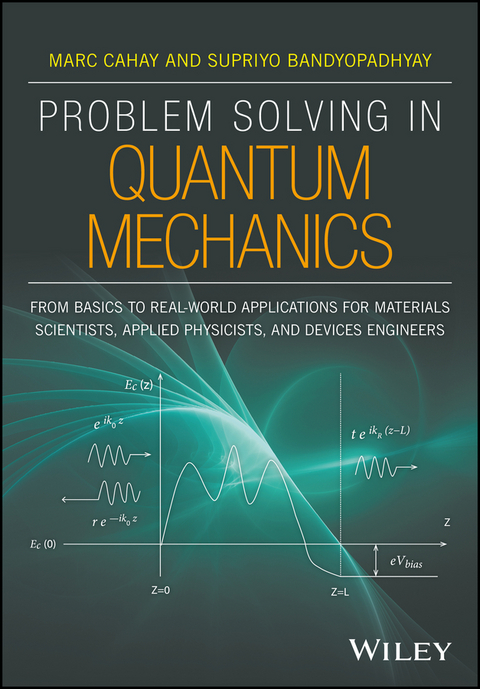
Problem Solving in Quantum Mechanics (eBook)
John Wiley & Sons (Verlag)
978-1-118-98873-2 (ISBN)
This topical and timely textbook is a collection of problems for students, researchers, and practitioners interested in state-of-the-art material and device applications in quantum mechanics. Most problem are relevant either to a new device or a device concept or to current research topics which could spawn new technology. It deals with the practical aspects of the field, presenting a broad range of essential topics currently at the leading edge of technological innovation.
Includes discussion on:
Properties of Schroedinger Equation
Operators
Bound States in Nanostructures
Current and Energy Flux Densities in Nanostructures
Density of States
Transfer and Scattering Matrix Formalisms for Modelling Diffusive Quantum Transport
Perturbation Theory, Variational Approach and their Applications to Device Problems
Electrons in a Magnetic or Electromagnetic Field and Associated Phenomena
Time-dependent Perturbation Theory and its Applications
Optical Properties of Nanostructures
Problems in Quantum Mechanics: For Material Scientists, Applied Physicists and Device Engineers is an ideal companion to engineering, condensed matter physics or materials science curricula. It appeals to future and present engineers, physicists, and materials scientists, as well as professionals in these fields needing more in-depth understanding of nanotechnology and nanoscience.
MARC CAHAY, Spintronics and Vacuum Nanoelectronics Laboratory, University of Cincinnati, USA
SUPRIYO BANDYOPADHYAY, School of Engineering, Virginia Commonwealth University, USA
This topical and timely textbook is a collection of problems for students, researchers, and practitioners interested in state-of-the-art material and device applications in quantum mechanics. Most problem are relevant either to a new device or a device concept or to current research topics which could spawn new technology. It deals with the practical aspects of the field, presenting a broad range of essential topics currently at the leading edge of technological innovation. Includes discussion on: Properties of Schroedinger Equation Operators Bound States in Nanostructures Current and Energy Flux Densities in Nanostructures Density of States Transfer and Scattering Matrix Formalisms for Modelling Diffusive Quantum Transport Perturbation Theory, Variational Approach and their Applications to Device Problems Electrons in a Magnetic or Electromagnetic Field and Associated Phenomena Time-dependent Perturbation Theory and its Applications Optical Properties of Nanostructures Problems in Quantum Mechanics: For Material Scientists, Applied Physicists and Device Engineers is an ideal companion to engineering, condensed matter physics or materials science curricula. It appeals to future and present engineers, physicists, and materials scientists, as well as professionals in these fields needing more in-depth understanding of nanotechnology and nanoscience.
MARC CAHAY, Spintronics and Vacuum Nanoelectronics Laboratory, University of Cincinnati, USA SUPRIYO BANDYOPADHYAY, School of Engineering, Virginia Commonwealth University, USA
About the Authors ix
Preface xi
1 General Properties of the Schrodinger Equation 1
2 Operators 15
3 Bound States 47
4 Heisenberg Principle 80
5 Current and Energy Flux Densities 101
6 Density of States 128
7 Transfer Matrix 166
8 Scattering Matrix 205
9 Perturbation Theory 228
10 Variational Approach 245
11 Electron in a Magnetic Field 261
12 Electron in an Electromagnetic Field and Optical Properties of Nanostructures 281
13 Time-Dependent Schrodinger Equation 292
A Postulates of Quantum Mechanics 314
B Useful Relations for the One-Dimensional Harmonic Oscillator 317
C Properties of Operators 319
D The Pauli Matrices and their Properties 322
E Threshold Voltage in a High Electron Mobility Transistor Device 325
F Peierls's Transformation 329
G Matlab Code 332
Index 343
Preface
Over the last two decades, there has been a dramatic increase in the study of physical and biological systems at the nanoscale. In fact, this millenium has been referred to as the “nanomillenium.” The fields of nanoscience and nanoengineering have been fuelled by recent spectacular discoveries in mesoscopic physics, a new understanding of DNA sequencing, the advent of the field of quantum computing, tremendous progress in molecular biology, and other related fields. A fundamental understanding of physical phenomena at the nanoscale level will require future generations of engineers and scientists to grasp the intricacies of the quantum world and master the fundamentals of quantum mechanics developed by many pioneers since the 1920s. For electrical engineers, condensed matter physicists, and materials scientists who are involved with electronic and optical device research, quantum mechanics will assume a special significance. For instance, progress in the semiconductor industry has tracked Gordon Moore's prediction in 1965 regarding continued downscaling of electronic devices on a chip [1]. The density of transistors in a semiconductor chip has increased ever since in a geometric progression, roughly doubling every 18 months. In state-of-the-art semiconductor chips, the separation between the source and drain in currently used fin field effect transistors (FinFETs) is below 10 nm. All future devices for semiconductor chip applications are likely to be strongly affected by the laws of quantum mechanics, and an understanding of these laws and tenets must be added to the repertoire of a device engineer and scientist [2].
Another challenge is to understand the quantum mechanical laws that will govern device operation when the projected density of 1013 transistors per cm2, anticipated by 2017, is finally reached. Density increase, however, comes with a cost: if energy dissipation does not scale down concomitantly with device dimensions there will be thermal runaway, resulting in chip meltdown. This doomsday scenario has been dubbed the “red brick wall” by the International Technology Roadmap for Semiconductors [3]. The foremost challenge is to find alternatives to the current semiconductor technology that would lead to a drastic reduction in energy dissipation during device operation. Such a technology, if and when it emerges, will very likely draw heavily on quantum mechanics as opposed to classical physics. Alternatives based on semiconductor heterostructures employing AlGaAs/GaAs or other III–V or II–VI materials have been investigated for several decades and have led to myriad quantum mechanical devices and architectures exploiting the special properties of quantum wells, wires, and dots [4–7]. Future device engineers, applied physicists, and material scientists will therefore need to be extremely adept at quantum mechanics.
The need for reform in the teaching of quantum mechanics at both the undergraduate and graduate levels is now evident [8], and has been discussed in many articles over the last few years [9–16] and at dedicated conferences on the subject, including many recent Gordon Research conferences. There are already some efforts under way at academic institutions to better train undergraduate students in this area. Many curricula have been modified to include more advanced classes in quantum mechanics for students in the engineering disciplines [10, 11]. This initiative has been catalyzed by the recent enthusiasm generated by the prospects of quantum computing and quantum communication [17]. This is a discipline that embraces knowledge in four different fields: electrical engineering, physics, materials science, and computer science.
Many textbooks have been written on quantum mechanics [18–30]. Only a few have dealt with practical aspects in the field suitable for a wide audience comprised of device engineers, applied physicists, and materials scientists [31–44]. In fact, quantum mechanics is taught very differently by high energy physicists and electrical engineers. In order for the subject to be entertaining and understandable to either discipline, they must be taught by their own kind to avoid a culture shock for the uninitiated students. Carr and McKagan have recently discussed the significant problems with graduate quantum mechanics education [13]. Typically, most textbooks are inadequate or devote too little time to exploring topics of current exciting new research and development that would prepare graduate students for the rapidly growing fields of nanoscience, nanoengineering and nanotechnology. As pointed out by Carr and McKagan, from a purely theoretical point of view, the history of quantum mechanics can be divided into four periods. In the first ten years following the 1926 formulation of the famous equation by Schrödinger, the early pioneers in the field developed the formalism taught in many undergraduate classes, including wave mechanics, its matrix formulations, and an early version of its interpretation with the work of Bohm and Bohr, among others. Then, until the mid 1960s, new concepts were developed, mostly addressing many-body aspects, with landmark achievements such as a formulation of density functional theory. This was accompanied by quantum electrodynamics and a successful explanation of low temperature superconductivity by Bardeen, Cooper, and Schrieffer. The third period began in 1964 with the pioneering work of Bell. The question of interpretation of quantum mechanics reached a deeper level with many theoretical advances, which eventually led to the fourth period in the field starting with the pioneering work of Aspect et al. in 1982 and the first successful experimental proof of Bell's inequality. Fundamental research in quantum mechanics now includes the fields of quantum computing and quantum communication, which have progressed in large strides helped by the rapid technological advances in non-linear optics, spintronic devices, and other systems fabricated with sophisticated techniques such as molecular beam epitaxy, metal organic chemical vapor deposition, atomic layer epitaxy, and various self-assembly techniques. The tremendous progress in the field has also been accelerated with the development of new characterization techniques including scanning and tunneling electron microscopy, atomic force microscopy, near field scanning optical microscopy, single photon detection, single electron detection, and others.
Many books dedicated to problems in quantum mechanics have appeared over the years. Most of them concentrate on exercises to help readers master the principles and fundamentals of the theory. In contrast, this work is a collection of problems for students, researchers, and practitioners interested in state-of-the-art material and device applications. It is not a textbook filled with precepts. Since examples are always better than precepts, this book is a collection of practical problems in quantum mechanics with solutions. Every problem is relevant either to a new device or a device concept, or to topics of current material relevant to the most recent research and development in practical quantum mechanics that could lead to new technological developments. The collection of problems covered in this book addresses topics that are covered in quantum mechanics textbooks but whose practical applications are often limited to a few end-of-the-book problems, if even that.
The present book should therefore be an ideal companion to a graduate-level textbook (or the instructor's personal lecture notes) in an engineering, condensed matter physics, or materials science curriculum. This book can not only be used by graduate students preparing for qualifying exams but is an ideal resource for the training of professional engineers in the fast-growing field of nanoscience. As such, it is appealing to a wide audience comprised not only of future generations of engineers, physicists, and material scientists but also of professionals in need of refocusing their areas of expertise toward the rapidly burgeoning areas of nanotechnology in our everyday life. The student is expected to have some elementary knowledge of quantum mechanics gleaned from modern physics classes. This includes a basic exposure to Planck's pioneering work, Bohr's concept of the atom, the meaning of the de Broglie wavelength, a first exposure to Heisenberg's uncertainty principle, and an introduction to the Schrödinger equation, including its solution for simple problems such as the particle in a box and the analysis of tunneling through a simple rectangular barrier. The authors have either organized or served on panels of many international conferences dedicated to the field of nanoscience and nanotechnology over the last 25 years. They have given or organized many short courses in these areas and given many invited talks in their field of expertise spanning nanoelectronics, nano-optoelectronics, nanoscale device simulations, spintronics, and vacuum nanoelectronics, among others. They also routinely teach graduate classes centered on quantum mechanical precepts, and therefore have first-hand experience of student needs and where their understanding can fall short.
The problems in this book are grouped by theme in 13 different chapters. At the beginning of each chapter, we briefly describe the theme behind the set of problems and refer the reader to specific sections of existing books that offer some of the clearest exposures to the material needed to tackle the problems. The level of difficulty of each problem is indicated by an increasing number of asterisks. Most solutions are typically sketched with an outline of the major steps. Intermediate and lengthy algebra steps are kept to a minimum to...
| Erscheint lt. Verlag | 6.4.2017 |
|---|---|
| Sprache | englisch |
| Themenwelt | Naturwissenschaften ► Physik / Astronomie ► Quantenphysik |
| Naturwissenschaften ► Physik / Astronomie ► Theoretische Physik | |
| Technik | |
| Schlagworte | applied physics • Electrical & Electronics Engineering • Elektrotechnik u. Elektronik • Heisenberg uncertainty principle • <p>Quantum Mechanics • Nanomaterialien • nanomaterials • Nanoscale Devices • Nanotechnologie • nanotechnology • perturbation theory • Physics • Physik • Quantenelektronik • Quantenphysik u. Feldtheorie • Quantum Confined Structures</p> • Quantum Electronics • Quantum Physics & Field Theory • scattering theory • Schroedinger equation • transfer matrix • Variational Technique |
| ISBN-10 | 1-118-98873-6 / 1118988736 |
| ISBN-13 | 978-1-118-98873-2 / 9781118988732 |
| Informationen gemäß Produktsicherheitsverordnung (GPSR) | |
| Haben Sie eine Frage zum Produkt? |
 EPUB (Adobe DRM)
Kopierschutz: Adobe-DRM
Adobe-DRM ist ein Kopierschutz, der das eBook vor Mißbrauch schützen soll. Dabei wird das eBook bereits beim Download auf Ihre persönliche Adobe-ID autorisiert. Lesen können Sie das eBook dann nur auf den Geräten, welche ebenfalls auf Ihre Adobe-ID registriert sind.
Details zum Adobe-DRM
Dateiformat: EPUB (Electronic Publication)
EPUB ist ein offener Standard für eBooks und eignet sich besonders zur Darstellung von Belletristik und Sachbüchern. Der Fließtext wird dynamisch an die Display- und Schriftgröße angepasst. Auch für mobile Lesegeräte ist EPUB daher gut geeignet.
Systemvoraussetzungen:
PC/Mac: Mit einem PC oder Mac können Sie dieses eBook lesen. Sie benötigen eine
eReader: Dieses eBook kann mit (fast) allen eBook-Readern gelesen werden. Mit dem amazon-Kindle ist es aber nicht kompatibel.
Smartphone/Tablet: Egal ob Apple oder Android, dieses eBook können Sie lesen. Sie benötigen eine
Geräteliste und zusätzliche Hinweise
Buying eBooks from abroad
For tax law reasons we can sell eBooks just within Germany and Switzerland. Regrettably we cannot fulfill eBook-orders from other countries.
aus dem Bereich