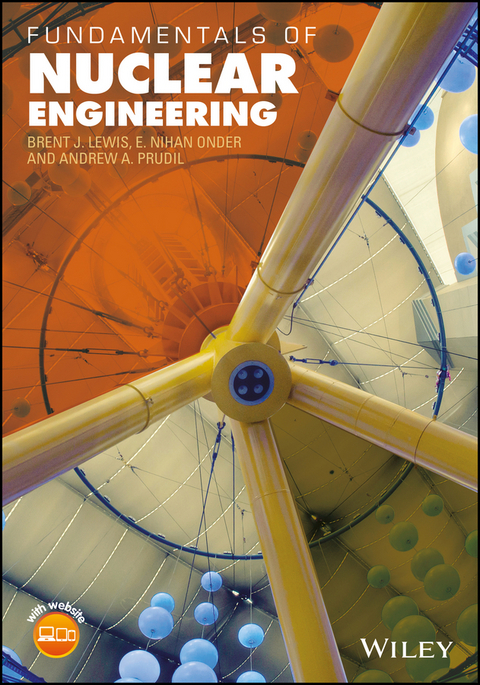
Fundamentals of Nuclear Engineering (eBook)
John Wiley & Sons (Verlag)
978-1-119-27155-0 (ISBN)
Fundamental of Nuclear Engineering is derived from over 25 years of teaching undergraduate and graduate courses on nuclear engineering. The material has been extensively class tested and provides the most comprehensive textbook and reference on the fundamentals of nuclear engineering. It includes a broad range of important areas in the nuclear engineering field; nuclear and atomic theory; nuclear reactor physics, design, control/dynamics, safety and thermal-hydraulics; nuclear fuel engineering; and health physics/radiation protection. It also includes the latest information that is missing in traditional texts, such as space radiation. The aim of the book is to provide a source for upper level undergraduate and graduate students studying nuclear engineering.
BRENT J. LEWIS, Royal Military College of Canada
E. NIHAN ONDER, Canadian Nuclear Laboratories
ANDREW A. PRUDIL, Canadian Nuclear Laboratories
BRENT J. LEWIS, Royal Military College of Canada E. NIHAN ONDER, Canadian Nuclear Laboratories ANDREW A. PRUDIL, Canadian Nuclear Laboratories
1 Atomic and Nuclear Theory 9
1.1 Historical Review 9
1.2 Models of the Nucleus 10
2 Nuclear Reactor Design and Physics 53
2.1 Overall Concept and Description of Nuclear Reactors 53
2.2 Neutron Diffusion 71
2.3 Slowing Down of Neutrons 75
2.4 Criticality and the Steady State 86
2.5 Advanced Reactor Physics 96
3 Nuclear Reactor Dynamics and Control 120
3.1 Overview of Reactor Kinetics Behaviour 120
3.2 Point Reactor Model and the Inhour Equation 125
3.3 Reactor Control 138
3.4 Nuclear Fuel Management 146
4 Nuclear Reactor Materials and Fuel Engineering 174
4.1 Nuclear Reactor Materials 174
4.2 Fuel Production 202
4.3 Fuel Element Thermal Performance 218
4.4 Fuel Chemistry 240
4.5 Fuel Restructuring 248
4.6 Fission Product Behaviour 252
4.7 Fuel Performance 285
5 Thermal Hydraulics 314
5.1 Choice of Coolant 314
5.2 Definitions and Simple Two-Phase Flow Relationships 315
5.3 Two-Phase Flow 318
5.4 Pressure Drop 343
5.5 Heat Transfer 380
6 Nuclear Reactor Safety 573
6.1 Reactor Licensing and Regulation 573
6.2 General Principles of Reactor Safety 586
6.3 Engineered Safety Features 590
6.4 Reactor Safety Analysis 597
6.5 Reliability and Risk Assessment 619
6.6 Nuclear Reactor Accidents 624
6.7 Radiation Dose Calculations 640
6.8 Nuclear Emergency Response 659
6.9 Fission Product Release and Severe Core Damage Phenomena 669
7 Health Physics and Radiation Protection 711
7.1 Interaction of Radiation with Matter 711
7.2 Health Physics and Radiation Protection 730
7.3 Biological Effects of Radiation 763
7.4 Radiation Protection 779
7.5 Contamination Treatment 788
7.6 Space Radiation 788
Appendix 1 Physical Constants and Conversion Factors 811
Appendix 2 Table of Atomic Mass Excesses 813
Appendix 3 Some Values of Nuclear Spins and Parities 900
Appendix 4 Reactor Physics Parameters 903
Appendix 5 Physical and Biological Data for Radionuclides 905
Appendix 6 Cross-Sections of Some Radionuclides 907
Appendix 7 Properties of Elements and Some Molecules 909
Appendix 8 Isotopic Cross-Sections 913
Appendix 9 Direct and Cumulative Thermal Fission Product Yields for Various Fissile Isotopes 926
Index 943
Prologue
Introduction
Nuclear technology was first developed in the 1940s during research on weapons production during the World War II. Attention turned to commercial nuclear power in the 1950s. Today, nuclear energy is an important source of electricity production for three main reasons: (i) supply, (ii) environmental footprint (i.e., climate change) and (iii) economics.
As shown in Figure p.1, nuclear power provides about 11% of the global electricity needs. In particular, as of 2015, there have been 16 000 reactor years of experience with 436 commercial power reactors in 31 countries that supply 378 000 MW (electrical) of total capacity; in addition, 67 nuclear power reactors are also under construction with 166 reactors being planned (Table P.1). Fifty-six countries operate a total of 240 research reactors as a source of neutrons for scientific research and for the production of medical and industrial isotopes. Moreover, there are about 180 nuclear reactors that power ships and submarines.
Figure p.1 World electricity production in 2012. Source: World nuclear association.
From 1990 to 2010, the world electricity (e) capacity rose by 57 GWe (17.75%), with a rise in electricity produced from nuclear power of 755 TWh (40%), as shown in Figure p.2, due to new plant construction (36%), uprating of other plants (7%) and an increase in availability of plants (57%). The USA itself accounts for nearly one third of the world's nuclear electricity (see the first column of Table P.1), where nuclear power plant performance has increased over the past twenty years with capacity factors over 90% in five of the seven years up to 2013. In 2011 and 2012, both capacity and output diminished, with cutbacks in Germany and Japan (i.e., in Japan dropping from 13 TWh in 2010 to 0 TWh in 2015 as seen in Table P.1) following the Fukushima reactor accident (see Chapter 6).
Nuclear power is important because of its relatively low environmental footprint in terms of climate change. The lifecycle greenhouse gas (GHG) emissions from different forms of electricity generation for all phases of the process including construction, operation, and decommissioning are shown in Figure p.3 based on the analysis of twenty studies. This analysis shows that generating electricity from fossil fuels results in much greater emissions than that from nuclear or renewable generation.
Data for costs in the United States for various sources of electricity production from 1995 to 2012 (Figure p.4) show nuclear generation (i.e., for the fuel plus operation and maintenance) at 2.40 cents/kWh, as compared with coal at 3.27 cents/kWh and gas at 3.40 cents/kWh. These costs exclude indirect costs and capital costs that are plant/utility specific and also depend on the age of the plant.
A finish study for projected electricity costs in 2003 suggested nuclear production at €2.37 cents/kWh, coal at €2.63 cents/kWh and natural gas at €3.22 cents/kWh (Figure p.5). This study assumed a 91% capacity factor, 5% interest rate and 40-year plant life. The relative effects of capital and fuel costs are depicted. Nuclear production specifically has a relatively high capital cost that depends importantly on the financing costs and length of time for construction. On the other hand, the fuel costs are much lower, so that once a nuclear plant is built its costs are more predictable compared to gas or coal. In addition, a carbon tax can impact costs, that is, with carbon emissions trading at €20/t CO2, the electricity costs for coal and gas increase to €4.25 and 3.92 cents/kWh, respectively. Finally, in 2015, a report from the Institute for Energy Research on the levelized cost of electricity from existing generation resources suggested nuclear production at slightly over $90/MWh, compared with coal at almost $100/MWh and gas just over $70/MWh.
Table P.1 World nuclear power reactors and uranium requirements
| Nuclear electricity generation 2014 | Reactors operable August 2015 | Reactors under construction August 2015 | Reactors planned August 2015 | Reactors proposed August 2015 | Uranium required 2015 |
| Country | Billion kWh (or TWh) | % electricity | No. | MWe net | No. | MWe gross | No. | MWe gross | No. | MWe gross | tonnes U |
| Argentina | 5.3 | 4.0 | 3 | 1627 | 1 | 27 | 2 | 1950 | 2 | 1300 | 215 |
| Armenia | 2.3 | 30.7 | 1 | 376 | 0 | 0 | 1 | 1060 | 88 |
| Bangladesh | 0 | 0 | 0 | 0 | 0 | 0 | 2 | 2400 | 0 | 0 | 0 |
| Belarus | 0 | 0 | 0 | 0 | 2 | 2388 | 0 | 0 | 2 | 2400 | 0 |
| Belgium | 32.1 | 47.5 | 7 | 5943 | 0 | 0 | 0 | 0 | 0 | 0 | 1017 |
| Brazil | 14.5 | 2.9 | 2 | 1901 | 1 | 1405 | 0 | 0 | 4 | 4000 | 326 |
| Bulgaria | 15.0 | 31.8 | 2 | 1906 | 0 | 0 | 1 | 950 | 0 | 0 | 324 |
| Canada | 98.6 | 16.8 | 19 | 13 553 | 0 | 0 | 2 | 1500 | 3 | 3800 | 1784 |
| Chile | 0 | 0 | 0 | 0 | 0 | 0 | 0 | 0 | 4 | 4400 | 0 |
| China | 123.8 | 2.4 | 26 | 23 144 | 25 | 27 393 | 43 | 49 970 | 136 | 153 000 | 8161 |
| Czech Republic | 28.6 | 35.8 | 6 | 3904 | 0 | 0 | 2 | 2400 | 1 | 1200 | 566 |
| Egypt | 0 | 0 | 0 | 0 | 0 | 0 | 2 | 2400 | 2 | 2400 | 0 |
| Finland | 22.6 | 34.6 | 4 | 2741 | 1 | 1700 | 1 | 1200 | 1 | 1500 | 751 |
| France | 418.0 | 76.9 | 58 | 63 130 | 1 | 1750 | 0 | 0 | 1 | 1750 | 9230 |
| Germany | 91.8 | 15.8 | 8 | 10 728 | 0 | 0 | 0 | 0 | 0 | 0 | 1889 |
| Hungary | 14.8 | 53.6 | 4 | 1889 | 0 | 0 | 2 | 2400 | 0 | 0 | 357 |
| India | 33.2 | 3.5 | 21 | 5302 | 6 | 4300 | 22 | 21 300 | 35 | 40 000 | 1579 |
| Indonesia | 0 | 0 | 0 | 0 | 0 | 0 | 1 | 30 | 4 | 4000 | 0 |
| Iran | 3.7 | 1.5 | 1 | 915 | 0 | 0 | 2 | 2000 | 7 | 6300 | 176 |
| Israel | 0 | 0 | 0 | 0 | 0 | 0 | 0 | 0 | 1 | 1200 | 0 |
| Italy | 0 | 0 | 0 | 0 | 0 | 0 | 0 | 0 | 0 | 0 | 0 |
| Japan | 0 | 0 | 43 | 40 480 | 3 | 3036 | 9 | 12 947 | 3 | 4145 | 2549 |
| Jordan | 0 | 0 | 0 | 0 | 0 | 0 | 2 | 2000 | 0 |
| Kazakhstan | 0 | 0 | 0 | 0 | 0 | 0 | 2 | 600 | 2 | 600 | 0 |
| Korea DPR (North) | 0 | 0 | 0 | 0 | 0 | 0 | 0 | 0 | 1 | 950 | 0 |
| Korea RO (South) | 149.2 | 30.4 | 24 | 21 677 | 4 | 5600 | 8 | 11... |
| Erscheint lt. Verlag | 31.3.2017 |
|---|---|
| Sprache | englisch |
| Themenwelt | Naturwissenschaften ► Physik / Astronomie ► Thermodynamik |
| Technik ► Elektrotechnik / Energietechnik | |
| Technik ► Maschinenbau | |
| Schlagworte | Advanced Nuclear Power Reactors • atomic theory • CANDU reactor • fuel chemistry • fuel damage • fuel engineering • Fundamental of Nuclear Engineering • fundamentals of nuclear engineering • Generation IV Designs • Health physics • Light Water Reactors • LWRs • Maschinenbau • mechanical engineering • Nuclear Engineering • nuclear fuel engineering • Nuclear Fuel Fabrication • nuclear physics • Nuclear Reactor Control • Nuclear reactor design • nuclear reactor dynamics • Nuclear Reactor Physics • Nuclear Reactor Safety • nuclear theory • Radiation protection • Reactor Accidents • Reactor Design • reactor operation • Reactor Physics • Reactor Safety • Reactor theory • Small Nuclear Power Reactors • SMRs • Space radiation • thermal-hydraulics • thermodynamics • Thermodynamik |
| ISBN-10 | 1-119-27155-X / 111927155X |
| ISBN-13 | 978-1-119-27155-0 / 9781119271550 |
| Informationen gemäß Produktsicherheitsverordnung (GPSR) | |
| Haben Sie eine Frage zum Produkt? |
 EPUB (Adobe DRM)
Kopierschutz: Adobe-DRM
Adobe-DRM ist ein Kopierschutz, der das eBook vor Mißbrauch schützen soll. Dabei wird das eBook bereits beim Download auf Ihre persönliche Adobe-ID autorisiert. Lesen können Sie das eBook dann nur auf den Geräten, welche ebenfalls auf Ihre Adobe-ID registriert sind.
Details zum Adobe-DRM
Dateiformat: EPUB (Electronic Publication)
EPUB ist ein offener Standard für eBooks und eignet sich besonders zur Darstellung von Belletristik und Sachbüchern. Der Fließtext wird dynamisch an die Display- und Schriftgröße angepasst. Auch für mobile Lesegeräte ist EPUB daher gut geeignet.
Systemvoraussetzungen:
PC/Mac: Mit einem PC oder Mac können Sie dieses eBook lesen. Sie benötigen eine
eReader: Dieses eBook kann mit (fast) allen eBook-Readern gelesen werden. Mit dem amazon-Kindle ist es aber nicht kompatibel.
Smartphone/Tablet: Egal ob Apple oder Android, dieses eBook können Sie lesen. Sie benötigen eine
Geräteliste und zusätzliche Hinweise
Buying eBooks from abroad
For tax law reasons we can sell eBooks just within Germany and Switzerland. Regrettably we cannot fulfill eBook-orders from other countries.
aus dem Bereich