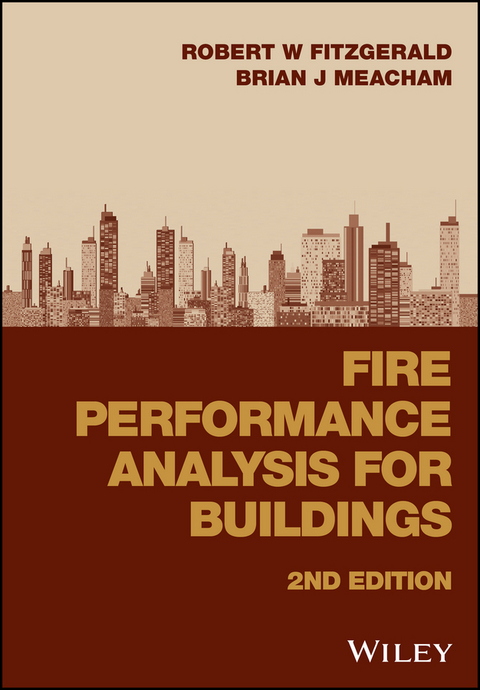
Fire Performance Analysis for Buildings (eBook)
John Wiley & Sons (Verlag)
978-1-118-92649-9 (ISBN)
A building fire is dynamic. A continually changing hostile fire environment influences time relationships that affect fire defenses and risks to people and building functions. The fire and fire defenses in each building interact with different sequences and distinct ways. Risks are characterized by the building's performance.
Significantly updated and restructured new edition
Fire Performance Analysis for Buildings, 2nd Edition organizes the complex interactions into an analytical framework to evaluate any building - at any location - built under any regulatory jurisdiction or era. Systematic, logical procedures evaluate individual component behavior and integrate results to understand holistic performance. The Interactive Performance Information (IPI) chart structures complex time-related interactions among the fire, fire defenses, and associated risks. Quantification uses state-of-the-art deterministic methods of fire safety engineering and fire science. Managing uncertainty is specifically addressed.
Key features:
- Emphasizes fire performance analysis for new or existing buildings.
- Augments fire dynamics calculation methods with qualitative methods to form a more complete understanding of the effects of hostile fire characteristics on building performance.
- Describes fire ground operations for engineers with no fire service experience. An analysis evaluates ways the site and building design help or hinder manual fire suppression.
- Establishes a transition from traditional structural requirements to modern calculation based structural analysis and design for fire conditions. Structural concepts are described for non-structural engineers to enable the roles of each profession to be integrated into comprehensive performance evaluations.
- Addresses techniques of managing uncertainty to improve understanding and communication with professionals of other disciplines.
- Describes methods of risk management using information from the building's performance analysis.
Fire Performance Analysis for Buildings, 2nd Edition has been completely restructured around a performance based framework. Applications integrate traditional fire defenses with fire science and engineering to combine component performance with holistic performance.
Robert W. Fitzgerald, Worcester Polytechnic Institute, USA
Brian J. Meacham, Worcester Polytechnic Institute, USA
A building fire is dynamic. A continually changing hostile fire environment influences time relationships that affect fire defenses and risks to people and building functions. The fire and fire defenses in each building interact with different sequences and distinct ways. Risks are characterized by the building s performance. Significantly updated and restructured new edition Fire Performance Analysis for Buildings, 2nd Edition organizes the complex interactions into an analytical framework to evaluate any building - at any location - built under any regulatory jurisdiction or era. Systematic, logical procedures evaluate individual component behavior and integrate results to understand holistic performance. The Interactive Performance Information (IPI) chart structures complex time-related interactions among the fire, fire defenses, and associated risks. Quantification uses state-of-the-art deterministic methods of fire safety engineering and fire science. Managing uncertainty is specifically addressed. Key features: Emphasizes fire performance analysis for new or existing buildings. Augments fire dynamics calculation methods with qualitative methods to form a more complete understanding of the effects of hostile fire characteristics on building performance. Describes fire ground operations for engineers with no fire service experience. An analysis evaluates ways the site and building design help or hinder manual fire suppression. Establishes a transition from traditional structural requirements to modern calculation based structural analysis and design for fire conditions. Structural concepts are described for non-structural engineers to enable the roles of each profession to be integrated into comprehensive performance evaluations. Addresses techniques of managing uncertainty to improve understanding and communication with professionals of other disciplines. Describes methods of risk management using information from the building s performance analysis. Fire Performance Analysis for Buildings, 2nd Edition has been completely restructured around a performance based framework. Applications integrate traditional fire defenses with fire science and engineering to combine component performance with holistic performance.
Robert W. Fitzgerald, Worcester Polytechnic Institute, USA Brian J. Meacham, Worcester Polytechnic Institute, USA
Title Page 5
Copyright Page 6
Contents 7
Preface 25
Acknowledgements 27
Chapter 1 Fire Performance and Buildings 29
1.1 The Dynamics of Building Fire Performance 29
1.2 The Anatomy of Building Fire Safety 29
1.3 Analysis and Design 30
1.4 Performance Analysis 31
1.5 Quantification 31
1.6 The Organization 32
Part I The Foundation 35
Chapter 2 Preliminary Organization 37
2.1 Introduction 37
2.2 Overview of Evaluations 37
Part One: Organizational Concepts 40
2.3 The Diagnostic Fire 40
2.4 Anatomy of a Representative Fire 40
2.5 Fire Prevention 41
2.6 Fire Scenarios 41
Part Two: Barriers, Spaces, and Connectivity 43
2.7 Spaces and Barriers 43
2.8 Barriers and Fire 43
2.9 Barrier Performance 44
2.10 Space–Barrier Connectivity 44
2.11 Virtual Barriers 46
2.12 Virtual Barrier Applications 46
2.13 Space–Barrier Discussion 50
Part Three: Fire Defenses 51
2.14 Fire Defenses 51
2.15 Active Fire Defenses 52
2.15.1 Fire Detection and Alarm 52
2.15.2 The Automatic Sprinkler System 53
2.15.3 Fire Department Operations 53
2.15.4 Building Fire Brigade 54
2.15.5 Special Hazard Automatic Suppression Systems 54
2.15.6 Special Features 55
2.15.7 Occupant Activities 55
2.16 Passive Fire Defenses 56
2.16.1 Structural Fire Protection 56
2.16.2 Barriers 56
2.16.3 Opening Protectives 57
2.16.4 The Egress System 57
2.16.5 Area of Refuge 58
2.16.6 Fire Attack Route 58
2.17 Closure 58
Chapter 3 Tools of Analysis 59
3.1 Introduction 59
Part One: The Logic 60
3.2 The Framework Logic 60
3.3 The Major Parts 60
3.4 Event Logic Diagrams 62
3.5 Event Logic Observations 66
3.6 Logic Networks 67
3.7 Decomposing Logic Networks 69
3.8 Network Diagram Observations 74
3.9 Single Value Networks 75
3.10 Time Relationships Using Event Trees 75
3.11 Continuous Value Networks 76
3.12 The IPI Chart 76
3.13 Coding 78
Part Two: Space–Barrier Connectivity 79
3.14 Introduction 79
3.15 Room Connectivity 79
3.16 Building Interconnectivity 81
3.17 Segmenting Buildings 82
3.18 Summary 82
Part Three: Additional Tools 83
3.19 Networks and Charts 83
3.20 Organizational Charts 83
3.21 Organizational Networks 84
3.22 Closure 85
Chapter 4 An Introduction to the Interactive Performance Information Chart 87
4.1 Introduction 87
4.2 The Basic Template 87
4.3 The Working Template 89
4.4 Reading IPI Charts 91
4.5 Building Comparisons 96
4.6 IPI Enhancements 96
4.7 Summary 97
Chapter 5 Quantification 101
5.1 Performance Evaluations 101
5.2 Information Accessibility 102
5.3 Quantification 102
5.4 Performance Estimates 103
5.5 Uncertainty in Performance Estimates 104
5.6 Philosophical Reflections 105
5.7 Closure 105
Part II The Parts 107
Chapter 6 The Room Fire 109
6.1 Introduction 109
Part One: Room Fire Concepts 110
6.2 Fire 110
6.3 The Role of Heat: Ignition 110
6.4 The Role of Heat: Heat of Combustion and Heat Release Rate 111
6.5 The Role of Heat: Heat Transfer 111
6.6 Realms of Fire Growth 114
6.7 Fire Development: Fire Free Status to EB 115
6.8 Room Fires 116
6.9 Feedback 117
6.10 Flashover 118
6.11 Fully Developed Fire 119
6.12 The Role of Ventilation 119
6.13 The Role of Barriers 120
6.14 The Fire Development Process: EB to FO 121
6.15 The Fire Development Process: FO to Burnout 121
6.16 Summary 121
Part Two: Room Fire Descriptors 122
6.17 Introduction 122
6.18 Fuels 122
6.19 Fuel Packages and Fuel Groups 124
6.20 Heat Release Rate 125
6.20.1 Determining the HRR 126
6.20.2 Furniture Calorimeter 126
6.20.3 Cone Calorimeter 128
6.20.4 Pause for Discussion 128
6.21 Fire Size Measures 129
6.22 Overview of Factors that Affect Room Fire Behavior 130
6.22.1 Realm 1: Pre-burning 130
6.22.2 Realm 2: Initial burning 130
6.22.3 Realm 3: Vigorous Burning 132
6.22.4 Realm 4: Interactive Burning 134
6.22.5 Realm 5: Remote Burning 136
6.23 Flashover 136
6.24 ?t2 Fires 139
6.25 Realm 6: Fully Developed Fire 140
6.26 Limits of Applicability 141
6.27 Large Rooms: Full Room Involvement 141
6.28 Fire Safety Engineering in the Information Age 142
6.29 Closure 146
Chapter 7 The Room Fire: Qualitative Analysis 147
7.1 The Role of Qualitative Analysis 147
7.2 Qualitative Estimates for Room Fires 148
Part One: Bottom-up Estimates 149
7.3 Bottom-up Scenario Estimates 149
7.3.1 Realm 1: FFS to IG 149
7.3.2 Realm 2: IG to EB 149
7.3.3 Realm 3: EB to Enclosure Point (EP) 151
7.3.4 Realm 4: EP to Ceiling Point (CP) 152
7.3.5 Realm 5: CP to FO 154
7.4 Time and the Fire Growth Potential 154
7.5 FGP Adjustments 156
7.6 Estimating Spread-over Scenarios 159
Part Two: Top-down Estimates 161
7.7 Qualitative Room Classifications 161
7.8 FGP Comparisons 161
7.9 Interior Design and Model Rooms 162
7.10 FGP Classification Groups 163
7.11 Selecting FGP Groups 165
7.11.1 Evaluation Guidelines 165
7.11.2 Classification Examples 167
7.12 Discussion 173
7.13 Closure 174
Chapter 8 Beyond the Room of Origin 175
8.1 Introduction 175
8.2 The Inspection Plan 175
Part One: Barrier Effectiveness 177
8.3 Barrier Functions in Buildings 177
8.4 Barrier Fire Functions 177
8.5 Concepts for Barrier Evaluations 178
8.6 Barrier Failure Modes 180
8.7 Barrier Failures and Building Performance 186
Part Two: Barrier–Space Modules 187
8.8 Introduction 187
8.9 Barrier–Space Modules 187
8.10 Massive Barrier Failure (D) 187
8.11 Hot-spot Barrier Failure (T) 189
8.12 The Role of Interior Finish 189
8.13 Virtual Barriers 190
8.14 Qualitative Diagnostic Fire Analysis: Room Classifications 190
8.15 Qualitative Diagnostic Fire Analysis: Barrier Contributions 192
8.16 Qualitative Diagnostic Fire Analysis: Modules 192
Part Three: Qualitative Fire Analysis 193
8.17 Introduction 193
8.18 The Process 193
8.19 Discussion 200
8.20 Information Technology Enhancements 201
Chapter 9 Smoke Analysis 203
9.1 Introduction 203
9.2 The Plan 204
9.3 Smoke 204
9.4 Buoyancy Forces 205
9.5 Natural Air Movement 206
9.6 Wind 208
9.7 Tenability Considerations 208
9.8 Smoke Movement Analysis 210
9.9 Smoke Movement Networks 211
9.10 Qualitative Smoke Movement Analysis 214
9.11 Quantitative Analysis 214
9.12 Discussion 216
Chapter 10 The Diagnostic Fire 219
10.1 Diagnostic Fires 219
10.2 Interactive Performance Information (IPI) Chart and the Diagnostic Fire 219
10.3 Closure 220
Chapter 11 Fire Detection 221
11.1 Introduction 221
Part One: Automatic Detection 222
11.2 Instrument Detection 222
11.3 Detection Instruments 222
11.3.1 Heat Detectors 223
11.3.2 Smoke Detectors 223
11.3.3 Flame Detectors 224
11.3.4 Operating Modes 224
11.4 Automatic Detection Analysis 225
11.5 Instrument Reliability 226
Part Two: Human Detection 228
11.6 Concepts in Human Fire Detection 228
11.7 Human Detection Analysis 228
11.8 Closure 230
Chapter 12 Alarm: Actions After Detection 231
12.1 Introduction 231
Part One: Alert Occupants 233
12.2 Focus on Alert 233
12.3 Alerting Occupants 233
12.3.1 Audible Signals 234
12.3.2 Visual Signals 234
12.3.3 Human Alerting 235
12.3.4 Nuisance Alarms 235
12.3.5 Operating Modes 235
12.4 Summary 236
Part Two: Notify Local Fire Department 237
12.5 Introduction 237
12.6 Human Notification (MN) 237
12.6.1 Decide to Notify the Fire Department (dmn) 238
12.6.2 Send the Message (smn) 239
12.6.3 Message is Correctly Received (rmn) 239
12.7 Discussion 240
12.8 Automated Notification Services 241
12.8.1 Proprietary Supervising Station System 241
12.8.2 Central Station 242
12.8.3 Remote Station 242
12.8.4 Auxiliary Fire Alarm System 243
12.9 Discussion 244
Part Three: Building System Interfaces 245
12.10 Release Services 245
Chapter 13 Fire Department Extinguishment: Arrival 247
13.1 Introduction 247
13.2 Organizing the Topic 247
Part One: Manual Extinguishment Overview 249
13.3 The Role of the Fire Department 249
13.4 Building Analysis Overview 249
13.5 Part A: Ignition to Notification 251
13.6 Part B: Notification to Arrival 251
13.7 Part C: Arrival to Extinguishment 252
Part Two: Community Fire Departments 254
13.8 Fire Department Organizations 254
13.9 Fire Companies 254
13.9.1 Engine Company 255
13.9.2 Ladder Company 256
13.9.3 Specialized Companies 256
13.9.4 Emergency Services 257
13.9.5 Response Information 257
13.10 Building Fire Brigades 257
Part Three: Community Fire Response 259
13.11 Fire Department Response Time 259
13.12 Communications Centers 259
13.13 Alarm Handling Time 260
13.14 Turnout Time 261
13.15 Travel Time 262
13.16 Response Time Analysis 262
Chapter 14 Fire Department Extinguishment: First Water (MA) 265
The Fire Fighter and the Engineer 265
14.1 Introduction 267
Part One: An Overview of Manual Extinguishment Analysis 269
14.2 The Process 269
14.3 Phase 1: Initial Water Application (MA) 270
14.3.1 Find the Fire 271
14.3.2 Establish a Water Supply 272
14.3.3 The Attack Launch Point 273
14.3.4 Interior Attack Lines 275
14.3.5 Critical Fire Conditions 275
14.3.6 Extinguishing the Fire 276
14.4 Summary 276
Part Two: A Brief Look at Fire Fighting 277
14.5 Initial Fire Ground Actions 277
14.6 Information 277
14.7 Pause for Discussion 279
14.8 Manual Fire Fighting 280
14.9 No Two Fires Are Alike 281
14.10 Summary 281
Part Three: Supply Water Analysis 282
14.11 Introduction 282
14.12 Scenario Analysis 282
14.13 Supply Water Analysis 286
14.14 Supply Water Discussion 288
14.15 Project Analysis 288
14.16 Task Modules 289
14.17 Time and Tasks 289
14.18 Variability 290
14.19 General Analysis 291
14.20 Work Breakdown Structure 291
14.21 Task Precedence 292
14.22 Network Construction 295
14.23 Network Calculations 295
14.24 Variation Analysis 297
14.25 Additional Examples 298
14.26 Levels of Detail 300
14.27 Time Coordination 302
14.28 Discussion 304
Part Four: Interior Fire Attack Analysis 306
14.29 Introduction 306
14.30 Overview of Stretching Interior Attack Lines 306
14.31 Task Modules 307
14.32 Architectural Segments 308
14.33 Architectural Obstacles 309
14.34 ALP Pre-movement 309
14.35 Multiple Attack Lines 310
14.36 Variables 310
14.37 Time Estimates 311
14.38 Attack Route Analysis 311
Part Five: Phase 1 Analysis 318
14.39 Introduction 318
14.40 Phase 1 Comments 318
14.41 Calculating Time Durations 319
14.42 If… 319
14.43 What If… 321
14.44 The IPI Chart 322
14.45 Summary 322
Chapter 15 Fire Department Extinguishment: Control and Extinguishment 323
15.1 First Water Applied… Now What? 323
15.2 The Engineer and the Incident Commander 323
15.3 Pause to Review Available Information 324
15.4 Phase 2 Assessments 326
15.5 Offensive Attack 327
15.6 Defensive Fire Fighting 327
15.7 Barrier Functions in Fire Fighting 328
15.8 Exposure Protection 329
15.9 Constraints 329
15.10 Critical Fire Conditions 330
15.11 Fire Control (MC) 331
15.12 Fire Extinguishment (ME) 331
15.13 Summary 332
Chapter 16 Automatic Sprinkler Suppression 333
16.1 Introduction 333
16.2 Sprinkler System Performance 333
Part One: Sprinkler Systems 335
16.3 Sprinkler Extinguishment 335
16.4 The Sprinkler System 336
16.5 Types of Sprinkler Systems 337
Part Two: Sprinkler Performance 340
16.6 Organization for Thinking 340
16.7 Agent Application (AA) 340
16.8 Agent Application Events 341
16.9 Operational Effectiveness Observations 342
16.10 Sprinkler Fusing (fac) 344
16.11 Water Discharge (dac) 345
16.12 Water Flow Continuity (cac) 347
16.13 Obstructions (wac) 348
16.14 Operational Effectiveness Guidelines 349
16.15 Analysis and the IPI Chart 350
16.16 Auxiliary Equipment and Other Conditions 350
16.17 Partially Sprinklered Buildings 350
16.18 Fire Department Mutual Aid 351
16.19 Automatic Suppression 351
16.20 Closure 352
Chapter 17 The Composite Fire 353
17.1 Introduction 353
17.2 The Fire Limit (L) 353
17.3 Composite Fire 355
17.4 Theoretical Completeness 355
17.5 Summary 356
Chapter 18 Materials, Codes, Standards, Practices, and Performance 359
18.1 Introduction 359
Part One: Building Construction 361
18.2 The Structural Frame 361
18.3 Material Behavior in Fires 362
18.3.1 Structural Steel 362
18.3.2 Concrete 363
18.3.3 Concrete Masonry Units 363
18.3.4 Prestressed Concrete 364
18.3.5 Wood 364
18.3.6 Gypsum 364
18.3.7 Glass 365
Part Two: Historical Perspective 366
18.4 The Built Environment Around World War I 366
18.5 Structural Practice Around World War I 366
18.6 A Century of Evolution 367
18.7 Fire Safety Around World War I 367
18.8 The Fire Safety Solution 368
18.9 Building Code Organization for Fire Safety 369
18.10 Structural Fire Topics Around World War I 369
18.11 Building Code Observations 370
Part Three: Fire Endurance Testing 373
18.12 Fire Test Interpretations 373
18.13 The Standard Fire Endurance Test 373
18.14 Fire Endurance Test Discussion 374
Part Four: Fire Severity 377
18.15 Introduction 377
18.16 Fuel Loads 377
18.17 The Ingberg Correlation 380
18.18 Room Fire Discussion 381
18.19 Fire Severity Theories 383
18.19.1 Ingberg Theory 383
18.19.2 Law Correlation 384
18.19.3 Pettersson Equation 385
18.19.4 Normalized Heat Load 385
18.20 Fire Severity Comparisons 386
18.21 Awareness Pause 387
18.22 Estimating Burnout Time 388
18.23 Influences on Barrier Performance 389
18.24 Automatic Protection and Barriers 389
Part Five: Transitions 391
18.25 The Issue 391
Chapter 19 Concepts in Structural Analysis for Fire Conditions 393
19.1 Introduction 393
19.2 Structural Fire Performance 393
Part One: Building Design 395
19.3 The Development Process 395
19.4 Building Design 395
19.5 Information Technology 396
Part Two: Structural Engineering and Building Design 399
19.6 The Master Builder 399
19.7 The Rise of Engineering 399
19.8 The Building 400
19.9 The Emergence of Structural Engineering 400
19.10 A Brief Pause about 1950 402
19.11 The Great Leap Forward 403
19.12 Structural Design for Fire Conditions 404
Part Three: Structural Engineering 405
19.13 Introduction 405
19.14 Beam Analysis 405
19.14.1 Simple Beams 405
19.14.2 Continuous Flexural Members 409
19.15 Structures and Materials 412
19.16 Structural Engineering 412
19.17 Structural Engineering and Building Design 413
Part Four: Structural Analysis for Fire Conditions 415
19.18 Introduction 415
19.19 Outcomes 415
19.20 Pause for Discussion 416
19.21 The Process 417
19.22 Structural Mechanics 418
19.23 Protection Methods 420
19.24 Diagnostic Fire 420
19.25 Heat Transfer 421
19.26 Structural Performance 422
19.27 Reinforced Concrete 422
19.28 Mechanical Properties 423
19.29 Flexural Members in Reinforced Concrete 424
19.30 Concrete Members at Elevated Temperatures 426
19.31 Pause for Discussion 426
19.32 Other Materials 427
19.33 Summary 427
Chapter 20 Target Spaces and Smoke 429
20.1 Introduction 429
20.2 Orientation 429
20.3 Tenability Measures for Humans 431
20.4 Visibility in Smoke 432
20.5 Equipment and Data Storage 433
20.6 Overview of Target Space Analysis 434
20.7 Target Rooms 435
20.8 Barrier Effectiveness 435
20.9 Mechanical Pressurization 436
20.10 Fire Department Ventilation 437
20.11 Summary 437
Chapter 21 Life Safety 439
21.1 Introduction 439
21.2 Human Reaction to Products of Combustion 440
21.3 Tenability 442
21.4 Fire Fighter Safety 442
Chapter 22 Risk Characterizations 445
22.1 Introduction 445
22.2 The Exposed 445
Part One: Human Safety 447
22.3 Life Safety 447
22.4 Overview of Life Safety Alternatives 447
22.5 Prescriptive Code Egress 449
22.6 Plans Approval for Prescriptive Code Egress 450
22.7 Overview of Egress Risk Characterizations 451
22.8 Discussion 451
22.9 Pre-evacuation Activities 452
22.10 Pre-evacuation Evaluations 454
22.11 Travel Times 454
22.12 Defend in Place 456
22.13 Areas of Refuge 456
22.14 Fire Department Rescue I 456
22.15 Risk Characterizations for Life Safety 457
Part Two: Other Risks 459
22.16 Property Protection 459
22.17 Continuity of Operations 459
22.18 Threat to Neighboring Exposures 460
22.19 Threat to Environment 460
22.20 Closure 460
Chapter 23 Fire Prevention 463
23.1 Introduction 463
Part One: Prevent Established Burning 464
23.2 Prevent EB 464
23.2.1 Ignition Potential 464
23.2.2 Initial Fire Growth 465
23.3 Occupant Extinguishment 465
23.4 Portable Fire Extinguishers 466
23.5 Evaluating Extinguisher Effectiveness 467
23.6 Discussion 468
Part Two: Automatic Special Hazard Suppression 470
23.7 Introduction 470
23.8 Carbon Dioxide Systems 471
23.9 Clean Agent Systems 471
23.10 Dry Chemical Extinguishing Systems 472
23.11 Water-spray Extinguishing Systems 473
23.12 Fine Water Mist Extinguishing Systems 473
23.13 Foam Extinguishing Systems 473
23.14 Explosion Suppression Systems 474
23.15 Building Evaluations for Special Hazard Installations 474
23.16 Closure 475
Part III The Analysis 477
Chapter 24 Fire Performance: Framework for Analysis 479
24.1 Organizational Concepts 479
24.2 Performance Evaluations 479
24.3 Analytical Framework 480
24.4 Fire, Risk, and Buildings 482
Chapter 25 The Diagnostic Fire 483
25.1 Introduction 483
25.2 Top-down Estimates 484
25.3 Modular Estimates 484
25.4 Bottom-up Scenario Analysis 486
25.5 Network Estimates 486
25.6 Scenario Applications 489
25.7 Interactive Performance Information (IPI) Chart Applications 490
Chapter 26 Fire Detection 491
26.1 Introduction 491
Part One: Automatic Detection 492
26.2 Detection Analysis 492
26.3 Detection Example 494
26.4 Detection Estimate 497
26.5 Detector Reliability 497
Part Two: Human Detection 499
26.6 Concepts in Human Detection Analysis 499
26.7 Human Detection Analysis 499
26.8 Closure 501
Chapter 27 Fire Department Notification 503
27.1 Introduction 503
27.2 The Human Link in Notification 503
27.3 Human Notification Analysis 504
27.3.1 The Role of Detection 506
27.3.2 Initial Scenario Analysis 506
27.3.3 Information Augmentation 507
27.4 Human Notification 507
27.5 Automated Notification Analysis 508
27.6 Closure 509
Chapter 28 Fire Department Extinguishment 511
28.1 Introduction 511
28.2 Framework for Analysis 511
28.3 Notification to Arrival 511
28.4 Fire Department Response 513
28.5 Arrival to Extinguishment 516
28.6 Phase 1 Analysis 517
28.7 Phase 2 Analysis 517
28.8 Phase 3 Analysis 518
28.9 Putting It Together 520
28.10 Discussion 526
28.11 Closure 527
Chapter 29 Automatic Sprinkler Suppression 529
29.1 Introduction 529
29.2 Agent Application (AA) 530
29.3 Design Effectiveness (AC) 532
29.3.1 First Sprinkler Fusing (fac) 532
29.3.2 Multiple Sprinkler Fusing (fac) 532
29.3.3 Discharge Density (dac) 533
29.3.4 Water Continuity (cac) 533
29.3.5 Obstructions (wac) 534
29.4 Automatic Sprinkler Suppression (A) 535
29.5 Automatic Sprinkler System Analysis 535
29.5.1 Role of Performance Analysis 537
29.5.2 Organizing Performance Analysis 537
29.5.3 Performance Evaluation 541
29.6 Sprinkler Reliability 542
29.7 Closure 542
Chapter 30 The Composite Fire 545
30.1 Introduction 545
30.2 Event Logic Description 545
30.3 Network Description 547
30.4 Summary 548
Chapter 31 Structural Performance 549
31.1 Introduction 549
31.2 Interactive Performance Information (IPI) Documentation 549
31.3 IPI Numerical Estimates 551
31.4 Summary 552
Chapter 32 Target Space Smoke Analysis 553
32.1 Introduction 553
32.2 Success or Failure? 554
32.3 Target Room Performance Bounds 555
Chapter 33 Life Safety Analysis 559
33.1 Introduction 559
33.2 The Exposed 559
33.3 The Exposure 560
33.4 The Window of Time 560
33.5 Pre-movement Time for Egress 561
33.5.1 Fire Detection (OD) 562
33.5.2 Alert Occupants (OA) 563
33.5.3 Occupants Start Egress (OT) 563
33.6 Occupant Life Safety (LS) 564
33.7 Discussion 564
33.8 Defend in Place 566
33.9 Closure 566
Chapter 34 Prevent Established Burning 569
34.1 Introduction 569
Part One: Established Burning Prevention 572
34.2 Ignition Potential 572
34.3 Established Burning Evaluation 572
34.3.1 Fire Self-termination 573
34.3.2 Occupant Extinguishment 574
34.4 Scenario Selection 574
34.5 Prevent EB: Discussion 574
Part Two: Special Hazards Protection 578
34.6 The Role of Special Hazards Suppression 578
34.7 Framework for Analysis 578
34.8 Special Hazards Analysis 579
34.9 Protection Combinations 579
34.10 Closure 582
Part IV Managing Uncertainty 583
Chapter 35 Understanding Uncertainty 585
35.1 Introduction 585
35.2 Window of Uncertainty 585
35.3 Calibrating Uncertainty 586
35.4 Degree-of-Belief Estimations 587
35.5 The Role of the Analytical Framework 588
35.6 Sprinkler Analysis Networks 588
35.7 Sprinkler Control (AC) 589
35.8 Pause to Organize Thoughts 590
35.9 Calculating Single Value Outcomes 591
35.10 Graphing Results 592
35.11 Cumulative Evaluations 596
35.12 Sprinkler Reliability (AA) 600
35.13 Sprinkler System Performance (A) 601
35.14 Control and Extinguishment 602
35.15 Sprinkler Performance for a Building 604
35.16 Visual Thinking 605
35.17 The IPI Chart 606
35.18 The Narrative 606
35.19 Sprinklers and the Fire Department 606
35.20 Other Components 607
35.21 Summary 607
Chapter 36 Visual Thinking 609
36.1 Introduction 609
36.2 A Case Study 609
36.3 A Way of Thinking 612
36.4 The Interactive Performance Information (IPI) Chart Relation 612
36.5 Performance Evaluators 613
36.6 Reading Performance Curves 614
36.6.1 Detection 614
36.6.2 Fire Department Notification 616
36.6.3 Sprinkler Control 617
36.6.4 Fire Extinguishment 618
36.7 The L Curve 619
36.8 L Curve Illustration 622
36.9 Variability and Reliability 622
36.10 Summary 623
Chapter 37 Introduction to Risk Management 625
37.1 Introduction 625
Part One: The Process 626
37.2 Audience 626
37.3 Fire Safety Management 626
37.4 Decisions and Uncertainty 628
37.5 Management Applications 628
37.6 Comparisons 629
37.7 Process Overview 629
Part Two: Information Acquisition 632
37.8 Introduction 632
37.9 Understand the Problem 632
37.10 Describe the Building 633
37.11 Evaluate Performance 633
37.12 Characterize Risk 633
Part Three: Develop a Risk Management Program 636
37.13 Structure a Risk Management Program 636
37.14 Evaluate “Prevent EB” 636
37.15 Evaluate Special Hazards Protection 637
37.16 Emergency Preparedness 637
37.17 Decision Analysis 639
37.18 Prepare the Presentation 640
37.19 Decision-making 641
Chapter 38 Analytical Foundations 643
38.1 Historical Origins 643
Part One: Logic Diagrams and Networks 645
38.2 Event Trees 645
38.3 Fault and Success Trees 646
38.4 Fault and Success Tree Calculations 647
38.5 Fault and Success Trees Beyond the Room of Origin 648
38.6 Network Organization 649
38.7 Network Calculations 649
38.8 Sequential Path Analysis 651
38.9 Rooms Beyond the Room of Origin 652
38.10 Modular Analysis 652
38.11 Closure 654
Part Two: Probability 656
38.12 Meanings of Probability 656
38.13 Fire Safety Applications 657
38.14 Degree of Belief 657
38.15 Mathematics of Probability 658
38.16 Assessment Quality 658
Part Three: The Role of Judgment 660
38.17 Introduction 660
38.18 Building Decisions 660
38.19 Judgment in Engineering 660
38.20 Language and Culture 661
38.21 Uncertainty and Performance 661
38.22 Summary 662
Appendix A Organizational Structure 665
A.1 TheOrganizational Framework 665
A.2 BasicOrganization 665
A.3 TheComposite Fire 665
A.4 TheDiagnostic Fire (?) 667
A.5 FireDepartment Manual Extinguishment 668
A.6 Detection 668
A.7 Notification 670
A.8 Notificationto Arrival 671
A.9 Arrivalto Extinguishment 673
A.10 AutomaticSprinkler System 674
A.11 BuildingResponse: Structural Behavior 675
A.12 BuildingResponse: Space Tenability 676
A.13 RiskCharacterizations 676
A.14 OccupantMovement 678
A.15 OtherRisks 679
A.16 PreventEstablished Burning (EB): Occupant Extinguishment 679
A.17 PreventEB: Special Hazards Protection 681
A.18 Closure 681
Appendix B Model Building 683
Description 683
Index 689
EULA 721
| Erscheint lt. Verlag | 29.3.2017 |
|---|---|
| Sprache | englisch |
| Themenwelt | Naturwissenschaften ► Physik / Astronomie ► Mechanik |
| Technik ► Architektur | |
| Technik ► Bauwesen | |
| Technik ► Maschinenbau | |
| Schlagworte | analytical framework for building evaluation • Architecture • Architektur • Bauentwurf • Bauingenieur- u. Bauwesen • Brandschutz • Building Design • chart structures complex time-related fire interactions • Civil Engineering & Construction • effects of hostile fire characteristics on building performance • fire ground operations for engineers with no fire service experience • fire performance analysis for buildings • fire performance analysis for new or existing buildings • Fire Protection • how to integrate traditional fire defenses with fire science and engineering • Interactive Performance Information (IPI) • ipi • Maschinenbau • mechanical engineering • Mechanical Engineering Special Topics • Mech Engineering Special Topics • risk management derived from building's performance analysis • Spezialthemen Maschinenbau |
| ISBN-10 | 1-118-92649-8 / 1118926498 |
| ISBN-13 | 978-1-118-92649-9 / 9781118926499 |
| Informationen gemäß Produktsicherheitsverordnung (GPSR) | |
| Haben Sie eine Frage zum Produkt? |
 PDF (Adobe DRM)
Kopierschutz: Adobe-DRM
Adobe-DRM ist ein Kopierschutz, der das eBook vor Mißbrauch schützen soll. Dabei wird das eBook bereits beim Download auf Ihre persönliche Adobe-ID autorisiert. Lesen können Sie das eBook dann nur auf den Geräten, welche ebenfalls auf Ihre Adobe-ID registriert sind.
Details zum Adobe-DRM
Dateiformat: PDF (Portable Document Format)
Mit einem festen Seitenlayout eignet sich die PDF besonders für Fachbücher mit Spalten, Tabellen und Abbildungen. Eine PDF kann auf fast allen Geräten angezeigt werden, ist aber für kleine Displays (Smartphone, eReader) nur eingeschränkt geeignet.
Systemvoraussetzungen:
PC/Mac: Mit einem PC oder Mac können Sie dieses eBook lesen. Sie benötigen eine
eReader: Dieses eBook kann mit (fast) allen eBook-Readern gelesen werden. Mit dem amazon-Kindle ist es aber nicht kompatibel.
Smartphone/Tablet: Egal ob Apple oder Android, dieses eBook können Sie lesen. Sie benötigen eine
Geräteliste und zusätzliche Hinweise
Buying eBooks from abroad
For tax law reasons we can sell eBooks just within Germany and Switzerland. Regrettably we cannot fulfill eBook-orders from other countries.
aus dem Bereich