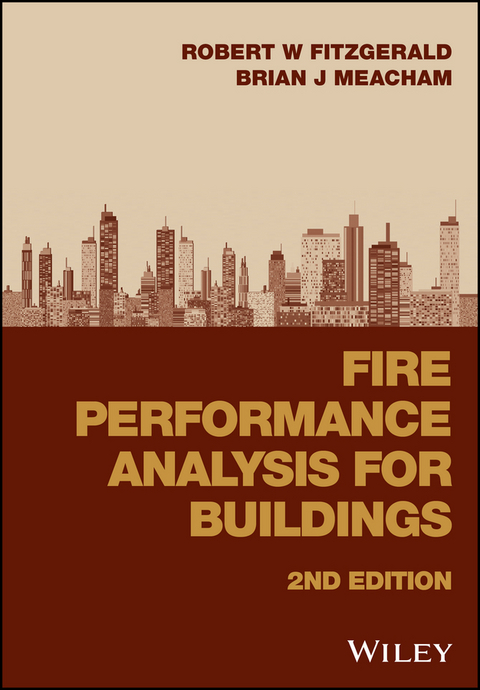
Fire Performance Analysis for Buildings (eBook)
John Wiley & Sons (Verlag)
978-1-118-92633-8 (ISBN)
Robert W. Fitzgerald, Worcester Polytechnic Institute, USA
Brian J. Meacham, Worcester Polytechnic Institute, USA
A building fire is dynamic. A continually changing hostile fire environment influences time relationships that affect fire defenses and risks to people and building functions. The fire and fire defenses in each building interact with different sequences and distinct ways. Risks are characterized by the building s performance. Significantly updated and restructured new edition Fire Performance Analysis for Buildings, 2nd Edition organizes the complex interactions into an analytical framework to evaluate any building - at any location - built under any regulatory jurisdiction or era. Systematic, logical procedures evaluate individual component behavior and integrate results to understand holistic performance. The Interactive Performance Information (IPI) chart structures complex time-related interactions among the fire, fire defenses, and associated risks. Quantification uses state-of-the-art deterministic methods of fire safety engineering and fire science. Managing uncertainty is specifically addressed. Key features: Emphasizes fire performance analysis for new or existing buildings. Augments fire dynamics calculation methods with qualitative methods to form a more complete understanding of the effects of hostile fire characteristics on building performance. Describes fire ground operations for engineers with no fire service experience. An analysis evaluates ways the site and building design help or hinder manual fire suppression. Establishes a transition from traditional structural requirements to modern calculation based structural analysis and design for fire conditions. Structural concepts are described for non-structural engineers to enable the roles of each profession to be integrated into comprehensive performance evaluations. Addresses techniques of managing uncertainty to improve understanding and communication with professionals of other disciplines. Describes methods of risk management using information from the building s performance analysis. Fire Performance Analysis for Buildings, 2nd Edition has been completely restructured around a performance based framework. Applications integrate traditional fire defenses with fire science and engineering to combine component performance with holistic performance.
Robert W. Fitzgerald, Worcester Polytechnic Institute, USA Brian J. Meacham, Worcester Polytechnic Institute, USA
Preface xxiii
Acknowledgements xxv
1 Fire Performance and Buildings 1
2 Preliminary Organization 9
3 Tools of Analysis 31
4 An Introduction to the Interactive Performance Information Chart 59
5 Quantification 73
Part II The Parts 79
6 The Room Fire 81
7 The Room Fire: Qualitative Analysis 119
8 Beyond the Room of Origin 147
9 Smoke Analysis 175
10 The Diagnostic Fire 191
11 Fire Detection 193
12 Alarm: Actions After Detection 203
13 Fire Department Extinguishment: Arrival 219
14 Fire Department Extinguishment: First Water (MA) 237
15 Fire Department Extinguishment: Control and Extinguishment 295
16 Automatic Sprinkler Suppression 305
17 The Composite Fire 325
18 Materials, Codes, Standards, Practices, and Performance 331
19 Concepts in Structural Analysis for Fire Conditions 365
20 Target Spaces and Smoke 401
21 Life Safety 411
22 Risk Characterizations 417
23 Fire Prevention 435
Part III The Analysis 449
24 Fire Performance: Framework for Analysis 451
25 The Diagnostic Fire 455
26 Fire Detection 463
27 Fire Department Notification 475
28 Fire Department Extinguishment 483
29 Automatic Sprinkler Suppression 501
30 The Composite Fire 517
31 Structural Performance 521
32 Target Space Smoke Analysis 525
33 Life Safety Analysis 531
34 Prevent Established Burning 541
Part IV Managing Uncertainty 555
35 Understanding Uncertainty 557
36 Visual Thinking 581
37 Introduction to Risk Management 597
38 Analytical Foundations 615
Appendix A Organizational Structure 637
A.1 The Organizational Framework 637
A.2 Basic Organization 637
A.3 The Composite Fire 637
A.4 The Diagnostic Fire (Î) 639
A.5 Fire Department Manual Extinguishment 640
A.6 Detection 640
A.7 Notification 642
A.8 Notification to Arrival 643
A.9 Arrival to Extinguishment 645
A.10 Automatic Sprinkler System 646
A.11 Building Response: Structural Behavior 647
A.12 Building Response: Space Tenability 648
A.13 Risk Characterizations 648
A.14 Occupant Movement 650
A.15 Other Risks 651
A.16 Prevent Established Burning (EB): Occupant Extinguishment 651
A.17 Prevent EB: Special Hazards Protection 653
A.18 Closure 653
Appendix B Model Building 655
Description 655
Plans 655
Index 661
1
Fire Performance and Buildings
1.1 The Dynamics of Building Fire Performance
A building fire is dynamic because hostile fire characteristics change minute by minute. The dynamic fire produces products of combustion that affect the building and its fire defenses. The continually changing building environment influences time relationships for risk characterizations involving occupants and building functions. These actions occur in a variety of sequences and ways for different buildings.
During a fire, some components complete their roles and become inactive before other components become operational. Additionally, actions of some parts of the system depend on the status and sequential phasing of other components. Performance evaluations analyze interactions that combine time‐dependent changes in the fire, building fire defenses, and people.
The goal of this book is to organize the complicated process into an analytical framework with which an engineer can evaluate fire performance. A performance evaluation enables one to understand specific component behavior as a part of holistic building performance.
Time is the common factor that links all of the important events.
1.2 The Anatomy of Building Fire Safety
Figure 1.1 shows the major parts of the complete system of fire performance for buildings. Initially, the system is organized into three major groups:
- The composite fire combines a diagnostic fire and the active extinguishment actions provided by local fire department manual extinguishment and automatic sprinkler suppression, if present.
- The building response is based on the flame‐heat and smoke‐gas products of combustion produced by the composite fire and their movement through the building. The process continues from ignition to extinguishment.
- The risk characterizations for exposed people, property, and functions are based on the building’s response.
Figure 1.1 System components.
Figure 1.1 is a static representation of the major parts. At each minute into the fire, the status of each part changes.
The analytical framework decomposes each part into components that can be evaluated separately. The components are recombined to incorporate the influences of time, fire conditions, and other components within the system. This allows each component to be evaluated as an independent unit and the effects combined to describe holistic performance.
1.3 Analysis and Design
Analysis and design are two sides of the same coin. In its most basic form, all design involves trial and error. For example, a design process starts by gathering information about a building’s function, the design objectives, hazards to which the building will be subjected, the dimensional, material, economic and site constraints, and regulatory expectations. An initial trial design is formulated and then analyzed to evaluate the extent to which function, economics, and safety are acceptable. The design is then updated by changing parts of the trial design that did not perform in an acceptable manner. The iterative process of design–analyze–redesign continues until an updated design produces acceptable conditions for function, safety, and economy.
This book does not address building design, nor does it use any specific code or design standard. Rather, it describes how to analyze a building for a hostile fire. The results of the fire analysis provide a basis to characterize risk for people, property, and function. The goal is to describe a way to understand fire performance and risk characterizations for any existing building or proposed new building design. Although the book does not describe conventional procedures to accomplish design objectives, a performance analysis will give an insight into effective ways to achieve stated objectives.
1.4 Performance Analysis
A performance analysis creates an understanding of what to expect during a building fire. After evaluating the building’s performance, one can identify associated risk characterizations to people, property, operational continuity, neighbors, and the environment.
Evaluation procedures integrate two distinct parts:
- An analytical framework to provide systematic, methodical procedures to structure individual component behavior and integrate all parts into a holistic entity.
- Quantification to provide numerical measures of performance.
The primary goal of this book is to identify a framework for analyzing fire performance in buildings. However, a framework is sterile without ways to quantify the critical events. One cannot exist without the other.
Fire safety is an emerging engineering discipline. Consequently, all numerical measures for component quantification do not have the same level of development. Some components, such as structural fire analysis and detector actuation, are relatively well developed and one can have confidence in calculations. Room fire models can provide accurate representations of behavior within their limits of theory and input knowledge. On the other hand, certain aspects of manual fire extinguishment, automatic fire suppression, and barrier effectiveness are inadequate for comprehensive numerical analyses. Nevertheless, the framework uses existing knowledge for quantification and developing a performance understanding.
Quantification uses any information or calculation tool that is relevant and seems appropriate to obtain the necessary numerical measures. Sources such as computer programs, experimental data, calculated values, observed information, and failure analyses become resources for quantification. Quantification procedures may be viewed as a set of tools. An engineer selects appropriate and available tools for each need. The framework organizes the analysis to incorporate quantitative measures of performance.
1.5 Quantification
The goal of a performance analysis is to understand expected building behavior and the associated risk characterizations during a fire. Building evaluations use specific fire scenarios to acquire this understanding.
A scenario evaluation uses three types of analysis. A quantitative analysis calculates outcomes using available information. Fire safety has not yet evolved to provide reliable, unique source quantification for the range of conditions routinely encountered in buildings. Therefore, the quantitative analysis is augmented by a qualitative analysis to provide a sense of proportion for expected behavior. A qualitative analysis incorporates many features that affect outcomes for interpreting numerical calculations.
Quantitative analyses and qualitative analyses are used together in an evaluation. Often, a quantitative analysis is a primary source for performance measures. The qualitative analysis helps to ensure that an outcome incorporates all of the important features and provides reasonable values. At other times, a qualitative analysis is the dominant evaluative tool and quantitative information is used to augment or give confidence to the estimates. Qualitative analyses are often used to select initial scenarios that become the basis for a performance analysis.
Both quantitative and qualitative analyses are sensitive to changes in condition. For example, the status of a door being open or closed may significantly affect performance. Fuel packages may use differing construction materials that can have significantly different burning characteristics. This produces different time‐related outcomes that, in turn, may affect the performance of other components.
Often, “what if” questions become evident during the decision‐making function of scenario identification and one may wish to examine performance differences that could occur. A variability analysis provides a basis for ascertaining if possible changes will significantly affect performance outcomes or will have only a relatively benign influence. A variability analysis examines important questions that could affect quantitative or qualitative outcomes. Variability analyses establish “windows of behavior” to better understand building features that affect fire safety.
1.6 The Organization
This book organizes the complex system of fire in buildings in a way that enables one to understand both an individual component’s behavior and its effect on holistic building performance. This involves:
- Identification of a comprehensive analytical framework. This framework is logically structured and consistent to be adaptable for any building and geographical location.
- Use of deterministic component evaluations that combine state‐of‐the‐art fire science with engineering knowledge and information.
- Use of organizational charts to record key information and to visualize time‐related complexity in a way that performance expectations may be explained to other professions.
The analytical framework is the primary focus of attention, and different aspects of the framework and its quantification are presented in each of the four units of this book:
- Unit One: The Foundation. This unit describes the structure of the organizational framework. The framework adapts established techniques of other disciplines for fire safety evaluations. The Interactive Performance Information (IPI) chart becomes the central tool to relate time sequencing with critical events for performance...
| Erscheint lt. Verlag | 27.3.2017 |
|---|---|
| Sprache | englisch |
| Themenwelt | Naturwissenschaften ► Physik / Astronomie ► Mechanik |
| Technik ► Architektur | |
| Technik ► Bauwesen | |
| Technik ► Maschinenbau | |
| Schlagworte | analytical framework for building evaluation • Architecture • Architektur • Bauentwurf • Bauingenieur- u. Bauwesen • Brandschutz • Building Design • chart structures complex time-related fire interactions • Civil Engineering & Construction • effects of hostile fire characteristics on building performance • fire ground operations for engineers with no fire service experience • fire performance analysis for buildings • fire performance analysis for new or existing buildings • Fire Protection • how to integrate traditional fire defenses with fire science and engineering • Interactive Performance Information (IPI) • ipi • Maschinenbau • mechanical engineering • Mechanical Engineering Special Topics • Mech Engineering Special Topics • risk management derived from building's performance analysis • Spezialthemen Maschinenbau |
| ISBN-10 | 1-118-92633-1 / 1118926331 |
| ISBN-13 | 978-1-118-92633-8 / 9781118926338 |
| Informationen gemäß Produktsicherheitsverordnung (GPSR) | |
| Haben Sie eine Frage zum Produkt? |
 EPUB (Adobe DRM)
Kopierschutz: Adobe-DRM
Adobe-DRM ist ein Kopierschutz, der das eBook vor Mißbrauch schützen soll. Dabei wird das eBook bereits beim Download auf Ihre persönliche Adobe-ID autorisiert. Lesen können Sie das eBook dann nur auf den Geräten, welche ebenfalls auf Ihre Adobe-ID registriert sind.
Details zum Adobe-DRM
Dateiformat: EPUB (Electronic Publication)
EPUB ist ein offener Standard für eBooks und eignet sich besonders zur Darstellung von Belletristik und Sachbüchern. Der Fließtext wird dynamisch an die Display- und Schriftgröße angepasst. Auch für mobile Lesegeräte ist EPUB daher gut geeignet.
Systemvoraussetzungen:
PC/Mac: Mit einem PC oder Mac können Sie dieses eBook lesen. Sie benötigen eine
eReader: Dieses eBook kann mit (fast) allen eBook-Readern gelesen werden. Mit dem amazon-Kindle ist es aber nicht kompatibel.
Smartphone/Tablet: Egal ob Apple oder Android, dieses eBook können Sie lesen. Sie benötigen eine
Geräteliste und zusätzliche Hinweise
Buying eBooks from abroad
For tax law reasons we can sell eBooks just within Germany and Switzerland. Regrettably we cannot fulfill eBook-orders from other countries.
aus dem Bereich