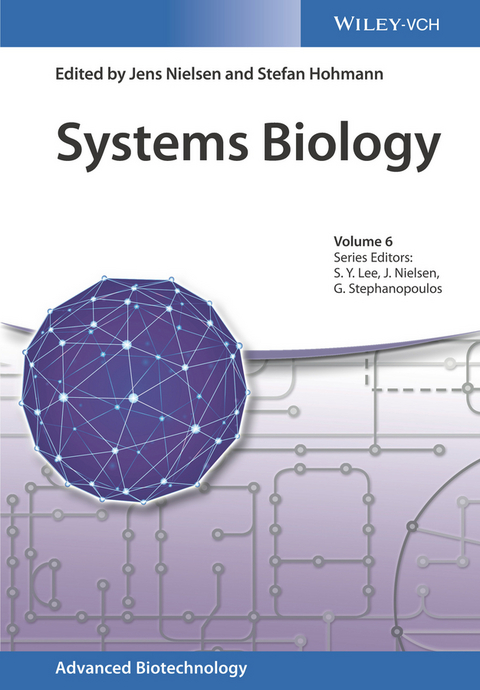
Systems Biology (eBook)
432 Seiten
Wiley-Blackwell (Verlag)
978-3-527-69616-1 (ISBN)
Each chapter represents a valuable introduction to one specific branch of systems biology, while also including the current state of the art and pointers to future directions. Following different methods for the integrative analysis of omics data, the book goes on to describe techniques that allow for the direct quantification of carbon fluxes in large metabolic networks, including the use of 13C labelled substrates and genome-scale metabolic models. The latter is explained on the basis of the model organism Escherichia coli as well as the human metabolism. Subsequently, the authors deal with the application of such techniques to human health and cell factory engineering, with a focus on recent progress in building genome-scale models and regulatory networks. They highlight the importance of such information for specific biological processes, including the ageing of cells, the immune system and organogenesis. The book concludes with a summary of recent advances in genome editing, which have allowed for precise genetic modifications, even with the dynamic control of gene expression.
This is part of the Advances Biotechnology series, covering all pertinent aspects of the field with each volume prepared by eminent scientists who are experts on the topic in question.
Jens Nielsen has a PhD degree (1989) in Biochemical Engineering from the Danish Technical University (DTU), and after that established his independent research group and was appointed full Professor there in 1998. He was Fulbright visiting professor at MIT in 1995-1996. At DTU he founded and directed the Center for Microbial Biotechnology. In 2008 he was recruited as Professor and Director to Chalmers University of Technology, Sweden. Jens Nielsen has received numerous Danish and international awards including the Nature Mentor Award, and is member of several academies, including the National Academy of Engineering in USA and the Royal Swedish Academy of Science. He is a founding president of the International Metabolic Engineering Society.
Stefan Hohmann is Head of the Department of Biology and Biological Engineering at Chalmers University (Sweden). He studied biology and microbiology at the Technische Universitat Darmstadt (Germany), where he received his PhD in 1987 and became professor in 1993. He held positions as visiting professor at the Katholieke Universiteit Leuven (Belgium) and the University of the Orange Free State (South Africa), before joining the University of Gothenburg in 1999 as professor, a position he hold until his change to Chalmers University in 2015. Stefan Hohmann serves as chairman of several committees and is the Swedish representative at the European Molecular Biology Laboratory (EMBL) Research Council.
Sang Yup Lee is Distinguished Professor at the Department of Chemical and Biomolecular Engineering at the Korea Advanced Institute of Science and Technology (KAIST). He is currently the Director of the Center for Systems and Synthetic Biotechnology, Director of the BioProcess Engineering Research Center, and Director of the Bioinformatics Research Center. He received numerous awards, including the National Order of Merit, the Merck Metabolic Engineering Award and the Elmer Gaden Award. Lee is the Editor-in-Chief of the Biotechnology Journal and Associate Editor and board member of numerous other journals. Lee is currently serving as a member of Presidential Advisory Committee on Science and Technology (Korea).
Professor Gregory Stephanopoulos is the W. H. Dow Professor of Chemical Engineering at the Massachusetts Institute of Technology (MIT, USA) and Director of the MIT Metabolic Engineering Laboratory. He is also Instructor of Bioengineering at Harvard Medical School (since 1997). He has been recognized by numerous awards from the American Institute of Chemical Engineers (AIChE) (Wilhelm, Walker and Founders awards), American Chemical Society (ACS), Society of industrial Microbiology (SIM), BIO (Washington Carver Award), the John Fritz Medal of the American Association of Engineering Societies, and others. In 2003 he was elected member of the National Academy of Engineering (USA) and in 2014 President of AIChE.
Jens Nielsen has a PhD degree (1989) in Biochemical Engineering from the Danish Technical University (DTU), and after that established his independent research group and was appointed full Professor there in 1998. He was Fulbright visiting professor at MIT in 1995-1996. At DTU he founded and directed the Center for Microbial Biotechnology. In 2008 he was recruited as Professor and Director to Chalmers University of Technology, Sweden. Jens Nielsen has received numerous Danish and international awards including the Nature Mentor Award, and is member of several academies, including the National Academy of Engineering in USA and the Royal Swedish Academy of Science. He is a founding president of the International Metabolic Engineering Society. Stefan Hohmann is Head of the Department of Biology and Biological Engineering at Chalmers University (Sweden). He studied biology and microbiology at the Technische Universität Darmstadt (Germany), where he received his PhD in 1987 and became professor in 1993. He held positions as visiting professor at the Katholieke Universiteit Leuven (Belgium) and the University of the Orange Free State (South Africa), before joining the University of Gothenburg in 1999 as professor, a position he hold until his change to Chalmers University in 2015. Stefan Hohmann serves as chairman of several committees and is the Swedish representative at the European Molecular Biology Laboratory (EMBL) Research Council. Sang Yup Lee is Distinguished Professor at the Department of Chemical and Biomolecular Engineering at the Korea Advanced Institute of Science and Technology (KAIST). He is currently the Director of the Center for Systems and Synthetic Biotechnology, Director of the BioProcess Engineering Research Center, and Director of the Bioinformatics Research Center. He received numerous awards, including the National Order of Merit, the Merck Metabolic Engineering Award and the Elmer Gaden Award. Lee is the Editor-in-Chief of the Biotechnology Journal and Associate Editor and board member of numerous other journals. Lee is currently serving as a member of Presidential Advisory Committee on Science and Technology (Korea). Professor Gregory Stephanopoulos is the W. H. Dow Professor of Chemical Engineering at the Massachusetts Institute of Technology (MIT, USA) and Director of the MIT Metabolic Engineering Laboratory. He is also Instructor of Bioengineering at Harvard Medical School (since 1997). He has been recognized by numerous awards from the American Institute of Chemical Engineers (AIChE) (Wilhelm, Walker and Founders awards), American Chemical Society (ACS), Society of industrial Microbiology (SIM), BIO (Washington Carver Award), the John Fritz Medal of the American Association of Engineering Societies, and others. In 2003 he was elected member of the National Academy of Engineering (USA) and in 2014 President of AIChE.
Cover 1
Title Page 5
Copyright 6
Contents 7
List of Contributors 17
About the Series Editors 25
Chapter 1 Integrative Analysis of Omics Data 27
Summary 27
1.1 Introduction 27
1.2 Omics Data and Their Measurement Platforms 30
1.2.1 Omics Data Types 30
1.2.2 Measurement Platforms 31
1.3 Data Processing: Quality Assessment, Quantification, Normalization, and Statistical Analysis 32
1.3.1 Quality Assessment 33
1.3.2 Quantification 35
1.3.3 Normalization 36
1.3.4 Statistical Analysis 37
1.4 Data Integration: From a List of Genes to Biological Meaning 38
1.4.1 Data Resources for Constructing Gene Sets 39
1.4.1.1 Gene Ontology Terms 39
1.4.1.2 KEGG and Reactome 39
1.4.1.3 Genome-Scale Metabolic Reconstructions 40
1.4.2 Gene Set Analysis 40
1.4.2.1 Gene Set Overenrichment Tests 42
1.4.2.2 Rank-Based Enrichment Tests 42
1.4.3 Networks and Network Topology 43
1.5 Outlook and Perspectives 44
References 45
Chapter 2 13C Flux Analysis in Biotechnology and Medicine 51
2.1 Introduction 51
2.1.1 Why Study Metabolic Fluxes? 51
2.1.2 Why are Isotope Tracers Important for Flux Analysis? 52
2.1.3 How are Fluxes Determined? 54
2.2 Theoretical Foundations of 13C MFA 55
2.2.1 Elementary Metabolite Units (EMUs) 56
2.2.2 Flux Uncertainty Analysis 57
2.2.3 Optimal Design of Isotope Labeling Experiments 58
2.2.4 Isotopically Nonstationary MFA (INST-MFA) 60
2.3 Metabolic Flux Analysis in Biotechnology 62
2.3.1 13C MFA for Host Characterization 62
2.3.2 13C MFA for Pinpointing Yield Losses and Futile Cycles 65
2.3.3 13C MFA for Bottleneck Identification 67
2.4 Metabolic Flux Analysis in Medicine 68
2.4.1 Liver Glucose and Oxidative Metabolism 69
2.4.2 Cancer Cell Metabolism 73
2.4.3 Fuel Oxidation and Anaplerosis in the Heart 74
2.4.4 Metabolism in Other Tissues: Pancreas, Brain, Muscle, Adipose, and Immune Cells 75
2.5 Emerging Challenges for 13C MFA 76
2.5.1 Theoretical and Computational Advances: Multiple Tracers, Co-culture MFA, Dynamic MFA 76
2.5.2 Genome-Scale 13C MFA 77
2.5.3 New Measurement Strategies 78
2.5.4 High-Throughput MFA 79
2.5.5 Application of MFA to Industrial Bioprocesses 79
2.5.6 Integrating MFA with Omics Measurements 80
2.6 Conclusion 81
Acknowledgments 81
Disclosure 81
References 81
Chapter 3 Metabolic Modeling for Design of Cell Factories 97
Summary 97
3.1 Introduction 97
3.2 Building and Refining Genome-Scale Metabolic Models 98
3.2.1 Generate a Draft Metabolic Network (Step 1) 100
3.2.2 Manually Curate the Draft Metabolic Network (Step 2) 101
3.2.3 Develop a Constraint-Based Model (Step 3) 103
3.2.4 Revise the Metabolic Model through Reconciliation with Experimental Data (Step 4) 105
3.2.5 Predicting the Effects of Genetic Manipulations 107
3.3 Strain Design Algorithms 109
3.3.1 Fundamentals of Bilevel Optimization 110
3.3.2 Algorithms Involving Only Gene/Reaction Deletions 120
3.3.3 Algorithms Involving Gene Additions 120
3.3.4 Algorithms Involving Gene Over/Underexpression 121
3.3.5 Algorithms Involving Cofactor Changes 124
3.3.6 Algorithms Involving Multiple Design Criteria 125
3.4 Case Studies 126
3.4.1 Strains Producing Lactate 126
3.4.2 Strains Co-utilizing Sugars 126
3.4.3 Strains Producing 1,4-Butanediol 128
3.5 Conclusions 129
Acknowledgments 129
References 130
Chapter 4 Genome-Scale Metabolic Modeling and In silico Strain Design of Escherichia coli 135
4.1 Introduction 135
4.2 The COBRA Approach 136
4.3 History of E. coli Metabolic Modeling 137
4.3.1 Pre-genomic-era Models 137
4.3.2 Genome-Scale Models 138
4.4 In silico Model-Based Strain Design of E. coli Cell Factories 141
4.4.1 Gene Deletions 153
4.4.2 Gene Up/Downregulations 153
4.4.3 Gene Insertions 154
4.4.4 Cofactor Engineering 154
4.4.5 Other Approaches 154
4.5 Future Directions of Model-Guided Strain Design in E. coli 155
References 156
Chapter 5 Accelerating the Drug Development Pipeline with Genome-Scale Metabolic Network Reconstructions 165
Summary 165
5.1 Introduction 165
5.1.1 Drug Development Pipeline 166
5.1.2 Overview of Genome-Scale Metabolic Network Reconstructions 166
5.1.3 Analytical Tools and Mathematical Evaluation 167
5.1.3.1 Flux Balance Analysis (FBA) 167
5.1.3.2 Flux Variability Analysis (FVA) 168
5.2 Metabolic Reconstructions in the Drug Development Pipeline 168
5.2.1 Target Identification 169
5.2.2 Drug Side Effects 171
5.3 Species-Level Microbial Reconstructions 172
5.3.1 Microbial Reconstructions in the Antibiotic Development Pipeline 172
5.3.1.1 Applications in the Drug Development Pipeline 172
5.3.2 Metabolic-Reconstruction-Facilitated Rational Drug Target Identification 173
5.3.2.1 Targeting Genes Essential for Biomass Production 173
5.3.2.2 Targeting Virulence Factors 173
5.3.2.3 Metabolite-centric Targeting 174
5.3.3 Repurposing and Expanding Utility of Antibiotics 175
5.3.3.1 Virtual Drug Screens Informed by Metabolic Reconstructions 175
5.3.3.2 Limiting Resistance with Drug Combinations 175
5.3.3.3 Improving Treatment Options by Increasing Sensitivity to Antibiotics 176
5.3.4 Improving Toxicity Screens with the Human Metabolic Network Reconstruction 176
5.4 The Human Reconstruction 177
5.4.1 Approaches for the Human Reconstruction 178
5.4.2 Target Identification 178
5.4.2.1 Drug Targeting in Cancer 178
5.4.2.2 Drug Targeting in Metabolic Diseases 179
5.4.3 Toxicity and Other Side Effects 180
5.5 Community Models 181
5.5.1 Host-Pathogen Community Models 181
5.5.2 Eukaryotic Community Models 182
5.6 Personalized Medicine 182
5.7 Conclusion 183
References 184
Chapter 6 Computational Modeling of Microbial Communities 189
Summary 189
6.1 Introduction 189
6.1.1 Microbial Communities 189
6.1.2 Modeling Microbial Communities 191
6.1.3 Model Structures 191
6.1.4 Quantitative Approaches 192
6.2 Ecological Models 194
6.2.1 Generalized Predator-Prey Model 195
6.2.2 Evolutionary Game Theory 196
6.2.3 Models Including Additional Dimensions 197
6.2.4 Advantages and Disadvantages 197
6.3 Genome-Scale Metabolic Models 198
6.3.1 Introduction and Applications 198
6.3.2 Genome-Scale Metabolic Modeling of Microbial Communities 200
6.3.3 Simulation of Microbial Communities Assuming Steady State 201
6.3.3.1 Predicting Interactions Using FBA 201
6.3.3.2 Identifying Minimal Media by Mixed Integer Linear Programming 202
6.3.3.3 Pareto Optimality Analysis by FBA 202
6.3.3.4 Modeling Chemostat Co-culture 203
6.3.3.5 Community FBA with Community Mass Balance 203
6.3.4 Dynamic Simulation of Multispecies Models 203
6.3.5 Spatial and Temporal Modeling of Communities 204
6.3.6 Using Bilevel Optimization to Capture Multiple Objective Functions 205
6.3.6.1 OptCom 205
6.3.6.2 d-OptCom 207
6.3.6.3 CASINO Toolbox 207
6.3.6.4 Advantages and Disadvantages 208
6.3.6.5 Current Challenges and Future Directions 208
6.4 Concluding Remarks 209
References 209
Chapter 7 Drug Targeting of the Human Microbiome 217
Summary 217
7.1 Introduction 217
7.2 The Human Microbiome 218
7.3 Association of the Human Microbiome with Human Diseases 220
7.3.1 Nasal-Sinus Diseases 220
7.3.2 Gut Diseases 220
7.3.3 Cardiovascular Diseases 222
7.3.4 Metabolic Disorders 222
7.3.5 Autoimmune Disorders 223
7.3.6 Lung Diseases 223
7.3.7 Skin Diseases 223
7.4 Drug Targeting of the Human Microbiome 224
7.4.1 Prebiotics 224
7.4.2 Probiotics 226
7.4.3 Antimicrobials 227
7.4.3.1 Antibiotics 227
7.4.3.2 Antimicrobial Peptides 228
7.4.4 Signaling Inhibitors 228
7.4.5 Metabolites 229
7.4.5.1 Short-Chain Fatty Acids 229
7.4.5.2 Bile Acids 229
7.4.6 Metabolite Receptors and Enzymes 230
7.4.6.1 Metabolite Receptors 230
7.4.6.2 Metabolic Enzymes 230
7.4.7 Microbiome-Aided Drug Metabolism 231
7.4.7.1 Drug Delivery and Release 231
7.4.7.2 Drug Toxicity 232
7.4.8 Immune Modulators 232
7.4.9 Synthetic Commensal Microbes 233
7.5 Future Perspectives 233
7.6 Concluding Remarks 234
Acknowledgments 234
References 235
Chapter 8 Toward Genome-Scale Models of Signal Transduction Networks 241
8.1 Introduction 241
8.2 The Potential of Network Reconstruction 245
8.3 Information Transfer Networks 248
8.4 Approaches to Reconstruction of ITNs 251
8.5 The rxncon Approach to ITNWR 256
8.6 Toward Quantitative Analysis and Modeling of Large ITNs 260
8.7 Conclusion and Outlook 262
Acknowledgments 262
Glossary 263
References 264
Chapter 9 Systems Biology of Aging 269
Summary 269
9.1 Introduction 269
9.2 The Biology of Aging 271
9.3 The Mathematics of Aging 275
9.3.1 Databases Devoted to Aging Research 275
9.3.2 Mathematical Modeling in Aging Research 275
9.3.3 Distribution of Damaged Proteins during Cell Division: A Mathematical Perspective 282
9.3.3.1 Cell Growth 282
9.3.3.2 Cell Death 283
9.3.3.3 Cell Division 283
9.4 Future Challenges 286
Conflict of Interest 288
References 288
Chapter 10 Modeling the Dynamics of the Immune Response 291
10.1 Background 291
10.2 Dynamics of NF-KB Signaling 292
10.2.1 Functional Role and Regulation of NF-kB 292
10.2.2 Dynamics of the NF-KB Response to Cytokine Stimulation 293
10.3 JAK/STAT Signaling 299
10.3.1 Functional Roles of the STAT Proteins 299
10.3.2 Regulation of the JAK/STAT Pathway 300
10.3.3 Multiplicity and Cross-talk in JAK/STAT Signaling 301
10.3.4 Early Modeling of STAT Signaling 302
10.3.5 Minimal Models of STAT Activation Dynamics 303
10.3.6 Cross-talk with Other Immune Pathways 305
10.3.7 Population Dynamics of the Immune System 307
10.4 Conclusions 308
Acknowledgments 309
References 309
Chapter 11 Dynamics of Signal Transduction in Single Cells Quantified by Microscopy 315
11.1 Introduction 315
11.2 Single-Cell Measurement Techniques 317
11.2.1 Flow Cytometry 317
11.2.2 Mass Cytometry 317
11.2.3 Single-Cell Transcriptomics 318
11.2.4 Single-Cell Mass Spectrometry 318
11.2.5 Live-Cell Imaging 318
11.3 Microscopy 319
11.3.1 Epi-Fluorescence Microscopy 320
11.3.2 Fluorescent Proteins 321
11.3.3 Relocation Sensors 321
11.3.4 Förster Resonance Energy Transfer 324
11.4 Imaging Signal Transduction 326
11.4.1 Quantifying Small Molecules 326
11.4.2 Monitoring Enzymatic Activity 327
11.4.2.1 Endogenous Relocation Sensors 327
11.4.2.2 Passive Relocation Sensors 328
11.4.2.3 Active Relocation Sensors 329
11.4.2.4 FRET Biosensors 330
11.4.3 Probing Protein-Protein Interactions 330
11.4.3.1 FRET in Protein Complexes 330
11.4.3.2 Bimolecular Fluorescence Complementation 331
11.4.3.3 Dimerization-Dependent FP 332
11.4.4 Measuring Protein Synthesis 333
11.4.4.1 mRNA Transcription 333
11.4.4.2 Protein Synthesis 334
11.4.4.3 Expression Dynamics Visualized by Protein Relocation 337
11.5 Conclusions 337
References 338
Chapter 12 Image-Based In silico Models of Organogenesis 345
Summary 345
12.1 Introduction 345
12.2 Typical Workflow of Image-Based In silico Modeling Experiments 346
12.2.1 In silico Models of Organogenesis 348
12.2.2 Imaging as a Source of (Semi-)Quantitative Data 349
12.2.2.1 Imaging a Growing Organ 350
12.2.3 Image Analysis and Quantification 352
12.2.4 Computational Simulations of Models Describing Organogenesis 354
12.2.5 Image-Based Parameter Estimation 355
12.2.6 In silico Model Validation and Exchange 355
12.2.6.1 In silico Model Validation 355
12.2.6.2 Model Exchange via the Systems Biology Markup Language (SBML) 356
12.3 Application: Image-Based Modeling of Branching Morphogenesis 357
12.3.1 Image-Based Model Selection 357
12.4 Future Avenues 360
References 360
Chapter 13 Progress toward Quantitative Design Principles of Multicellular Systems 367
Summary 367
13.1 Toward Quantitative Design Principles of Multicellular Systems 367
13.2 Breaking Multicellular Systems into Distinct Functional and Spatial Modules May Be Possible 368
13.3 Communication among Cells as a Means of Cell-Cell Interaction 372
13.4 Making Sense of the Combinatorial Possibilities Due to Many Ways that Cells Can Be Arranged in Space 376
13.5 From Individual Cells to Collective Behaviors of Cell Populations 378
13.6 Tuning Multicellular Behaviors 381
13.7 A New Framework for Quantitatively Understanding Multicellular Systems 385
Acknowledgments 387
References 388
Chapter 14 Precision Genome Editing for Systems Biology - A Temporal Perspective 393
Summary 393
14.1 Early Techniques in DNA Alterations 393
14.2 Zinc-Finger Nucleases 395
14.3 TALENs 395
14.4 CRISPR-Cas9 396
14.5 Considerations of Gene-Editing Nuclease Technologies 398
14.5.1 Repairing Nuclease-Induced DNA Damage 398
14.5.2 Nuclease Specificity 399
14.6 Applications 402
14.6.1 CRISPR Nuclease Genome-Wide Loss-of-Function Screens (CRISPRn) 403
14.6.2 CRISPR Interference: CRISPRi 404
14.6.3 CRISPR Activation: CRISPRa 404
14.6.4 Further Scalable Additions to the CRISPR-Cas Gene Editing Tool Arsenal 405
14.6.5 In vivo Applications 405
14.6.5.1 Animal Disease Models 405
14.6.5.2 Gene Therapy 405
14.7 A Focus on the Application of Genome-Engineering Nucleases on Chromosomal Rearrangements 406
14.7.1 Introduction to Chromosomal Rearrangements: The First Disease-Related Translocation 406
14.7.2 A Global Look at the Mechanisms behind Chromosomal Rearrangements 408
14.7.3 Creating Chromosomal Rearrangements Using CRISPR-Cas 409
14.8 Future Perspectives 410
References 410
Index 419
EULA 429
| Erscheint lt. Verlag | 21.3.2017 |
|---|---|
| Reihe/Serie | Advanced Biotechnology |
| Advanced Biotechnology | Advanced Biotechnology |
| Mitarbeit |
Herausgeber (Serie): Sang Yup Lee, J. Nielsen, Gregory Stephanopoulos |
| Sprache | englisch |
| Themenwelt | Naturwissenschaften ► Biologie |
| Naturwissenschaften ► Chemie | |
| Technik | |
| Schlagworte | Analysis • Bioinformatics & Computational Biology • Bioinformatik • Bioinformatik u. Computersimulationen in der Biowissenschaften • biological • Biotechnologie • Biotechnologie i. d. Biowissenschaften • Biotechnologie i. d. Chemie • Biotechnology • Biowissenschaften • Cell & Molecular Biology • Chemie • Chemistry • constructing • contributors • Data • FluX • Gene • genes • Integration • Integrative • isotope tracers • Life Sciences • List • metabolic • Omics Data • platforms • References • series editors • Study • Systembiologie • Tobias • Zell- u. Molekularbiologie |
| ISBN-10 | 3-527-69616-4 / 3527696164 |
| ISBN-13 | 978-3-527-69616-1 / 9783527696161 |
| Informationen gemäß Produktsicherheitsverordnung (GPSR) | |
| Haben Sie eine Frage zum Produkt? |
 PDF (Adobe DRM)
Kopierschutz: Adobe-DRM
Adobe-DRM ist ein Kopierschutz, der das eBook vor Mißbrauch schützen soll. Dabei wird das eBook bereits beim Download auf Ihre persönliche Adobe-ID autorisiert. Lesen können Sie das eBook dann nur auf den Geräten, welche ebenfalls auf Ihre Adobe-ID registriert sind.
Details zum Adobe-DRM
Dateiformat: PDF (Portable Document Format)
Mit einem festen Seitenlayout eignet sich die PDF besonders für Fachbücher mit Spalten, Tabellen und Abbildungen. Eine PDF kann auf fast allen Geräten angezeigt werden, ist aber für kleine Displays (Smartphone, eReader) nur eingeschränkt geeignet.
Systemvoraussetzungen:
PC/Mac: Mit einem PC oder Mac können Sie dieses eBook lesen. Sie benötigen eine
eReader: Dieses eBook kann mit (fast) allen eBook-Readern gelesen werden. Mit dem amazon-Kindle ist es aber nicht kompatibel.
Smartphone/Tablet: Egal ob Apple oder Android, dieses eBook können Sie lesen. Sie benötigen eine
Geräteliste und zusätzliche Hinweise
Buying eBooks from abroad
For tax law reasons we can sell eBooks just within Germany and Switzerland. Regrettably we cannot fulfill eBook-orders from other countries.
aus dem Bereich