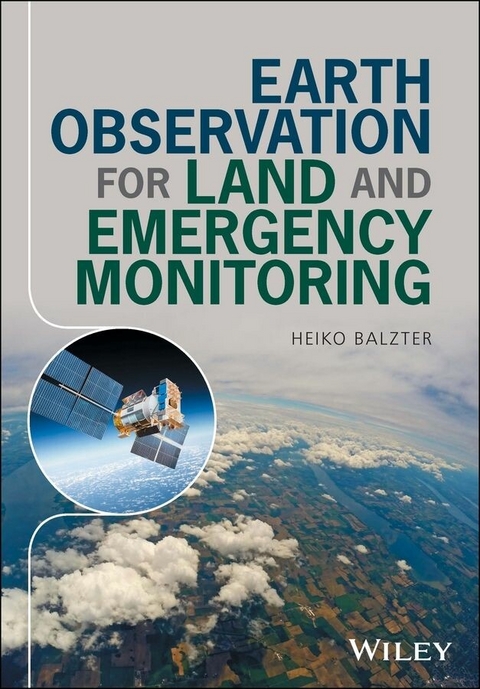
Earth Observation for Land and Emergency Monitoring (eBook)
John Wiley & Sons (Verlag)
978-1-118-79373-2 (ISBN)
Earth Observation Science (EOS) is the study of the global Earth land-ocean-atmosphere system through observations. The principal tools for such studies are measurements from space since these provide the coverage of the planet that is necessary to capture the behaviour of the entire coupled system. In addition, surface observations, and measurements from aircraft, balloons and sounding rockets provide valuable contributors to what are now termed 'integrated, global observing systems.' Coupled with models, the EOS measurement suites provide powerful tools for research into the factors controlling and changing the Earth system in which we live.
The objectives of this book are to describe new methods and applications of satellite technology in the fields of land and emergency monitoring. It draws on new research outcomes from the European FP7 project GIONET (European Centre of Excellence in Earth Observation Research Training). GIONET combines industrial partners with universities and research institutes, and this book provides a perspective on Earth Observation applications that is motivated by the cross-fertilisation of both sectors. Hence, this book will find readers in both industry and academia.
This book highlights a broad range of innovative uses of Earth Observation technology to support environmental management, decision making, crisis management and climate policies. It uses advanced concepts of multi-sensor image integration, multi-temporal analysis and synergies between data and models. This is a truly interdisciplinary subject that encompasses a range of applications in various fields which are discussed in detail throughout the text. If you are interested in remote sensing applications and looking for inspiration, this is the book for you.
About the editor
Heiko Balzter is Professor of Physical Geography and Director of the Centre for Landscape and Climate Research at the University of Leicester, UK.
Earth Observation Science (EOS) is the study of the global Earth land-ocean-atmosphere system through observations. The principal tools for such studies are measurements from space since these provide the coverage of the planet that is necessary to capture the behaviour of the entire coupled system. In addition, surface observations, and measurements from aircraft, balloons and sounding rockets provide valuable contributors to what are now termed "e;integrated, global observing systems. Coupled with models, the EOS measurement suites provide powerful tools for research into the factors controlling and changing the Earth system in which we live. The objectives of this book are to describe new methods and applications of satellite technology in the fields of land and emergency monitoring. It draws on new research outcomes from the European FP7 project GIONET (European Centre of Excellence in Earth Observation Research Training). GIONET combines industrial partners with universities and research institutes, and this book provides a perspective on Earth Observation applications that is motivated by the cross-fertilisation of both sectors. Hence, this book will find readers in both industry and academia. This book highlights a broad range of innovative uses of Earth Observation technology to support environmental management, decision making, crisis management and climate policies. It uses advanced concepts of multi-sensor image integration, multi-temporal analysis and synergies between data and models. This is a truly interdisciplinary subject that encompasses a range of applications in various fields which are discussed in detail throughout the text. If you are interested in remote sensing applications and looking for inspiration, this is the book for you.
About the editor Heiko Balzter is Professor of Physical Geography and Director of the Centre for Landscape and Climate Research at the University of Leicester, UK.
List of Contributors vii
Preface xi
1 Earth Observation for Land and Emergency Monitoring Core Services 1
Heiko Balzter
Part I Forest Monitoring 5
2 Methodology for Regional to Global Mapping of Aboveground Forest Biomass: Integrating Forest Allometry, Ground Plots, and Satellite Observations 7
P. Rodriguez-Veiga, S. Saatchi, J. Wheeler, K. Tansey and Heiko Balzter
3 Remote Sensing for Aboveground Biomass Estimation in Boreal Forests 33
M.A. Stelmaszczuk?]Górska, C.J. Thiel and C.C. Schmullius
4 Forest Mapping of the Congo Basin using Synthetic Aperture Radar (SAR) 57
J. Wheeler, P. Rodriguez-Veiga, Heiko Balzter, K. Tansey and N.J. Tate
Part II Land Cover and Land Cover Change Monitoring 75
5 Multi?]Frequency SAR Applications for Land Cover Classification Within Copernicus Downstream Services 77
B.F. Spies, A. Lamb and Heiko Balzter
6 Unsupervised Land Use/Land Cover Change Detection with Integrated Pixel and Object Based Approaches for High Resolution Remote Sensing Imagery 101
S. Shrestha, C. Smith and Z. Bochenek
7 Earth Observation Land Data Assimilation System (EO?]LDAS) Regularization Constraints over Barrax Site 117
M. Chernetskiy, N. Gobron, J. Gómez?]Dans, P. Lewis and C.C. Schmullius
Part III Coastal Zone and Freshwater Monitoring 141
8 SAR?]Based EO of Salt Marsh Habitats in Support of Integrated Coastal Zone Management 143
S.J. van Beijma, A. Comber and A. Lamb
9 A Framework for Lakeshore Vegetation Assessment Using Field Spectroscopy and Airborne Hyperspectral Imagery 159
D. Stratoulias, I. Keramitsoglou, P. Burai, L. Csaba, A. Zlinszky, V.R. Tóth and Heiko Balzter
10 Copernicus Framework for Monitoring Lake Balaton Phytoplankton 173
S.C.J. Palmer, A. Zlinszky, Heiko Balzter, V. Nicolás?]Perea and V.R. Tóth
Part IV Land Deformation Mapping and Humanitarian Crisis Response 193
11 InSAR Techniques for Land Deformation Monitoring 195
P. Kourkouli, U. Wegmüller, A. Wiesmann and K. Tansey
12 Mapping Land Surface Displacements in the Swiss Alps with Radar Interferometry 209
J. Papke, T. Strozzi and N.J. Tate
13 Sample Supervised Search?]Centric Approaches in Geographic Object?]Based Image Analysis: Concepts, State of the Art and a Future Outlook 223
C. Fourie and E. Schoepfer
Part V Earth Observation for Climate Adaptation 245
14 Remote Sensing of Wetland Dynamics as Indicators of Water Availability in Semi?]Arid Africa 247
L. Moser, A. Schmitt, S. Voigt and E. Schoepfer
15 Satellite Derived Information for Drought Detection and Estimation of Water Balance 285
M. Ofwono, K. Dabrowska?]Zielinska, J. Kaduk and V. Nicolás-Perea
16 Conclusions 301
Heiko Balzter
Index 305
1
Earth Observation for Land and Emergency Monitoring Core Services
Heiko Balzter
National Centre for Earth Observation, University of Leicester, Centre for Landscape and Climate Research, Department of Geography, Leicester, UK
The Copernicus programme is Europe’s flagship operational Earth Observation programme. It is comprised of a number of core services aiming at specific user groups. Many policies and international initiatives rely on Earth Observation to deliver information services. The downstream development of new satellite applications is a rapidly growing global market and creates jobs, economic growth and prosperity for societies.
The Copernicus initiative is delivering many core monitoring services of the oceans, the land surface, air quality, climate change and the polar ice sheets. It is a laudable programme in its aspiration to provide operational long‐term observations of critical parameters from space. However, it has limitations and there is room for developing new and improved innovative information services around the existing Copernicus service portfolio.
The initial operations of the European Copernicus programme from 2011 to 2014 have delivered a comprehensive range of satellite applications in support of sustainable forestry. The Geoland‐2 project has established the operational Copernicus land monitoring core service, which is now implemented with a global, European, local and in‐situ component. Global data products to support sustainable agriculture and forestry include surface albedo, fractionally absorbed PAR (FAPAR), fraction of PAR absorbed by vegetation for photosynthesis processes, Leaf Area Index (LAI), Top of Canopy spectral reflectance, Fractional cover (Fcover), Normalized Difference Vegetation Index (NDVI), Vegetation Condition Index (VCI), Vegetation Productivity Indicator (VPI), Dry Matter Productivity (DMP), burnt area, active fires, land surface temperature, soil moisture, areas of water bodies, water level (lakes and rivers), and vegetation phenology at 1 km resolution.
At the European scale, the vector‐based CORINE land cover (reference year 1990) is being updated (last produced in 2000 and 2006, and currently being updated to 2012). It consists of 44 land cover classes and uses a Minimum Mapping Unit (MMU) of 25 ha area, or a minimum width of 100 m for linear landscape structures. Land cover changes are mapped with an MMU of 5 ha by visual interpretation of high‐resolution satellite imagery. CORINE has a wide range of applications, underpinning the European Communities policies in the domains of environment, but also agriculture, transport, spatial planning etc. The High‐Resolution‐Layers (HRL) at 100 m spatial resolution include two forestry data products: tree cover density and forest type. In GIO‐land an additional two forest products are being produced for the European Commission’s Joint Research Centre (JRC): tree cover presence/absence, and dominant leaf type at 25 m spatial resolution. The tree cover density dataset maps the level of tree cover density in a range from 0–100%, has no MMU (minimum number of pixels to form a patch) and a minimum mapping width of 20 m. The forest type products in their original 20 m resolution version consists of the dominant leaf type (MMU of 0.5 ha, 10% tree cover density threshold applied), and a support layer showing trees under agricultural use and in urban contexts (derived from CORINE and imperviousness 2009 data). For the final 100 m product trees under agricultural use and urban context from the support layer are removed.
This book introduces the reader to the outcomes from four years of research in support of the Copernicus Land Monitoring Core Service and the Emergency Monitoring Core Service.
The research was funded by the Marie Curie PEOPLE programme in Framework Programme 7, as an Initial Training Network. The GIONET project established a European Centre of Excellence in Earth Observation Research Training in 2011, when Copernicus was called “GMES” (Global Monitoring for Environment and Security), and just entered into its GMES Initial Operations phase (GIO).
GIONET trained 14 PhD researchers in academia, industry, and research centres in advanced remote sensing skills, accompanied by interpersonal, entrepreneurship and management skills. Seven organizations from five European countries employed the researchers and were supported by a large group of associated partners.
This book is structured into thematic chapters, covering Forest Monitoring (Part I), Land Cover and Land Cover Change Monitoring (Part II), Coastal Zone and Freshwater Monitoring (Part III), Land Deformation Mapping and Humanitarian Crisis Response Strategies (Part IV) and Earth Observation for Climate Adaptation (Part V). A Conclusions chapter summarizes the main findings presented in the book.
The UN initiative “Reducing Emissions from Deforestation and Forest Degradation” (REDD+) provides a strong user pull for forest information from space. In Part I on forest monitoring a concept for global forest biomass mapping is presented, making use of geographically varying forest allometric models, spaceborne profiling LiDAR (ICESAT‐GLAS) and Synthetic Aperture Radar (SAR). Synergies between multi‐temporal and multi‐frequency interferometric radar and optical satellite data for biomass mapping and change detection are discussed and a SAR mapping application to the Congo Basin presented.
Conceived in 1985 as the CORINE programme, land cover monitoring is the most operational element of the Copernicus programme. The methodology remains largely unchanged. Part II on land cover and land cover change monitoring presents approaches that go beyond the current implementation of largely optical/near‐infrared based land cover monitoring methods. Classification methods with multi‐frequency, multi‐temporal SAR data over semi‐arid and forested African landscapes are explained and contrasted against the capabilities of optical‐near‐infrared high‐resolution satellite images. A methodological framework for multi‐scale remote sensing concludes this chapter.
The European Water Framework Directive requires monitoring of the ecological status and water quality of all major water bodies and their habitats. Earth Observation is only beginning to influence this application area. In Part III on coastal zone and freshwater monitoring, a study of salt marsh habitats in Wales is presented. Salt marshes are regarded as effective buffers against sea level rise and can be mapped with multi‐sensor data to support Integrated Coastal Zone Management. Freshwater applications focus on the ecology of emergent and submerged macrophytes in Lake Balaton, Hungary, using airborne hyperspectral and LiDAR remote sensing to map the extent of reed die‐back syndrome, and satellite remote sensing to map and monitor optically active water quality parameters, such as chlorophyll‐a as a proxy for phytoplankton biomass and blooms.
The recent past was characterized by many humanitarian crises and natural disasters. Part IV of this book describes the use of radar interferometry for land deformation mapping applications and demonstrates the use of machine learning algorithms in the context of humanitarian crisis response strategies. After a short review on radar interferometry, a new hybrid method using Differential SAR Interferometry/Persistent Scatterer Interferometry for ground‐motion monitoring from spaceborneSAR data is demonstrated and applied to different land cover types. Chapter 12 describes the use of spaceborne SAR and ground‐based radar interferometry for mapping landslide displacements in the Swiss Alps. New methods for the detection of small‐scale land surface feature changes in complex humanitarian crisis situations are demonstrated, transferring machine learning algorithms to environmental remote sensing.
With an increasing likelihood that mankind is unable or unwilling to respond effectively to the causes of climate change, there is a widening recognition that we will have to adapt to its impacts. In Part V on Earth Observation for climate adaptation, a study on remote sensing of wetland dynamics as indicator of water availability in semi‐arid Africa is presented, using time series of optical and SAR satellite imagery. Satellite observations of drought events and crop stress in Europe conclude this chapter.
The book presents a collection of original research findings interspersed with selected review chapter and intends to serve as a compendium on the state‐of‐the‐art in remote sensing in support of land and emergency monitoring going beyond the current operational monitoring services in Copernicus.
I am grateful to the GIONET team for the inspiring and productive work over the past four years, in particular to my colleagues at the University of Leicester, UK, Airbus Defence and Space (formerly Astrium GEO‐Information Services), UK, Gamma Remote Sensing AG, Switzerland, the Institute of Geodesy and Cartography (IGIK) in Warsaw, Poland, Friedrich‐Schiller‐University in Jena, Germany, the Hungarian Academy of Sciences – Centre for Ecological Research and the German Aerospace Center (DLR), and the associated partners in the Joint Research Centre of the European Commission in Ispra, Italy, University of Stirling, UK, University of Padova, Italy, the National Observatory of Athens, Greece, Chalmers University in Sweden, and the companies Trimble, Germany, EXELIS Visual Information...
| Erscheint lt. Verlag | 14.3.2017 |
|---|---|
| Sprache | englisch |
| Themenwelt | Naturwissenschaften ► Biologie ► Ökologie / Naturschutz |
| Naturwissenschaften ► Geowissenschaften ► Geografie / Kartografie | |
| Naturwissenschaften ► Geowissenschaften ► Geologie | |
| Technik | |
| Schlagworte | Climate Policies • Earth measurements from aircraft • Earth measurements from balloons • Earth measurements from sounding rockets • Earth Observation Applications • Earth Observation for Land and Emergency Monitoring • Earth Observation Science • Earth Observation technology • earth sciences • Earth surface observations • earth system • environmental crisis management • Environmental Decision Making • Environmental Management • Environmental Science • Environmental Studies • EOS • EOS measurement suites • European Centre of Excellence in Earth Observation Research Training • European FP7 project GIONET • Fernerkundung • Geowissenschaften • GIONET • GIS & Remote Sensing • GIS u. Fernerkundung • global observing systems • Integrated • land and emergency monitoring • multi-sensor image integration • multi-temporal analysis • Remote Sensing Applications • Satellite Technology • Umweltforschung • Umweltwissenschaften |
| ISBN-10 | 1-118-79373-0 / 1118793730 |
| ISBN-13 | 978-1-118-79373-2 / 9781118793732 |
| Informationen gemäß Produktsicherheitsverordnung (GPSR) | |
| Haben Sie eine Frage zum Produkt? |
 EPUB (Adobe DRM)
Kopierschutz: Adobe-DRM
Adobe-DRM ist ein Kopierschutz, der das eBook vor Mißbrauch schützen soll. Dabei wird das eBook bereits beim Download auf Ihre persönliche Adobe-ID autorisiert. Lesen können Sie das eBook dann nur auf den Geräten, welche ebenfalls auf Ihre Adobe-ID registriert sind.
Details zum Adobe-DRM
Dateiformat: EPUB (Electronic Publication)
EPUB ist ein offener Standard für eBooks und eignet sich besonders zur Darstellung von Belletristik und Sachbüchern. Der Fließtext wird dynamisch an die Display- und Schriftgröße angepasst. Auch für mobile Lesegeräte ist EPUB daher gut geeignet.
Systemvoraussetzungen:
PC/Mac: Mit einem PC oder Mac können Sie dieses eBook lesen. Sie benötigen eine
eReader: Dieses eBook kann mit (fast) allen eBook-Readern gelesen werden. Mit dem amazon-Kindle ist es aber nicht kompatibel.
Smartphone/Tablet: Egal ob Apple oder Android, dieses eBook können Sie lesen. Sie benötigen eine
Geräteliste und zusätzliche Hinweise
Buying eBooks from abroad
For tax law reasons we can sell eBooks just within Germany and Switzerland. Regrettably we cannot fulfill eBook-orders from other countries.
aus dem Bereich