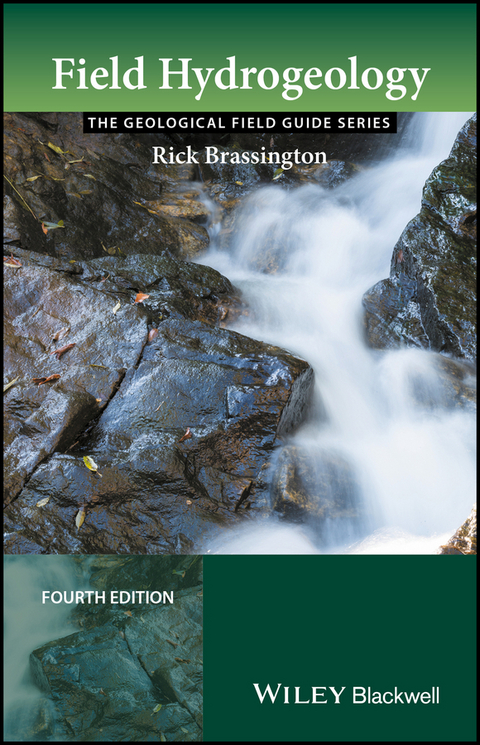
Field Hydrogeology (eBook)
John Wiley & Sons (Verlag)
978-1-118-39738-1 (ISBN)
The fourth edition of this bestselling textbook has been fully revised in order to present the most up-to-date and comprehensive guide to completing a hydrogeological study. Beautifully presented with full colour photos and diagrams throughout, Field Hydrogeology retains its practical pocket size for easy use in the field. This new edition includes all the recent developments in the environmental regulations, with particular focus on the use of innovative technology. New topics include geothermal energy, soakaways, marrying manual water level readings with logger records, prediction of long-term drawdown and lateral extent of impacts, and flow measurement in locations with small head gradients.
With case studies and text boxes to aid comprehension, and a particular emphasis on practical application, this is an essential tool for students taking Hydrogeology and/or field course modules in Geology, Earth Sciences, Hydrogeology and Engineering courses.
Rick Brassington Consultant Hydrogeologist.
He worked in the UK public water industry for some 24 years before moving into consultancy. He was employed at director level in three major companies before setting up his own consultancy in 1998. He has also been the Visiting Professor of Hydrogeology in the School of Civil Engineering and Geosciences at Newcastle University since 2007.
The fourth edition of this bestselling textbook has been fully revised in order to present the most up-to-date and comprehensive guide to completing a hydrogeological study. Beautifully presented with full colour photos and diagrams throughout, Field Hydrogeology retains its practical pocket size for easy use in the field. This new edition includes all the recent developments in the environmental regulations, with particular focus on the use of innovative technology. New topics include geothermal energy, soakaways, marrying manual water level readings with logger records, prediction of long-term drawdown and lateral extent of impacts, and flow measurement in locations with small head gradients. With case studies and text boxes to aid comprehension, and a particular emphasis on practical application, this is an essential tool for students taking Hydrogeology and/or field course modules in Geology, Earth Sciences, Hydrogeology and Engineering courses.
Rick Brassington Consultant Hydrogeologist. He worked in the UK public water industry for some 24 years before moving into consultancy. He was employed at director level in three major companies before setting up his own consultancy in 1998. He has also been the Visiting Professor of Hydrogeology in the School of Civil Engineering and Geosciences at Newcastle University since 2007.
Cover 1
Title Page 5
Copyright 6
Dedication 7
Contents 9
Preface 13
Acknowledgements 15
Chapter 1 Introduction 17
1.1 Groundwater Systems 17
1.2 Conceptual Model 21
1.3 Groundwater Computer Modelling 27
1.4 Hydrogeological Report Writing 28
1.5 Expert Witness 30
Chapter 2 Desk Study 33
2.1 Defining the Area 34
2.2 Identifying the Aquifers 34
2.3 Groundwater Levels 36
2.4 Surface Water 37
2.5 Recharge 37
2.6 Groundwater Use 39
2.7 Groundwater Chemistry 40
2.8 Aerial Photographs and Satellite Imagery 41
2.9 Planning a Fieldwork Programme 44
Chapter 3 Field Evaluation of Aquifers 45
3.1 Grain Size Analysis 45
3.2 Hydraulic Properties of Aquifers 48
3.3 Hydraulic Properties and Rock Types 51
3.4 Assessing Hydraulic Properties 58
3.5 Using Hydraulic Property Information 60
Chapter 4 Groundwater Levels 65
4.1 Water-Level Dippers 65
4.2 Continuous Water-Level Recorders 71
4.3 Measuring Ground Levels and Locations 76
4.4 Tool-Box 80
4.5 Well Catalogue 82
4.6 Field Surveys for Wells, Boreholes and Springs 82
4.7 Interpretation of Abstraction Borehole Water Levels 89
4.8 Groundwater-Level Monitoring Networks 98
4.9 Groundwater-Level Fluctuations 100
4.10 Managing Groundwater-Level Data 109
4.11 Constructing Groundwater Contour Maps and Flow Nets 110
4.12 Interpretation of Contour Maps and Flow Nets 112
4.13 Using Other Groundwater Information 115
Chapter 5 Rainfall, Springs and Streams 118
5.1 Precipitation 118
5.2 Evaporation 123
5.3 Springs 125
5.4 Stream-Flow Measurement 133
5.5 Stage-Discharge Relationships 146
5.6 Choosing the Best Method 148
5.7 Processing Flow Data 148
Chapter 6 Pumping Tests 151
6.1 What Is a Pumping Test? 151
6.2 Planning a Pumping Test 152
6.3 Pumps and Pumping 152
6.4 On-Site Measurements 158
6.5 Pre-Test Monitoring 164
6.6 Test Set-up 165
6.7 Step Tests 166
6.8 Constant Rate Tests 168
6.9 Recovery Tests 169
6.10 Pumping Test Analysis 170
6.11 Tests on Single Boreholes 180
6.12 Packer Tests 185
Chapter 7 Groundwater Chemistry 188
7.1 Analytical Suites and Determinands 188
7.2 Sampling Equipment 190
7.3 Sampling Protocols 204
7.4 Monitoring Networks 215
7.5 Using Chemical Data 216
Chapter 8 Recharge Estimation 221
8.1 Water Balance 221
8.2 Rainfall Recharge 222
8.3 Induced Recharge 227
8.4 Other Sources of Recharge 229
Chapter 9 Specialist Techniques 231
9.1 Borehole and Piezometer Installation 231
9.2 Down-Hole Geophysics 239
9.3 Using Artificial Tracers 245
Chapter 10 Practical Applications 253
10.1 Borehole Prognoses 253
10.2 Groundwater Supplies 254
10.3 Wells in Shallow Aquifers 260
10.4 Contaminated Land Investigations 261
10.5 Landfills and Leachate 264
10.6 Geothermal Energy 267
10.7 Groundwater Lowering by Excavation 269
10.8 Rising Water Tables 274
10.9 Soakaways 276
10.10 Investigating Wetland Hydrology 276
Appendix A Good Working Practice 279
A1.1 Safety Codes 279
A1.2 Safety Clothing and Equipment 279
A1.3 Distress Signals 281
A1.4 Exposure or Hypothermia 281
A1.5 Heat Exhaustion 281
A1.6 Working Near Wells, Boreholes and Monitoring Piezometers 282
A1.7 Hygiene Precautions for Water Supplies 282
A1.8 Trial Pits 283
A1.9 Electrical Equipment 283
A1.10 Filling Fuel Tanks 283
A1.11 Waste Disposal Sites 283
A1.12 Stream Flow Measurement 284
Appendix B Conversion Factors 285
References and Further Reading 290
Index 297
EULA 312
| Erscheint lt. Verlag | 14.3.2017 |
|---|---|
| Reihe/Serie | Geological Field Guide |
| The Geological Field Guide Series | The Geological Field Guide Series |
| Sprache | englisch |
| Themenwelt | Naturwissenschaften ► Geowissenschaften ► Hydrologie / Ozeanografie |
| Technik | |
| Schlagworte | beautifully • bestselling textbook • Colour • earth sciences • EASY • Edition • environmental • field hydrogeology • focus • full • Geowissenschaften • Groundwater & Hydrogeology • Grundwasser u. Hydrogeologie • Innovative • New • Order • particular • pocket • Practical • presented • Recent Developments • Regulations • Revised • Technology • throughout • use |
| ISBN-10 | 1-118-39738-X / 111839738X |
| ISBN-13 | 978-1-118-39738-1 / 9781118397381 |
| Informationen gemäß Produktsicherheitsverordnung (GPSR) | |
| Haben Sie eine Frage zum Produkt? |
 PDF (Adobe DRM)
Kopierschutz: Adobe-DRM
Adobe-DRM ist ein Kopierschutz, der das eBook vor Mißbrauch schützen soll. Dabei wird das eBook bereits beim Download auf Ihre persönliche Adobe-ID autorisiert. Lesen können Sie das eBook dann nur auf den Geräten, welche ebenfalls auf Ihre Adobe-ID registriert sind.
Details zum Adobe-DRM
Dateiformat: PDF (Portable Document Format)
Mit einem festen Seitenlayout eignet sich die PDF besonders für Fachbücher mit Spalten, Tabellen und Abbildungen. Eine PDF kann auf fast allen Geräten angezeigt werden, ist aber für kleine Displays (Smartphone, eReader) nur eingeschränkt geeignet.
Systemvoraussetzungen:
PC/Mac: Mit einem PC oder Mac können Sie dieses eBook lesen. Sie benötigen eine
eReader: Dieses eBook kann mit (fast) allen eBook-Readern gelesen werden. Mit dem amazon-Kindle ist es aber nicht kompatibel.
Smartphone/Tablet: Egal ob Apple oder Android, dieses eBook können Sie lesen. Sie benötigen eine
Geräteliste und zusätzliche Hinweise
Buying eBooks from abroad
For tax law reasons we can sell eBooks just within Germany and Switzerland. Regrettably we cannot fulfill eBook-orders from other countries.
aus dem Bereich