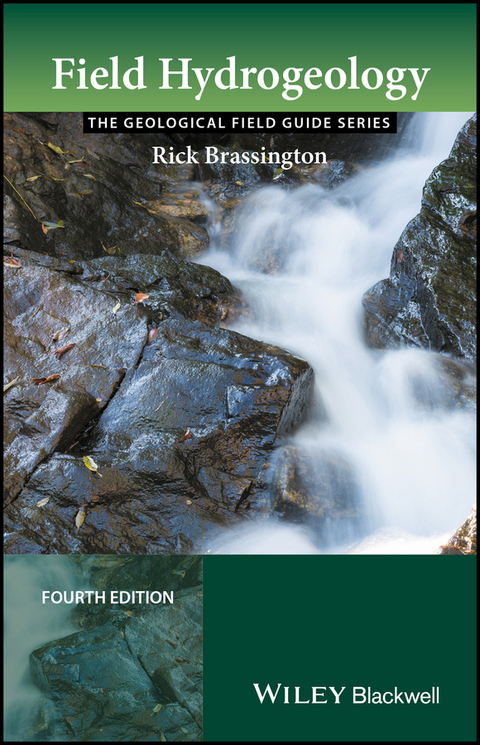
Field Hydrogeology (eBook)
John Wiley & Sons (Verlag)
978-1-118-39739-8 (ISBN)
The fourth edition of this bestselling textbook has been fully revised in order to present the most up-to-date and comprehensive guide to completing a hydrogeological study. Beautifully presented with full colour photos and diagrams throughout, Field Hydrogeology retains its practical pocket size for easy use in the field. This new edition includes all the recent developments in the environmental regulations, with particular focus on the use of innovative technology. New topics include geothermal energy, soakaways, marrying manual water level readings with logger records, prediction of long-term drawdown and lateral extent of impacts, and flow measurement in locations with small head gradients.
With case studies and text boxes to aid comprehension, and a particular emphasis on practical application, this is an essential tool for students taking Hydrogeology and/or field course modules in Geology, Earth Sciences, Hydrogeology and Engineering courses.
Rick Brassington Consultant Hydrogeologist.
He worked in the UK public water industry for some 24 years before moving into consultancy. He was employed at director level in three major companies before setting up his own consultancy in 1998. He has also been the Visiting Professor of Hydrogeology in the School of Civil Engineering and Geosciences at Newcastle University since 2007.
Rick Brassington Consultant Hydrogeologist. He worked in the UK public water industry for some 24 years before moving into consultancy. He was employed at director level in three major companies before setting up his own consultancy in 1998. He has also been the Visiting Professor of Hydrogeology in the School of Civil Engineering and Geosciences at Newcastle University since 2007.
Preface xi
Acknowledgements xiii
1 Introduction 1
1.1 Groundwater Systems 1
1.2 Conceptual Model 5
1.3 Groundwater Computer Modelling 11
1.4 Hydrogeological Report Writing 12
1.5 Expert Witness 14
2 Desk Study 17
2.1 Defining the Area 18
2.2 Identifying the Aquifers 18
2.3 Groundwater Levels 20
2.4 Surface Water 21
2.5 Recharge 21
2.6 Groundwater Use 23
2.7 Groundwater Chemistry 24
2.8 Aerial Photographs and Satellite Imagery 25
2.9 Planning a Fieldwork Programme 28
3 Field Evaluation of Aquifers 29
3.1 Grain Size Analysis 29
3.2 Hydraulic Properties of Aquifers 32
3.3 Hydraulic Properties and Rock Types 35
3.4 Assessing Hydraulic Properties 42
3.5 Using Hydraulic Property Information 44
4 Groundwater Levels 49
4.1 Water-Level Dippers 49
4.2 Continuous Water-Level Recorders 55
4.3 Measuring Ground Levels and Locations 60
4.4 Tool-Box 64
4.5 Well Catalogue 66
4.6 Field Surveys for Wells, Boreholes and Springs 66
4.7 Interpretation of Abstraction Borehole Water Levels 73
4.8 Groundwater-Level Monitoring Networks 82
4.9 Groundwater-Level Fluctuations 84
4.10 Managing Groundwater-Level Data 93
4.11 Constructing Groundwater Contour Maps and Flow Nets 94
4.12 Interpretation of Contour Maps and Flow Nets 96
4.13 Using Other Groundwater Information 99
5 Rainfall, Springs and Streams 102
5.1 Precipitation 102
5.2 Evaporation 107
5.3 Springs 109
5.4 Stream-Flow Measurement 117
5.5 Stage-Discharge Relationships 130
5.6 Choosing the Best Method 132
5.7 Processing Flow Data 132
6 Pumping Tests 135
6.1 What Is a Pumping Test? 135
6.2 Planning a Pumping Test 136
6.3 Pumps and Pumping 136
6.4 On-Site Measurements 142
6.5 Pre-Test Monitoring 148
6.6 Test Set-up 149
6.7 Step Tests 150
6.8 Constant Rate Tests 152
6.9 Recovery Tests 153
6.10 Pumping Test Analysis 154
6.11 Tests on Single Boreholes 164
6.12 Packer Tests 169
7 Groundwater Chemistry 172
7.1 Analytical Suites and Determinands 172
7.2 Sampling Equipment 174
7.3 Sampling Protocols 188
7.4 Monitoring Networks 199
7.5 Using Chemical Data 200
8 Recharge Estimation 205
8.1 Water Balance 205
8.2 Rainfall Recharge 206
8.3 Induced Recharge 211
8.4 Other Sources of Recharge 213
9 Specialist Techniques 215
9.1 Borehole and Piezometer Installation 215
9.2 Down-Hole Geophysics 223
9.3 Using Artificial Tracers 229
10 Practical Applications 237
10.1 Borehole Prognoses 237
10.2 Groundwater Supplies 238
10.3 Wells in Shallow Aquifers 244
10.4 Contaminated Land Investigations 245
10.5 Landfills and Leachate 248
10.6 Geothermal Energy 251
10.7 Groundwater Lowering by Excavation 253
10.8 Rising Water Tables 258
10.9 Soakaways 260
10.10 Investigating Wetland Hydrology 260
A Good Working Practice 263
A1.1 Safety Codes 263
A1.2 Safety Clothing and Equipment 263
A1.3 Distress Signals 265
A1.4 Exposure or Hypothermia 265
A1.5 Heat Exhaustion 265
A1.6 Working Near Wells, Boreholes and Monitoring Piezometers 266
A1.7 Hygiene Precautions for Water Supplies 266
A1.8 Trial Pits 267
A1.9 Electrical Equipment 267
A1.10 Filling Fuel Tanks 267
A1.11 Waste Disposal Sites 267
A1.12 Stream Flow Measurement 268
B Conversion Factors 269
References and Further Reading 274
Index 281
Chapter 1
INTRODUCTION
Groundwater provides an important source of drinking water over much of the world. It also has the fundamental importance of maintaining river and stream flows during periods without rain and also supporting wetland sites. Groundwater is under threat worldwide from overabstraction and by contamination from a wide range of human activities. In many countries, activities that may impact on groundwater are regulated by government organisations, which frequently require hydrogeological investigations to assess the risks posed by new developments.
Pumping from new wells may reduce the quantities that can be pumped from others nearby, cause local spring flows to dwindle, or dry up wetlands. The hydrogeologist will be expected to make predictions on such effects and can only do so if he or she has a proper understanding of the local groundwater system based on adequate field observations. It is equally important to evaluate groundwater quality to ensure that it is suitable for drinking and for other uses. Groundwater commonly provides the flow path that allows pollutants to be leached from industrially contaminated sites, landfills, septic tanks, chemical storage areas and many more. Hydrogeological studies are needed to define groundwater systems in order to prevent such contamination or manage its clean-up. This book is concerned with the field techniques used by hydrogeologists to evaluate groundwater systems for any or all of these purposes and with the primary or initial interpretation of the data collected in the field.
1.1 Groundwater Systems
Groundwater is an integral part of the hydrological cycle, a complex system that circulates water over the whole planet; this is illustrated in Figure 1.1. The hydrological cycle starts as energy from the sun evaporates water from the oceans to form large cloud masses that are moved by the global wind system and, when conditions are right, precipitate as rain, snow or hail. Some of it falls onto land and collects to form streams and rivers, which eventually flow back into the sea, from where the process starts all over again. Not all rainfall contributes to surface water flow, as some is returned to the atmosphere by evaporation from lakes and rivers, from soil moisture and as transpiration from plants. Water that percolates through the soil to reach the water table becomes groundwater. In thick aquifers, groundwater at depth is below the depth of freshwater circulation and is saline, often with a higher electrical conductivity than seawater. The same is true for groundwater down dip from the outcrop of an aquifer. Groundwater flows through the rocks to discharge into either streams or rivers. In coastal areas, groundwater discharges into the sea, and the aquifer contains seawater at depth. The volume of water percolating into the aquifers defines the groundwater resources that both support natural systems and are available for long-term water supply development. In most groundwater studies it is necessary to consider the other components of the cycle as well as the groundwater itself in order to understand the groundwater system. Consequently, hydrogeological investigations usually include a range of field measurements to assess these parameters.
Figure 1.1 The hydrological cycle.
Groundwater flow through saturated rock is driven by a hydraulic gradient, which, in unconfined aquifers, is the water table. Rocks that both contain groundwater and allow water to flow through them in significant quantities are termed aquifers. Flow rates that are considered as significant will vary from place to place and also depend on how much water is needed. Water supplies to individual houses require small groundwater flows compared to wells supplying a town. In pollution studies, even small groundwater flow rates may transport considerable amounts of contaminant over long periods of time. A critical part of the definition is that the rock allows a flow of water, rather than simply containing groundwater. Some rocks such as clays have a relatively high water content, although water is unable to flow through them easily. Other rocks may not be saturated but still have the property to permit water to flow, and therefore should be regarded in the same way as an aquifer, a clear example being the part of an aquifer formation that lies above the water table.
Unless groundwater is removed by pumping from wells, it will flow through an aquifer towards natural discharge points. These comprise springs, seepages into streams and rivers, and discharges directly into the sea. The property of an aquifer that allows fluids to flow through it is termed permeability, and this is controlled largely by geological factors. Properties of the fluid are also important, and water permeability is more correctly called hydraulic conductivity. Hydrogeologists often think of hydraulic conductivity on a field scale in terms of an aquifer's transmissivity, which is the hydraulic conductivity multiplied by the effective saturated thickness of the aquifer.
In both sedimentary rocks and unconsolidated sediments, groundwater is contained in and moves through the pore spaces between individual grains. Fracture systems in solid rocks significantly increase the hydraulic conductivity of the rock mass. Indeed, in crystalline aquifers of all types, most groundwater flow takes place through fractures, and very little, if any, moves through the body of the rock itself. Some geological materials do not transmit groundwater at significant rates, while others only permit small quantities to flow through them. Such materials are termed aquicludes and aquitards, respectively, and although they do not transmit much water, they influence the movement of water through aquifers. Very few natural materials are completely uniform and most contain aquiclude and aquitard materials.
Figure 1.2 shows how the presence of an aquiclude, such as clay, can give rise to springs and may support a perched water table above the main water table in an aquifer. The top diagram (Figure 1.2a) shows a lower confined aquifer and an upper water table aquifer. The upper aquifer includes low-permeability material that supports a perched water table. The diagram shows the rest-water levels in various wells in both aquifers. Figure 1.2b shows how both confined and unconfined conditions can occur in the same aquifer. In zone A, the aquifer is fully confined by the overlying clay and is fully saturated. The groundwater in this part of the aquifer is at a pressure controlled by the level of water at point p, and water in wells would rise to this level above the top of the aquifer. In zone B, the overlying clay will prevent any direct recharge, although it is unconfined, like zone C. The aquifer in zone C is unconfined and receives direct recharge. Seasonal fluctuations in the water-table levels will alter the lateral extent of zone B along the edge of the aquifer. It is likely to be at a minimum at the end of the winter and at its greatest extent in the autumn, before winter recharge causes groundwater levels to rise.
Figure 1.2 (a) A lower confined aquifer and an upper water table aquifer that includes low-permeability material supporting a perched water table. (b) Both confined and unconfined conditions can occur in the same aquifer.
Where impermeable rocks overlie an aquifer, the pressure of the groundwater body can be such that the level of water in wells would rise above the base of the overlying rock (i.e. the top of the aquifer). In such instances the aquifer is said to be confined. Sometimes this pressure may be sufficiently great that the water will rise above the ground surface and flow from wells and boreholes without pumping. This condition is termed artesian flow, and both the aquifer and the wells that tap it are said to be artesian.
A groundwater system, therefore, consists of rainfall recharge percolating into the ground down to the water table, and then flowing through rocks of varying permeabilities towards natural discharge points. The flow rates and volumes of water flowing through the system depend upon the rainfall, evaporation, the geological conditions that determine permeability, and many other factors. It is this system that a hydrogeologist is trying to understand by carrying out field measurements and interpreting the data in terms of the geology. The four key factors in achieving a successful investigation are to understand the geology; to interpret the groundwater-level data in terms of the three-dimensional (3D) distribution of heads that drive all groundwater flow systems; to remember that groundwater and surface water systems are interdependent; and to use a structured iterative approach to developing your understanding of the groundwater system you are investigating.
1.2 Conceptual Model
The foundation of all hydrogeological investigations is to gather sufficient reliable information to develop an understanding of how a particular groundwater system works. Such an understanding is usually called a conceptual model and comprises a quantified description encompassing all aspects of the local hydrogeology. Consequently, it is necessary for you to think about the way you will develop a conceptual model at the beginning of each project and as the basis of planning the work that is needed.
Although inexorably linked, the activities that form a hydrogeological investigation and the methodology of developing a conceptual model are not exactly the same. The...
| Erscheint lt. Verlag | 8.3.2017 |
|---|---|
| Reihe/Serie | Geological Field Guide |
| The Geological Field Guide Series | The Geological Field Guide Series |
| Sprache | englisch |
| Themenwelt | Naturwissenschaften ► Geowissenschaften ► Hydrologie / Ozeanografie |
| Technik | |
| Schlagworte | beautifully • bestselling textbook • Colour • earth sciences • EASY • Edition • environmental • field hydrogeology • focus • full • Geowissenschaften • Groundwater & Hydrogeology • Grundwasser u. Hydrogeologie • Innovative • New • Order • particular • pocket • Practical • presented • Recent Developments • Regulations • Revised • Technology • throughout • use |
| ISBN-10 | 1-118-39739-8 / 1118397398 |
| ISBN-13 | 978-1-118-39739-8 / 9781118397398 |
| Informationen gemäß Produktsicherheitsverordnung (GPSR) | |
| Haben Sie eine Frage zum Produkt? |
 EPUB (Adobe DRM)
Kopierschutz: Adobe-DRM
Adobe-DRM ist ein Kopierschutz, der das eBook vor Mißbrauch schützen soll. Dabei wird das eBook bereits beim Download auf Ihre persönliche Adobe-ID autorisiert. Lesen können Sie das eBook dann nur auf den Geräten, welche ebenfalls auf Ihre Adobe-ID registriert sind.
Details zum Adobe-DRM
Dateiformat: EPUB (Electronic Publication)
EPUB ist ein offener Standard für eBooks und eignet sich besonders zur Darstellung von Belletristik und Sachbüchern. Der Fließtext wird dynamisch an die Display- und Schriftgröße angepasst. Auch für mobile Lesegeräte ist EPUB daher gut geeignet.
Systemvoraussetzungen:
PC/Mac: Mit einem PC oder Mac können Sie dieses eBook lesen. Sie benötigen eine
eReader: Dieses eBook kann mit (fast) allen eBook-Readern gelesen werden. Mit dem amazon-Kindle ist es aber nicht kompatibel.
Smartphone/Tablet: Egal ob Apple oder Android, dieses eBook können Sie lesen. Sie benötigen eine
Geräteliste und zusätzliche Hinweise
Buying eBooks from abroad
For tax law reasons we can sell eBooks just within Germany and Switzerland. Regrettably we cannot fulfill eBook-orders from other countries.
aus dem Bereich