Science and Technology of Separation Membranes (eBook)
John Wiley & Sons (Verlag)
978-1-118-93256-8 (ISBN)
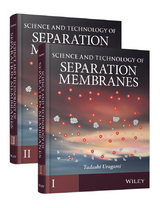
- Written by a renowned author with more than 40 years' experience in membrane science and technology, and polymer science
- Covers all major current applications of membrane technology in two definitive volumes
- Includes academic analyses, applications and practical problems for each existing membrane technology
- Includes novel applications such as membrane reactors, hybrid systems and optical resolution as well as membrane fuel cells
Tadashi Uragami, Functional Separation Membrane Research Center, Japan
Offers a comprehensive overview of membrane science and technology from a single source Written by a renowned author with more than 40 years experience in membrane science and technology, and polymer science Covers all major current applications of membrane technology in two definitive volumes Includes academic analyses, applications and practical problems for each existing membrane technology Includes novel applications such as membrane reactors, hybrid systems and optical resolution as well as membrane fuel cells
Tadashi Uragami, Functional Separation Membrane Research Center, Japan
1
Introduction to Membrane Science and Technology
1.1 History of Membrane Science and Technology
The word ‘osmosis’ is used to describe the permeation of water through a diaphragm in contact on one side with a water–ethanol mixture and on the other side with pure water, as shown in Figure 1.1, a process discovered by Nollet in 1748 [1]. Probably, the relation between a semipermeable membrane and the osmotic pressure was recognized first by Nollet.
Figure 1.1 Osmosis across the semi‐permeable membrane. ΔP is the hydrostatic pressure difference.
Graham carried out more systematic studies on mass transport in semipermeable membranes, studied the diffusion of gases through different media and, furthermore, discovered that rubber exhibits different permeabilities to different gases [2]. Membranes in the nineteenth and early twentieth centuries were not applied to industrial or commercial fields, but were used to analyse physical/chemical theories. As a good example, van’t Hoff used the measurements of osmotic pressure of solutions with membranes to develop his limit law, to explain the behaviour of ideal dilute solutions, in 1887; this work led directly to the van’t Hoff equation.
Most of the early studies on membrane permeation were carried out with natural membranes, such as bladders of pig, cattle, fish and sausage casings made of animal gut or gum elastics. Traube was the first to introduce an artificially prepared semipermeable membrane by precipitating cupric ferrocyanide in a thin layer of porous porcelain [3]. This type of membrane was used by Pfeffer in his fundamental studies on osmosis [4]. The theoretical treatment and much of the interpretation of osmotic phenomena and mass transport through membranes is based on the studies of Fick, who interpreted diffusion in liquids as a function of concentration gradients, and van’t Hoff, who gave a thermodynamic explanation for the osmotic pressure of dilute solutions [5,6]. A little later, Nernst and Planck introduced the flux equation for electrolytes under the driving force of a concentration or electrical potential gradient [7,8]. With the classical publications of Donnan describing the theory of membrane equilibria and membrane potentials in the presence of electrolytes, the early history of membrane science ends with most of the basic phenomena satisfactorily described and theoretically interpreted [9].
Until about 1960, interest in membrane technology was mainly in the academic field. Cellulose nitrate, the first synthetic (or semisynthetic) polymer was studied by Schoenbein [10] in 1846. In 1855 Fick [11] used cellulose nitrate membranes in his classic study ‘Über Diffusion’. In the same year, the concept of solution, that is, membrane–permeant interaction, to membrane permeation theory was proposed by L’hermite [12]. Thus, at the very outset, the cast of characters for the ongoing solution–diffusion drama was complete. In 1860, Schumacher dipped test tubes into cellulose nitrate (collodion) solutions and prepared the first tubular membranes [13]. Baranetzky [14] prepared the first flat membranes in 1872. Bechhold [15] prepared the first series of microfiltration membranes of graded pore size in 1907 and was also the first to define the relationship between bubble point, surface tension and pore radius, and developed a method of making the first synthetic membranes by impregnating a filter paper with a solution of nitrocellulose in glacial acetic acid [16]. These membranes could be prepared and accurately reproduced with different permeabilities by varying the ratio of acetic acid to nitrocellulose. Nitrocellulose membranes were also used in the studies of Zsigmondy and Bachmann as ultrafilters to separate macromolecules and fine particles from an aqueous solution [17]. Based on a patent of Zsigmondy, Sartorius GmbH began in 1927 the production of a series of nitrocellulose membranes with various pore sizes. These membranes were used in microbiological laboratories in analytical applications.
Early attempts to control and vary porosity were largely empirical. Bechhold observed that permeability varied inversely with the concentration of polymer in the sol. Bigelow and Gemberling [18] studied the effects of drying time on the membrane preparation process. Zsigismondy et al. [19] and Elford [20] developed two series of graded pore‐size membranes of cellulose nitrate. The former were the basis for the first commercial microfiltration membranes, which appeared in 1927 in Germany.
The concept of pore‐size distribution was developed by Karplus, cited by Erbe [21], who combined bubble point and permeability measurements. The development of the first successfully functioning haemodialyser [22] was the key to the large‐scale application of membranes in the biomedical area.
Industrial interest of the membrane separation technology suddenly increased from about 1950. On the other hand, with the progress in high polymer chemistry, a large number of synthetic polymers which are excellent for the preparation of new membranes with specific transport properties, excellent mechanical and thermal stability were provided. In addition, a comprehensive theory based on the thermodynamics of irreversible processes for membrane transport properties was proposed by Staverman [23] and Kedem and Katchalsky [24]. Merten described membrane processes based on postulating certain membrane transport models, such as the model of a diffusion–solution membrane [25].
In 1960 the important paper by Maier and Scheuermann [26] provided the basic mechanism which has since been utilized by Kesting to accommodate every (wet, dry and thermal) class of phase inversion membranes within its general framework. The two editions of Synthetic Polymeric Membranes [27,28] provide comprehensive coverage of phase inversion, which is by far the most versatile and important membrane fabrication process.
The beginning of the golden age of membrane science and technology depended significantly upon both the invention of reverse osmosis by Professor Reid [29] and the development of the asymmetric cellulose acetate membrane by Loeb and Sourirajan [30,31]. The development of a reverse osmosis membrane from cellulose acetate which gave high salt rejection and high fluxes at moderate operating pressures by Loeb and Sourirajan was a major advance toward the application of reverse osmosis membranes as an effective technology for the production of potable water from sea water.
The membrane developed by them was an asymmetric structure consisting of a dense skin layer, which determines the selectivity of salt and flux of desalinated water, and a porous layer that holds the mechanical strength of the whole membrane. The preparation of asymmetric cellulose acetate membranes is based on a phase inversion process in which a homogeneous polymer solution is converted into a two‐phase system, such as a solid polymer‐rich phase forming the solid polymer structure and a polymer lean phase making the liquid‐filled membrane pores [27,28,32]. Soon, other synthetic polymers – such as polyamides, polyacrylonitrile, polysulfone and polyethylene – were used as basic material for the preparation of synthetic membranes in reverse osmosis desalination. These polymers often showed better mechanical strength, chemical stability, thermal stability and tolerance for bacteria than the cellulose esters as semi‐natural material. However, cellulose acetate remained the dominant material for the preparation of reverse osmosis membranes until the development of the interfacial‐polymerized composite membrane [33,34]. These membranes showed significantly higher fluxes, higher rejection, and better chemical stability, mechanical strength, tolerance for bacteria and chlorine sterility than the cellulose acetate membranes.
Microfiltration was developed in 1918 by Richard Zsigmondy, who is a Nobel Prize in Chemistry winner, and then he developed the ultrafiltration membrane in 1922 and established the basics of membrane separation technology as one of founders of Sartorius. In medicine, dialysis (from Greek dialusis, ‘διάλυσις’, meaning dissolution, dia, meaning through, and lysis, meaning loosening or splitting) is a process for removing waste and excess water from the blood and is used primarily as an artificial replacement for lost kidney function in people with kidney failure (https://en.wikipedia.org/wiki/Dialysis). Electrodialysis (ED) is used to transport salt ions from one solution through ion‐exchange membranes to another solution under the influence of an applied electric potential difference. This is done in a configuration called an electrodialysis cell. The cell consists of a feed (dilute) compartment and a concentrate (brine) compartment formed by an anion exchange membrane and a cation exchange membrane placed between two electrodes. (https://en.wikipedia.org/wiki/Electrodialysis). This method was proposed for the first time in 1890 by Maigrot and Sabates [35]. Reverse osmosis was proposed by Reid and Breton [29] and developed by Loeb and Sourirajan [30] for the desalination of sea water.
Nanofiltration is a relatively recent membrane filtration process used most often with low total dissolved solids water, such as surface water and fresh groundwater, with the purpose of softening (polyvalent cation removal) and removal of disinfection by‐product precursors, such as natural organic matter and synthetic organic...
| Erscheint lt. Verlag | 14.3.2017 |
|---|---|
| Sprache | englisch |
| Themenwelt | Naturwissenschaften ► Chemie ► Technische Chemie |
| Technik ► Maschinenbau | |
| Technik ► Umwelttechnik / Biotechnologie | |
| Schlagworte | chemical engineering • Chemische Verfahrenstechnik • Controlled release pharmaceuticals • Dünne Schichten, Oberflächen u. Grenzflächen • Dialysis • Dünne Schichten, Oberflächen u. Grenzflächen • Filtration • Materials Science • Materialwissenschaften • Membrane Fuel Cells • Membrane Reactors • Membranes • Permeation • Polymer Science & Technology • Polymerwissenschaft u. -technologie • Reverse OSmosis • Separation processes • Thin Films, Surfaces & Interfaces |
| ISBN-10 | 1-118-93256-0 / 1118932560 |
| ISBN-13 | 978-1-118-93256-8 / 9781118932568 |
| Informationen gemäß Produktsicherheitsverordnung (GPSR) | |
| Haben Sie eine Frage zum Produkt? |
 EPUB (Adobe DRM)
Kopierschutz: Adobe-DRM
Adobe-DRM ist ein Kopierschutz, der das eBook vor Mißbrauch schützen soll. Dabei wird das eBook bereits beim Download auf Ihre persönliche Adobe-ID autorisiert. Lesen können Sie das eBook dann nur auf den Geräten, welche ebenfalls auf Ihre Adobe-ID registriert sind.
Details zum Adobe-DRM
Dateiformat: EPUB (Electronic Publication)
EPUB ist ein offener Standard für eBooks und eignet sich besonders zur Darstellung von Belletristik und Sachbüchern. Der Fließtext wird dynamisch an die Display- und Schriftgröße angepasst. Auch für mobile Lesegeräte ist EPUB daher gut geeignet.
Systemvoraussetzungen:
PC/Mac: Mit einem PC oder Mac können Sie dieses eBook lesen. Sie benötigen eine
eReader: Dieses eBook kann mit (fast) allen eBook-Readern gelesen werden. Mit dem amazon-Kindle ist es aber nicht kompatibel.
Smartphone/Tablet: Egal ob Apple oder Android, dieses eBook können Sie lesen. Sie benötigen eine
Geräteliste und zusätzliche Hinweise
Buying eBooks from abroad
For tax law reasons we can sell eBooks just within Germany and Switzerland. Regrettably we cannot fulfill eBook-orders from other countries.
aus dem Bereich