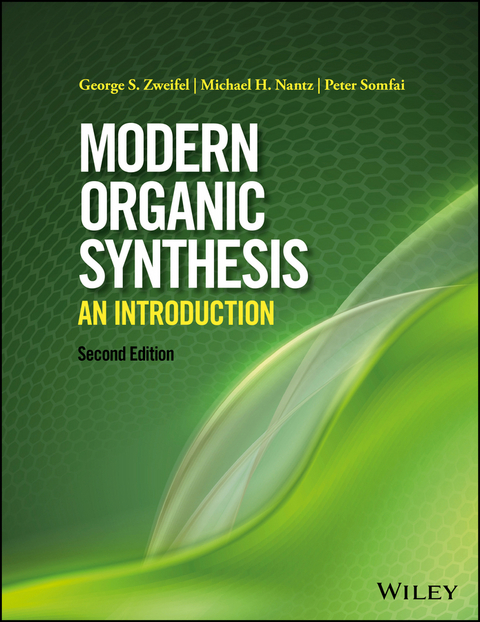
Modern Organic Synthesis (eBook)
John Wiley & Sons (Verlag)
978-1-119-08676-5 (ISBN)
This book bridges the gap between sophomore and advanced / graduate level organic chemistry courses, providing students with a necessary background to begin research in either an industry or academic environment.
• Covers key concepts that include retrosynthesis, conformational analysis, and functional group transformations as well as presents the latest developments in organometallic chemistry and C-C bond formation
• Uses a concise and easy-to-read style, with many illustrated examples
• Updates material, examples, and references from the first edition
• Adds coverage of organocatalysts and organometallic reagents
GEORGE S. ZWEIFEL, PhD, is Professor Emeritus at the University of California, Davis.
MICHAEL H. NANTZ, PhD, is Professor of Chemistry and Distinguished University Scholar at the University of Louisville.
PETER SOMFAI, PhD, is Professor of Chemistry at Lund University.
This book bridges the gap between sophomore and advanced / graduate level organic chemistry courses, providing students with a necessary background to begin research in either an industry or academic environment. Covers key concepts that include retrosynthesis, conformational analysis, and functional group transformations as well as presents the latest developments in organometallic chemistry and C C bond formation Uses a concise and easy-to-read style, with many illustrated examples Updates material, examples, and references from the first edition Adds coverage of organocatalysts and organometallic reagents
GEORGE S. ZWEIFEL, PhD, is Professor Emeritus at the University of California, Davis. MICHAEL H. NANTZ, PhD, is Professor of Chemistry and Distinguished University Scholar at the University of Louisville. PETER SOMFAI, PhD, is Professor of Chemistry at Lund University.
1
Synthetic Design
In character, in manners, in style, in all things, the supreme excellence is simplicity.
Henry Wadsworth Longfellow
Chemistry touches everyone's daily life, whether as a source of important drugs, polymers, detergents, or insecticides. Since the field of organic chemistry is intimately involved with the synthesis of these compounds, there is a strong incentive to invest large resources in synthesis. Our ability to predict the usefulness of new organic compounds before they are prepared is still rudimentary. Hence, both in academia and at many chemical companies, research directed toward the discovery of new types of organic compounds continues at an unabated pace. Also, natural products, with their enormous diversity in molecular structure and their possible medicinal use, have been and still are the object of intensive investigations by synthetic organic chemists.
Faced with the challenge to synthesize a new compound, how does the chemist approach the problem? Obviously, one has to know the tools of the trade, their potential and limitations. A synthetic project of any magnitude requires not only a thorough knowledge of available synthetic methods, but also of reaction mechanisms, commercial starting materials, analytical tools (IR, UV, NMR, MS) and isolation techniques. The ever-changing development of new tools and refinement of old ones makes it important to keep abreast of the current chemical literature.
What is an ideal or viable synthesis and how does one approach a synthetic project? The overriding concern in a synthesis is the yield, including the inherent concepts of simplicity (fewest steps), selectivity (chemoselectivity, regioselectivity, diastereoselectivity, and enantioselectivity). Furthermore, the experimental ease of the transformations and whether they are environmentally acceptable must be considered.
Synthesis of a molecule such as pumiliotoxin C involves careful planning and strategy. How would a chemist approach the synthesis of pumiliotoxin C?1 This chapter outlines strategies for the synthesis of such target molecules based on retrosynthetic analysis.
E. J. Corey (Nobel Prize, 1990) introduced and promoted the concept of retrosynthetic analysis, whereby a molecule is disconnected leading to logical precursors.2 Today, retrosynthetic analysis plays an integral and indispensable role in research.
1.1 Retrosynthetic Analysis3
The following discussion on retrosynthetic analysis covers topics similar to those in Warren's Organic Synthesis: The Disconnection Approach3a and Willis and Will's Organic Synthesis.3g For an advanced treatment of the subject matter, see Corey and Cheng's The Logic of Chemical Synthesis.3b
Basic Concepts
The construction of a synthetic tree by working backward from the target molecule (TM) is called retrosynthetic analysis or antithesis. The symbol ⇒ signifies a reverse synthetic step and is called a transform. The main transforms are disconnections, or cleavage of C–C bonds, and functional group interconversions(FGI).
Retrosynthetic analysis involves the disassembly of a TM into available starting materials by sequential disconnections and FGI. Structural changes in the retrosynthetic direction should lead to substrates that are more readily available than the TM. Synthons are fragments resulting from disconnection of carbon–carbon bonds of the TM. The actual substrates used for the forward synthesis are the synthetic equivalents (SEs). Also, reagents derived from inverting the polarity (IP) of synthons may serve as SEs.
Synthetic design involves two distinct steps3a: (1) retrosynthetic analysis and (2) subsequent translation of the analysis into a “forward direction” synthesis. In the analysis, the chemist recognizes the functional groups in a molecule and disconnects proximally by methods corresponding to known and reliable reconnection reactions.
Chemical bonds can be cleaved heterolytically or homolytically, or through concerted transform (into two neutral, closed-shell fragments). The following discussion will focus on heterolytic and cyclic disconnections.
Donor and Acceptor Synthons3c,g
Heterolytic retrosynthetic disconnection of a carbon–carbon bond in a molecule breaks the TM into an acceptor synthon, a carbocation, and into a donor synthon, a carbanion. In a formal sense, the reverse reaction—the formation of a C–C bond—then involves the union of an electrophilic acceptor synthon and a nucleophilic donor synthon. Tables 1.1 and 1.2 show some important acceptor and donor synthons and their synthetic equivalents.3c
Often, more than one disconnection is feasible, as depicted in retrosynthetic analyses A and B below. In the synthesis, a plan for the sequence of reactions is drafted according to the analysis by adding reagents and conditions.
Table 1.1 Common Acceptor Synthons
Table 1.2 Common Donor Synthons
Alternating Polarity Disconnections3g,4
The question of how one chooses appropriate carbon–carbon bond disconnections is related to functional group manipulations since the distribution of formal charges in the carbon skeleton is determined by the functional group(s) present. The presence of a heteroatom in a molecule imparts a pattern of electrophilicity and nucleophilicity to the atoms of the molecule. The concept of alternating polarities or latent polarities (imaginary charges) often enables one to identify the best positions to make a disconnection within a complex molecule.
Functional groups may be classified as follows:4a
| E Class: | Groups conferring electrophilic character to the attached carbon (+): |
| –OH, –OR, O, NR, –X (halogens) |
| G Class: | Groups conferring nucleophilic character to the attached carbon (-): |
| –Li, –MgX, –AlR2, –SiR3 |
| A Class: | Functional groups that exhibit ambivalent character (+ or -): |
| –BR2, CCR2, CCR, –NO2, N, –SR, –S(O)R, –SO2R |
The positive charge (+) is placed at the carbon attached to an E class functional group (e.g., O, –OH, –Br) and the TM is then analyzed for consonant and dissonant patterns by assigning alternating polarities to the remaining carbons. In a consonant pattern, carbon atoms with the same class of functional groups have matching polarities, whereas in a dissonant pattern their polarities are unlike. If a consonant pattern is present in a molecule, a simple synthesis may often be achieved.
Examples of choosing reasonable disconnections of functionally substituted molecules based on the concept of alternating polarity are shown below.
One Functional Group
In the example shown above, there are two possible ways to disconnect the TM, 2-pentanol. Disconnection close to the functional group (path a) leads to substrates (SE) that are readily available. Moreover, reconnecting these reagents leads directly to the desired TM in high yield using well-known methodologies. Disconnection via path b also leads to readily accessible substrates. However, their reconnection to furnish the TM requires more steps and involves two critical reaction attributes: quantitative formation of the enolate ion and control of its monoalkylation by ethyl bromide.
Two Functional Groups in a 1,3-Relationship
The consonant charge pattern and the presence of a β-hydroxy ketone moiety in the TM suggest a retro-aldol transform. Either the hydroxy-bearing carbon or the carbonyl carbon of the TM may serve as an electrophilic site and the corresponding α-carbons as the nucleophilic sites. However, path b is preferable since it does not require a selective FGI (reduction).
Two Functional Groups in a 1,4-Relationship
The dissonant charge pattern for 2,5-hexanedione exhibits a positive (+) polarity at one of the α-carbons, as indicated in the acceptor synthon above. Thus, the α-carbon in this synthon requires an inversion of polarity (Umpolung in German) from the negative (−) polarity normally associated with a ketone α-carbon. An appropriate substrate (SE) for the acceptor synthon is the electrophilic α-bromo ketone. It should be noted that an enolate ion might act as a base resulting in deprotonation of an α-halo ketone, a reaction that could lead to the formation of an epoxy ketone (Darzens condensation). To circumvent this problem, a weakly basic enamine is used instead of the enolate.
In the case of 5-hydroxy-2-hexanone shown below, Umpolung of the polarity in the acceptor synthon is accomplished by using the electrophilic epoxide as the corresponding SE.
The presence of...
| Erscheint lt. Verlag | 13.3.2017 |
|---|---|
| Sprache | englisch |
| Themenwelt | Naturwissenschaften ► Chemie ► Organische Chemie |
| Naturwissenschaften ► Chemie ► Physikalische Chemie | |
| Technik | |
| Schlagworte | Chemie • Chemistry • Organic Chemistry • Organic synthesis, organic chemistry, retrosynthesis, conformational analysis, functional group transformations, organocatalysts, organometallic reagents • Organische Chemie • Organische Synthese • Pharmaceutical & Medicinal Chemistry • Pharmazeutische u. Medizinische Chemie |
| ISBN-10 | 1-119-08676-0 / 1119086760 |
| ISBN-13 | 978-1-119-08676-5 / 9781119086765 |
| Informationen gemäß Produktsicherheitsverordnung (GPSR) | |
| Haben Sie eine Frage zum Produkt? |
 EPUB (Adobe DRM)
Kopierschutz: Adobe-DRM
Adobe-DRM ist ein Kopierschutz, der das eBook vor Mißbrauch schützen soll. Dabei wird das eBook bereits beim Download auf Ihre persönliche Adobe-ID autorisiert. Lesen können Sie das eBook dann nur auf den Geräten, welche ebenfalls auf Ihre Adobe-ID registriert sind.
Details zum Adobe-DRM
Dateiformat: EPUB (Electronic Publication)
EPUB ist ein offener Standard für eBooks und eignet sich besonders zur Darstellung von Belletristik und Sachbüchern. Der Fließtext wird dynamisch an die Display- und Schriftgröße angepasst. Auch für mobile Lesegeräte ist EPUB daher gut geeignet.
Systemvoraussetzungen:
PC/Mac: Mit einem PC oder Mac können Sie dieses eBook lesen. Sie benötigen eine
eReader: Dieses eBook kann mit (fast) allen eBook-Readern gelesen werden. Mit dem amazon-Kindle ist es aber nicht kompatibel.
Smartphone/Tablet: Egal ob Apple oder Android, dieses eBook können Sie lesen. Sie benötigen eine
Geräteliste und zusätzliche Hinweise
Buying eBooks from abroad
For tax law reasons we can sell eBooks just within Germany and Switzerland. Regrettably we cannot fulfill eBook-orders from other countries.
aus dem Bereich