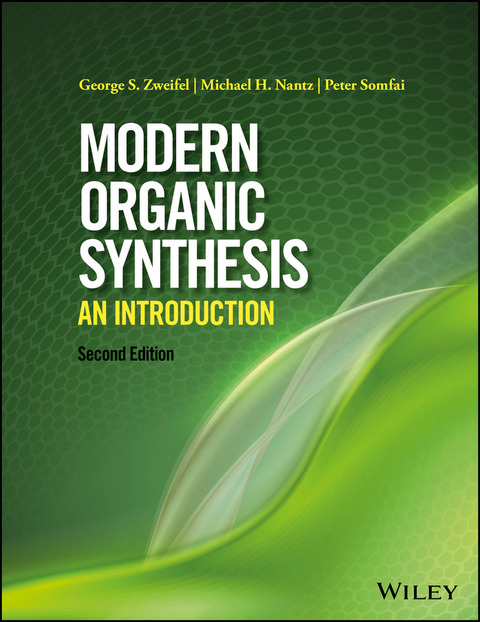
Modern Organic Synthesis (eBook)
John Wiley & Sons (Verlag)
978-1-119-08672-7 (ISBN)
This book bridges the gap between sophomore and advanced / graduate level organic chemistry courses, providing students with a necessary background to begin research in either an industry or academic environment.
• Covers key concepts that include retrosynthesis, conformational analysis, and functional group transformations as well as presents the latest developments in organometallic chemistry and C-C bond formation
• Uses a concise and easy-to-read style, with many illustrated examples
• Updates material, examples, and references from the first edition
• Adds coverage of organocatalysts and organometallic reagents
GEORGE S. ZWEIFEL, PhD, is Professor Emeritus at the University of California, Davis.
MICHAEL H. NANTZ, PhD, is Professor of Chemistry and Distinguished University Scholar at the University of Louisville.
PETER SOMFAI, PhD, is Professor of Chemistry at Lund University.
GEORGE S. ZWEIFEL, PhD, is Professor Emeritus at the University of California, Davis. MICHAEL H. NANTZ, PhD, is Professor of Chemistry and Distinguished University Scholar at the University of Louisville. PETER SOMFAI, PhD, is Professor of Chemistry at Lund University.
Modern Organic Synthesis 3
Contents 7
About the Authors 11
Preface to the Second Edition 13
Preface to the First Edition 15
1 Synthetic Design 17
1.1 Retrosynthetic Analysis 17
Basic Concepts 18
Donor and Acceptor Synthonsc,g 18
Alternating Polarity Disconnectionsg,4 20
1.2 Reversal of the Carbonyl Group Polarity (Umpolung) 22
Formyl and Acyl Anions Derived from 1,3-Dithianes5b,c,f 23
Acyl Anions Derived from Nitroalkanes 25
Acyl Anions Derived from Cyanohydrins 26
Acyl Anions Derived from Enol Ethers 27
Acyl Anions Derived from Lithium Acetylide 27
1.3 Steps in Planning a Synthesis 27
Construction of the Carbon Skeleton 27
Functional Group Interconversions (FGI) 31
Control of Relative Stereochemistry 32
Control of Enantioselectivity 32
1.4 Choice of Synthetic Method 32
Linear Synthesis versus Convergent Synthesis3h,j,23 33
1.5 Domino Reactions (Cascade or Tandem Reactions) 34
1.6 Computer-Assisted Retrosynthetic Analysis 35
References 35
2 Stereochemical Considerations in Planning Syntheses 37
2.1 Conformational Analysis1 37
Acyclic Systems3 37
Ring Systems 39
2.2 Evaluation of Non-Bonded Interactions 41
Monosubstituted Cyclohexane 41
Disubstituted Cyclohexanes 42
Evaluation of Destabilization Energies (ED) 43
Atypical Disubstituted Cyclohexanes 45
2.3 Six-Membered Heterocyclic Systems 45
Tetrahydropyrans 45
Anomeric Effect13 46
2.4 Polycyclic Ring Systems 46
Hydrindane 46
Decalin—Bicyclo4.4.0decane 47
Bridged Bicyclic Systems 48
Tricyclic Systems 49
2.5 Cyclohexyl Systems with sp2-Hybridized Atoms 49
Cyclohexanones 49
Cyclohexenes 50
2.6 Significant Energy Difference25 51
2.7 Computer-Assisted Molecular Modeling 51
2.8 Reactivity and Product Determination as a Function of Conformation 52
Terminology of Selectivity34 52
Esterification and Saponification 53
SN2-Type Reactions 54
Michael-Type Additions 55
E2 Elimination Reactions 55
Addition Reactions to Double Bonds 56
A1,3 Strain as a Control Element 57
Oxidation of Alcohols 58
References 58
3 The Concept of Protecting Functional Groups 61
3.1 Protection of N–H Groups 61
N-Benzylamines 62
Amides 62
Carbamates 62
N-(p-Methoxyphenyl)amines 63
3.2 Protection of OH Groups 64
Alkyl Ethers 64
Benzylic Ethers 64
Trityl Ethers 65
Silyl Ethers 66
Alkoxylalkyl Ethers (Acetals) 68
Esters 70
3.3 Protection of Diols as Acetals 71
1,2-Diols 71
1,3-Diols 72
3.4 Protection of Carbonyl Groups in Aldehydes and Ketones 72
Via O,O-Acetals 72
Via S,S-Acetals 76
3.5 Protection of the Carboxyl Group 78
Alkyl Esters 79
Aryl Esters 81
Silyl Esters 81
Protection of the Carboxyl Group as an Oxazoline 81
Protection of the Carboxyl Group as an Orthoester 82
3.6 Protection of Double Bonds 82
3.7 Protection of Triple Bonds 82
References 82
4 Functional Group Transformations 87
4.1 Oxidation of Alcohols to Aldehydes and Ketones 87
4.2 Reagents and Procedures for Alcohol Oxidation 88
Jones Reagent 88
Collins–Ratcliff Reagent 88
Pyridinium Chlorochromate (PCC) py-H+ CrO3Cl– 89
Pyridinium Dichromate (PDC) py-H+2Cr2O7?2 89
Swern Oxidation 89
Dess–Martin Periodinane (DMP) Oxidation 90
Tetrapropylammonium Perruthenate (TPAP) Pr4N+ RuO4- 91
4.3 Chemoselective Oxidizing Agents 92
Activated Manganese Dioxide 92
Barium Manganate 93
Silver Carbonate on Celite—Fetizons Reagent 93
2,2,6,6-Tetramethyl-1-piperidinyloxy (TEMPO) 94
Ceric Ammonium Nitrate 94
Triphenylcarbenium Tetrafluoroborate 95
4.4 Oxidation of Acyloins 95
4.5 Oxidation of Tertiary Allylic Alcohols (The Babler Oxidation) 95
4.6 Oxidative Procedures to Carboxylic Acids 96
Oxidation of Aldehydes to Carboxylic Acids 96
Oxidation of Aldehydes to Carboxylic Esters 97
Oxidation of Terminal Alkynes 97
4.7 Allylic Oxidation of Alkenes 98
Selenium Dioxide 98
Chromium and Manganese Reagents for Allylic Oxidation 99
Copper-Catalyzed Allylic Oxidation 99
Palladium-Catalyzed C–H Activation 100
4.8 Terminology for Reduction of Carbonyl Compounds 101
4.9 Nucleophilic Reducing Agents 102
Aluminum Hydrides 102
Borohydrides , 104
4.10 Electrophilic Reducing Agents 107
Diisobutylaluminum Hydride— i-Bu2AlH 107
Borane Tetrahydrofuran and Borane Dimethylsulfide74a,c,e—BH3•THF, BH3•SMe2 109
4.11 Regio- and Chemoselective Reductions 109
Reductions of ?, ?-Unsaturated Aldehydes and Ketones 109
Reduction of Aldehydes in the Presence of Ketones, 111
Reduction of Ketones in the Presence of Aldehydes 111
Reduction of Ketones in the Presence of Esters 111
Reduction of Carboxylic Acids in the Presence of Ketones or Esters 112
Reduction of Esters in the Presence of Amides or Nitriles 112
4.12 Diastereoselective Reductions of Cyclic Ketones 113
4.13 Inversion of Secondary Alcohol Stereochemistry (The Mitsunobu Reaction) 114
4.14 Diastereofacial Selectivity in Acyclic Systems 115
Enantiotopicity 116
Diastereotopicity—Asymmetric Induction 116
4.15 Enantioselective Reductions 120
Alpine-Borane—Ipc-9-BBN 121
B-Chlorodiisopinocampheylborane—(Ipc)2BCl 122
Oxazaborolidines—CBS Reduction 122
BINAL-H 123
Enzymatic Approaches to Enantioenriched Alcohols 124
References 124
5 Functional Group Transformations 131
5.1 Reactions of Carbon–Carbon Double Bonds 131
Hydrogenation of Carbon–Carbon Double Bonds 131
Dissolving Metal Reductions 135
Hydration of Alkenes 141
Epoxidation of Alkenes 149
Epoxidation of Allylic Alcohols 160
Dihydroxylation of Alkenes—Formation of 1,2-Diols 166
Cleavage of Carbon–Carbon Double Bonds 171
5.2 Reactions of Carbon–Carbon Triple Bonds 176
Catalytic Semi-Reduction of Alkynes 176
Reduction of Alkynes via Protonolysis of Alkenylboranes 178
Preparation of trans-Alkenes 180
Hydration of Alkynes 181
References 183
6 Formation of Carbon–Carbon Single Bonds via Enolate Anions 191
6.1 1,3-Dicarbonyl Compounds 191
Malonates 192
b-Keto Esters 195
1,3-Diketones 199
6.2 Direct Alkylation of Enolates 201
Ester Enolates 201
Enolates Derived From Carboxylic Acids, Amides, and Nitriles 202
Ketone Enolatesa,c,g, 203
6.3 Cyclization Reactions—Baldwins Rules for Ring Closure 209
Intramolecular Aldol Condensations 210
Intramolecular Alkylation of Enolates 210
6.4 Stereochemistry of Cyclic Ketone Alkylation 211
6.5 Imine and Hydrazone Anionsb 212
Imine Alkylation 213
Hydrazone Alkylation 213
6.6 Enamines, 213
Preparation of Enamines 214
Alkylation of Enamines 214
Stereoselective Alkylation of Enamines 214
Acylation 215
6.7 The Aldol Reaction 215
Intermolecular Aldol Reactions 215
Intramolecular Aldol Reactions 216
Mixed Aldol Reactions 217
Stereoselective Aldol Reactions 219
Enantioselective Aldol Reactions 224
6.8 Condensation Reactions of Enols and Enolates 229
The Mannich Reaction 229
Michael Addition 231
6.9 Robinson Annulation 233
References 236
7 Formation of Carbon–Carbon Bonds via Organometallic Reagents 243
7.1 Organolithium Reagents 243
Organolithiums from Alkyl Halides and Lithium Metal 245
Organolithiums via Lithium–Halogen Exchange 245
Organolithiums via Lithium–Metal Exchange (Transmetalation) 247
Organolithiums via Lithium–Hydrogen Exchange (Metalation) 247
Reagents, Solvents, and Conditions for Efficient Metalation 248
Conjugate Addition Reactions of Lithium Reagents 252
7.2 Organomagnesium Reagents 252
Preparation of Grignard Reagents 252
Reactions of Grignard Reagents with Carbonyl Compounds 253
Cross-coupling and Substitution Reactions 255
7.3 Organotitanium Reagents 255
7.4 Organocerium Reagents 256
7.5 Organocopper Reagents 257
Preparation of Organocuprates 258
Reactions of Organocuprates 259
Tandem 1,4-Addition—Enolate Trapping 263
Stereochemistry of 1,4-Addition Reactions 265
Preparation of Enones: Substrates for Conjugate Additions 265
7.6 Organochromium Reagents 267
7.7 Organozinc Reagents 268
Preparation of Organozinc Compounds 268
Reactions of Organozinc Compounds 269
7.8 Organoboron Reagents 272
Carbonylation 273
Cyanidation 274
Dichloromethyl Methyl Ether Reaction 275
Mattesons Boronic Ester Homologation 275
Asymmetric Allyl- and Crotylboration 277
7.9 Organosilicon Reagents 280
Properties of Bonds to Silicon 280
Preparation and Reactions of Alkynylsilanes, Alkenylsilanes, and Allylsilanes 281
Acylsilanes 288
7.10 Organogold Chemistry 290
Nucleophilic Addition to Alkynes, Alkenes, and Allenes 290
Cycloisomerizations 292
References 294
8 Palladium-Catalyzed Coupling Reactions 301
8.1 Palladium Oxidation State 301
8.2 Organic Synthesis with Palladium(0) Complexes 302
Oxidative Addition–Reductive Elimination 303
8.3 The Heck Reaction—Palladium(0)-Catalyzed Olefin Insertion Reactions.1h,k,15 304
8.4 Palladium-Catalyzed Cross-Coupling with Organometallic Reagents 308
The Negishi Reaction 308
The Suzuki Reaction 311
The Stille Reaction 315
8.5 Cross-Coupling Reactions Involving sp-Carbons 317
The Castro–Stephens Reaction 318
Preparation of Conjugated Enediynes 319
Preparation of 1,3-Diynes 319
8.6 The Trost–Tsuji Reaction 320
References 323
9 Formation of Carbon–Carbon ?-Bonds 329
9.1 Formation of Carbon–Carbon Double Bonds 329
b-Elimination Reactions 329
Pyrolytic syn-Elimination Reactions 332
Syntheses of Stereodefined Alkenes from Alkynes 334
The Wittig, Peterson, and Julia Olefination Reactions 339
The Shapiro Reaction 352
9.2 Formation of Carbon–Carbon Triple Bonds 359
Elimination Reactions 359
Alkylation, 361
Isomerization 364
One-Step, One-Carbon Homologation—Seyferth–Gilbert Reagent 365
References 366
10 Syntheses of Carbocyclic Systems 371
10.1 Intramolecular Free Radical Cyclizations 371
Acyloin Condensation 371
Pinacol Coupling 375
The McMurry Reaction—Synthesis of Alkenesa, 376
10.2 Cation–?????? Cyclizations 377
10.3 Pericyclic Reactions 380
The Diels–Alder Reaction, 381
Intramolecular Diels–Alder Reactions 387
Asymmetric Diels–Alder Reactions 389
1,3-Dipolar Cycloaddition Reactions—3+2 Cycloadditions 391
10.4 Ring-Closing Olefin Metathesis 391
References 394
Index 399
EULA 407
| Erscheint lt. Verlag | 9.3.2017 |
|---|---|
| Sprache | englisch |
| Themenwelt | Naturwissenschaften ► Chemie ► Organische Chemie |
| Naturwissenschaften ► Chemie ► Physikalische Chemie | |
| Technik | |
| Schlagworte | Chemie • Chemistry • Organic Chemistry • Organic synthesis, organic chemistry, retrosynthesis, conformational analysis, functional group transformations, organocatalysts, organometallic reagents • Organische Chemie • Organische Synthese • Pharmaceutical & Medicinal Chemistry • Pharmazeutische u. Medizinische Chemie |
| ISBN-10 | 1-119-08672-8 / 1119086728 |
| ISBN-13 | 978-1-119-08672-7 / 9781119086727 |
| Informationen gemäß Produktsicherheitsverordnung (GPSR) | |
| Haben Sie eine Frage zum Produkt? |
 PDF (Adobe DRM)
Kopierschutz: Adobe-DRM
Adobe-DRM ist ein Kopierschutz, der das eBook vor Mißbrauch schützen soll. Dabei wird das eBook bereits beim Download auf Ihre persönliche Adobe-ID autorisiert. Lesen können Sie das eBook dann nur auf den Geräten, welche ebenfalls auf Ihre Adobe-ID registriert sind.
Details zum Adobe-DRM
Dateiformat: PDF (Portable Document Format)
Mit einem festen Seitenlayout eignet sich die PDF besonders für Fachbücher mit Spalten, Tabellen und Abbildungen. Eine PDF kann auf fast allen Geräten angezeigt werden, ist aber für kleine Displays (Smartphone, eReader) nur eingeschränkt geeignet.
Systemvoraussetzungen:
PC/Mac: Mit einem PC oder Mac können Sie dieses eBook lesen. Sie benötigen eine
eReader: Dieses eBook kann mit (fast) allen eBook-Readern gelesen werden. Mit dem amazon-Kindle ist es aber nicht kompatibel.
Smartphone/Tablet: Egal ob Apple oder Android, dieses eBook können Sie lesen. Sie benötigen eine
Geräteliste und zusätzliche Hinweise
Buying eBooks from abroad
For tax law reasons we can sell eBooks just within Germany and Switzerland. Regrettably we cannot fulfill eBook-orders from other countries.
aus dem Bereich